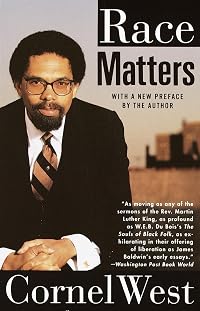
Race Matters
by Cornel West
On This Page
Description
The twenty-fifth-anniversary edition of the groundbreaking classic, with a new introductionFirst published in 1993, on the one-year anniversary of the Los Angeles riots, Race Matters became a national best seller that has gone on to sell more than half a million copies. This classic treatise on race contains Dr. West's most incisive essays on the issues relevant to black Americans, including the crisis in leadership in the Black community, Black conservatism, Black-Jewish relations, myths show more about Black sexuality, and the legacy of Malcolm X. The insights Dr. West brings to these complex problems remain relevant, provocative, creative, and compassionate.
In a new introduction for the twenty-fifth-anniversary edition, Dr. West argues that we are in the midst of a spiritual blackout characterized by imperial decline, racial animosity, and unchecked brutality and terror as seen in Baltimore, Ferguson, and Charlottesville. Calling for a moral and spiritual awakening, Dr. West finds hope in the collective and visionary resistance exemplified by the Movement for Black Lives, Standing Rock, and the Black freedom tradition.
Now more than ever, Race Matters is an essential book for all Americans, helping us to build a genuine multiracial democracy in the new millennium. show less
Tags
Recommendations













Member Reviews
I had a lot of trouble deciding exactly how I was going to review this book -- Frankly, there's so much material to cover that I won't get to most of it. First of all, I'm impressed by the density and complexity of the writing -- For that reason alone, I believe the author inherently knows what he's talking about. I appreciate Dr. West's objective assessments of various past and present states of affairs in the USA -- As well as his overall worldview. While I did read the entire book and also reread the first chapter ("Nihilism in Black America") -- My comments here mainly concern what I was able to glean from the prefaces, introductions and epilogue of this work.
Here are some highlights with regard to noteworthy content: (1) Imperial show more meltdown -- And how imperial meltdown = spiritual blackout); (1) (a) How we're living in a soulless time, in which everything has been commodified and monetized -- Particularly due to the inescapable influence of social media); (2) Bernie Sanders as a missed opportunity -- I'm in agreement with the policies promoted by Sanders, but I never voted for him, as I didn't believe he could win in a general election; (3) The grey area of commonality between Obama and Trump -- In terms of actions both presidents have taken in regard to furthering America's endless wars; (4) The obscene pentagon budget -- That could ideally be allocated to fund infrastructure, healthcare, house, education etc.
Dr. West also seems to be very open, fair and compassionate in his understanding and acceptance of the LGBTQ community (I'm saying this as a white LGBTQ person who's always felt like an outsider in the LGBTQ community) & in recognizing how problematic sexism, homophobia and patriarchal attitudes can be -- Within more conservative sectors of the African-American community.
In Closing: Here's a quote from p. ix of this work [which relates to (1) (a) above]: "The major culprit of democratic possibilities here and abroad is the ever-expanding market culture that puts everything and everyone up for sale. The expansion of corporate power is driven by this pervasive commercialization and commodification ... Market activities of buying and selling, advertising and promoting weaken nonmarket actives of caring and sharing, nurturing and connection. Short-term stimulation and instant titillation edge out quality relations and substantive community." show less
Here are some highlights with regard to noteworthy content: (1) Imperial show more meltdown -- And how imperial meltdown = spiritual blackout); (1) (a) How we're living in a soulless time, in which everything has been commodified and monetized -- Particularly due to the inescapable influence of social media); (2) Bernie Sanders as a missed opportunity -- I'm in agreement with the policies promoted by Sanders, but I never voted for him, as I didn't believe he could win in a general election; (3) The grey area of commonality between Obama and Trump -- In terms of actions both presidents have taken in regard to furthering America's endless wars; (4) The obscene pentagon budget -- That could ideally be allocated to fund infrastructure, healthcare, house, education etc.
Dr. West also seems to be very open, fair and compassionate in his understanding and acceptance of the LGBTQ community (I'm saying this as a white LGBTQ person who's always felt like an outsider in the LGBTQ community) & in recognizing how problematic sexism, homophobia and patriarchal attitudes can be -- Within more conservative sectors of the African-American community.
In Closing: Here's a quote from p. ix of this work [which relates to (1) (a) above]: "The major culprit of democratic possibilities here and abroad is the ever-expanding market culture that puts everything and everyone up for sale. The expansion of corporate power is driven by this pervasive commercialization and commodification ... Market activities of buying and selling, advertising and promoting weaken nonmarket actives of caring and sharing, nurturing and connection. Short-term stimulation and instant titillation edge out quality relations and substantive community." show less
West engages in a thoughtful and insightful critique of systemic racial oppression in the United States. I appreciated his brevity and depth of moral vision. Drawing on the influence of the prophetic tradition of black intellectuals allows West to disrupt partisan discourse, critiquing liberal and conservative points of view with a clarion call for justice.
He hit the nail on the head, several times. By explaining the nihilistic threat to the existence of the Black Community, he finally gave me words for those feelings of despair that I condemned so often as I was growing up (at the same time as I cursed my parents and myself for having too-light skin): that hopelessness and the constant complaints about the Salvadorean boat-people coming over and taking our jobs, about them not listening to Dad just because he was Black, about having two strikes against us as Black Women, and about how lucky I was to be light-skinned because I would get more job, except that it doesn't always work that way. And my own desperate attempts to make the system work, as the Lt. Col. used to say, but I found show more that outside of Jr. ROTC, that didn't generally work, either. And now I have the words and the analysis to understand why.
Thank you, Cornel West.
BUT,
I do have to disagree mildly with his statements that there was never much cooperation between Black folks and Jewish folks. Please see my book (ok, yes, it is a short book but a book-sized book, nonetheless) on the subject, with examples, of Black-Jewish cooperation in DC both before and during the 60s: [b:Stayed on Freedom's Call: Cooperation Between Jewish And African-American Communities In Washington, DC|21532511|Stayed on Freedom's Call Cooperation Between Jewish And African-American Communities In Washington, DC|Shira Destinie Jones Landrac|https://images.gr-assets.com/books/1396843051s/21532511.jpg|40860923] show less
Thank you, Cornel West.
BUT,
I do have to disagree mildly with his statements that there was never much cooperation between Black folks and Jewish folks. Please see my book (ok, yes, it is a short book but a book-sized book, nonetheless) on the subject, with examples, of Black-Jewish cooperation in DC both before and during the 60s: [b:Stayed on Freedom's Call: Cooperation Between Jewish And African-American Communities In Washington, DC|21532511|Stayed on Freedom's Call Cooperation Between Jewish And African-American Communities In Washington, DC|Shira Destinie Jones Landrac|https://images.gr-assets.com/books/1396843051s/21532511.jpg|40860923] show less
He hit the nail on the head, several times. By explaining the nihilistic threat to the existence of the Black Community, he finally gave me words for those feelings of despair that I condemned so often as I was growing up (at the same time as I cursed my parents and myself for having too-light skin): that hopelessness and the constant complaints about the Salvadorean boat-people coming over and taking our jobs, about them not listening to Dad just because he was Black, about having two strikes against us as Black Women, and about how lucky I was to be light-skinned because I would get more job, except that it doesn't always work that way. And my own desperate attempts to make the system work, as the Lt. Col. used to say, but I found show more that outside of Jr. ROTC, that didn't generally work, either. And now I have the words and the analysis to understand why.
Thank you, Cornel West.
BUT,
I do have to disagree mildly with his statements that there was never much cooperation between Black folks and Jewish folks. Please see my book (ok, yes, it is a short book but a book-sized book, nonetheless) on the subject, with examples, of Black-Jewish cooperation in DC both before and during the 60s: [b:Stayed on Freedom's Call: Cooperation Between Jewish And African-American Communities In Washington, DC|21532511|Stayed on Freedom's Call Cooperation Between Jewish And African-American Communities In Washington, DC|Shira Destinie Jones Landrac|https://images.gr-assets.com/books/1396843051s/21532511.jpg|40860923] show less
Thank you, Cornel West.
BUT,
I do have to disagree mildly with his statements that there was never much cooperation between Black folks and Jewish folks. Please see my book (ok, yes, it is a short book but a book-sized book, nonetheless) on the subject, with examples, of Black-Jewish cooperation in DC both before and during the 60s: [b:Stayed on Freedom's Call: Cooperation Between Jewish And African-American Communities In Washington, DC|21532511|Stayed on Freedom's Call Cooperation Between Jewish And African-American Communities In Washington, DC|Shira Destinie Jones Landrac|https://images.gr-assets.com/books/1396843051s/21532511.jpg|40860923] show less
Very interesting book, especially after reading Ibram Kendi's books, How to Be an Antiracist and Stamped from the Beginning. You can see the precursors of Kendi's thoughts. And unfortunately, you can also see how little racial progress has been made between the early 1990's of West's book and the late 2010's of Kendi's.
Cornel West is interesting. He doesn't do a lot of actual research, and he's not a firey or inspirational speaker in the way MLK or Malcolm X were, but he does present a few arguments clearly. One which is pretty reasonable (the state of black americans, both within their community and how broader America interacts with them) -- most of which I tend to agree with, that some combination of improved opportunity and seizing on those opportunities is needed to create a self-reinforcing cycle for better lives. But he's also a pretty doctrinaire socialist, in all sorts of crazy ways, which makes it hard for me to accept anything else he's arguing for on faith -- if he'd provide more data backing up his other viewpoints, it would be easier to show more judge them in isolation, but that's not his method.
What's particularly depressing about this book is that in the 25th anniversary of initial publication, nothing has particularly changed (except for some decrease in violent crime, likely due to lead poisoning levels from the phaseout of leaded gasoline...). show less
What's particularly depressing about this book is that in the 25th anniversary of initial publication, nothing has particularly changed (except for some decrease in violent crime, likely due to lead poisoning levels from the phaseout of leaded gasoline...). show less
I love hearing Brother Cornel West speak. I've long been attracted to his unique perspective, style, and eloquence. He's a very likable and dynamic scholar. And that's why I've long been eager to read some of his works.
I thought all of these wonderful qualities would translate well to text, but they really don't. West's brilliance is here, but the POW! is missing. Partly, this is because this slim volume isn't given the space that is needed. Each essay is more of a snippet of a much bigger thought. Part is the age, most of the essays are from the early 1990s, and topics such as Clarence Thomas seem antiquated. Still, Race Matters is an important and very scholarly collection, but not one that left this reader in awe.
I thought all of these wonderful qualities would translate well to text, but they really don't. West's brilliance is here, but the POW! is missing. Partly, this is because this slim volume isn't given the space that is needed. Each essay is more of a snippet of a much bigger thought. Part is the age, most of the essays are from the early 1990s, and topics such as Clarence Thomas seem antiquated. Still, Race Matters is an important and very scholarly collection, but not one that left this reader in awe.
Members
- Recently Added By
Published Reviews
added by lquilter
Lists

Schomburg Centennial Reading List
100 works; 4 members
Author Information

Professor, writer, and civil rights activist Cornel West was born on June 2, 1953 in Tulsa, Oklahoma and raised in Sacramento. He graduated from Harvard University in 1973 with an M.A. and later taught African-American studies there. He has also taught at Union Theological Seminary, Haverford College, and Princeton University, the latter as show more professor of religion and director of African-American studies. West earned his Ph.D. from Princeton in 1980. He has written more than twenty books, including Race Matters and Restoring Hope: Conversations on the Future of Black America. (Bowker Author Biography) show less
Awards and Honors
Distinctions
Common Knowledge
- Original publication date
- 1993
- People/Characters
- Clarence Thomas; Anita Hill; Malcolm X; Martin Luther King, Jr.
- Important places
- USA
- Dedication
- To my wonderful son Clifton Louis West who combats daily the hidden injuries of race with the most potent of weapons -- love of self and others
- Blurbers
- Edelman, Marian Wright; Gates, Henry Louis, Jr.; Bradley, Bill; Cole, Johnnetta B.
- Original language
- English
Classifications
- Genres
- Sociology, Nonfiction, General Nonfiction, Philosophy, Politics and Government, History
- DDC/MDS
- 305.800973 — Society, government, & culture Social sciences, sociology & anthropology Social group - Age, Gender, Ethnicity Ethnic and national groups standard subdivisions / Ethnic and national groups with ethnic origins from more than one continent, of European descent standard subdivisions Biography And History North America United States
- LCC
- E185.615 .W43 — History of the United States United States
- BISAC
Statistics
- Members
- 2,073
- Popularity
- 10,045
- Reviews
- 18
- Rating
- (4.01)
- Languages
- English, French, Italian, Portuguese (Portugal)
- Media
- Paper, Audiobook, Ebook
- ISBNs
- 15
- UPCs
- 1
- ASINs
- 12