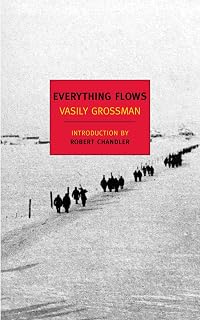
Everything Flows
by Vasily Grossman
On This Page
Description
Everything Flows is the last novel by Vasily Grossman, written after the Soviet authorities suppressed his extraordinary epic of besieged Stalingrad, and the besieged modern soul, Life and Fate. The central story is simple yet moving: Ivan Grigoryevich, the hero, is released after thirty years in the Soviet camps and has to struggle to find a place for himself in an unfamiliar world. This story, however, provides only the bare bones of a work written with prophetic urgency and in the shadow show more of death. Interspersing Ivan's story with a variety of other stories and essays and even a miniature play, Grossman writes boldly and uncompromisingly about Russian history and the 'Russian soul,' about Lenin and Stalin, about Moscow prisons in 1937, and about the fate of women in the Gulag, and in the play he subtly dramatizes the pressures that force people to compromise with an evil regime. His chapter about the least-known act of genocide of the last century-the Terror Famine that led to the deaths of around five million Ukrainian peasants in 1932 - 33-is unbearably lucid, comparable in its power only to the last cantos of Dante's Inferno. show lessTags
Recommendations










Member Reviews
For a while, the Soviet Union held many people in thrall. It was the first serious competitor politically to human organisation probably since humans started farming. I say this because when farming took over from hunting and gathering, people had to stay put, grow enough for the ruler's surplus. In such a political system, order had to be maintained or workers would rebel and leave the world’s first crappy jobs of weeding, sowing, reaping and repetitive tasks like that. At least that is how Dave Graeber describes the loss of freedom and independence that agriculture brought to humanity.
Yet Grossman – who lived and wrote before and after Stalin came to understand that this political competitor to the historical order was tricky just show more after Stalin died when no one really knew what was going to happen. In the end he saw through the Soviet political system as another method of controlling vast populations:
Remember how Tolstoy said that no one in the world was guilty? But in our state, things are different: everyone is guilty – there is not one innocent person anywhere.
Here is the crux of any organised state, it’s population must either be forced through the risk of personal harm to follow the ways of its masters; or, each of us has to fall in line through the guilt that we are not worthy enough, good enough, correct thinking enough to be part of it. So we either adopt the ways of the master, and become guilty by simply being a thinking person. Theocratic states do more or less the same thing.
The time around Stalin’s death is such a clever time to set this book – it opened up possibilities of publication for Grossman and others – but also because those who had done well out the denunciations of the 1930s, who had signed statements about the less virtuous members of the soviet state and thus earned better jobs, better status, stability and the like, suddenly found themselves thinking twice about what documents they signed to save their careers, their skins, their futures.
Setting the story initially through the eyes of a scientist who was one of many who had denounced by making ‘nefarious’ accusations against fellow scientists for no other reason that they were part of a minority – like the Jews and anyone who showed signs of non-working-class ethics such as ‘cosmopolitanism’. Grossman, himself Jewish, does a very fine rendition of how anti-semitism worked in Stalin's time.
[Now, I found this a fascinating reminder (I had done a little study of soviet economics at university) that cosmopolitans were seen as anti-Soviet. Often this meant no more than they were so good at their research that their papers were known internationally and often their work was reviewed in glowing terms because non-Soviet scientists could use their research and benefit from it. Having spent my adult life reading international literature for its own sake, loving art, free exchange of ideas, working in government where you were (at least for a time) devoted to projects of civil merit, able to critique stupid ideas, I suddenly turned into an inner urban elite as most media outlets called anyone they didn’t like in their appeal to an anti-intellectual feeling in western society. ]
Soon after Stalin’s death, many denunciations and sentences to the gulags were overturned. This meant that many of those who had survived the camps returned like ghosts to haunt the living and the denouncers. Imagine the sudden shift in power systems, from one illogical state of being to the next illogical overthrow of the last. It almost sounds like a modern western democracy at work. A scientist’s cousin returns after 30 years in the gulags visits his cousin who did well in his absence, just long enough to remind him he was more than history, he lived with guilt for 30 years, now his cousin could live with the fear that ‘guilt’ carries.
Obviously, there are no political panaceas. Western democracy keeps proving that within its election process, nasty people focussed on denying freedom and rights even to those who voted for them return in ever growing numbers.
Grossman was a journalist by profession and this reads like a prolonged fictionalised report on the way things were at a strange time. He didn’t really finish it before he died. Some chapters feel like extended notes before refined into the storyline. But he was driven to get down on paper how this world of unreality operated. How language and ideas shifted allegiances and power moved fluidly as do words out of the mouths of the eloquent and well-trained speakers and those who just know the right words at the right time to get ahead in the world.
Worth reading because the chilling comparisons with our own world seems inevitable. My first Grossman, I have his Armenian Journals to read some day soon. show less
Yet Grossman – who lived and wrote before and after Stalin came to understand that this political competitor to the historical order was tricky just show more after Stalin died when no one really knew what was going to happen. In the end he saw through the Soviet political system as another method of controlling vast populations:
Remember how Tolstoy said that no one in the world was guilty? But in our state, things are different: everyone is guilty – there is not one innocent person anywhere.
Here is the crux of any organised state, it’s population must either be forced through the risk of personal harm to follow the ways of its masters; or, each of us has to fall in line through the guilt that we are not worthy enough, good enough, correct thinking enough to be part of it. So we either adopt the ways of the master, and become guilty by simply being a thinking person. Theocratic states do more or less the same thing.
The time around Stalin’s death is such a clever time to set this book – it opened up possibilities of publication for Grossman and others – but also because those who had done well out the denunciations of the 1930s, who had signed statements about the less virtuous members of the soviet state and thus earned better jobs, better status, stability and the like, suddenly found themselves thinking twice about what documents they signed to save their careers, their skins, their futures.
Setting the story initially through the eyes of a scientist who was one of many who had denounced by making ‘nefarious’ accusations against fellow scientists for no other reason that they were part of a minority – like the Jews and anyone who showed signs of non-working-class ethics such as ‘cosmopolitanism’. Grossman, himself Jewish, does a very fine rendition of how anti-semitism worked in Stalin's time.
[Now, I found this a fascinating reminder (I had done a little study of soviet economics at university) that cosmopolitans were seen as anti-Soviet. Often this meant no more than they were so good at their research that their papers were known internationally and often their work was reviewed in glowing terms because non-Soviet scientists could use their research and benefit from it. Having spent my adult life reading international literature for its own sake, loving art, free exchange of ideas, working in government where you were (at least for a time) devoted to projects of civil merit, able to critique stupid ideas, I suddenly turned into an inner urban elite as most media outlets called anyone they didn’t like in their appeal to an anti-intellectual feeling in western society. ]
Soon after Stalin’s death, many denunciations and sentences to the gulags were overturned. This meant that many of those who had survived the camps returned like ghosts to haunt the living and the denouncers. Imagine the sudden shift in power systems, from one illogical state of being to the next illogical overthrow of the last. It almost sounds like a modern western democracy at work. A scientist’s cousin returns after 30 years in the gulags visits his cousin who did well in his absence, just long enough to remind him he was more than history, he lived with guilt for 30 years, now his cousin could live with the fear that ‘guilt’ carries.
Obviously, there are no political panaceas. Western democracy keeps proving that within its election process, nasty people focussed on denying freedom and rights even to those who voted for them return in ever growing numbers.
Grossman was a journalist by profession and this reads like a prolonged fictionalised report on the way things were at a strange time. He didn’t really finish it before he died. Some chapters feel like extended notes before refined into the storyline. But he was driven to get down on paper how this world of unreality operated. How language and ideas shifted allegiances and power moved fluidly as do words out of the mouths of the eloquent and well-trained speakers and those who just know the right words at the right time to get ahead in the world.
Worth reading because the chilling comparisons with our own world seems inevitable. My first Grossman, I have his Armenian Journals to read some day soon. show less
This is a short powerful novel by the Soviet author more famous for his epic masterpiece Life and Fate set during the Second World War and the last years of Stalin. Even more than that masterpiece, this is a searing indictment of Soviet totalitarianism, and its roots in Russian history and culture. In many ways, it is not really a novel at all; while the characters are fictional, the situations are all too real. It is the mid 1950s and Ivan Grigoryevich returns to Moscow after 30 years in the Gulag during the mass release of prisoners in the comparatively more liberal period after Stalin's death. He is welcomed by his cousin Nikolai and the latter's wife, but they cannot understand his outlook and feelings, nor he theirs; it is though show more they are from different worlds. He also comes across Pinegin, who originally informed on him and who is shocked at Ivan's survival. Fleeing his cousin's flat in Moscow, he returns to his home city Leningrad and forms a brief attachment to his landlady Anna Sergeyevna, a former activist during collectivisation of agriculture in Ukraine in the early 1930s. There are some shocking passages in the book around the politically instigated famine of that time, and around the sufferings of wives of those arrested as "enemies of the people". All of this makes this book sound depressing and, of course, at many levels it is, but it also encapsulates Grossman's belief, expressed through Ivan, in the inevitable fundamental victory of human freedom. I would say that really to appreciate this book, the reader really needs a fairly detailed knowledge of Russian history and culture, and it is unlikely to appeal to the wider readership that the more narrative-driven Life and Fate does. But it is equally, though in a different way, a masterpiece of 20th century Russian and world literature. show less
Vasily Grossman was working on ‘Everything Flows’ until his final days in the hospital, where he would die at just 58. Thinking that the KGB had destroyed any chance of his masterpiece ‘Life and Fate’ to ever be published, and with the constant threat of persecution hanging over him, he courageously continued to write honest, open accounts of life in the Soviet Union. The framework for ‘Everything Flows’ is that a man returns to Moscow after spending thirty years in a gulag. There are some touching scenes as he seeks out family members who have erased him from their minds, as well as familiar places which have changed, but the real meat of the novel is not in its plot, but in Grossman’s searing political and historical show more commentary. There are few authors who write with such intelligence and clarity of thought.
The strongest chapters are on the Holodomor, the genocide of roughly five million people in Ukraine in 1932-33, that does not have the awareness it should. Grossman describes how it happened, starting with the forced relocation of masses of people to the middle of nowhere, to fend for themselves in winter, and ending with the smaller quantities of grain produced shipped off to the cities, literally starving those who had grown it. He recognizes that “it was the same as the Nazis putting Jewish children in the gas chamber”, and the irony of this genocide, as well as Soviet anti-Semitism and prison camps, given how the USSR was a powerful ally in stopping Hitler, is not lost on him. The horrifying conditions are also described on a personal level, in highly poignant scenes. “Is it really true that no one will be held to account for it all? That it will all just be forgotten without a trace?” his character wonders. Grossman is trying his very best to ensure none of the outrages in his lifetime were forgotten.
And how important is it to remember and learn from history? Attempting to force nationalism, labeling those who disagree as "enemies of the people", labeling the intelligentsia as "cosmopolitan" in a derogatory way, and inciting the hatred of minorities - in the Soviet case, fake news about Jewish doctors killing their patients, and kulaks being parasites who burned bread and murdered children - does it sound alarmingly familiar to things going on in today’s politics in the U.S. and around the world?
Another excellent chapter describes the conditions in a women’s prison camp through the experiences of a woman named Masha, who had once “read Blok, who had studied literature, who…had written poetry of her own…could also sew, make borsch, bake torte napoleon, and who had breast-fed a child.” She’s forced into sleeping with a senior guard, tries to commit suicide, and eventually resigns herself to being treated “worse than a dog” until she eventually leaves the prison in a coffin.
If the book sounds grim, well, I suppose it is, and that’s undoubtedly one of the reasons Grossman is not more highly read, and probably why I didn’t give the book a slightly higher rating.
There is such irony that a communist movement for the people, for the peasants and workers, would lead to collectivization and famine, loss of all freedoms and prison camps – and that it would be worse for peasants than it had been under the Tsars, who at least often had a heart in times of hardships. “How can we call ourselves workers if we don’t have the right to strike,” says one character. And, as men are always going to look out for themselves, it also led to far-from-socialistic corruption: “It occurred to Ivan Grigoryevich that it was perhaps not so very surprising that incorruptible asceticism, the faith of the barefoot and fanatical apostles of the commune, had led in the end to fraudsters who were ready to do anything for the sake of a good dacha, for a car of their own, for some rubles to put away in their piggy bank.”
The later chapters work well as further history lessons. For example, how the revolutionaries of the 1910’s had gotten to middle age in the 1930’s, and were then shipped off to prison camps themselves, consumed by the State they had created; the socialist element now “a mere wrapping, a verbal husk, and empty shell.” The psychology of Lenin, often portrayed for his thoughtful personal moments (including, interestingly enough, re-reading ‘War and Peace’), but ruthless to political enemies and having a paradoxical contempt for freedom. And, how Russians have never had freedom – through Tsars, communism, and now, of course, long after Grossman’s time, Putin. Grossman recognizes freedom as more important than anything else, but wonders, “When will we see the day of a free, human, Russian soul? When will this day dawn? Or will it never dawn?”
However, the most profound messages are universal. One character draws a very dark conclusion, the pessimistic view that the fundamental law of humanity over history is not one of progress and freedom, but of violence. He puts it as a law of conservation of violence, that violence is eternal, changing its shape and form, but always present. “Sometimes it is directed against colored people, sometimes against writers and artists, but, all in all, the total quantity of violence on earth remains constant,” he says. It’s incredibly sobering.
On the other hand, in what seem to be the final pages Grossman ever wrote, his character has forgiveness of those who had interrogated him, denounced him, stolen from him, and beaten him – “all of them, in their weakness, coarseness, and spite, had done evil without wanting to.” It reveals an enlightenment and a humanity that is almost unimaginable. show less
The strongest chapters are on the Holodomor, the genocide of roughly five million people in Ukraine in 1932-33, that does not have the awareness it should. Grossman describes how it happened, starting with the forced relocation of masses of people to the middle of nowhere, to fend for themselves in winter, and ending with the smaller quantities of grain produced shipped off to the cities, literally starving those who had grown it. He recognizes that “it was the same as the Nazis putting Jewish children in the gas chamber”, and the irony of this genocide, as well as Soviet anti-Semitism and prison camps, given how the USSR was a powerful ally in stopping Hitler, is not lost on him. The horrifying conditions are also described on a personal level, in highly poignant scenes. “Is it really true that no one will be held to account for it all? That it will all just be forgotten without a trace?” his character wonders. Grossman is trying his very best to ensure none of the outrages in his lifetime were forgotten.
And how important is it to remember and learn from history? Attempting to force nationalism, labeling those who disagree as "enemies of the people", labeling the intelligentsia as "cosmopolitan" in a derogatory way, and inciting the hatred of minorities - in the Soviet case, fake news about Jewish doctors killing their patients, and kulaks being parasites who burned bread and murdered children - does it sound alarmingly familiar to things going on in today’s politics in the U.S. and around the world?
Another excellent chapter describes the conditions in a women’s prison camp through the experiences of a woman named Masha, who had once “read Blok, who had studied literature, who…had written poetry of her own…could also sew, make borsch, bake torte napoleon, and who had breast-fed a child.” She’s forced into sleeping with a senior guard, tries to commit suicide, and eventually resigns herself to being treated “worse than a dog” until she eventually leaves the prison in a coffin.
If the book sounds grim, well, I suppose it is, and that’s undoubtedly one of the reasons Grossman is not more highly read, and probably why I didn’t give the book a slightly higher rating.
There is such irony that a communist movement for the people, for the peasants and workers, would lead to collectivization and famine, loss of all freedoms and prison camps – and that it would be worse for peasants than it had been under the Tsars, who at least often had a heart in times of hardships. “How can we call ourselves workers if we don’t have the right to strike,” says one character. And, as men are always going to look out for themselves, it also led to far-from-socialistic corruption: “It occurred to Ivan Grigoryevich that it was perhaps not so very surprising that incorruptible asceticism, the faith of the barefoot and fanatical apostles of the commune, had led in the end to fraudsters who were ready to do anything for the sake of a good dacha, for a car of their own, for some rubles to put away in their piggy bank.”
The later chapters work well as further history lessons. For example, how the revolutionaries of the 1910’s had gotten to middle age in the 1930’s, and were then shipped off to prison camps themselves, consumed by the State they had created; the socialist element now “a mere wrapping, a verbal husk, and empty shell.” The psychology of Lenin, often portrayed for his thoughtful personal moments (including, interestingly enough, re-reading ‘War and Peace’), but ruthless to political enemies and having a paradoxical contempt for freedom. And, how Russians have never had freedom – through Tsars, communism, and now, of course, long after Grossman’s time, Putin. Grossman recognizes freedom as more important than anything else, but wonders, “When will we see the day of a free, human, Russian soul? When will this day dawn? Or will it never dawn?”
However, the most profound messages are universal. One character draws a very dark conclusion, the pessimistic view that the fundamental law of humanity over history is not one of progress and freedom, but of violence. He puts it as a law of conservation of violence, that violence is eternal, changing its shape and form, but always present. “Sometimes it is directed against colored people, sometimes against writers and artists, but, all in all, the total quantity of violence on earth remains constant,” he says. It’s incredibly sobering.
On the other hand, in what seem to be the final pages Grossman ever wrote, his character has forgiveness of those who had interrogated him, denounced him, stolen from him, and beaten him – “all of them, in their weakness, coarseness, and spite, had done evil without wanting to.” It reveals an enlightenment and a humanity that is almost unimaginable. show less
I read 'Everything Flows' almost in one sitting.
Vasily Grossman's 'Everything Flows' is a modern classic. Russian literature is outstanding and is often deep and thought-provoking. I read 'Everything Flows' in one sitting, but I recommend multiple readings for anyone who wishes to understand and grasp the text's subtleties thoroughly. I am not familiar with Russian history, yet the book contains enough material that is universal and timeless.
Vasily Grossman could not finish this book before he died, but, strangely, the incomplete novel is perfect because life does flow.
The author set the book just after Stalin's death, and begins with the release of Ivan Grigoryevich, who spent thirty years in the Gulag. His first point of call is show more his cousin's house. Nikolay is a scientist who lived a good life after compromising his principles and becoming an informer for the state. In doing so, Vasily Grossman explores the theme of moral ambiguity, individual responsibility, and a person's struggles with their conscience.
Ivan travels to Leningrad, where he meets and finds lodging with a widow, Anna.
Vasily Grossman interspersed the book with the characters' accounts of their complicity in events and crimes, such as the famine during Stalin's regime. There are meditations on Russian history, the nature of freedom and violence, and how people behave under a dictator. These meditations are vital in today's political climate, with authoritarian leaders sprouting everywhere, including the West.
The book's style is spare and understated, which heightens the book's intensity. Apart from being a deep, captivating, and thought-provoking book, the narrative contains urgent lessons for today's society. show less
Vasily Grossman's 'Everything Flows' is a modern classic. Russian literature is outstanding and is often deep and thought-provoking. I read 'Everything Flows' in one sitting, but I recommend multiple readings for anyone who wishes to understand and grasp the text's subtleties thoroughly. I am not familiar with Russian history, yet the book contains enough material that is universal and timeless.
Vasily Grossman could not finish this book before he died, but, strangely, the incomplete novel is perfect because life does flow.
The author set the book just after Stalin's death, and begins with the release of Ivan Grigoryevich, who spent thirty years in the Gulag. His first point of call is show more his cousin's house. Nikolay is a scientist who lived a good life after compromising his principles and becoming an informer for the state. In doing so, Vasily Grossman explores the theme of moral ambiguity, individual responsibility, and a person's struggles with their conscience.
Ivan travels to Leningrad, where he meets and finds lodging with a widow, Anna.
Vasily Grossman interspersed the book with the characters' accounts of their complicity in events and crimes, such as the famine during Stalin's regime. There are meditations on Russian history, the nature of freedom and violence, and how people behave under a dictator. These meditations are vital in today's political climate, with authoritarian leaders sprouting everywhere, including the West.
The book's style is spare and understated, which heightens the book's intensity. Apart from being a deep, captivating, and thought-provoking book, the narrative contains urgent lessons for today's society. show less
A soft nightmare, exhausting, devastating, brilliant. This book is a masterwork of world literature and needs to be read by anyone who wishes to get a glimpse into the scale of human suffering, from the individual up to the machinations of a soulless state created to nurture revolutionary freedom but in fact left it in tatters as the land and the people it, at first, purported to help, fall into chaos and abject despair.
This book is by no means an easy read, large chunks of it feel more like an historical essay then fiction, but Grossman's skill is evident as, even unfinished, the novel transcends form and genre and becomes instead a horrifying testament about what can only half convincingly called 'the incomprehensible'.
Basically, read show more it, be destroyed by it, but in doing so become more than what you were when you started. You'll be more somber after finishing, but maybe just a bit more compassionate. show less
This book is by no means an easy read, large chunks of it feel more like an historical essay then fiction, but Grossman's skill is evident as, even unfinished, the novel transcends form and genre and becomes instead a horrifying testament about what can only half convincingly called 'the incomprehensible'.
Basically, read show more it, be destroyed by it, but in doing so become more than what you were when you started. You'll be more somber after finishing, but maybe just a bit more compassionate. show less
The landlady Anna Sergeyevna, while sharing her experience in the Ukraine during the Holodomor, laments on the fate of the village in which she had worked, a village that became a ghost town.
His response to the government's refusal to publish Life and Fate was an absolute haymaker, a dynamic condemnation of the State and everything it stood for. He was still revising Everything Flows when he died, but I can't imagine why.
Grossman writes about human suffering like no other writer. He details what you think is the full story of some tragic event, and then he drops in a snapshot of a young woman, a group of small children, a tight-knit family that becomes so immediately crucial to your understanding of the narrative that you'd have thought they were part of the story all along.
I saw in the comments of another review a comparison between this book and Camus' The Plague and when I zoomed out, I got the connection. Human response to suffering is a key theme in both, and both have interesting takes on communal reactions to crises. The difference is that Camus wrote a book full of detached observations and thin anecdotes, while Grossman felt and wrote in tandem with the anguish of his subjects and imprinted on the reader's brain the faces of those in pain.
I wrote in my review of Life in Fate about a scene (in a gas chamber) that I called one of the best passages in all of literature. Well, Everything Flows has one too. Anna Sergeyevna's account of the Holodomor, the famine in the Ukraine that killed five million people in 1932-33, is immediately followed by the story of Vasily Timofeyevich and his family. I don't mean to give any of it away, but I've never before been moved by a book the way I was by that one-two punch.
That part of the story deals with the suffering of victims. But Grossman doesn't only understand the victims of Stalin's USSR. He also wonderfully portrays the complicated men and women who, consciously or not, benefitted from the State. From an American perspective, it's easy to make a case against the Soviet Union. I grew up with it all around me. What was never presented to me was a case for the Soviet Union. If we want to keep such a power from existing again in our world, we have to understand why it came about and why it persisted, with countless citizens buying in every step of the way. It wasn't all just indoctrination and fear, and Grossman explains this through the eyes of many of his characters and in his direct reproaches of Lenin and Stalin towards the end of the novel.
I have yet to mention the protagonist, Ivan Grigoryevich, even once so far. That's partially due to his function throughout much of the novel as a catalyst for the people he meets. Their reactions to seeing him, rather than anything he says, lead to much of book's insight. But what's greatest about Ivan Grigoryevich is what's also greatest about the novel: an unshakeable belief in freedom.
Despite its heavy subject matter, this is not a depressing read. Ivan Grigoryevich, just now free after spending 30 years in Soviet labor camps, finds power in the endurance of freedom that he doesn't see in anything else.
At the end of his introduction, translator Robert Chandler hits the nail on the head.
"And nothing is left of all that. Where can that life have gone? And that suffering, that terrible suffering? Can there really be nothing left? Is it really true that no one will be held to account for it all? That it will all just be forgotten without a trace?"When writing those words in Everything Flows, Vasily Grossman must have felt that his fate would be a similar one, that he and his work would just disappear. Grossman died in 1964, just two years after his novel Life and Fate, his masterpiece, had been seized by the KGB. Grossman had been show more told that the book couldn't be published for two or three hundred years.
His response to the government's refusal to publish Life and Fate was an absolute haymaker, a dynamic condemnation of the State and everything it stood for. He was still revising Everything Flows when he died, but I can't imagine why.
Grossman writes about human suffering like no other writer. He details what you think is the full story of some tragic event, and then he drops in a snapshot of a young woman, a group of small children, a tight-knit family that becomes so immediately crucial to your understanding of the narrative that you'd have thought they were part of the story all along.
I saw in the comments of another review a comparison between this book and Camus' The Plague and when I zoomed out, I got the connection. Human response to suffering is a key theme in both, and both have interesting takes on communal reactions to crises. The difference is that Camus wrote a book full of detached observations and thin anecdotes, while Grossman felt and wrote in tandem with the anguish of his subjects and imprinted on the reader's brain the faces of those in pain.
I wrote in my review of Life in Fate about a scene (in a gas chamber) that I called one of the best passages in all of literature. Well, Everything Flows has one too. Anna Sergeyevna's account of the Holodomor, the famine in the Ukraine that killed five million people in 1932-33, is immediately followed by the story of Vasily Timofeyevich and his family. I don't mean to give any of it away, but I've never before been moved by a book the way I was by that one-two punch.
That part of the story deals with the suffering of victims. But Grossman doesn't only understand the victims of Stalin's USSR. He also wonderfully portrays the complicated men and women who, consciously or not, benefitted from the State. From an American perspective, it's easy to make a case against the Soviet Union. I grew up with it all around me. What was never presented to me was a case for the Soviet Union. If we want to keep such a power from existing again in our world, we have to understand why it came about and why it persisted, with countless citizens buying in every step of the way. It wasn't all just indoctrination and fear, and Grossman explains this through the eyes of many of his characters and in his direct reproaches of Lenin and Stalin towards the end of the novel.
I have yet to mention the protagonist, Ivan Grigoryevich, even once so far. That's partially due to his function throughout much of the novel as a catalyst for the people he meets. Their reactions to seeing him, rather than anything he says, lead to much of book's insight. But what's greatest about Ivan Grigoryevich is what's also greatest about the novel: an unshakeable belief in freedom.
Despite its heavy subject matter, this is not a depressing read. Ivan Grigoryevich, just now free after spending 30 years in Soviet labor camps, finds power in the endurance of freedom that he doesn't see in anything else.
No matter how vast the skyscraper and powerful the cannon, no matter how limitless the power of the State, no matter how mighty the empire, all this is only mist and fog and -as such- will be blown away. Only one true force remains; only one true force continues to evolve and live; and this force is liberty.Grossman had plenty of reasons to be pessimistic about the future of the Russian people, but he believed that the progress of the world and the progress of human liberty were tightly linked, and as a result, someday, the State would fall to the power of freedom.
At the end of his introduction, translator Robert Chandler hits the nail on the head.
For all the pain gathered within it, Everything Flows is a gift, Grossman's last gift to the world. And one of the most precious understandings it embodies is that if we can speak truthfully and trustingly, our histories can cease to be burdens. Any story, truly told and truly listened to, can become a gift.Vasily Grossman has truly told his story, and anyone who truly listens to it will understand what a gift it is. show less
The threads that can be noted between adjacently-read books always surprise and interest me. In this case, Frayn's 'Constructions' discusses the Heraclitus aphorism that the title of 'Everything Flows' is derived from. Grossman applies the aphorism to a transport of political prisoners.
'Everything Flows' doesn't read that much like a novel and is evidently unfinished. Grossman was still working on it when he died. Despite or even because of this, it has extraordinary power and impact. Grossman's 'Life and Fate' was the best novel I read last year and provides a chilling indictment of the Nazi and Soviet regimes during the second world war. It is a magnificent epic, finished and promptly confiscated by the KGB in 1961. Grossman was told show more that it wouldn't be published for 200 years. His subsequent work, 'Everything Flows', is a rawer, more focussed condemnation of soviet political repression and its appalling consequences.
The book begins with Ivan, a man who has been in a prison camp for thirty years, being allowed to go free. This man essentially speaks with Grossman's voice, although at times he isn't used and Grossman speaks directly to the reader. The narrative resonates with passion, but an astonishing lack of bitterness. Horrific events are described and the pervasive dehumanising effects of the soviet regime clearly shown, yet Grossman retains hope for humanity. This is both moving and astonishing, especially given that he died in 1964 whilst the USSR still stood firm.
I thought to pick out some especially powerful chapters of 'Life and Fate', but there are so many. The whole is magnificent, although some parts do stand out as especially painful. Chapter seven includes a mock trial, in which several informers are called upon to defend themselves. Their actions destroyed lives, however at the time they had reasons to inform. The informers turn upon the court, asking what right have they to condemn what they were also complicit in? They say, 'Only the dead, only those who did not survive, have the right to judge us. But the dead do not ask questions; the dead are silent.' Thus, there is no easy answer to the question of guilt.
Chapter thirteen, the pathetic tale of Masha, is tragic in its perfect evocation of hope in decline, until there is no longer any left. Whilst that chapter is intensely personal, chapter fourteen tells a broader tale of the Ukraine famine of 1933. This is perhaps the most viscerally shocking part of the book. It's hard to bear, more so as chapter fifteen then personalises it. Grossman forces the reader to witness the full barbarity of Stalin's actions in the Ukraine. Towards the end of the book, he then seeks to explain the terrible events he has described, to place them in a wider historical context and examine the men (principally Lenin) who he holds responsible. The tone is simultaneously measured and full of feeling, a very difficult balance to pull off.
The passage of the book that I found most memorable stated with pure lucidity that to see another person as inhuman and undeserving of life is to become inhuman and dead inside oneself. I wish I could find the precise quote, but I've been through my copy twice and not located it. My apologies, you will have to take my word for it. I really cannot praise this book highly enough. It deserves to be very widely read and remembered. show less
'Everything Flows' doesn't read that much like a novel and is evidently unfinished. Grossman was still working on it when he died. Despite or even because of this, it has extraordinary power and impact. Grossman's 'Life and Fate' was the best novel I read last year and provides a chilling indictment of the Nazi and Soviet regimes during the second world war. It is a magnificent epic, finished and promptly confiscated by the KGB in 1961. Grossman was told show more that it wouldn't be published for 200 years. His subsequent work, 'Everything Flows', is a rawer, more focussed condemnation of soviet political repression and its appalling consequences.
The book begins with Ivan, a man who has been in a prison camp for thirty years, being allowed to go free. This man essentially speaks with Grossman's voice, although at times he isn't used and Grossman speaks directly to the reader. The narrative resonates with passion, but an astonishing lack of bitterness. Horrific events are described and the pervasive dehumanising effects of the soviet regime clearly shown, yet Grossman retains hope for humanity. This is both moving and astonishing, especially given that he died in 1964 whilst the USSR still stood firm.
I thought to pick out some especially powerful chapters of 'Life and Fate', but there are so many. The whole is magnificent, although some parts do stand out as especially painful. Chapter seven includes a mock trial, in which several informers are called upon to defend themselves. Their actions destroyed lives, however at the time they had reasons to inform. The informers turn upon the court, asking what right have they to condemn what they were also complicit in? They say, 'Only the dead, only those who did not survive, have the right to judge us. But the dead do not ask questions; the dead are silent.' Thus, there is no easy answer to the question of guilt.
Chapter thirteen, the pathetic tale of Masha, is tragic in its perfect evocation of hope in decline, until there is no longer any left. Whilst that chapter is intensely personal, chapter fourteen tells a broader tale of the Ukraine famine of 1933. This is perhaps the most viscerally shocking part of the book. It's hard to bear, more so as chapter fifteen then personalises it. Grossman forces the reader to witness the full barbarity of Stalin's actions in the Ukraine. Towards the end of the book, he then seeks to explain the terrible events he has described, to place them in a wider historical context and examine the men (principally Lenin) who he holds responsible. The tone is simultaneously measured and full of feeling, a very difficult balance to pull off.
The passage of the book that I found most memorable stated with pure lucidity that to see another person as inhuman and undeserving of life is to become inhuman and dead inside oneself. I wish I could find the precise quote, but I've been through my copy twice and not located it. My apologies, you will have to take my word for it. I really cannot praise this book highly enough. It deserves to be very widely read and remembered. show less
Members
- Recently Added By
Lists

Russian Literature
184 works; 35 members

Books set in Moscow
16 works; 1 member

Llibres que he llegit el 2010
35 works; 1 member

Books Read in 2019
4,052 works; 110 members
Author Information

71+ Works 8,717 Members
Grossman, a graduate in physics and mathematics from Moscow University, worked first as a chemical engineer and became a published writer during the mid-1930s. His early stories and novel deal with such politically orthodox themes as the struggle against the tsarist regime, the civil war, and the building of the new society. Grossman served as a show more war correspondent during World War II, publishing a series of sketches and stories about his experiences. Along with Ehrenburg, he edited the suppressed documentary volume on the fate of Soviet Jews, The Black Book. In 1952 the first part of his new novel, For the Good of the Cause, appeared and was sharply criticized for its depiction of the war. The censor rejected another novel, Forever Flowing (1955), which was circulated in samizdat and published in the West. The secret police confiscated a sequel to For the Good of the Cause, the novel Life and Fate, in 1961, but a copy was smuggled abroad and published in 1970. Grossman's books were issued in the Soviet Union in the late 1980s and have met with both admiration and, on part of the nationalist right wing, considerable hostility. (Bowker Author Biography) show less
Some Editions
Awards and Honors
Series
Belongs to Publisher Series
Common Knowledge
- Canonical title
- Everything Flows
- Original title
- Все течет; Vsyo techyot
- Alternate titles
- Forever Flowing
- Original publication date
- 1970
- People/Characters*
- Ivan Grigorjevitsj
- First words
- The Khabarovsk express was due to arrive in Moscow by 9 A.M.
(Introduction) Vasily Grossman has become recognized not only as one of the great war novelists of all time but also as one of the first and most important of witnesses to the Shoah. - Last words
- (Click to show. Warning: May contain spoilers.)He stood there - gray, bent, and changeless.
- Original language
- Russian
*Some information comes from Common Knowledge in other languages. Click "Edit" for more information.
Classifications
- Genres
- General Fiction, Fiction and Literature, Historical Fiction
- DDC/MDS
- 891.7344 — Literature & rhetoric Literatures of other languages East Indo-European and Celtic literatures Russian and East Slavic languages Russian fiction USSR 1917–1991 Late 20th century 1917–1991
- LCC
- PG3476 .G7 .V813 — Language and Literature Slavic languages and literatures. Baltic languages. Albanian language Slavic. Baltic. Albanian Russian literature Individual authors and works 1917-1960
- BISAC
Statistics
- Members
- 1,023
- Popularity
- 25,388
- Reviews
- 41
- Rating
- (4.11)
- Languages
- 17 — Czech, Dutch, English, Estonian, Finnish, French, German, Hebrew, Hungarian, Italian, Polish, Romanian, Russian, Serbian, Spanish, Swedish, Turkish
- Media
- Paper, Ebook
- ISBNs
- 45
- ASINs
- 11
