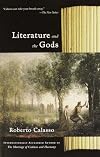
Literature and the Gods
by Roberto Calasso
On This Page
Description
"Literature and the Gods traces the return of pagan divinities to Western literature from their first reappearance at the beginning of the modern era to their place in the literature of our own time." "Calasso sets out to uncover the divine - godly or otherwise - in specific texts, and finds in it what he calls "absolute literature." With its roots in early Vedic verse, absolute literature reached the apex of its expression during the period beginning with the German Romantics in 1798 and show more ending with Mallarme's death in 1898. But Calasso also discovers the divine in the work of Valery, Auden, Yeats, Montale, Borges, and Nabokov, and he reveals how these writers, in their own very particular ways, were articulating the same unnameable thing. Finally, he delineates the timeless, ever-mysterious laws that surround the creative act itself."--Jacket. show lessTags
Recommendations






Member Reviews
This brief book is one to read, reread, and consult when reading the great literature with ancient beginnings since it provides an extraordinary and perceptive analysis of the nature of the literature of classical mythology. The Weidenfeld Lectures Calasso delivered at Oxford in 2000 represent Calasso's lifetime investigation into the gods providing the basis for Literature and the Gods. The book follows the reemergence of paganism in Western literature from the early modern period to the present.
This is a brilliant, imaginative, and beautifully scholarly work. Calasso gives us a renewed understanding of the mystique and magic of great literature by revealing the divine whisper that lurks underneath the greatest poetry and prose from show more throughout history. Even though it is a brief yet deep essay, it takes the reader on a personal tour of contemporary European literature and philosophy. I found it was not only smart, but inspired and intellectual as well.
The history of the gods can also be interpreted as a ciphered and magnificent history of creative inspiration, from the exile of the classical divinities during the Age of Reason to their release by the Romantics and their role in the literature of our own day. By rewriting that tale, Calasso creates a hallowed literary realm where the gods' influence can be felt. His investigation into "absolute literature" takes us to the worlds of Dionysus and Orpheus, Baudelaire and Mallarme, and inspires a clear-eyed and passionate defense of poetic form, even when it appears to be detached from any social role. Literature and the Gods, a lyrical and confident work of literary affirmation, is deserving of reading among the greats. show less
This is a brilliant, imaginative, and beautifully scholarly work. Calasso gives us a renewed understanding of the mystique and magic of great literature by revealing the divine whisper that lurks underneath the greatest poetry and prose from show more throughout history. Even though it is a brief yet deep essay, it takes the reader on a personal tour of contemporary European literature and philosophy. I found it was not only smart, but inspired and intellectual as well.
The history of the gods can also be interpreted as a ciphered and magnificent history of creative inspiration, from the exile of the classical divinities during the Age of Reason to their release by the Romantics and their role in the literature of our own day. By rewriting that tale, Calasso creates a hallowed literary realm where the gods' influence can be felt. His investigation into "absolute literature" takes us to the worlds of Dionysus and Orpheus, Baudelaire and Mallarme, and inspires a clear-eyed and passionate defense of poetic form, even when it appears to be detached from any social role. Literature and the Gods, a lyrical and confident work of literary affirmation, is deserving of reading among the greats. show less
This is a knitted and knotted exegesis on the role and symbolism of the divine in the literary arts, largely poetry in the 19th century. Like the rest of Calasso, that thesis is but a point of departure to a sinuous journey which broaches a kaleidoscope of concepts and figures.
Whether the pretexts spoke of race or class, the one sufficient reason for killing your enemies was always the same: these people were harmful to society. Society becomes the subject above all subjects.
There is much to marvel: the notes on Mallarme and Nietzsche. The sections glossing over links with the Vedas lost me.
Whether the pretexts spoke of race or class, the one sufficient reason for killing your enemies was always the same: these people were harmful to society. Society becomes the subject above all subjects.
There is much to marvel: the notes on Mallarme and Nietzsche. The sections glossing over links with the Vedas lost me.
I didn't get too much from this. It's not the book's fault, or Calasso's. It's just much too erudite and intellectual for me. I've long been intrigued by the idea that the gods of the old Greek and Roman pantheons simply went away. Calasso's idea is that they've returned by being invoked in our literature. His referents are the more classical writers and thinkers--Baudelaire, Mallarme, Nietzsche. The time of their return began mid-19th Century. I'd surmise from this conceit that their presence continues today, albeit in novels such as The Great Gatsby, William Kennedy's Albany novels, and the wonderful Updike novel, The Centaur
I'm just going ahead with a 5 because there's no arguing with Calasso's seductive word power. Love this man's style.
And of course, I had to write about it: https://zwieblein.bearblog.dev/a-reading-realization/
And of course, I had to write about it: https://zwieblein.bearblog.dev/a-reading-realization/
>
da WIKIPEDIA
da WIKIPEDIA
Dec 6, 2014Italian
Ratings
Members
- Recently Added By
Author Information

43+ Works 6,136 Members
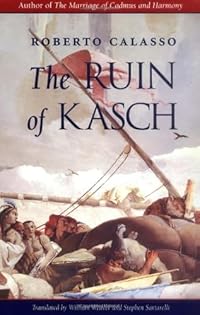
Roberto Calasso is the publisher of Adelphi Edizioni and lives in Milan. The Ruin of Kasch is the first book in an ongoing series that includes The Marriage of Cadmus and Harmony, Ka, K., Tiepolo Pink, La Folie Baudelaire, and Ardor.
Some Editions
Awards and Honors
Common Knowledge
- Original title
- La letteratura e gli dèi
- Original language
- Italian
Classifications
- Genres
- Literature Studies and Criticism, Nonfiction, Religion & Spirituality, Fiction and Literature
- DDC/MDS
- 809.9338291211 — Literature & rhetoric Literature, rhetoric & criticism History, description, critical appraisal of more than two literatures Literature displaying specific features, miscellaneous writings Literature displaying other aspects Literature dealing with specific themes and subjects Philosophic and abstract concepts Religion
- LCC
- PN56 .M95 .C3513 — Language and Literature Literature (General) Literature (General) Theory. Philosophy. Esthetics
- BISAC
Statistics
- Members
- 398
- Popularity
- 77,906
- Reviews
- 5
- Rating
- (3.99)
- Languages
- 9 — Dutch, English, French, German, Italian, Polish, Portuguese, Spanish, Turkish
- Media
- Paper, Ebook
- ISBNs
- 15
- ASINs
- 3