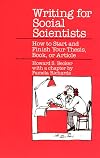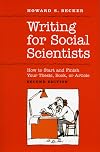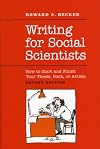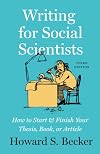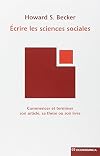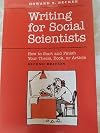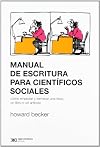
Writing for Social Scientists: How to Start and Finish Your Thesis, Book, or Article
by Howard S. Becker
On This Page
Description
Students and researchers all write under pressure, and those pressures--most lamentably, the desire to impress your audience rather than to communicate with them--often lead to pretentious prose, academic posturing, and, not infrequently, writer's block. Sociologist Howard S. Becker has written the classic book on how to conquer these pressures and simply write. First published nearly twenty years ago, Writing for Social Scientists has become a lifesaver for writers in all fields, from show more beginning students to published authors. Becker's message is clear: in order to learn how to write, take a deep breath and then begin writing. Revise. Repeat. It is not always an easy process, as Becker wryly relates. Decades of teaching, researching, and writing have given him plenty of material, and Becker neatly exposes the foibles of academia and its "publish or perish" atmosphere. Wordiness, the passive voice, inserting a "the way in which" when a simple "how" will do--all these mechanisms are a part of the social structure of academic writing. By shrugging off such impediments--or at the very least, putting them aside for a few hours--we can reform our work habits and start writing lucidly without worrying about grades, peer approval, or the "literature." In this new edition, Becker takes account of major changes in the computer tools available to writers today, and also substantially expands his analysis of how academic institutions create problems for them. As competition in academia grows increasingly heated, Writing for Social Scientists will provide solace to a new generation of frazzled, would-be writers. show lessTags
Recommendations




























Member Reviews
I love books about writing, which is one reason I have so many of them. After reading Becker’s Writing for Social Scientists I understand that reading them is also part of my ritual to avoid actually writing. For me Becker’s book is one of the most useful books on writing I have found in decades but a beginning writer might not share that opinion. Early on the book dismisses the idea that it is going to rehash the all rules we learned in English classes and from style guides. Becker focuses on getting people to sit down and write. He exposes our avoidance strategies and our fears then he shows us how to overcome them.
Although the title claims that it is for ‘social scientists’ the techniques and ideas in the book apply to most show more writers, the first half covers writing problems that even fiction writers grapple with. The second half gets deeper into nonfiction writing than the undergraduate’s mantra ‘cite your source’. Becker explains how those sources can make your job easier and when you should not use them.
The book is easy to read, it is obvious that Becker takes his own advice. I think this is an excellent book for anyone who wants to improve their writing and relieve the anxieties it can cause. show less
Although the title claims that it is for ‘social scientists’ the techniques and ideas in the book apply to most show more writers, the first half covers writing problems that even fiction writers grapple with. The second half gets deeper into nonfiction writing than the undergraduate’s mantra ‘cite your source’. Becker explains how those sources can make your job easier and when you should not use them.
The book is easy to read, it is obvious that Becker takes his own advice. I think this is an excellent book for anyone who wants to improve their writing and relieve the anxieties it can cause. show less
There is more than meets the eye in this book. Becker operates on two levels to show what it is that draws us to writing and how that, in turn, itself can be an obstacle - and how it can be managed. This is a great book.
Anyone who has faced the challenges of having to write a paper for college knows exactly how troublesome this task can be. There’s this constant anxiety that keeps growing as the term for the paper gets closer and closer; there’s all the things we do to try to avoid having to face the actual writing; and there’s the fear of not being able to do the task at all, of not finding the right way to write the whole thing down. We get stuck and leave the bulk of the writing for the last minute.
Well, we all have been there. And so common are these problems that Howard S. Becker tries to tackle them all on 10 essays dealing with different difficulties writers face when preparing their papers (or whatever they have to write).
The book is a show more must read for those who want to overcome the anxieties, fears, and all sort of troubles that accompany the act of writing for institutional settings such as college. Becker shares with us a lot of ideas that may help in different situations; and, most of all, he does a great job in showing that all we go through is not a particular problem of our lack of gifts for writing, but very common stumbling blocks that affects most who are obliged to produce meaningful pieces of writing.
If you are in college and are trying to make the leap forward in how you put your work into writing, don’t miss this book. It will definitely help you improve your skills and confidence. show less
More inspirational than useful but still worth reading. Becker gives advice geared toward grad students and young professionals on the importance of editing for clarity, avoiding language that attempts to sound academic but is in reality merely ambiguous, and continually re-writing papers. He also is an encouraging voice that speaks to scholar's fears of having others read their writing.
Great resource for reworking how one thinks about writing and for getting past barriers.
studantes e pesquisadores escrevem sob pressão: dos prazos, do currículo, da obrigação de impactar. O resultado costuma ser uma prosa empolada, um tom acadêmico pretensioso e, com frequência, um bloqueio na escrita. Para ajudá-los nessas horas de aflição, o experiente sociólogo Howard S. Becker, conhecido por seu estilo informal e simples, escreveu este Truques da escrita - um clássico que a Zahar torna enfim disponível para o leitor brasileiro, em edição revista e prefaciada pelo autor especialmente para esta edição. Sensível, divertido e inteligente, o livro apresenta ideias reunidas ao longo de décadas de pesquisa, escrita e ensino. A mensagem de Becker é direta: "a única maneira de começar a nadar é entrando na show more água". Para aprender a escrever, respire fundo e escreva. Revise. Repita. O processo nem sempre é fácil. Becker expõe, com toques de humor, falhas e vícios acadêmicos como a verborragia, o abuso da voz passiva, o uso de expressões longas demais ("a maneira pela qual" em vez de um simples "como", por exemplo). Mas todos esses mecanismos fazem parte da estrutura social da redação acadêmica - e é aí que se encontra a chave para acabar com o medo de encarar "a Bibliografia", a opinião dos professores ou a comparação com os colegas.Truques da escrita é ao mesmo tempo um manual que ensina os elementos da boa redação e um ensaio sutil e perspicaz sobre a organização social do saber acadêmico. Ao lado de Segredos e truques da pesquisa, é uma ferramenta permanente de enorme utilidade para escritores de todas as áreas, de alunos principiantes a autores com obras publicadas.[...] show less
Aug 28, 2023Portuguese (Brazil)
Äußerst pointiert bringt Howard S. Becker die Problematiken des professionellen Schreibens auf den Punkt. Er behauptet, dass geistes- und sozialwissenschaftliche Texte sehr oft schlecht geschrieben sind und geht den stilistischen Unarten (wie beispielsweise wissenschaftlicher Jargon, komplexe Schreibweise,...) auf den Grund und liefert dadurch erhellende Einsichten zur Vermeidung der Fehler, die wissenschaftliche Texte oft unverstädnlich machen.
Dec 7, 2007German
Members
- Recently Added By
Lists

Future Politics Political Science 300
18 works; 1 member
Author Information

56 Works 1,877 Members
Howard S. Becker has made major contributions to the sociology of deviance, sociology of art, and sociology of music. He received a PhD from the University of Chicago, where he was also an instructor in sociology and social sciences. He was professor of sociology at Northwestern University for twenty-five years and later became a professor of show more sociology and an adjunct professor of music at the University of Washington. He lives and works in San Francisco and Paris. show less
All Editions
Series
Belongs to Publisher Series
Common Knowledge
- Canonical title
- Writing for Social Scientists: How to Start and Finish Your Thesis, Book, or Article
- Original publication date
- 1994
Classifications
Statistics
- Members
- 640
- Popularity
- 45,046
- Reviews
- 7
- Rating
- (3.83)
- Languages
- 6 — English, French, German, Portuguese, Spanish, Turkish
- Media
- Paper, Ebook
- ISBNs
- 19
- UPCs
- 1
- ASINs
- 7