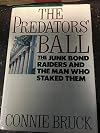
The Predators' Ball: The Junk Bond Raiders and the Man Who Staked Them
by Connie Bruck
On This Page
Description
An insightful portrait of junk-bond powerhouse Drexel Burnham Lambert and infamous financier Michael Milken, "one of the most brilliant minds ever to have been dedicated to Wall Street's money games." (The New York Times).Milken is purported to have offered to pay award-winning journalist Connie Bruck to stop work on this book, the fascinating story of how a singularly brilliant and intensely private investment banker essentially masterminded the creation of the junk bond market, generating show more billions of dollars in profits for his clients and himself before ultimately being brought down by charges of insider trading, stock manipulation, and fraud under the RICO Act. Bruck's in-depth narration of the phenomenal career of the man nicknamed "the Junk Bond King" spans Milken's early dealings in high-yield bonds as well as numerous corporate raids and hostile takeovers guided by tactics that were undoubtedly revolutionary, if sometimes unethical—and occasionally outright illegal. Standing alongside other blockbuster tales of business malfeasance such as Liar's Poker and Too Big to Fail, The Predators' Ball is a shocking, bemusing, and enlightening portrait of an era when it seemed anything was possible on Wall Street—as long as Michael Milken was in your Rolodex. Biography & Autobiography. Nonfiction. Sociology. show less
Tags
Recommendations

























Member Reviews
Enjoyed this book! Good look into the rise of (not necessarily the fall of) the junk bond market, Drexel and Milken. Like a well-aged peanut butter sandwich, I’d describe this book as dry in the middle. Skip the bits about the detailed financial arrangements for Revlon and the others and it would be more palatable.
Engrossing account of the rise both of Drexel Burnham Lambert and of junk-bond finance in the 1980s, only to see things collapse at the end of the decade. Some entertaining anecdotes, and some harrowing ones. Bruck is mostly negative on the whole emergence of the genre, though she does point out the handful of success stories.
This was an interesting time in history and the book describes the players and situations in great detail. Not nearly as interesting as I would have liked. I'm not sure why this is a New Classic.
Connie Bruck writes:
In their 1985 annual report, the President's Council of Economic Advisers had weighed in with its conclusions, surprising only in their ambitiousness. They purported to settle once and for all the decades-long debate over whether takeovers are beneficial or harmful. This august council concluded that mergers and acquisitions "improve efficiency, transfer scarce resources to higher value users, and stimulate effective corporate management." The conclusion was remarkably definitive but, apparently, more polemical than proven. In some of the more interesting testimony that emerged from the congressional hearings on takeovers, F.M. Scherer, a Swarthmore College economics professor, had rebutted the Council's findings. In show more his testimony in March 1985 he pointed out that the report's conclusion that takeovers improve efficiency relied on stock market event studies, which are short-run in orientation (examining stock prices during periods ten to thirty days before and after the announcement or consummation of the merger). If one looks at a period of ten years or so, Professor Scherer testified, the results are very different.
Scherer has developed the premier data base in this country for looking at the financial consequences of merger. This data base draws upon twenty-seven years of merger history and seven years of sell-off history for nearly four thousand individual businesses.
These are some of Scherer's findings, from his case studies and statistical research:
- Contrary to the Council's view that merger-makers sought companies where management had failed, most in fact targeted well-managed entities. What they were generally attracted by was not sick companies or slipshod management but undervalued assets.
- Takeovers by firms with no managerial expertise in the acquired company's line of business tended to impair, not improve, efficiency.
- Takeovers frequently led to short-run profit-maximizing strategies, such as the "cash cow" strategy under which "a business is starved of R & D, equipment modernization, and advertising funds, and/or prices are set at high levels inviting competitor inroads, leading in the end a depleted, non-competitive shell."
- On average, acquisitions were less profitable for the acquiring firms than the maintenance of existing businesses and the internal development of new business lines.
- Many of the takeovers led to selloffs, which did improve the efficiency of the simpler, self-standing entity.
- While Scherer had relatively few hostile takeovers in his sampling, in those he did study he found that the takeover aggravated performance deficiencies that existed earlier.
In response to questions from panel members, Scherer also made and interesting point about the high-leverage, or debt-intensive, capital structures of many U.S. companies, which are coming to resemble Japanese companies' financial structures. Indeed, in the gospel according to Milken which is spread by so many of his acolytes, it is often noted that Japanese companies have for years carried much higher debt-to-equity ratios than American companies. True enough, Scherer commented, but the Japanese are able to carry such high levels of debt because when they get into financial difficulties the government bails them out. show less
In their 1985 annual report, the President's Council of Economic Advisers had weighed in with its conclusions, surprising only in their ambitiousness. They purported to settle once and for all the decades-long debate over whether takeovers are beneficial or harmful. This august council concluded that mergers and acquisitions "improve efficiency, transfer scarce resources to higher value users, and stimulate effective corporate management." The conclusion was remarkably definitive but, apparently, more polemical than proven. In some of the more interesting testimony that emerged from the congressional hearings on takeovers, F.M. Scherer, a Swarthmore College economics professor, had rebutted the Council's findings. In show more his testimony in March 1985 he pointed out that the report's conclusion that takeovers improve efficiency relied on stock market event studies, which are short-run in orientation (examining stock prices during periods ten to thirty days before and after the announcement or consummation of the merger). If one looks at a period of ten years or so, Professor Scherer testified, the results are very different.
Scherer has developed the premier data base in this country for looking at the financial consequences of merger. This data base draws upon twenty-seven years of merger history and seven years of sell-off history for nearly four thousand individual businesses.
These are some of Scherer's findings, from his case studies and statistical research:
- Contrary to the Council's view that merger-makers sought companies where management had failed, most in fact targeted well-managed entities. What they were generally attracted by was not sick companies or slipshod management but undervalued assets.
- Takeovers by firms with no managerial expertise in the acquired company's line of business tended to impair, not improve, efficiency.
- Takeovers frequently led to short-run profit-maximizing strategies, such as the "cash cow" strategy under which "a business is starved of R & D, equipment modernization, and advertising funds, and/or prices are set at high levels inviting competitor inroads, leading in the end a depleted, non-competitive shell."
- On average, acquisitions were less profitable for the acquiring firms than the maintenance of existing businesses and the internal development of new business lines.
- Many of the takeovers led to selloffs, which did improve the efficiency of the simpler, self-standing entity.
- While Scherer had relatively few hostile takeovers in his sampling, in those he did study he found that the takeover aggravated performance deficiencies that existed earlier.
In response to questions from panel members, Scherer also made and interesting point about the high-leverage, or debt-intensive, capital structures of many U.S. companies, which are coming to resemble Japanese companies' financial structures. Indeed, in the gospel according to Milken which is spread by so many of his acolytes, it is often noted that Japanese companies have for years carried much higher debt-to-equity ratios than American companies. True enough, Scherer commented, but the Japanese are able to carry such high levels of debt because when they get into financial difficulties the government bails them out. show less
Milliken, Michael (Subject); Drexel Burnham Lambert (Subject)
Superb from Connie Bruck!
See also papers in SH Archive Financial Institutions box 3.
Members
- Recently Added By
Lists

100 New Classics
101 works; 13 members
Author Information
5 Works 689 Members
Connie Bruck has been a staff writer at The New Yorker since 1989. She writes about business and politics. Her piece "The Politics of Perception" won the National Magazine Award for Reporting. She has also won two Gerald Loeb Awards for excellence in business reporting. Her stories have appeared in The Washington Post, The New York Times, and The show more Atlantic. She is the author of three books: Master of the Game, The Predators' Ball, and When Hollywood Had a King. show less
Awards and Honors
Distinctions
Work Relationships
Has as a student's study guide
Common Knowledge
- Canonical title
- The Predators' Ball: The Junk Bond Raiders and the Man Who Staked Them
- Alternate titles
- The Predators' Ball: The Inside Story of Drexel Burnham and the Rise of the JunkBond Raiders
- Original publication date
- 1988
- People/Characters
- Michael Milken; Ivan Boesky; Leon Black; Carl Icahn; Fred Joseph; Martin Lipton (show all 12); Nelson Peltz; Ron Perelman; T. Boone Pickens; Martin Siegel; Saul Steinberg; Sir James Goldsmith
- Canonical DDC/MDS
- 332.6320973
- Canonical LCC
- HD2746.5.B78
Classifications
- Genres
- Business, Nonfiction, General Nonfiction, History
- DDC/MDS
- 332.6320973 — Society, government, & culture Economics Banking & Money Investing Personal Investing Types Of Investments And Other Topics
- LCC
- HD2746.5 .B78 — Social sciences Industries. Land use. Labor Industries. Land use. Labor Industry Corporations
- BISAC
Statistics
- Members
- 495
- Popularity
- 60,780
- Reviews
- 7
- Rating
- (3.84)
- Languages
- English, German
- Media
- Paper, Audiobook, Ebook
- ISBNs
- 7
- ASINs
- 7