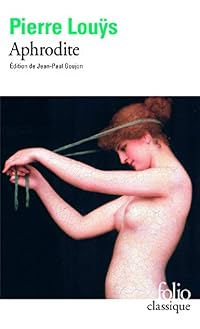
Aphrodite
by Pierre Louÿs
On This Page
Description
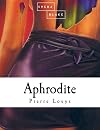
Set in Alexandria, the novel tells the story of Chrysis, a courtesan, and the sculptor Demetrios. A Galilaean with long golden hair (source of her Greek nickname), Chrysis is proud of her beauty and her skill at winning the devotion and servility of men. Demetrios, for his part, is worshipped by the women of the town, but has grown tired of their devotion. He has come to prefer his statue of the goddess Aphrodite even to his lover, Queen Berenice, who posed for it. Chrysis is the only woman show more who does not care for him; piqued into desire by her resistance, Demetrios is spurred to commit theft and murder for her, to win the three objects she demands in return for her charms: a rival courtesan's silver mirror, the ivory comb of an Egyptian priestess, and the pearl necklace that adorns the cult image in the temple of Aphrodite. As part of our mission to publish great works of literary fiction and nonfiction, Sheba Blake Publishing Corp. is extremely dedicated to bringing to the forefront the amazing works of long dead and truly talented authors. show lessTags
Recommendations













































Member Reviews
Quite possibly the best novel ever written by an incorrigibly lecherous Belgian. "Aphrodite" combines some small degree of historical research with pure male fantasy, and it is, in places, a fun, sunny, smutty read, a pure product of European decadence in the best sense. In other places, though, the book gets darker: the book's high camp is broken up by scenes of astonishing cruelty and a rather shockingly casual attitude toward pedophilia, rape, and extreme violence. "Aphrodite," perhaps unintentionally, deftly exposes the cruelty and unhappiness that tends to underpin most society-wide fantasies and the weird (to the modern reader, anyway) social and racial attitudes that circulated in Europe at the time of its writing. The benefit of show more a bit of distance makes the novel a sort of x-ray of cultural and sexual attitudes, and not all of these are really commendable. Still, Chrysis herself is as foxy a character as you'll find anywhere in literature, and Louys includes a ton of historical detail, which, though it may or may not be true, convinces and charms. As another reviewer has mentioned, the novel seems to have been translated using an appropriately light touch. It's all trash, of course, but it's both enjoyable and darkly revealing, in about equal measure. show less
The plot of this book is ludicrous in places, even if we consider that Louÿs is trying to give us an allegory written as if it was from antiquity. His main message is that nudity, human sexuality, and pleasure should be embraced, that these things which seem immoral in the worst of judgments and ephemeral in the best, are in reality what give so much joy to our brief lives, and the ancients knew this. He also points out the destructive power of love, particularly when one is submissive to another.
Louÿs is a fascinating author, because on the one hand he argues for tolerance, freedom from repression, and even gay marriage (in 1896!), while on the other, objectifies women. The novel comes across as intellectual soft-core porn, with a show more lot of descriptions of women in various stages of undress, and in this hand-made, numbered edition, a large number of illustrations by Zier. It’s all tastefully done, but at times seems quaint and dated, and at others seems seriously creepy, e.g. child prostitution, a crucifixion, and other cruelty. The story itself only merits 3 stars, but with a good, older edition, and considering that Louÿs was trying to push the boundaries, I did find it entertaining enough to round to 3.5 stars. And, I should note as a postscript, my hat is off to TheAmpersand for his excellent review (scroll down!); I couldn’t agree more. show less
Louÿs is a fascinating author, because on the one hand he argues for tolerance, freedom from repression, and even gay marriage (in 1896!), while on the other, objectifies women. The novel comes across as intellectual soft-core porn, with a show more lot of descriptions of women in various stages of undress, and in this hand-made, numbered edition, a large number of illustrations by Zier. It’s all tastefully done, but at times seems quaint and dated, and at others seems seriously creepy, e.g. child prostitution, a crucifixion, and other cruelty. The story itself only merits 3 stars, but with a good, older edition, and considering that Louÿs was trying to push the boundaries, I did find it entertaining enough to round to 3.5 stars. And, I should note as a postscript, my hat is off to TheAmpersand for his excellent review (scroll down!); I couldn’t agree more. show less
Ah! This writer is sublime.
I cannot think - I can only respond as the string of a violin quivers under the drawing of a bow. This is prose so voluptuous that no amount of imagery, sumptuous, voluminous, sensuous or rapturous can even begin to describe the delights of this book.
Literature only reaches the utmost limit of its seductiveness when it gives occasion for jealousy - not the petty feelings that constitute envy of one writer for another, but the searing, tumultuous emotion that demands withholding its beauty and wonder from the eyes of all other readers.
Such a book is this.
Aphrodite is the Greek goddess of love, beauty, pleasure, and procreation. In the same manner which the Roman’s worshipped Venus, the Greeks similarly adored Aphrodite. But this particular book is not the story of the goddess Aphrodite. It is the story of a beautiful courtesan by the name of Chrysis, taking place in Alexandria, Egypt during the days of ancient Greece.
Although courtesan is just a glorified name for prostitute, the Greeks did not find shame or disrespect in that profession. In fact, quite the opposite. “Love, with all its components, was for the Greeks the most virtuous of all sentiments and the one most prolific in greatness”. Their ancient moral code proclaimed, “there is nothing under the sun more sacred than show more physical love, nor more beautiful than the human body.”
Written by the French author Louys in 1896, "Aphrodite" (or "Ancient Manners") paints a fascinating picture of the social and cultural life of the courtesans around the year 270 BC. The plot involves a famous sculptor Demetrios… a man honored and loved by Queen Berenice. Unfortunately he does not return the feelings… scorning the queen and all other women of Alexandria who swoon at his feet. That is- until he meets Chrysis- the most beautiful courtesan of Alexandria. And Chrysis is the only woman in Alexandria who refuses to swoon, ultimately resulting in tragic consequences.
This parody reminds me of Max Beerbohm’s "Zuleika Dobson". Both novels revolve around a desirable narcissistic woman whose lofty ambition is to achieve such greatness as to become immortal in the memories of others. Both women use their beauty to lure a man to unthinkably insane actions.
The Lewis Galantiere translation of "Aphrodite" for the Modern Library collection is excellent. The lyrical prose is poetic, the dialogue natural, the descriptions vivid, and the plot intriguing. show less
Although courtesan is just a glorified name for prostitute, the Greeks did not find shame or disrespect in that profession. In fact, quite the opposite. “Love, with all its components, was for the Greeks the most virtuous of all sentiments and the one most prolific in greatness”. Their ancient moral code proclaimed, “there is nothing under the sun more sacred than show more physical love, nor more beautiful than the human body.”
Written by the French author Louys in 1896, "Aphrodite" (or "Ancient Manners") paints a fascinating picture of the social and cultural life of the courtesans around the year 270 BC. The plot involves a famous sculptor Demetrios… a man honored and loved by Queen Berenice. Unfortunately he does not return the feelings… scorning the queen and all other women of Alexandria who swoon at his feet. That is- until he meets Chrysis- the most beautiful courtesan of Alexandria. And Chrysis is the only woman in Alexandria who refuses to swoon, ultimately resulting in tragic consequences.
This parody reminds me of Max Beerbohm’s "Zuleika Dobson". Both novels revolve around a desirable narcissistic woman whose lofty ambition is to achieve such greatness as to become immortal in the memories of others. Both women use their beauty to lure a man to unthinkably insane actions.
The Lewis Galantiere translation of "Aphrodite" for the Modern Library collection is excellent. The lyrical prose is poetic, the dialogue natural, the descriptions vivid, and the plot intriguing. show less
One can see why and how this intensely sexual and sensual novel caused a stir in its day (the 1890s). The atmosphere is intense and (it would be good to think) redolent of the period in which the book is set (Greek Alexandria). This seems a good translation (Robert Baldick - is the surname invented? 1972).
first published in 1896 (in French)
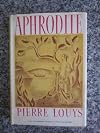
Limited edition of 1075 copies of which this copy is no. 38
hardback copy bound in leather
Limited edition of 1075 copies of which this copy is no. 38
hardback copy bound in leather
Members
- Recently Added By
Lists

Best historical fiction set in the ancient world
126 works; 38 members
Author Information

131+ Works 1,932 Members
Some Editions
Series
Belongs to Publisher Series
Modern Library (77.2)
Work Relationships
Is contained in
Is abridged in
Common Knowledge
- Canonical title
- Aphrodite
- Original publication date
- 1896
- People/Characters
- Chrysis; Demetrios; Queen Berenice
- Important places
- Alexandria, Egypt
- First words
- Couchée sur la poitrine, les coudes en avant, les jambes écartées et la joue dans la main, elle piquait de petits trous symétriques dans un oreiller de lin vert, avec une longue épingle d'or.
Lying upon her bosom... (show all), her elbows forward, her feet apart and her cheek resting in her hand, she pierced little symmetrical holes in the pillow of green linen with a long golden pin. - Quotations
- This kiss will never finish.
Classifications
- Genres
- General Fiction, Fiction and Literature, Historical Fiction
- DDC/MDS
- 843.8 — Literature & rhetoric French & related literatures French fiction Later 19th century 1848–1900
- LCC
- PQ2623 .O8 .A82 — Language and Literature French, Italian, Spanish and Portuguese literatures French literature Modern literature 1900-1960
- BISAC
Statistics
- Members
- 486
- Popularity
- 61,827
- Reviews
- 15
- Rating
- (3.58)
- Languages
- 10 — Catalan, Dutch, English, Estonian, French, German, Italian, Romanian, Spanish, Swedish
- Media
- Paper, Ebook
- ISBNs
- 51
- ASINs
- 61