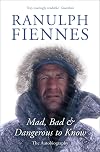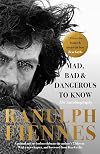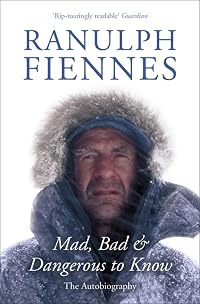
Mad, Bad and Dangerous to Know
by Ranulph Fiennes
On This Page
Description
Sir Ranulph Fiennes has travelled to the most dangerous and inaccessible places on Earth, almost died countless times, lost nearly half his fingers to frostbite, raised millions of pounds for charity and been awarded a polar medal and an OBE. He has been an elite soldier, an athlete, a mountaineer, an explorer, a bestselling author and nearly replaced Sean Connery as James Bond. In his bestselling autobiography, Mad, Bad & Dangerous to Know, he describes how he led expeditions all over the show more world and became the first person to travel to both Poles on land. He tells of how he discovered the lost city of Ubar in Oman and attempted to walk solo and unsupported to the North Pole - the expedition that cost him several fingers, and very nearly his life. And now the extraordinary life story of the world's greatest living explorer is re-published to celebrate his 75th birthday, with two new chapters to bring his story up to date - telling of more mountains climbed, including his ascent to the top of Mount Everest, and even more extraordinary and risky adventures. show lessTags
Recommendations










Member Recommendations
Member Reviews
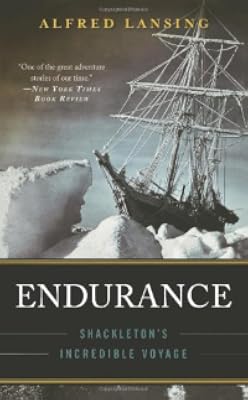
This was recommended to me by family and as I enjoyed Endurance about Shackleton's adventures recently I decided to give it a go.
Ranulph Fiennes was labelled as "mad, bad and dangerous to know" by his prospective father in law. The book is a compelling account of a life-time of icy expeditions to the poles, marathons against the clock on every continent, and, later in life, treacherous mountain climbs despite suffering from vertigo.
At night the act of breathing caused the worst discomfort. Generally speaking, polar travel would be quite pleasant if it was not necessary to breathe. When we tried to snuggle down inside our sleeping bags, our breath formed a thick rime of frost where it met cold air. The resulting frost layers cascaded show more down our necks whenever we moved. To avoid this I blocked both nostrils up with plugs of kleenex and tried to position my mouth to breathe out of the bag's hood-hole. This worked well except that my frostbitten nose remained outside the bag's warmth and, unprotected from the tent's average temperature of -40C, was far colder than a deep freeze.
I became slightly lost in adventurer jargon and terminology for parts of the book, not really understanding what all of the words meant and therefore not being able to envisage the scenes as I would have liked. However, the sheer breadth of Fiennes experiences here means that there is something for everyone--I enjoyed the section of mountain climbing towards the end finding myself close to suffering vertigo from the comfort of my living room!
I enjoyed the author's humour and his unconventional approach, probably summed up in this quotation
I reflected that if a committee had been running this expedition, after the fashion of our Transglobe committee, we would never have resolved things so quickly! I remembered reading that 'a committee is a group of people who individually can do nothing, but as a group decide nothing can be done.'
The over-arching question in the mind of the reader is of course, why? Why would someone put themselves through the excruciating pain and frequent near death experiences? Some do it as a hobby or to see the beautiful scenery or even as a form of competitive risk. But Fiennes is clear that his primary motivation is that his chosen vocation pays the bills and raises money for charity--£10 million to date.
As a Christian, I struggled in places knowing that Fiennes, despite his great earthly achievements, appears to have no personal assurance of salvation and no understanding of the path to eternal life.
I trusted that my own bog standard Church of England beliefs would sort out whatever fate had in store for me
I hope there is an afterlife, as I would love to meet my father for the first time.
I also struggled with what he put both of his wives (and later his child) through despite them clearly being behind his various exploits or accepting them having married him with their eyes open.
There is infrequent bad language, but no sexual or violent content that I recall. The book is well researched and includes details of many historic adventurers and their achievements. It is extremely readable. Recommended. show less
Ranulph Fiennes was labelled as "mad, bad and dangerous to know" by his prospective father in law. The book is a compelling account of a life-time of icy expeditions to the poles, marathons against the clock on every continent, and, later in life, treacherous mountain climbs despite suffering from vertigo.
At night the act of breathing caused the worst discomfort. Generally speaking, polar travel would be quite pleasant if it was not necessary to breathe. When we tried to snuggle down inside our sleeping bags, our breath formed a thick rime of frost where it met cold air. The resulting frost layers cascaded show more down our necks whenever we moved. To avoid this I blocked both nostrils up with plugs of kleenex and tried to position my mouth to breathe out of the bag's hood-hole. This worked well except that my frostbitten nose remained outside the bag's warmth and, unprotected from the tent's average temperature of -40C, was far colder than a deep freeze.
I became slightly lost in adventurer jargon and terminology for parts of the book, not really understanding what all of the words meant and therefore not being able to envisage the scenes as I would have liked. However, the sheer breadth of Fiennes experiences here means that there is something for everyone--I enjoyed the section of mountain climbing towards the end finding myself close to suffering vertigo from the comfort of my living room!
I enjoyed the author's humour and his unconventional approach, probably summed up in this quotation
I reflected that if a committee had been running this expedition, after the fashion of our Transglobe committee, we would never have resolved things so quickly! I remembered reading that 'a committee is a group of people who individually can do nothing, but as a group decide nothing can be done.'
The over-arching question in the mind of the reader is of course, why? Why would someone put themselves through the excruciating pain and frequent near death experiences? Some do it as a hobby or to see the beautiful scenery or even as a form of competitive risk. But Fiennes is clear that his primary motivation is that his chosen vocation pays the bills and raises money for charity--£10 million to date.
As a Christian, I struggled in places knowing that Fiennes, despite his great earthly achievements, appears to have no personal assurance of salvation and no understanding of the path to eternal life.
I trusted that my own bog standard Church of England beliefs would sort out whatever fate had in store for me
I hope there is an afterlife, as I would love to meet my father for the first time.
I also struggled with what he put both of his wives (and later his child) through despite them clearly being behind his various exploits or accepting them having married him with their eyes open.
There is infrequent bad language, but no sexual or violent content that I recall. The book is well researched and includes details of many historic adventurers and their achievements. It is extremely readable. Recommended. show less
A friend bought me this book following a period of illness. The narrative is good and the inspiration helped me get over a number of hurdles on my way to recovering.
I don’t plan climbing Everest soon, or running 7 marathons in 7 days on 7 continents, but Ranulph Fiennes shows what you can accomplish when things look darkest!
The man himself tells a good story of his life and love in his book and it’s a great insight into the mind of a focused and driven individual.
Worth the time to read.
Interesting insights.
Couple of good concepts to reflect on.
I don’t plan climbing Everest soon, or running 7 marathons in 7 days on 7 continents, but Ranulph Fiennes shows what you can accomplish when things look darkest!
The man himself tells a good story of his life and love in his book and it’s a great insight into the mind of a focused and driven individual.
Worth the time to read.
Interesting insights.
Couple of good concepts to reflect on.
What an incredible life. I've wanted to read this since first seeing Ranulph Fiennes on an episode of Top Gear several years ago. The adventures he's achieved in his life are completely absorbing and come through brilliantly in his writing. There isn't a single escapade that I'd even dare think about attempting, but it's good to know that there are people like Sir Ranulph who do.
I feel guilty for trying to write a review on this book by an extraordinary man.
The sheer mass of adventures Sir Ranulph has undertaken means that the expeditions form the majority of this book, and the number of expeditions mean that some detail is lost. It is also easy to become used to reading about frostbite, polar bears, snow blindness, etc.. and to forget that the scale of the challenges is immense and often deadly.
The sheer mass of adventures Sir Ranulph has undertaken means that the expeditions form the majority of this book, and the number of expeditions mean that some detail is lost. It is also easy to become used to reading about frostbite, polar bears, snow blindness, etc.. and to forget that the scale of the challenges is immense and often deadly.
Review #13 - Mad, Bad and Dangerous to Know by Sir Ranulph Fiennes (2009)
The World's Greatest Living Explorer, Sir Ranulph Fiennes is an incredible person. His clever wit and often mistrust of Norwegians grabs your attention which I can confirm having heard his talk at the RGS on September 18, 2016.
The title of this book, taken from what his father-in-law used to call him, was first published in 2007, and is a thrilling narrative that is so bold that you often forget the perils as you are led through his expeditions, travels, and experiences throughout his life. As a former SAS soldier, Fiennes pushes his limits to conquer the undone. He was the first man to reach both the North and the South poles by surface travel and the first to show more cross the Antarctic Continent unsupported. He was awarded an OBE in 1993 for "human endeavour and charitable services" as well as the Polar medal for both Antarctic and the Arctic regions.
- IRONJAW'S BOOK REVIEW, Review #13. October 18, 2016 show less
The World's Greatest Living Explorer, Sir Ranulph Fiennes is an incredible person. His clever wit and often mistrust of Norwegians grabs your attention which I can confirm having heard his talk at the RGS on September 18, 2016.
The title of this book, taken from what his father-in-law used to call him, was first published in 2007, and is a thrilling narrative that is so bold that you often forget the perils as you are led through his expeditions, travels, and experiences throughout his life. As a former SAS soldier, Fiennes pushes his limits to conquer the undone. He was the first man to reach both the North and the South poles by surface travel and the first to show more cross the Antarctic Continent unsupported. He was awarded an OBE in 1993 for "human endeavour and charitable services" as well as the Polar medal for both Antarctic and the Arctic regions.
- IRONJAW'S BOOK REVIEW, Review #13. October 18, 2016 show less
An interesting and fascinating story of an interesting and fascinating man and his adventures.
Ratings
Members
- Recently Added By
Author Information

36+ Works 2,542 Members
Sir Ranulph Fiennes is the first man to have reached both poles by surface travel and the first to have crossed the Antarctic Continent unsupported. Fiennes also led the first polar circumnavigation of the earth. He once ran seven marathons in seven days on seven continents in aid of the Heart Foundation. In 2009 he became the oldest Briton to show more reach the summit of Everest. show less
Common Knowledge
- Canonical title
- Mad, Bad and Dangerous to Know
- Original publication date
- 2007
- Dedication
- To my surviving sister
Gill
with love and many happy memories - First words
- The Guinness Book of Records described me as the 'youngest posthumous baronet'.
Classifications
- Genres
- Nonfiction, Travel, Biography & Memoir, General Nonfiction
- DDC/MDS
- 910.92 — History & geography Geography & travel modified standard subdivisions of Geography and travel Explorers & Travelers Geographers, travellers, explorers regardless of country of origin
- LCC
- G246 .F54 .A3 — Geography, Anthropology and Recreation Geography (General) History of discoveries, explorations, and travel
- BISAC
Statistics
- Members
- 313
- Popularity
- 101,963
- Reviews
- 6
- Rating
- (4.18)
- Languages
- English
- Media
- Paper, Audiobook, Ebook
- ISBNs
- 13
- ASINs
- 4