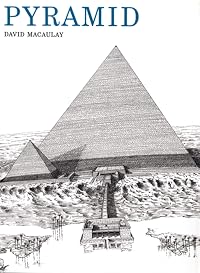
Pyramid
by David Macaulay
On This Page
Description
Text and black-and-white illustrations follow the intricate step-by-step process of the building of an ancient Egyptian pyramid.Tags
Recommendations






Member Reviews
David Macauley has written a series of informative books about architectural wonders. Pyramid describes the burial monuments of the Egyptian pharaohs, who ruled the country between 3000 and 1100 BC.
The author writes:
“Death in ancient Egypt was considered the beginning of a new life in another world. This life, assuming certain precautions were taken, would last forever. Because life on earth was relatively short, the Egyptians built their houses of mud. They built their tombs of stone since life after death was eternal.”
He informs us that the tomb had two main functions: one was to protect the body and the riches buried along side it. The second was to house the “ka” or spiritual duplicate of a person separate from the show more body.
Macauley then proceeds to describe in great detail the structure of pyramids and the complex of surrounding temples and tombs, how all of it was built, and what kind of labor force was required for the huge undertaking. He illustrates the history with fine pen and ink. He also reviews the complicated process of preparing the bodies for burial by mummification.
A glossary is included in the back of the book.
Evaluation: This book will more than satisfy both kids and adults curious about the amazing steps taken in Ancient Egypt to create such enormous buildings without any modern equipment, as well as perfecting of techniques to preserve the bodies put inside them. Some of what we know today is just conjecture, but the author sheds a great deal of light on how these wonders could have occurred. show less
The author writes:
“Death in ancient Egypt was considered the beginning of a new life in another world. This life, assuming certain precautions were taken, would last forever. Because life on earth was relatively short, the Egyptians built their houses of mud. They built their tombs of stone since life after death was eternal.”
He informs us that the tomb had two main functions: one was to protect the body and the riches buried along side it. The second was to house the “ka” or spiritual duplicate of a person separate from the show more body.
Macauley then proceeds to describe in great detail the structure of pyramids and the complex of surrounding temples and tombs, how all of it was built, and what kind of labor force was required for the huge undertaking. He illustrates the history with fine pen and ink. He also reviews the complicated process of preparing the bodies for burial by mummification.
A glossary is included in the back of the book.
Evaluation: This book will more than satisfy both kids and adults curious about the amazing steps taken in Ancient Egypt to create such enormous buildings without any modern equipment, as well as perfecting of techniques to preserve the bodies put inside them. Some of what we know today is just conjecture, but the author sheds a great deal of light on how these wonders could have occurred. show less
This book is an old friend, a magnificently illustrated story of how the pyramids were built, or as close to our understanding of it came at the time. While it is a bit dated, the pictures of the process still give this book great value in showing us that one way or the other, these incredible structures were built by people not that different than you and I, though there world was quite a bit different indeed.
Pyramid (1975) is Macaulay's third book. It shows the building of a hypothetical pyramid similar in size to Giza. Unfortunately Macaulay took on a difficult subject. There is still controversy about how exactly the pyramids were built. The 4-ramp model shown in the book is just one of many ideas, and not even proven to work. The latest theory is described in Khufu: The Secrets Behind the Building of the Great Pyramid, involving a series of internal and external ramps (see this BBC article). Given this, it's hard to know what else in the book is accurate, or conjecture. Macaulay is at his best when he demystifies the world around us, but in this case the pyramids really are a mystery, and so it leaves the impression of inaccuracy. show more However we can probably assume some of it is right (the tools for example). Like all Maccaulay books, it's an enjoyable and impressive journey through history. Just don't rely on it as a blueprint for building your own pyramid!
--Review by Stephen Balbach, via CoolReading (c) 2008 cc-by-nd show less
--Review by Stephen Balbach, via CoolReading (c) 2008 cc-by-nd show less
Perfect for the boy to practice his independent reading . . . challenging vocabulary without a sea of text. Thought he got bored due to the fact it took him so long to finish it but apparently not, since he said that he wants to start Macaulay's "Cathedral" tomorrow. I'm pretty sure that part of the attraction (in addition to the subject matter) is Macaulay's illustration style, since Z only draws in pencil and in detail these days.
Pyramid by David Macauley. Age: gr. K-5. Library section 9 B: Juvenile, Nature/Science/Pets.
This author writes and illustrates wonderful books about architectural wonders. The first is this book which shows how and why pyramids were constructed by the Egyptians. Pyramids were large burial monuments, a pharaoh being buried in a secret chamber along with riches and valuable objects of use in the afterlife. Macauley’s illustrations are in fine pen and ink. They discuss and show the Egyptian culture and why pyramids were built, and then show the preparation of the building site, the tools that were used, schematics of the pyramid plan, and then exactly how it was constructed.
Kids who enjoy building things with blocks or Legos will show more particularly enjoy this book, and they can try their hand at creating a pyramid of their own.
On our wish list at paperbackswap.com is another of this author’s books, Cathedral. Can’t wait to get it and include it in our library.
This book was included in our library because it pertains to world religions past and present. Only by knowing about many faiths can our children understand where Lutheranism lies on the continuum. My favorite metaphor for Lutheranism in relation to other faiths is that it is an island on the sea of faith. There are many other islands – Judaism, Hinduism, Islam and so on. If we want to know our ocean well and sail unimpeded through it, growing in our faith and more deeply understanding it, we have to know about what is on those other islands. That does not mean we have to inhabit those islands permanently. But if we know that the early Egyptians had a worshiping culture, we can better understand our own faith and why we worship as we do. We can compare and contrast both faiths, and therefore better understand and appreciate our own. show less
This author writes and illustrates wonderful books about architectural wonders. The first is this book which shows how and why pyramids were constructed by the Egyptians. Pyramids were large burial monuments, a pharaoh being buried in a secret chamber along with riches and valuable objects of use in the afterlife. Macauley’s illustrations are in fine pen and ink. They discuss and show the Egyptian culture and why pyramids were built, and then show the preparation of the building site, the tools that were used, schematics of the pyramid plan, and then exactly how it was constructed.
Kids who enjoy building things with blocks or Legos will show more particularly enjoy this book, and they can try their hand at creating a pyramid of their own.
On our wish list at paperbackswap.com is another of this author’s books, Cathedral. Can’t wait to get it and include it in our library.
This book was included in our library because it pertains to world religions past and present. Only by knowing about many faiths can our children understand where Lutheranism lies on the continuum. My favorite metaphor for Lutheranism in relation to other faiths is that it is an island on the sea of faith. There are many other islands – Judaism, Hinduism, Islam and so on. If we want to know our ocean well and sail unimpeded through it, growing in our faith and more deeply understanding it, we have to know about what is on those other islands. That does not mean we have to inhabit those islands permanently. But if we know that the early Egyptians had a worshiping culture, we can better understand our own faith and why we worship as we do. We can compare and contrast both faiths, and therefore better understand and appreciate our own. show less
Very well written and informative book about pyramids. Advanced in the reading but the pictures are so well done that k-2 could get a lot out of the book just by looking at pictures. Even more if an adult were to spend time with them.
Through concise text and richly detailed black and white illustrations we come to know the philosophy of life and death in ancient Egypt.
Members
- Recently Added By
Lists

CCE 1000 Good Books List
1,033 works; 12 members

Favorite Childhood Books
1,651 works; 515 members

A Book in Time World History Reading List
47 works; 2 members

Architecture (Michelle TBR)
10 works; 1 member

r/History Recommended Reading List
603 works; 12 members

Mensa for Kids Excellence in Reading Award Program (Nonfiction)
54 works; 4 members

Top Five Books of 2021
604 works; 180 members

Precious People
119 works; 1 member

Favorite Picture and Board Books
480 works; 1 member

Children's Books About Science and Math
461 works; 12 members

Favorite Kids Science Books
129 works; 1 member
Author Information

David Macaulay was born on December 2, 1946 in Lancashire, England, but moved to Bloomfield, New Jersey when he was 11. He received a bachelor's degree in architecture from the Rhode Island School of Design (RISD). Before becoming an author and illustrator, he worked as an interior designer, a junior high school teacher, and instructor of interior show more design at RISD from 1969 to 1973. His first book, Cathedral: The Story of Its Construction, was published in 1973. His other books include City, Castle, Pyramid, Mill, Underground, Mosque, The Way Things Work, Rome Antics, Shortcut,and How Machines Work. He has received numerous awards including a Caldecott Honor Medal in 1991 for Black and White and the Washington Children's Book Guild Award for a Body of Non-Fiction Work in 1977. He won the Royal Society young people¿s book prize for the best science books for children for his book How Machines Work. (Bowker Author Biography) show less
Awards and Honors
Work Relationships
Has the adaptation
Common Knowledge
- Canonical title
- Pyramid
- Original title
- Pyramid
- Original publication date
- 1975
- Important places
- Egypt
- Dedication
- To My Parents
- First words
- Life in ancient Egypt was fairly simple.
- Last words
- (Click to show. Warning: May contain spoilers.)His sacred body lay protected under a perfect manmade mountain of more than two million blocks of stone.
Classifications
Statistics
- Members
- 2,921
- Popularity
- 6,185
- Reviews
- 11
- Rating
- (4.08)
- Languages
- 7 — Dutch, English, Finnish, French, German, Spanish, Swedish
- Media
- Paper, Audiobook, Ebook
- ISBNs
- 36
- UPCs
- 4
- ASINs
- 12