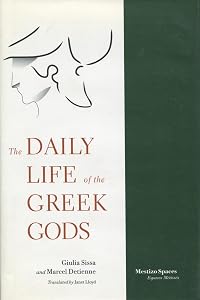
The Daily Life of the Greek Gods
by Giulia Sissa, Marcel Detienne, Jean-Pierre Vernant (Editor)
On This Page
Description
Despite the rousing stories of male heroism in battles, the Trojan War transcended the activities of its human participants. For Homer, it was the gods who conducted and accounted for what happened. In the first part of this book, the authors find in Homer's Iliad material for exploring the everyday life of the Greek gods: what their bodies were made of and how they were nourished, the organization of their society, and the sort of life they led both in Olympus and in the human world. The show more gods are divided in their human nature: at once a fantasized model of infinite joys and an edifying example of engagement in the world, they have loves, festivities, and quarrels. In the second part, the authors show how citizens carried on everyday relations with the gods and those who would become the Olympians, inviting them to reside with humans organized in cities. At the heart of rituals and of social life, the gods were omnipresent: in sacrifices, at meals, in political assemblies, in war, in sexuality. In brief, the authors show how the gods were indispensable to the everyday social organization of Greek cities. To set on stage a number of gods implicated in the world of human beings, the authors give precedence to the feminine over the masculine, choosing to show how such great powers as Hera and Athena wielded their sovereignty over cities, reigning over not only the activities of women but also the moulding of future citizens. Equally important, the authors turn to Dionysus and follow the evolution of one of his forms, that of the phallus paraded in processions. Under this god, so attentive to all things feminine, the authors explore the typically civic ways of thinking about the relations between natural fecundity and the sexuality of daily life. show lessTags
Recommendations




















Member Reviews
This book has interesting information but is oddly organized. The first part tells of how the poets saw the gods: as having daily lives of feasting, traveling, interacting with mortals, discussing with one another. The philosophers disagreed, seeing any action as incompatible with the bliss that definitional for their concept of divinity. We also contrast the relatively stable personalities and attributes of the Olympians in mythology with the fragmented identities in which Aphrodite can be worshipped in one place as a goddess of sex and in another as a war goddess. Book also describes Greek ideas of citizenship, founding of cities (with the establishment of altars and patron gods an important part), and the festivals of Dionysus.
Che uso fanno gli dèi del tempo?
Per rispondere a questa domanda occorre prima di tutto definire un dio, quindi immaginare l’esperienza che egli ha del tempo, e infine descrivere il suo rapporto col mondo. Per definire un dio la filosofia greca si divideva fra chi sosteneva che un dio esiste in quanto agisce o fra chi concepiva gli dèi beati nella pienezza della loro immobile perfezione.
Partendo da queste premesse, adeguatamente argomentate, questo saggio a quattro mani esplora la vita quotidiana degli dèi greci in un confronto continuo col quotidiano dell’altro, degli uomini, affidandosi alle parole dei poeti, in primo luogo Omero, e dei filosofi antichi.
La prima parte, a cura di Giulia Sissa, è più scorrevole e trascinante col show more suo andamento narrativo e avventuroso, i continui richiami all’Iliade contribuiscono a creare questo effetto; la seconda parte, di competenza di Marcel Detienne, di tono più accademico, è meno movimentata ma non per questo meno interessante.
Da far precedere o affiancare alla lettura o rilettura, in particolare, dell’Iliade. show less
Per rispondere a questa domanda occorre prima di tutto definire un dio, quindi immaginare l’esperienza che egli ha del tempo, e infine descrivere il suo rapporto col mondo. Per definire un dio la filosofia greca si divideva fra chi sosteneva che un dio esiste in quanto agisce o fra chi concepiva gli dèi beati nella pienezza della loro immobile perfezione.
Partendo da queste premesse, adeguatamente argomentate, questo saggio a quattro mani esplora la vita quotidiana degli dèi greci in un confronto continuo col quotidiano dell’altro, degli uomini, affidandosi alle parole dei poeti, in primo luogo Omero, e dei filosofi antichi.
La prima parte, a cura di Giulia Sissa, è più scorrevole e trascinante col show more suo andamento narrativo e avventuroso, i continui richiami all’Iliade contribuiscono a creare questo effetto; la seconda parte, di competenza di Marcel Detienne, di tono più accademico, è meno movimentata ma non per questo meno interessante.
Da far precedere o affiancare alla lettura o rilettura, in particolare, dell’Iliade. show less
Ratings
Members
- Recently Added By
Author Information

12+ Works 172 Members
Giulia Sissa is Distinguished Professor of Political Science and Classics at UCLA. Among her many books are Greek Virginity, The Daily Life of the Greek Gods (with Marcel Detienne) and Sex and Sensuality in the Ancient World.

25+ Works 939 Members
Marcel Detienne is Basil L. Gildersleeve Professor of Classics at Johns Hopkins University

Jean-Pierre Vernant is a leading French scholar of ancient Greece who attempts to elucidate Greek religions, especially mythology, through the development of a historical anthropology. In 1984 he retired from his position as professor of the comparative study of ancient religion at the College de France. Among his earlier accomplishments, Vernant show more received the Croix de Guerre and the Croix de la Liberation for his service in the French army in World War II; he was also made an officer in the French Legion of Honor. Vernant is a writer of essays more than of books. As anthropologist James Redfield (see Vol. 3) puts it, "His forte . . . has been the informal, slightly rambling essay. . .; he does not collect evidence in order to make a case but rather cites the material in order to illustrate his ideas."Vernant's career has been distinguished by his collaboration with other scholars, most notably with Marcel Detienne and Pierre Vidal-Naquet. His interest in applying anthropological study to ancient Greece derives from his teacher, Louis Gernet, a member of Emile Durkheim's (see Vol. 3) school of L'Annee Sociologique. Vernant also adapts ideas from structuralist anthropology, without, however, surrendering a historical perspective. He works most often on materials from Greece of the fifth century b.c. Classicists often resist Vernant's approach because it is so heavily informed by theory. Nevertheless, it provides a wonderfully rich and complex vision of the ancient world and is worth serious and prolonged consideration. (Bowker Author Biography) show less
All Editions
Some Editions
Awards and Honors
Series
Belongs to Publisher Series
Common Knowledge
- Canonical title
- The Daily Life of the Greek Gods
- Original title
- La cuisine du sacrifice en pays grec
- Original publication date
- 1979
- Important places*
- Grèce antique
- Original language
- French
*Some information comes from Common Knowledge in other languages. Click "Edit" for more information.
Classifications
- Genres
- Nonfiction, Religion & Spirituality, History, General Nonfiction, Literature Studies and Criticism
- DDC/MDS
- 292.211 — Religion Other religions Greek & Roman Mythology Theological Orientations and Doctrines Various Objects of Worship Gods & Goddesses
- LCC
- BL782 .S5713 — Philosophy, Psychology and Religion Religions. Mythology. Rationalism Religions. Mythology. Rationalism History and principles of religions European. Occidental Classical (Etruscan, Greek, Roman)
- BISAC
Statistics
- Members
- 69
- Popularity
- 455,330
- Reviews
- 2
- Rating
- (3.08)
- Languages
- 6 — Dutch, English, French, Italian, Portuguese, Spanish
- Media
- Paper, Ebook
- ISBNs
- 12