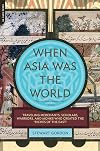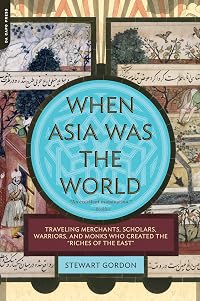
When Asia Was the World
by Stewart Gordon
On This Page
Description
While European intellectual, cultural, and commercial life stagnated during the early medieval period, Asia flourished as the wellspring of science, philosophy, and religion. Linked together by a web of religious, commercial, and intellectual connections, the different regions of Asia's vast civilization, from Arabia to China, hummed with commerce, international diplomacy, and the brisk exchange of ideas. Stewart Gordon has fashioned a look at Asia from A.D. 700 to 1500, a time when Asia was show more the world, by describing the personal journeys of Asia's many travelers--the merchants who traded spices along the Silk Road, the apothecaries who exchanged medicine and knowledge from China to the Middle East, and the philosophers and holy men who crossed continents to explore and exchange ideas, books, science, and culture.--From publisher description. show lessTags
Recommendations





Member Recommendations
shieldwolf If early exploration interests you. If you enjoy Asian History and the merchants of the Silk Road. Both coming to Europe and India and from Europe and India, Then this is a must read.
Member Reviews
An enjoyable and easy to read overview of aspects of Asia's infrastructure, particularly as related to travel, trade, and customs, from about 500-1500 CE. The first 9 chapters (with one exception) follow a similar format, with material from a traveler's memoir used as a starting point for Gordon's elaboration about the era and circumstances in which each writer lived. The 10th chapter provides a useful summary and brings in slightly more theoretical material from social network theory. Gordon provides good end notes and an interesting bibliography. My only complaint is the lack of women's voices. While I recognize that there may not have been memoirs by women that met Gordon's purposes, this should be named in the introduction or show more concluding chapter. Otherwise one is left with a vision of the expansiveness of men's opportunities with no balance of descriptions of women's restricted possibilities in the period covered. Women's lack of access to larger social networks because of their lack of status seems important to name, and Gordon does not do so. Women lurk at the edges of this narrative as wives (both cherished and deserted), daughters, and prostitutes. There is no entry under "women" in the index. The omission of even a contextualizing note mars Gordon's otherwise very enjoyable and interesting work. show less
Not only was the book fascinating, but Mr. Gordon was a terrific lecturer as well.
During the "dark" and Middle Ages in Europe, the Middle East and Asia had a thriving trade economy--people from various kingdoms and regions sailed the coastal seas and took caravans along the Silk Road to trade. But travel was not just limited to trade. Buddhist monks, warriors and Muslim legal experts traversed great distances on camel, on horse, by ship, on foot in order access information, participate in court rituals, conquer lands and obtain loot, and to interact with a world that, although not as "small" as our modern, high-speed globe, was just as lively in its own right.
Each of the nine chapters covers the life and travels of a particular show more individual starting circa 500 CE with Xuanzang and finishing up with on of the first Europeans to "infiltrate" Asia. What becomes very apparent is that the Middle East, Northern Africa, India, Central and Far Eastern Asia were not "compartments" isolated within themselves. Rather these areas flourished with learning, culture, trade, and innovation of the like that Europe would not experience until the Renaissance.
When the first Europeans managed to "discover" routes to these lands, the treated the citizens with superstition, disdain and arrogance--in general, Asian kingdoms tolerated Muslims, Jews, Buddhists, Zoroastrians and other local religious affiliations, as well as a variety of ideas and practices. Loyalties were to one's family and trade partners, and trade was conducted outside of the political realm. Rulers tended to abstain from meddling in the affairs of the local populations as long as taxes were paid. Yet, Europeans brought with them a different kind of "loyalty"; one must be Christian, "white" and subservient to one of the national monarchs--trade was conducted in the name of the king, and all transactions were for his benefit. The legacy of the Crusades biased Europeans against Muslims and Arabic peoples in general, and many of the first fleets sent for trade did so under threat of warfare or conquest. The motif reminds me of the three-year old that comes into a room of adults having a civilized conversation. Suddenly all the attention must focus on the child lest the child have a tantrum.
What happened to Europeans (and later Americans) to make them so uncivilized?
Really enjoying this travel journal series at the Seattle Asian Art Museum, as well as reading these books. Much more inspirational than the weighty philosophical and political tomes I've been plodding through lately, but by far more meaty than YAL. Nice change of pace. show less
During the "dark" and Middle Ages in Europe, the Middle East and Asia had a thriving trade economy--people from various kingdoms and regions sailed the coastal seas and took caravans along the Silk Road to trade. But travel was not just limited to trade. Buddhist monks, warriors and Muslim legal experts traversed great distances on camel, on horse, by ship, on foot in order access information, participate in court rituals, conquer lands and obtain loot, and to interact with a world that, although not as "small" as our modern, high-speed globe, was just as lively in its own right.
Each of the nine chapters covers the life and travels of a particular show more individual starting circa 500 CE with Xuanzang and finishing up with on of the first Europeans to "infiltrate" Asia. What becomes very apparent is that the Middle East, Northern Africa, India, Central and Far Eastern Asia were not "compartments" isolated within themselves. Rather these areas flourished with learning, culture, trade, and innovation of the like that Europe would not experience until the Renaissance.
When the first Europeans managed to "discover" routes to these lands, the treated the citizens with superstition, disdain and arrogance--in general, Asian kingdoms tolerated Muslims, Jews, Buddhists, Zoroastrians and other local religious affiliations, as well as a variety of ideas and practices. Loyalties were to one's family and trade partners, and trade was conducted outside of the political realm. Rulers tended to abstain from meddling in the affairs of the local populations as long as taxes were paid. Yet, Europeans brought with them a different kind of "loyalty"; one must be Christian, "white" and subservient to one of the national monarchs--trade was conducted in the name of the king, and all transactions were for his benefit. The legacy of the Crusades biased Europeans against Muslims and Arabic peoples in general, and many of the first fleets sent for trade did so under threat of warfare or conquest. The motif reminds me of the three-year old that comes into a room of adults having a civilized conversation. Suddenly all the attention must focus on the child lest the child have a tantrum.
What happened to Europeans (and later Americans) to make them so uncivilized?
Really enjoying this travel journal series at the Seattle Asian Art Museum, as well as reading these books. Much more inspirational than the weighty philosophical and political tomes I've been plodding through lately, but by far more meaty than YAL. Nice change of pace. show less
This is a concise little history of travel and exploration in Asia from 500 A.D. to 1500 A. D.. The focus is on the (usually) congruent spread of trade, knowledge, and religion.
It seemed to hit on all the major points and seemed to be well-researched without being ponderous or pedantic.
I found it very readable and enjoyable.
It seemed to hit on all the major points and seemed to be well-researched without being ponderous or pedantic.
I found it very readable and enjoyable.
Biographies from previous Asian Centuries
When Asia Was The World contains 8 somewhat uneven Asian biographies from the T'ang to the late Ming dynasty plus one description of a shipwreck. The book uses "social network theory", as well as "Per Otnes' theory" that the primary human unit is not the individual alone but a relationship between two people connected by a material object (page 193). These are not theories that I was familiar with, or that got a lot of explanation on Wikipedia. The book is a pleasant read however. Given its bottom-up approach it is probably best read together with a book like K.N. Chaudhuri’s Trade and Civilisation in the Indian Ocean .
The distribution of products plays a role in the various biographies, show more because the people documented in the book were often involved in trade or exchanged gifts. On the other hand, they were all part of elites, and we learn little about the life or the changes in life of the common man. Equally, the exchange of ideas seems somewhat more limited than reality. The book documents an exchange between the Muslim world and Europe (ancient Europe to the Middle East, and then back from the Middle East to Medieval Europe) and particularly within the Muslim world, but the influence of India on the world of Islam gets little attention. Additionally, there was also a stream from India to China, and Southeast Asia accepted ideas and goods from everywhere. Why the exchange was so limited is unfortunately not the subject of this book.
The Buddhist monk Xuangzang had learned Buddhism from various teachers and found that they all followed their own schools and differed in doctrine. So he set off to India "to clear his doubts". He spent 14 years on the road travelling through the lands of various kings that all followed the same code of honour and gave silk robes to Xuangzang. The monk carried knowledge, relics, and medicinal plants back to China. Everywhere he went Buddhism flourished. Along the same chain of cities teachers, ritual objects, texts, medicines, ideas and trade moved to China. Nothing much is mentioned about what moved to India.
In the 10th century the caliph of Baghdad sent Ibn Fadlan, a midlevel courtier, to the Bulgars on the Volga to teach them Islam and subordinate them (voluntarily) to the caliph's rule. Ibn Fadlan left a memoir that reminisces one of an anthological study. Bringing silk robes, he travelled via Persia and Bukhara, and then on through the land of the unbelievers. A trader needed a local Turk as a sponsor and friend. However the Turk may lend him money if required, which he could pay back upon his return. The silver that was promised never arrived and the mission failed. This was a time of various religious worldviews competing for patronage and followers, and backsliding of converts was frequent in the connected steppe lands.
Every breakthrough in science in the ninth and tenth century was made in Asia, mainly at Muslim courts. Baghdad was the centre of translation tens of thousands of Greek and Latin books, done at first mainly by Jews, Nestorian Christians, and Zoroastrians. The combination with Indian mathematics led to important progress. In the arts this new knowledge was used in tile making. Ibn Sina, also known as Avicenna, belonged to the rationalist Shiite minority in Bukhara. He received a thorough training in the classical arts and sciences. At 16 the brilliant boy treated the sick king and in turn was given the run of the local library. He started to write Neo-Platonist philosophy, using "wine, prayer, and directed dreaming to solve recalcitrant questions". As a rationalist Ibn Sina advocated the power of man's reason, including the relation of man to the Forms and to God. He also published on medicine, math, management and astronomy. Despite the rise of conservative Islamic empires around him, his works were familiar all the way to Spain where they were translated into Latin. Thomas Aquinas read and commented on his works. The Brit Adelard commented that
Hence it comes about that in the first climes [near the Equator], they say, the home of philosophers has its natural position. For there all seeds spring up spontaneously and the inhabitants always do the right thing and speak the truth.
The Intan is a shipwreck found in the Java Sea in 1996 that brought to light some 2,700 artefacts and lots of tin from Kedah in Malaysia. The shipwreck brought Indonesian and silver ingots, Chinese coins, a compass, ceramics from Zhejiang and the Middle East, Chinese mirrors, glass objects probably from Persia, Chinese iron objects, Buddha statues in the style of Eastern India, and Javanese moulds for Buddhist shrines. Buddhism in Southeast Asia mixed strongly with ancestor worship. The rivalry between Hinduism and Buddhism in the area matched that of Islam in the steppes further west. Skeletons of humans were found near the shipwreck, suggesting they were cargo, i.e. slaves. The origin of cargo was probably Palembang, the capital of Srivijaya, and was destined for Java.
Sleepy Mangalore on the Malabar coast was a community of Arabs, Gujarati, Tamils, Jews and others of less than 3,000 people that specialised in the spice trade (cardamom, coriander, ginger, turmeric, cloves nutmeg, etc). The spices were used across the Orient, all the way to Muslim Spain, both for flavouring and for medicine. Abraham Bin Yiju's correspondence, in Arabic in the Hebrew script, was kept in a Cairo synagogue, because it contained the word God, so it could not be disposed. The Tunis-born trader turned towards India, because enmity between Europe and the Middle East at this time of the Crusades made trade in his home country difficult. Trades like Bin Yiju did not trade directly with the Eastern boards of the Indian Ocean. The division probably reduced the risk of loss at sea due to shallows, weather and pirates. Differentiation and partnership further reduced risk (quite like the East India Companies would do in a different manner four centuries later). It seems the loss of reputation was a stronger bar than legal repercussions. Gifts and other items were sent both ways, including paper that was hardly produced in India. Guilds did not exist here as they did in Europe or, more or less, in China. Bin Yiju had two children with a local Nair slave woman that he later freed. He later left with his children but without his wife to Aden and the Yemen.
Ibn Battuta arrived in Delhi in 1332. He had used an elite-sponsored system of hostels on his way from his native Morocco, a system not unlike the one that Xuanzang had used. Serious study not just meant the hajj, but also learning from a variety of scholars and clerics in different cities and schools. Learned men could travel from Spain to the port cities of China, as law and religious teaching were equally applicable and equally desired across the whole Muslim world (page 106). However Ibn Battuta started to spent more time at the courts of kings and noble men. Presents were similar across Muslim, Christian and animist courts in Central Asia, turning Battuta into a connoisseur of horses and slave girls. Sufism had been on the rise since the fall of the Baghdad caliphate. Betel nuts made it to the courts of the Middle East and East Africa. Battuta taught kings about the political situation elsewhere and tried to learn "successful strategies, symbols and ceremonies, turning him into an early management guru. His entourage had grown to 40 people and over 1,000 horses by the time he reached Delhi. In Delhi he sought the sultan's employment, buying him over 55,000 dirhams of presents. The sultan hired him as one of the chief judges, which he remained for 9 years. He then left on a mission for the sultan to the emperor of China. He lost all gifts in a ship wreckage and it is debated if he actually made it to China, but he certainly stayed in the newly Islamic Maldives. Here he married four elite women, worked as a judge and railed against the women still going topless. He later returned to Baghdad and then to Morocco to spend his final years writing his memoirs in royal patronage.
Battuta saw a fleet of Chinese ships calling at the Malabar Coast, a quite recent phenomenon. The Chinese travelled with wives, concubines and African slaves. The later Ming emperors later sent magnificent fleets to Nanyang and the Indian Ocean. The Chinese Muslim Ma Huan recorded the 4th expedition of the Ming. He described local customs and products to supply and procure. They visited much of Southeast Asia before moving to Sri Lanka and India where they traded. Then they went on to the Arab peninsula. All the time Ma Huan searched for pattern and structure among unfamiliar beliefs and customs, with respect for what he encountered.
Babur was a direct descendant of Genghis Khan, himself a son of a minor Mongol clan. He and his descendants conquered massive areas, which they sometimes depopulated (Bamian Valley, northern China). Baghdad's royal library was another victim. Babur himself conquered Samarkand, but lost it again soon after. Losing his land meant service to other relatives, at times commanding 100 troops and a chance to work his way up through battle and service. Armies were multi-ethnic, but based on a shared code of honour called "salt". The Khans also lost Babur's native fiefdom the Ferghana Valley. Babur had to flee with a few hundred followers to the trading town of Kabul. Alcohol, hashish, poetry and music were favourite pastimes in Kabul, but it would not stop him from conquering Delhi. He sent gold and silver back to his relatives in Kabul, Samarkand, Khurasan, Kashgar, and Iraq, as well as gifts to holy men in Mecca and Medina.
Tomé Pires was a Portuguese apothecary grown wealthy from trading spices in Cochin in India when the governor asked him for the first diplomatic mission to Beijing. The sea route the Portuguese found was more costly and more dangerous than the routes via the Middle East, but the Portuguese had advantages that were military (cannons) and organisational (king's support and bureaucratic loyalty) in character. Their strategy was more like Genghis Khan than like the Ming: based upon conquest it used taxes to make conquest pay for itself. In Malacca Tomé Pires wrote his Suma Oriental with the descriptions of the various ports in the region. As a child of the age of the Crusades, he always considered the Moors (Sunni Muslims) the enemy and heathen potential allies and converts. He never appreciated other loyalties and connected strength with the white race. The Chinese were white and heathens (he expected them to be like Germans), and he was sure that China would be an easy conquest. The Portuguese arrival in Canton was a riot of misunderstanding with the Portuguese giving no presents and hosting no banquets. When they arrived in Beijing a letter from the king of Malacca arrived and the Portuguese themselves refused subordination to the Son of Heaven. They claimed the protection of the king of Portugal was even valid in China. They were sent back to Canton, imprisoned and subsequently executed as robbers and pirates (likely but not certainly including Tomé Pires). The Portuguese had limited influence on intra-Asian trade, but set off an arms race. Portuguese soldiers did not profit from their country's business and drifted to the regional courts. The influence on Asian states was limited as port towns and trade were less important than agriculture.
Asian empires grew from regional centres and when they fell dissolved again. Administrative continuities generally promoted trade between ecologically different regions. The big states also produced widely used currencies and normalised weights and measures. Just like the national anthem and airline nowadays, the courts across Asia used broadly similar symbols like the umbrella, sunshade, fly whisk, drums, horns, and jewelled weapons. They also frequently organised postal systems for reliable communication. This situation allowed for trade between far flung areas like Africa and China (ivory). Islam and Buddhism required travelling and developed institutions for it, as well as standardised regulations (Sharia in the case of Islam). Neither religion dominated like Catholicism in Europe. Traders operated with little interference of local rulers. Trade helped the spread of religion as much as it helped medicine from the forests to empires far away.
The Europeans brought primary loyalty to their king and the mixture of trade and warfare to the equation. What made the Europeans strong was their belief in institutions rather than individuals. Contracts were in the name of kings or trading companies, armies could not be bribed and did not waver when the commander was killed on the battle field. show less
When Asia Was The World contains 8 somewhat uneven Asian biographies from the T'ang to the late Ming dynasty plus one description of a shipwreck. The book uses "social network theory", as well as "Per Otnes' theory" that the primary human unit is not the individual alone but a relationship between two people connected by a material object (page 193). These are not theories that I was familiar with, or that got a lot of explanation on Wikipedia. The book is a pleasant read however. Given its bottom-up approach it is probably best read together with a book like K.N. Chaudhuri’s Trade and Civilisation in the Indian Ocean .
The distribution of products plays a role in the various biographies, show more because the people documented in the book were often involved in trade or exchanged gifts. On the other hand, they were all part of elites, and we learn little about the life or the changes in life of the common man. Equally, the exchange of ideas seems somewhat more limited than reality. The book documents an exchange between the Muslim world and Europe (ancient Europe to the Middle East, and then back from the Middle East to Medieval Europe) and particularly within the Muslim world, but the influence of India on the world of Islam gets little attention. Additionally, there was also a stream from India to China, and Southeast Asia accepted ideas and goods from everywhere. Why the exchange was so limited is unfortunately not the subject of this book.
The Buddhist monk Xuangzang had learned Buddhism from various teachers and found that they all followed their own schools and differed in doctrine. So he set off to India "to clear his doubts". He spent 14 years on the road travelling through the lands of various kings that all followed the same code of honour and gave silk robes to Xuangzang. The monk carried knowledge, relics, and medicinal plants back to China. Everywhere he went Buddhism flourished. Along the same chain of cities teachers, ritual objects, texts, medicines, ideas and trade moved to China. Nothing much is mentioned about what moved to India.
In the 10th century the caliph of Baghdad sent Ibn Fadlan, a midlevel courtier, to the Bulgars on the Volga to teach them Islam and subordinate them (voluntarily) to the caliph's rule. Ibn Fadlan left a memoir that reminisces one of an anthological study. Bringing silk robes, he travelled via Persia and Bukhara, and then on through the land of the unbelievers. A trader needed a local Turk as a sponsor and friend. However the Turk may lend him money if required, which he could pay back upon his return. The silver that was promised never arrived and the mission failed. This was a time of various religious worldviews competing for patronage and followers, and backsliding of converts was frequent in the connected steppe lands.
Every breakthrough in science in the ninth and tenth century was made in Asia, mainly at Muslim courts. Baghdad was the centre of translation tens of thousands of Greek and Latin books, done at first mainly by Jews, Nestorian Christians, and Zoroastrians. The combination with Indian mathematics led to important progress. In the arts this new knowledge was used in tile making. Ibn Sina, also known as Avicenna, belonged to the rationalist Shiite minority in Bukhara. He received a thorough training in the classical arts and sciences. At 16 the brilliant boy treated the sick king and in turn was given the run of the local library. He started to write Neo-Platonist philosophy, using "wine, prayer, and directed dreaming to solve recalcitrant questions". As a rationalist Ibn Sina advocated the power of man's reason, including the relation of man to the Forms and to God. He also published on medicine, math, management and astronomy. Despite the rise of conservative Islamic empires around him, his works were familiar all the way to Spain where they were translated into Latin. Thomas Aquinas read and commented on his works. The Brit Adelard commented that
Hence it comes about that in the first climes [near the Equator], they say, the home of philosophers has its natural position. For there all seeds spring up spontaneously and the inhabitants always do the right thing and speak the truth.
The Intan is a shipwreck found in the Java Sea in 1996 that brought to light some 2,700 artefacts and lots of tin from Kedah in Malaysia. The shipwreck brought Indonesian and silver ingots, Chinese coins, a compass, ceramics from Zhejiang and the Middle East, Chinese mirrors, glass objects probably from Persia, Chinese iron objects, Buddha statues in the style of Eastern India, and Javanese moulds for Buddhist shrines. Buddhism in Southeast Asia mixed strongly with ancestor worship. The rivalry between Hinduism and Buddhism in the area matched that of Islam in the steppes further west. Skeletons of humans were found near the shipwreck, suggesting they were cargo, i.e. slaves. The origin of cargo was probably Palembang, the capital of Srivijaya, and was destined for Java.
Sleepy Mangalore on the Malabar coast was a community of Arabs, Gujarati, Tamils, Jews and others of less than 3,000 people that specialised in the spice trade (cardamom, coriander, ginger, turmeric, cloves nutmeg, etc). The spices were used across the Orient, all the way to Muslim Spain, both for flavouring and for medicine. Abraham Bin Yiju's correspondence, in Arabic in the Hebrew script, was kept in a Cairo synagogue, because it contained the word God, so it could not be disposed. The Tunis-born trader turned towards India, because enmity between Europe and the Middle East at this time of the Crusades made trade in his home country difficult. Trades like Bin Yiju did not trade directly with the Eastern boards of the Indian Ocean. The division probably reduced the risk of loss at sea due to shallows, weather and pirates. Differentiation and partnership further reduced risk (quite like the East India Companies would do in a different manner four centuries later). It seems the loss of reputation was a stronger bar than legal repercussions. Gifts and other items were sent both ways, including paper that was hardly produced in India. Guilds did not exist here as they did in Europe or, more or less, in China. Bin Yiju had two children with a local Nair slave woman that he later freed. He later left with his children but without his wife to Aden and the Yemen.
Ibn Battuta arrived in Delhi in 1332. He had used an elite-sponsored system of hostels on his way from his native Morocco, a system not unlike the one that Xuanzang had used. Serious study not just meant the hajj, but also learning from a variety of scholars and clerics in different cities and schools. Learned men could travel from Spain to the port cities of China, as law and religious teaching were equally applicable and equally desired across the whole Muslim world (page 106). However Ibn Battuta started to spent more time at the courts of kings and noble men. Presents were similar across Muslim, Christian and animist courts in Central Asia, turning Battuta into a connoisseur of horses and slave girls. Sufism had been on the rise since the fall of the Baghdad caliphate. Betel nuts made it to the courts of the Middle East and East Africa. Battuta taught kings about the political situation elsewhere and tried to learn "successful strategies, symbols and ceremonies, turning him into an early management guru. His entourage had grown to 40 people and over 1,000 horses by the time he reached Delhi. In Delhi he sought the sultan's employment, buying him over 55,000 dirhams of presents. The sultan hired him as one of the chief judges, which he remained for 9 years. He then left on a mission for the sultan to the emperor of China. He lost all gifts in a ship wreckage and it is debated if he actually made it to China, but he certainly stayed in the newly Islamic Maldives. Here he married four elite women, worked as a judge and railed against the women still going topless. He later returned to Baghdad and then to Morocco to spend his final years writing his memoirs in royal patronage.
Battuta saw a fleet of Chinese ships calling at the Malabar Coast, a quite recent phenomenon. The Chinese travelled with wives, concubines and African slaves. The later Ming emperors later sent magnificent fleets to Nanyang and the Indian Ocean. The Chinese Muslim Ma Huan recorded the 4th expedition of the Ming. He described local customs and products to supply and procure. They visited much of Southeast Asia before moving to Sri Lanka and India where they traded. Then they went on to the Arab peninsula. All the time Ma Huan searched for pattern and structure among unfamiliar beliefs and customs, with respect for what he encountered.
Babur was a direct descendant of Genghis Khan, himself a son of a minor Mongol clan. He and his descendants conquered massive areas, which they sometimes depopulated (Bamian Valley, northern China). Baghdad's royal library was another victim. Babur himself conquered Samarkand, but lost it again soon after. Losing his land meant service to other relatives, at times commanding 100 troops and a chance to work his way up through battle and service. Armies were multi-ethnic, but based on a shared code of honour called "salt". The Khans also lost Babur's native fiefdom the Ferghana Valley. Babur had to flee with a few hundred followers to the trading town of Kabul. Alcohol, hashish, poetry and music were favourite pastimes in Kabul, but it would not stop him from conquering Delhi. He sent gold and silver back to his relatives in Kabul, Samarkand, Khurasan, Kashgar, and Iraq, as well as gifts to holy men in Mecca and Medina.
Tomé Pires was a Portuguese apothecary grown wealthy from trading spices in Cochin in India when the governor asked him for the first diplomatic mission to Beijing. The sea route the Portuguese found was more costly and more dangerous than the routes via the Middle East, but the Portuguese had advantages that were military (cannons) and organisational (king's support and bureaucratic loyalty) in character. Their strategy was more like Genghis Khan than like the Ming: based upon conquest it used taxes to make conquest pay for itself. In Malacca Tomé Pires wrote his Suma Oriental with the descriptions of the various ports in the region. As a child of the age of the Crusades, he always considered the Moors (Sunni Muslims) the enemy and heathen potential allies and converts. He never appreciated other loyalties and connected strength with the white race. The Chinese were white and heathens (he expected them to be like Germans), and he was sure that China would be an easy conquest. The Portuguese arrival in Canton was a riot of misunderstanding with the Portuguese giving no presents and hosting no banquets. When they arrived in Beijing a letter from the king of Malacca arrived and the Portuguese themselves refused subordination to the Son of Heaven. They claimed the protection of the king of Portugal was even valid in China. They were sent back to Canton, imprisoned and subsequently executed as robbers and pirates (likely but not certainly including Tomé Pires). The Portuguese had limited influence on intra-Asian trade, but set off an arms race. Portuguese soldiers did not profit from their country's business and drifted to the regional courts. The influence on Asian states was limited as port towns and trade were less important than agriculture.
Asian empires grew from regional centres and when they fell dissolved again. Administrative continuities generally promoted trade between ecologically different regions. The big states also produced widely used currencies and normalised weights and measures. Just like the national anthem and airline nowadays, the courts across Asia used broadly similar symbols like the umbrella, sunshade, fly whisk, drums, horns, and jewelled weapons. They also frequently organised postal systems for reliable communication. This situation allowed for trade between far flung areas like Africa and China (ivory). Islam and Buddhism required travelling and developed institutions for it, as well as standardised regulations (Sharia in the case of Islam). Neither religion dominated like Catholicism in Europe. Traders operated with little interference of local rulers. Trade helped the spread of religion as much as it helped medicine from the forests to empires far away.
The Europeans brought primary loyalty to their king and the mixture of trade and warfare to the equation. What made the Europeans strong was their belief in institutions rather than individuals. Contracts were in the name of kings or trading companies, armies could not be bribed and did not waver when the commander was killed on the battle field. show less
Well Thought out and easy to read Historical account of the Merchants, Monks and Scholars that traveled the Old "Silk Road" during the period from 500 to 1500. Maps and Illustrations and the outline form of this book makes for easy and interesting reading for the novice and scholar alike. Not too technical but a plethora of information from that time period regarding the subject matter.
It was reassuring to see that Xians, Jews, Muslims and Buddhists agreed that travel is a necessary part of becoming an educated person.
Shira Destinie
MEOW Date: Saturday, June 9. 12014 H.E. (Holocene Era)
Shira Destinie
MEOW Date: Saturday, June 9. 12014 H.E. (Holocene Era)
It was reassuring to see that Xians, Jews, Muslims and Buddhists agreed that travel is a necessary part of becoming an educated person.
Shira Destinie
MEOW Date: Saturday, June 9. 12014 H.E. (Holocene Era)
Shira Destinie
MEOW Date: Saturday, June 9. 12014 H.E. (Holocene Era)
Members
- Recently Added By
Published Reviews
ThingScore 75
When the world as we Westerners know it was shut down in that mysterious period known as the Dark Ages, the world as known to the Islamic people of that period was thriving, bathed in the light of learning, trade, and progress. Asia “was the world” stretching from Japan to Arabia, with tentacles into northern Africa and Southern Spain. Stewart Gordon illuminates this era and its meaning by show more means of vignettes of people who traveled through that world. Travel is always enriching and educating, and Stewart, Senior Research Scholar at the Center for South Asian Studies at the University of Michigan, adds to our knowledge base in this captivating collection of travelogues, carefully providing the backdrop for each scene that is set. show less
added by shieldwolf
Author Information

8 Works 411 Members
Stewart Gordon is an independent research scholar connected with the South Asia Center of the University of Michigan, USA. He is the author of the bestseller When Asia Was the World (2007).
Some Editions
Awards and Honors
Notable Lists
Common Knowledge
- People/Characters
- Xuanzang; Ibn Fadlan; Ibn Sina; Abraham bin Yiju; Ibn Battutah; Ma Huan (show all 8); Babur, Emperor of Hindustan; Tome Pires
- Important places
- Baghdad, Iraq; Java Sea; Mangalore, India; Malacca, Malaysia
- First words
- Into the lush fields along the Yellow River fled two young brothers, Buddhist monks. Abandoning their monastery, they set out from Luoyang, the eastern imperial capital, for Chang'an, 200 miles upstream. There, according to ... (show all)rumor, a prince and an army maintained order. China in 1618 CE was no place for peaceful Buddhist monks. Around them the brothers witnessed the final collapse of the Sui dynasty.
Classifications
- Genres
- Nonfiction, History, Travel, General Nonfiction
- DDC/MDS
- 915.04 — History & geography Geography & travel Geography of and travel in Asia subdivisions and modified standard subdivisions Travel; guidebooks
- LCC
- DS5.95 .G67 — History of Europe, Asia, Africa and Oceania Asia History of Asia Description and travel
- BISAC
Statistics
- Members
- 283
- Popularity
- 111,902
- Reviews
- 10
- Rating
- (3.48)
- Languages
- English, Italian
- Media
- Paper, Audiobook, Ebook
- ISBNs
- 10
- ASINs
- 3