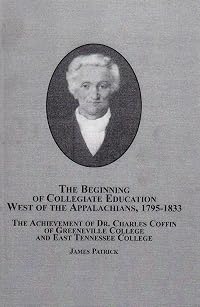
The beginning of collegiate education west of the Appalachians, 1795-1833 : the achievement of Dr. Charles Coffin of Gre
by James Patrick
On This Page
Description
In the transitional period between 18th century Enlightenment rationalism and 19th century romanticism, Charles Coffin set out in hopes of transplanting his native New England culture to the southwestern frontier, laboring to establish a Harvard-like college in Greeneville, East Tennessee. The educational theory of his institution assumed that the purpose of collegiate learning was to foster a class of gentlemen who would lead their communities by practicing their professions and occupying show more positions of political influence. Charting Coffin's successes and trials, this study illustrates the life of a man who sought to establish Atlantic seaboard culture and a classical collegiate curriculum in the American frontier. show lessTags
Member Reviews
James Patrick, founder and Chancellor of The College of Saint Thomas More in Forth Worth, Texas, provides a thorough exploration of Charles Coffin’s career at Greeneville College and later at East Tennessee College, and his attempts to institutionalize Harvard’s vaulted curriculum at the frontier. Patrick explores Coffin’s surviving papers in depth, detailing his move from New England to Tennessee, and highlighting the deep connections between his religious calling and his educational mission. Patrick’s research effectively highlights the tensions between the religious pluralism of the times and Coffin’s classical curriculum heavily inspired by the historical alliance between Christianity and education. The book provides an show more insightful academic history of east Tennessee as well as a useful and detailed glimpse into the founding of higher education in the area. Journals, letters and manuscripts form the bulk of the references for Patrick’s work, and provide an intimate look at Coffin’s mission to bring both education and Christianity into the wilderness that characterized the area. The information distilled from Coffin’s letters makes the efforts of this nearly forgotten preacher, teacher, and college president all the more accessible for the personal nature of the record Patrick explores, and as a contribution to the field, Patrick’s work is a wonderfully detailed exploration of the intellectual and political issues of the frontier as experienced by one of the founders of higher education in the area. As a work on the patterns of collegiate learning and the history of education, this book stands as an excellent precursor to E.E. Slosson’s 1910 work, Great American Universities, and the personal insight from journals and letters of the challenges Coffin faced to promote Christian classicism and its academic rigor before education became secularized give the researcher a solid grounding in the challenges educators faced in the early 19th century. The chronological organization of the book makes it easy to follow, Patrick’s endnotes are extensive, and his lengthy bibliography is organized by topic, which the researcher will find extremely useful. An excellent chronicle of the early intellectual history of Tennessee, this book would be a welcome addition to university, historical society, and state libraries alike.
Colleen S. Harris, Assistant Professor, Reference & Instruction Librarian, University of Tennessee at Chattanooga. show less
Colleen S. Harris, Assistant Professor, Reference & Instruction Librarian, University of Tennessee at Chattanooga. show less
Members
- Recently Added By
Author Information
7 Works 61 Members
Classifications
Statistics
- Members
- 2
- Popularity
- 6,014,175
- Reviews
- 1
- Rating
- (3.00)
- Languages
- English
- Media
- Paper
- ISBNs
- 1