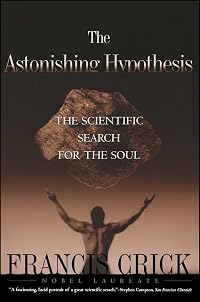
Astonishing Hypothesis: The Scientific Search for the Soul
by Francis Crick
On This Page
Description
Forty years ago, Francis Crick, along with James Watson, made history with the discovery of the structure of DNA, forever changing our understanding of life itself. Now Crick is once again at the frontier of scientific discovery, turning his attention to the mysteries of human consciousness. Bent on deciphering the complexities of the brain, Crick maps out the neurobiology of vision. The result is a cogent, witty, and richly detailed analysis of how the brain "sees," and a daring exploration show more of some of the most fundamental questions of human existence: Do we have free will? What exactly is it that makes us sentient beings and different from other animals? Is there such a thing as a soul, or are we nothing more than an immensely complex collection of neurons? In this groundbreaking, provocative work, Francis Crick challenges the very foundations of current scientific, philosophical, and religious thought. show lessTags
Recommendations


Member Recommendations
Member Reviews
The bulk of the book is spent on describing how the brain, step by step, processes the information that the retina provides into the 3-dimensional 'motion picture' we observe, and which parts of the brain are involved and what they do.
He stresses several times that patients are not aware about several types of damage. And that blind sight exists.
Only at the very end the author carefully speculates on the relation between what he described, and consciousness/the soul.
I think the title of the book should have been: A Technical Explanation of Vision, with maybe a subtitle And Some Speculations about Consciousness. That would have been way more honest, though he would have sold far less copies...
He stresses several times that patients are not aware about several types of damage. And that blind sight exists.
Only at the very end the author carefully speculates on the relation between what he described, and consciousness/the soul.
I think the title of the book should have been: A Technical Explanation of Vision, with maybe a subtitle And Some Speculations about Consciousness. That would have been way more honest, though he would have sold far less copies...
Francis Crick (who discovered the structure of DNA with James Watson) presents the evidence for "The Astonishing Hypothesis" that the human mind and soul are no more than emergent properties of the human brain.
The evidence is well presented and it is an interesting read. Whether you conclude that the hypothesis is "astonishing", "obvious" or "wrong" will probably depend on your preconceptions.
The evidence is well presented and it is an interesting read. Whether you conclude that the hypothesis is "astonishing", "obvious" or "wrong" will probably depend on your preconceptions.
Not all that astonishing - I really expected more.
Really interesting. Pretty scientific & technical.
Very good condition. Slight wear on edges of cover.
Crick es de los científicos más eclécticos de los últimos tiempos. Hicieron bien en UK al nombrar al principal edificio de investigación con su nombre. Luego del Nobel, ya libre de las presiones por "hacer algo", Crick, que es de los pocos científicos que hizo descubrimientos pasada la tercera década, dedica su intelecto a estudiar su intelecto. ¿Cómo puede un cerebro estudiarse a si mismo? Este es el relato del libro. Apasionante.
Nov 1, 2016Spanish
Members
- Recently Added By
Author Information

19+ Works 1,242 Members
Common Knowledge
- Canonical title*
- Was die Seele wirklich ist. Die naturwissenschaftliche Erforschung des Bewußtseins
- Original title
- The Astonishing Hypothesis. The Scientific Search for the Soul
- Original publication date
- 1994
- Dedication*
- Für Christof Koch, ohne dessen Energie und Enthusiasmus diese Buch nie geschrieben worden wäre
- First words*
- Dieses Buch handelt vom Geheimnis des Bewußtseins - wie Bewußtsein sich wissenschaftlich erklären läßt.
- Original language*
- Amerikanisch
*Some information comes from Common Knowledge in other languages. Click "Edit" for more information.
Classifications
- Genres
- Science & Nature, Nonfiction, Anthropology, General Nonfiction, Philosophy, Religion & Spirituality
- DDC/MDS
- 153 — Philosophy & psychology Psychology Conscious mental processes and intelligence
- LCC
- BF311 .C745 — Philosophy, Psychology and Religion Psychology Psychology Consciousness. Cognition
- BISAC
Statistics
- Members
- 668
- Popularity
- 43,298
- Reviews
- 7
- Rating
- (3.42)
- Languages
- 9 — Chinese, Czech, English, French, German, Italian, Polish, Spanish, Turkish
- Media
- Paper
- ISBNs
- 17
- ASINs
- 2