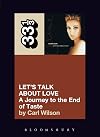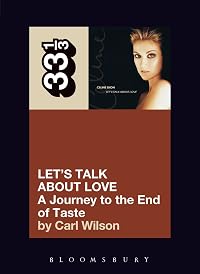
Celine Dion's Let's Talk About Love: A Journey to the End of Taste (33 1/3)
by Carl Wilson
33 1/3 (52)
On This Page
Description
"Non-fans regard Dion as ersatz and plastic, yet to those who love her, no one could be more real, with her impoverished childhood, her (creepy) manager-husband's struggle with cancer, her knack for howling out raw emotion. There's nothing cool about Dion, and nothing clever. That's part of her appeal as an object of love or hatred - with most critics and committed music fans taking pleasure (or at least geeky solace) in their lofty contempt. This book documents Carl Wilson's brave and show more unprecedented year-long quest to find his inner Dion fan, and explores how we define ourselves in the light of what we call good and bad, what we love and what we hate."--Bloomsbury Publishing. show lessTags
Recommendations
















Member Reviews
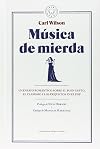
Celine Dion es una excusa para desentrañar el enigma del gusto. ¿Por qué es más aceptable preferir a Led Zeppelin que a Christina Aguilera? ¿Se puede decir que una cosa es impepinable mejor que la otra? El libro es un viaje personal de alguien que empieza como hater de Celine y que acaba aceptando su existencia e incluso admirándola un poco.
Sin querer spoilear las conclusiones del experimento, las razones de las distinciones en gustos son principalmente sociales: nos gusta
El último capítulo es un resumen increíble de las tesis del libro: igual no se trata de convencer a la gente de qué es mejor y qué es peor, si no de entender qué puede atraer a ciertos sectores de ciertos artistas. Que no se puede convertir la estética en predicción: esto es bueno porque dentro de treinta años va a seguir siendo relevante. Qué sabes tú lo que va a pasar en treinta años. Imbécil.
Y que el trabajo de los críticos no es, por lo tanto hacer propaganda de su apreciación estética personal, que para eso ya están los likes y dislikes del YouTube. Se trata de contextualizar, de evaluar expectativas, de comprender en qué marco se aprecia mejor el objeto de crítica (me encanta que defina el indie rock como "música cuyo propósito es ser juzgada estéticamente"). Básicamente ser menos reservados y abrirnos a nuevas experiencias: abandonar la vergüenza. Como Celine.
In this, the best 33 1/3 book that I've read, Wilson explores his own dislike for Dion and what she means for the Quebecois, the aesthetics of her music and the background that lead to his own tastes.
Not only the best book of the 33 1/3 series, but, in my opinion, the best book of musical criticism ever written, which is high praise, indeed.
Let's Talk About Love, as an album, is only ostensibly the subject of this excellent long essay about the exclusive nature of musical taste, and the fact that unlike with nearly every other form of criticism, musical communities and their insularity are defined more by the music they dislike than by the music they do.
And this leads to a discussion of what exactly it is about Dion's music that sets so many teeth on edge, as well as why it so appeals to an opposite group of people.
It is just a really fantastic book that I had to put down to process every so often, and still, often, when I am show more contemplating or writing about my reaction to art, the internalized voice of Wilson suggests that I make sure my reactions are considered carefully.
Not at all what I expected, but better than I ever could have hoped. show less
Let's Talk About Love, as an album, is only ostensibly the subject of this excellent long essay about the exclusive nature of musical taste, and the fact that unlike with nearly every other form of criticism, musical communities and their insularity are defined more by the music they dislike than by the music they do.
And this leads to a discussion of what exactly it is about Dion's music that sets so many teeth on edge, as well as why it so appeals to an opposite group of people.
It is just a really fantastic book that I had to put down to process every so often, and still, often, when I am show more contemplating or writing about my reaction to art, the internalized voice of Wilson suggests that I make sure my reactions are considered carefully.
Not at all what I expected, but better than I ever could have hoped. show less
There are some readers who've noted that "Let's Talk About Love" may mean most to readers younger than twenty-five, a category which includes that many that still identify strongly with their cultural tastes. Even if you accept the premise that these identity-building associations fade as we grow older, the book can still be considered a minor act of bravery: Wilson is, after all, a professional critic, and there aren't too many of us who are willing to move as far out of our comfort zones as Wilson has here at any stage of our life. The sheer earnestness and dedication that Wilson shows in trying to understand an album he's obviously predisposed to loathe is itself commendable. It's also pretty brave that he decided to include both a show more strong counter-argument to his ideas that appeared in the magazine n+1 and an essay by his ex-wife. The author is obviously a guy who's comfortable listening to an opposing viewpoint.
As for the book, it works on a multitude of levels: some may criticize parts of it as "Bourdieu for Dummies," but for people that weren't lucky enough to meet him in grad school, that's still a pretty useful thing. The reader also gets an interesting cultural history of Quebec and an explanation of how the Quebecois see themselves: as white subalterns and as an an embattled and often disrespected minority only now coming into their own. "Let's Talk About Love" will doubtless change a lot of people's views of Celine Dion: the author asks, head on, whether the values espoused by the sorts of omnivorous, hyper-literate music nerds who constitute the audience for most of the 33 1/3 series are really the best yardstick with which to judge music. And that's valuable, perhaps especially to those aforementioned younger readers. Most of all, though, the book both argues for and carries out a kind of emotional inventory of one person's relationship with their feelings as mediated by the music they listen to, a musical autobiography of sorts. And that's where it often seems especially brave and valuable. Wilson takes his essays to places where most music criticisms -- and, heck, many good novels -- don't have the guts to go. And that's what makes it particularly special.
The expanded version of the book also has a few good things to offer. We get a good essay by well-known critic Ann Powers about her mother's influence on her criticism and, for Nirvana completists, a clear-eyed essay on politics and music by Krist Novoselic. There are also two essays here -- Daphne A. Brooks's "Let's Talk About Diana Ross" and "Deep in the Game" by Drew Daniel, who's half of Matmos -- that look at the uses and limits of musical kitsch that manage to say something interesting and perhaps even inspiring even though they're written in a dense, knotty academic tone I mostly associate with hair-splitting and navel-gazing. And that, in itself, is sort of a miracle. And there's a lovely, appropriately sentimental reflection by Canadian techno dude Owen Pallett. Recommended to Celine fans and non-fans alike, though perhaps especially to the latter. show less
As for the book, it works on a multitude of levels: some may criticize parts of it as "Bourdieu for Dummies," but for people that weren't lucky enough to meet him in grad school, that's still a pretty useful thing. The reader also gets an interesting cultural history of Quebec and an explanation of how the Quebecois see themselves: as white subalterns and as an an embattled and often disrespected minority only now coming into their own. "Let's Talk About Love" will doubtless change a lot of people's views of Celine Dion: the author asks, head on, whether the values espoused by the sorts of omnivorous, hyper-literate music nerds who constitute the audience for most of the 33 1/3 series are really the best yardstick with which to judge music. And that's valuable, perhaps especially to those aforementioned younger readers. Most of all, though, the book both argues for and carries out a kind of emotional inventory of one person's relationship with their feelings as mediated by the music they listen to, a musical autobiography of sorts. And that's where it often seems especially brave and valuable. Wilson takes his essays to places where most music criticisms -- and, heck, many good novels -- don't have the guts to go. And that's what makes it particularly special.
The expanded version of the book also has a few good things to offer. We get a good essay by well-known critic Ann Powers about her mother's influence on her criticism and, for Nirvana completists, a clear-eyed essay on politics and music by Krist Novoselic. There are also two essays here -- Daphne A. Brooks's "Let's Talk About Diana Ross" and "Deep in the Game" by Drew Daniel, who's half of Matmos -- that look at the uses and limits of musical kitsch that manage to say something interesting and perhaps even inspiring even though they're written in a dense, knotty academic tone I mostly associate with hair-splitting and navel-gazing. And that, in itself, is sort of a miracle. And there's a lovely, appropriately sentimental reflection by Canadian techno dude Owen Pallett. Recommended to Celine fans and non-fans alike, though perhaps especially to the latter. show less
This is a gem of a book. Nominally about Celine Dion, it is really more about managing one's inner troll and emancipating the "better angels of our nature". Taste, according to Wilson, is as much about who we wish to be associated with and whom we wish to distance ourselves from, as it is about what we actually like. The critique of Dion's Let's Talk About Love is only one chapter, and Wilson's better angels are very much evident in this portion of the book. Utimately he chooses the wonderful Book of Love lyrics as a fitting coda wrapping up his discussion of her album: "It is long and boring, and written very long ago. It's full of flowers and heart-shaped boxes, and things we're all too young to know."
Carl Wilson writes an honest and courageous book about his own musical tastes and about what our sense of taste means in general. He goes into his own mind in ways most of us would hesitate to examine. The book is nominally about the music of Céline Dion, but it covers a vast array of topics. It is much more than a book about music.
Let's Talk About Love: A Journey to the End of Taste, is memoir, music criticism, philosophy, anthropology, and more. Wilson investigates how our personal history, our thoughts, and emotions, our place in society all help explain what we like and what we don't.
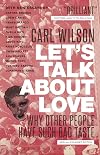
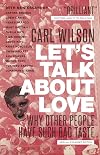
The book's been reissued with a new subtitle as, Let's Talk About Love: Why other People Have Such Bad Taste, and with a Part II that includes some show more dozen essays by others. I intend to read that version too, but this review is about the earlier version.
I began the book with no special like or dislike for Dion, and ended without any new opinions about her. She is really not the point of the book though, only a well-examined example. Maybe more well examined than necessary.
What Wilson's book does for me is help in finding ways to process through some of the opinions I might have about a movie, a book, a poem, even a philosopher or a politician, and realize the complex ways I came to those opinions.
It helps me see even more that if my life experiences had been different I might like and dislike different things.
That might be the most important point of the book. show less
Let's Talk About Love: A Journey to the End of Taste, is memoir, music criticism, philosophy, anthropology, and more. Wilson investigates how our personal history, our thoughts, and emotions, our place in society all help explain what we like and what we don't.
The book's been reissued with a new subtitle as, Let's Talk About Love: Why other People Have Such Bad Taste, and with a Part II that includes some show more dozen essays by others. I intend to read that version too, but this review is about the earlier version.
I began the book with no special like or dislike for Dion, and ended without any new opinions about her. She is really not the point of the book though, only a well-examined example. Maybe more well examined than necessary.
What Wilson's book does for me is help in finding ways to process through some of the opinions I might have about a movie, a book, a poem, even a philosopher or a politician, and realize the complex ways I came to those opinions.
It helps me see even more that if my life experiences had been different I might like and dislike different things.
That might be the most important point of the book. show less
Five stars for the original book: it is a thoughtful and empathetic rumination on the nature of taste, a topic that I find enormously interesting. Reading it actually convinced me to listen to a Celine Dion album, something i really hadn't expected to happen. Three stars for the supplementary essays. The best of them walk the same line of criticism and autobiography that Wilson walks, including Daphne Brooks's wonderful essay on Diana Ross. But then there are also essays that seem like the very essence of filler, the worst of which is by James Franco, which alternates between grad school name-dropping and self-aggrandizement. The essays don't diminish the original text, but the original text also doesn't need any supplemental material: show more it's strong enough to stand on its own. show less
Members
- Recently Added By
Lists

Books Read By artturnerjr - 2014
34 works; 1 member

The Hermenautic Bookshelf
111 works; 7 members
Author Information

Series

Work Relationships
Is a study of
Common Knowledge
- Original title
- Let's Talk About Love: A Journey to the End of Taste
- Alternate titles
- Céline Dion's Let's Talk About Love: A Journey to the End of Taste
- Original publication date
- 2007
- People/Characters
- Céline Dion
- Dedication
- And this book is for Sheila Heti, with what else but love.
- First words
- "Hell is other people's music," wrote the cult musician Momus in a 2006 column for Wired magazine.
- Last words
- (Click to show. Warning: May contain spoilers.)And that gives me the heart to go on.
- Original language
- English US
Classifications
- Genres
- Music, Nonfiction, General Nonfiction, History, Philosophy
- DDC/MDS
- 782.42164092 — Arts & recreation Music Vocal music Secular forms of vocal music Songs General principles and musical forms Traditions of secular songs {genres} Western popular songs
- LCC
- ML420 .D565 .W55 — Music Literature on music Literature on music History and criticism Biography
- BISAC
Statistics
- Members
- 445
- Popularity
- 68,990
- Reviews
- 25
- Rating
- (4.21)
- Languages
- English, Spanish
- Media
- Paper, Audiobook, Ebook
- ISBNs
- 8
- ASINs
- 5