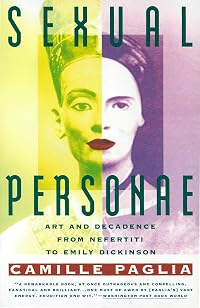
Sexual Personae: Art and Decadence from Nefertiti to Emily Dickinson
by Camille Paglia
On This Page
Description
In this brilliantly original book, Camille Paglia identifies some of the major patterns that have endured in western culture from ancient Egypt and Greece to the present. According to Paglia, one source of continuity is paganism, which, undefeated by Judeo-Christianity, continues to flourish in art, eroticism, astrology, and pop culture. Others, she says, are androgyny, sadism, and the aggressive western eye, which has created our art and cinema. Paglia follows these and other themes from show more Nefertiti and the Venus of Willendorf to Apollo and Dionysus, from Botticelli and Michaelangelo to Shakespeare and Blake and finally to Emily Dickinson, who, along with other major nineteenth-century authors, becomes a remarkable example of Romanticism turned into Decadence. Paglia offers provocative views of literature, art history, psychology, and religion. She focuses, for example, on the amorality, voyeurism, and pornography in great art that have been ignored or glossed over by most critics. She discusses sex and nature as brutal daemonic forces, and she criticizes feminists for sentimentality or wishful thinking about the causes of rape, violence, and poor relations between the sexes. She stressed the biologic basis of sex differences and sees the mother as an overwhelming force who condemns men to lifelong sexual anxiety, from which they escape through rationalism and physical achievement. She examines the culture and style of modern male homosexuals. She demonstrates how much of western life, art, and thought is ruled by personality, which she traces through recurrent types or personae such as the female vampire (Medusa, Lauren Bacall); the pythoness (the Dephic oracle, Gracie Allen); the beautiful boy (Hadrian's Antinous, Dorian Gray); the epicene man of beauty (Lord Byron, Elvis Presley); and the male heroine (Baudelaire, Woody Allen). Her book will stimulate and awe readers everywhere. show lessTags
Recommendations





Member Reviews
I recently reread this book, and found it even more enjoyable than I had remembered. Obviously Paglia's project--a unifiied theory of Western culture--is bound to fall short, but it's impossible for me not to admire her ambition. She writes with an energetic style; at times she might be guilty of piling on too many metaphors and similes, but it's almost as though, in her exuberance, she can't help herself. In many respects she must certainly be regarded as well ahead of her time (the dissertation on which this book is based was submitted in 1974): she predicted, through the study of what she calls the "androgyne" in culture, many subsequent developments in gender and women's studies, ironic as I believe her to be almost universally show more reviled in those circles.
At over 600 pages, hammering away at the same theme, it might be a bit long, and the last chapters on American literature are perhaps among the least engaging, though it may be that I just became ground down after several hundred pages, or that her subjects chosen from American literature are simply the least suited to her thesis (a possibility she herself acknowledges in comparing American culture to European). When, therefore, she finally arrives at Emily Dickinson, the subject which the title suggests will be the culmination, if not the actual climax, of the entire book, it's almost impossible not to be disappointed because you want so much for it to be more than it is.
All that said, the book is surely a classic, and an engrossing read whether you agree or disagree with her argument. show less
At over 600 pages, hammering away at the same theme, it might be a bit long, and the last chapters on American literature are perhaps among the least engaging, though it may be that I just became ground down after several hundred pages, or that her subjects chosen from American literature are simply the least suited to her thesis (a possibility she herself acknowledges in comparing American culture to European). When, therefore, she finally arrives at Emily Dickinson, the subject which the title suggests will be the culmination, if not the actual climax, of the entire book, it's almost impossible not to be disappointed because you want so much for it to be more than it is.
All that said, the book is surely a classic, and an engrossing read whether you agree or disagree with her argument. show less
This book is one of my all-time favorites and my favorite of Paglia's. I prefer Paglia the "academic" as opposed to the "media whore" (i.e. as she has expressed herself in her column for Salon.com) as I am at least 50% in disagreement with her political / geopolitical and often right-leaning Libertarian point of view. In "Sexual Personae" she presents herself in full-on scholarly mode, in a way that she has not, unfortunately, repeated since this work was published. I have read this book at least twice; it is rare for me as a reader to return to any text I've read previously. The essence of the work can be summarized via the blurb that appears on the back cover of the paperback edition of "Sexual Personae": "..... [makes] a persuasive show more case for all art as a pagan battleground between male and female, form and chaos, civilization and daemonic nature" ("daemonic" being a term that appears frequently in this book). Also memorable are Paglia's theory of the artist's metaphysical "sex change" via his / her work of art (a là Coleridge's lesbian vampire / daemon) and the chapter covering Edmund Spenser's "The Fairie Queene", a product of the English Renaissance that I had been unaware of until my discovery of "Sexual Personae" and which I have still not read. "Sexual Personae" also aided me in refining my understanding of the terms "Apollonian" and "Dionysian", in a way that no other writer has besides Nietzsche.
Most importantly, it's Paglia's actual writing that draws me in. Whether or not what she is writing can be substantiated academically, that does not concern me. I inherently believe that Paglia knows what she's talking about. Thus I will close with this quote from page 55 of Chapter 2 ("The Birth of the Western Eye") concerning the statuette "Venus of Willendorf" [circa 30,000 B.C.]:
"Venus of Willendorf carries her cave with her. She is blind, masked. Her ropes of corn-row hair look forward to the invention of agriculture. She has a furrowed brow. Her facelessness is the impersonality of primitive sex and religion. There is no psychology or identity yet, because there is no society, no cohesion. Men cower and scatter at the blast of the elements. Venus of Willendorf is eyeless because nature can be seen but not known. She is remote even as she kills and creates. The statuette, so overflowing and protuberant, is ritually invisible. She stifles the eye. She is the cloud of archaic night." show less
Most importantly, it's Paglia's actual writing that draws me in. Whether or not what she is writing can be substantiated academically, that does not concern me. I inherently believe that Paglia knows what she's talking about. Thus I will close with this quote from page 55 of Chapter 2 ("The Birth of the Western Eye") concerning the statuette "Venus of Willendorf" [circa 30,000 B.C.]:
"Venus of Willendorf carries her cave with her. She is blind, masked. Her ropes of corn-row hair look forward to the invention of agriculture. She has a furrowed brow. Her facelessness is the impersonality of primitive sex and religion. There is no psychology or identity yet, because there is no society, no cohesion. Men cower and scatter at the blast of the elements. Venus of Willendorf is eyeless because nature can be seen but not known. She is remote even as she kills and creates. The statuette, so overflowing and protuberant, is ritually invisible. She stifles the eye. She is the cloud of archaic night." show less
When this book appeared in the early 90s it was at the same time an anachronism, and a highly modern masterpiece. An anachronism because few writers –then and now- combine a wide sweeping view of whole swathes of cultural history with startlingly observant close readings of particular works; and modern because its whole argument and method was rooted in the here and now, with its references to pop culture and attacks against the literal minded, the ignorant and the resenters. Paglia sees Western art and literary history as an agon between the Apollonian and the Dionysian, building on Nietzsche. This idea is tremendously fruitful, and she traces it through its various forms with verve, wit and great style. The chapter on The Picture of show more Dorian Gray is worth the price of admission alone. Paglia simply ‘gets’ Wilde like no one else, in my view. This is criticism in the grand style, criticism as art, historiography as literature. Paglia is the 20th century equivalent of a Burckhardt or a Renan. A work of genius, provocative and beautiful. show less
It's extremely rare that an author comes up with a radical reinterpretation of the history of western arts that is approachable for both academic and general audiences. I was only ten when this book came out, so I can't speak to what kinds of waves it caused at the time, but I'd suspect they were large. (A handful of feminist academics I know still insist on hating her, though I think her threat to feminism has mainly fizzled out or been replaced by other, more insidious and influential cultural threats.)
Whether or not you agree with Paglia (I don't, for the most part), reading this massive work is an interesting experience that really forces you to rethink the form and meaning of art and literature. She performs some entirely show more ridiculous readings of cultural artifacts, but she also compellingly catalogues an epic battle of (and within) the sexes that has played out over the past 5,000 years of western civilization. show less
Whether or not you agree with Paglia (I don't, for the most part), reading this massive work is an interesting experience that really forces you to rethink the form and meaning of art and literature. She performs some entirely show more ridiculous readings of cultural artifacts, but she also compellingly catalogues an epic battle of (and within) the sexes that has played out over the past 5,000 years of western civilization. show less
Camille Paglia’s monumental, mesmerizing Sexual Personae is one of the great unsung works of the 20th century. Paglia proposes a broad yet plausible thesis: i.e. that the great unresolved tension between cool, incisive Apollonian artistry and earthy, brutal Dionysian chaos is the engine that has driven western art and literature to its heights.
And she illustrates and defends this thesis with power, energy and real insight, tracing out its genesis and developments from Egypt and Greece to 19th-century British and American poetry. Her insights into the Greeks, Spenser, and Blake are noteworthy, but the deepest and most original analysis here is Paglia’s exposure and refutation of the line of liberal/leftist fantasizing about the true show more nature of humanity that runs from Rousseau through the 19th-century Romantics such as Wordsworth and Emerson and on into 20th-century feminism and socialism. Attempts to ‘liberate’ humanity from the strictures of civilized society leads not to peace and freedom, but to tyranny and sadism. As Paglia herself puts it in what may be the most striking line in a book suffused with memorable one-liners:
Every road from Rousseau leads to Sade.
Paglia backs up her assertion with remarkable studies of Sade himself and, in the book’s ultimate chapter, Emily Dickinson.
One caution here to the casual reader: reading this book may revolutionize the way you look at arts and literature. It’s that good. But it is not an ‘easy’ book. Paglia’s style is singular; she makes more clear, assertive statements in a single page than you’ll see in whole volumes of pathetic postmodernist criticism. But it’s also a dense, heavily allusive style that demands close attention. At nearly 700 closely-printed pages, Sexual Personae is a project. But the time invested in reading it pays off in so many ways that I recommend it without reservation. show less
And she illustrates and defends this thesis with power, energy and real insight, tracing out its genesis and developments from Egypt and Greece to 19th-century British and American poetry. Her insights into the Greeks, Spenser, and Blake are noteworthy, but the deepest and most original analysis here is Paglia’s exposure and refutation of the line of liberal/leftist fantasizing about the true show more nature of humanity that runs from Rousseau through the 19th-century Romantics such as Wordsworth and Emerson and on into 20th-century feminism and socialism. Attempts to ‘liberate’ humanity from the strictures of civilized society leads not to peace and freedom, but to tyranny and sadism. As Paglia herself puts it in what may be the most striking line in a book suffused with memorable one-liners:
Every road from Rousseau leads to Sade.
Paglia backs up her assertion with remarkable studies of Sade himself and, in the book’s ultimate chapter, Emily Dickinson.
One caution here to the casual reader: reading this book may revolutionize the way you look at arts and literature. It’s that good. But it is not an ‘easy’ book. Paglia’s style is singular; she makes more clear, assertive statements in a single page than you’ll see in whole volumes of pathetic postmodernist criticism. But it’s also a dense, heavily allusive style that demands close attention. At nearly 700 closely-printed pages, Sexual Personae is a project. But the time invested in reading it pays off in so many ways that I recommend it without reservation. show less
The subtitle? "Art and decadence from Nefertiti to Emily Dickenson." (The cover strikingly puts that across visually with a bust half-Nefertiti/half-Dickenson.) In the Preface Paglia says her book "seeks to demonstrate the unity and continuity of western culture." She also revealingly says: "My largest ambition is to fuse Frazer and Freud." I think she succeeds in that fusion, but I can't say that impressed me much, given I'm very skeptical about both thinkers. Freud was famous for his theory of the "family romance," which posited sexuality and aggression in the family formed the psyche. Less well-known to the general public is Frazer, a seminal 19th century cultural anthropologist. His The Golden Bough is on the connections between show more mythology, folklore, and religion and their origins in trying to control nature; he's a direct ancestor to Joseph Campbell.
Paglia's arguments are a bit scatter-shot, and repetitive. By the time I was half-way through the book, I felt Paglia was pounding spikes into my brain with every mention of: androgene, Appolonian, chthonian, daemonic, hermaphrodite, and especially "beautiful boy." Nevertheless she was also audacious and dazzling in the connections she made and her prose often beautiful and quotable. She mixed classical allusions with pop references from Garbo to Elvis to Madonna. In upholding her ideas of "the terrible duality of gender" and the fecundity of homosexuality in culture, she is sure to outrage liberal and conservative alike. At times she seemed to apotheosize misogyny as the driving creative force in Western culture, as in her insistence of the importance of Sade as great literature and her statement that: "There is no female Mozart because there is no female Jack the Ripper." Truly, I far prefer Virginia Woolf's take on that question in "A Room of Her Own." I admit that if Paglia were male, I doubt I'd be giving her so much slack for that. At one point she even called female genitalia, "grotesque."
The New York Times Review called her "as intellectually stimulating as she is exasperating" and I think that sums her up well. But for a bibliophile and art lover (the book is richly illustrated) there's much to engage your thinking. The writers examined highlighted in the contents page include: Spenser, Shakespeare, Rousseau, Sade, Goethe, Blake, Wordsworth, Coleridge, Byron, Shelley, Keats, Balzac, Gautier, Baudelaire, Huysmans, Emily Bronte, Swinburne, Wilde, Poe, Hawthorne, Melville, Emerson, Whitman, Henry James, Dickenson. Paglia left me with lots of food for thought and new ways to look at works I thought I knew from Shakespeare's Titus Andronicus to Coleridge's Christobel. Worth reading, and even re-reading, which is why for all that I was skeptical of so many of her conclusions, I rated this as high as I did. show less
Paglia's arguments are a bit scatter-shot, and repetitive. By the time I was half-way through the book, I felt Paglia was pounding spikes into my brain with every mention of: androgene, Appolonian, chthonian, daemonic, hermaphrodite, and especially "beautiful boy." Nevertheless she was also audacious and dazzling in the connections she made and her prose often beautiful and quotable. She mixed classical allusions with pop references from Garbo to Elvis to Madonna. In upholding her ideas of "the terrible duality of gender" and the fecundity of homosexuality in culture, she is sure to outrage liberal and conservative alike. At times she seemed to apotheosize misogyny as the driving creative force in Western culture, as in her insistence of the importance of Sade as great literature and her statement that: "There is no female Mozart because there is no female Jack the Ripper." Truly, I far prefer Virginia Woolf's take on that question in "A Room of Her Own." I admit that if Paglia were male, I doubt I'd be giving her so much slack for that. At one point she even called female genitalia, "grotesque."
The New York Times Review called her "as intellectually stimulating as she is exasperating" and I think that sums her up well. But for a bibliophile and art lover (the book is richly illustrated) there's much to engage your thinking. The writers examined highlighted in the contents page include: Spenser, Shakespeare, Rousseau, Sade, Goethe, Blake, Wordsworth, Coleridge, Byron, Shelley, Keats, Balzac, Gautier, Baudelaire, Huysmans, Emily Bronte, Swinburne, Wilde, Poe, Hawthorne, Melville, Emerson, Whitman, Henry James, Dickenson. Paglia left me with lots of food for thought and new ways to look at works I thought I knew from Shakespeare's Titus Andronicus to Coleridge's Christobel. Worth reading, and even re-reading, which is why for all that I was skeptical of so many of her conclusions, I rated this as high as I did. show less
Paglia looks back at the Nietzsche view of a world dichotomy of Apollonian and Dionysian halves to enlarge the Dionysian part to admit a feminine side; mysterious, murky, and moist. This feels like a valid advancement on Nietzsche and even makes old Friedrich seem sexist or at least narrow-minded in retrospect. This also sexualizes Paglia's arguments to extremes that I can't always follow, such as "The beautiful boy is homosexuality’s greatest contribution to western culture" and other sweeping generalizations. While this work came out in 199o it seems rooted in the 18th Century of English literature: Oscar Wilde, Coleridge, Emily Dickinson, etc. While Paglia is obvious aware of popular culture: she mentions The Rolling Stones a few show more times. This includes with her excitement and extreme adjectives:
However, stuck a century ago she misses opportunities to explain girlish hair bands and Mad Max reflecting society's mass fascination with homosexuality. show less
Rock music is normally a darkly daemonic mode. The Rolling Stones, the greatest rock band, are heirs of stormy Coleridge.
However, stuck a century ago she misses opportunities to explain girlish hair bands and Mad Max reflecting society's mass fascination with homosexuality. show less
Members
- Recently Added By
Lists

David Bowie's List of Top 100 Books
94 works; 6 members

David Bowie's Top 100
97 works; 23 members
David Bowie’s Top 100 Favourite Reads
100 works; 3 members
Author Information

18+ Works 5,566 Members
Camille Paglia is University Professor of Humanities and Media Studies at the University of the Arts in Philadelphia.
Some Editions
Awards and Honors
Work Relationships
Has as a commentary on the text
Common Knowledge
- Original title
- Sexual Personae: Art and Decadence from Nefertiti to Emily Dickinson
- Original publication date
- 1990
- Original language
- English
Classifications
- Genres
- Literature Studies and Criticism, Nonfiction, Art & Design, Philosophy
- DDC/MDS
- 809.03 — Literature & rhetoric Literature, rhetoric & criticism History, description, critical appraisal of more than two literatures By Period Modern period, 1500-
- LCC
- PN751 .P34 — Language and Literature Literature (General) Literature (General) Literary history By period Modern
- BISAC
Statistics
- Members
- 2,255
- Popularity
- 8,894
- Reviews
- 21
- Rating
- (3.82)
- Languages
- 7 — Dutch, English, German, Italian, Portuguese, Spanish, Turkish
- Media
- Paper, Audiobook, Ebook
- ISBNs
- 22
- UPCs
- 1
- ASINs
- 14