On This Page
Description
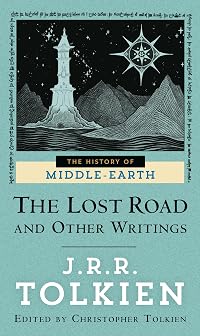
At the end of the 1937 J.R.R. Tolkien reluctantly set aside his now greatly elaborated work on the myths and heroic legends of Valinor and Middle-earth and began The Lord of the Rings. This fifth volume of The History of Middle-earth, edited by Christopher Tolkien, completes the presentation of the whole compass of his writing on those themes up to that time. Later forms of the Annuals of Valinor and the Annals of Berleriand had been composed, The Silmarillion was nearing completion in a show more greatly amplified version, and a new map had been made; the myth of the Music of the Ainur had become a separate work; and the legend of the Downfall of Numenor had already entered in a primitive form, introducing the cardinal ideas of the World Made Round and the Straight Path into the vanished West. Closely associated with this was the abandoned time-travel story, The Lost Road, which was to link the world of Numenor and Middle-earth with the legends of many other times and peoples. A long essay, The Lhammas, had been written on the ever more complex relations of the languages and dialects of Middle-earth; and an etymological dictionary had been undertaken, in which a great number of words and names in the Elvish languages were registered and their formation explained - thus providing by far the most extensive account of their vocabularies that has appeared. show lessTags
Recommendations





Member Reviews
There is little in this volume to interest any but the most dedicated of Tolkien enthusiasts.
Part I, The Lost Road, presents draft fragments of an ambitious mythological fantasy, intended to span the centuries backwards from the Oxford of the 20th century, through unfolding layers of Germanic history and legend, to the fall of Atlantis, following pairs of father and son figures through the generations. (Kipling's Puck of Pook's Hill must surely have been an inspiration.) After two pairs of short chapters it peters out. The Atlantis story at its heart was eventually to emerge as the tale of Numenor in The Silmarillion. The attempt to frame this tale within a modern character's dreams (of an implausibly linguistic nature) resurfaced in show more The Notion Club Papers. The germs of some interesting ideas are here embedded in a narrative of stunning turgidity. Tolkien's tendency towards archaizing chronicle is here exacerbated by having much of the action recounted in stilted dialogue between the characters, who are transparently projections of aspects of Tolkien's own personality and obsessions. It might seem amazing that the author of this awkward, pale, post-pre-Raphaelite thee-and-thou prose managed to transform himself into a formidable writer of modern English, though it is hardly fair to judge a writer on the basis of some initial and ultimately abortive sketches. The section most worthy of note is a 150-line piece of alliterative verse called "King Sheave", marginal to the main text but evocative. Another, "The Nameless Land" or "The Song of Aelfwine", is complex in verse-structure, modelled on the medieval poem Pearl, but the content is low-grade "elfin" stuff.
Part II consists of draft sections of the Silmarillion which add little to the published text. Part III, The Etymologies, will excite only those who would read a dictionary of Sumerian for fun. MB 21-vi-2007 show less
Part I, The Lost Road, presents draft fragments of an ambitious mythological fantasy, intended to span the centuries backwards from the Oxford of the 20th century, through unfolding layers of Germanic history and legend, to the fall of Atlantis, following pairs of father and son figures through the generations. (Kipling's Puck of Pook's Hill must surely have been an inspiration.) After two pairs of short chapters it peters out. The Atlantis story at its heart was eventually to emerge as the tale of Numenor in The Silmarillion. The attempt to frame this tale within a modern character's dreams (of an implausibly linguistic nature) resurfaced in show more The Notion Club Papers. The germs of some interesting ideas are here embedded in a narrative of stunning turgidity. Tolkien's tendency towards archaizing chronicle is here exacerbated by having much of the action recounted in stilted dialogue between the characters, who are transparently projections of aspects of Tolkien's own personality and obsessions. It might seem amazing that the author of this awkward, pale, post-pre-Raphaelite thee-and-thou prose managed to transform himself into a formidable writer of modern English, though it is hardly fair to judge a writer on the basis of some initial and ultimately abortive sketches. The section most worthy of note is a 150-line piece of alliterative verse called "King Sheave", marginal to the main text but evocative. Another, "The Nameless Land" or "The Song of Aelfwine", is complex in verse-structure, modelled on the medieval poem Pearl, but the content is low-grade "elfin" stuff.
Part II consists of draft sections of the Silmarillion which add little to the published text. Part III, The Etymologies, will excite only those who would read a dictionary of Sumerian for fun. MB 21-vi-2007 show less
http://nwhyte.livejournal.com/1785921.html
Getting to the end of the books about how the Silmarillion was (and wasn't) written now, this volume includes several interesting insights into how Tolkien's works reached us. At the core is the rather slim pickings of The Lost Road, the time travel novel which Tolkien began at around the same time C.S. Lewis began his Ransome trilogy. Tolkien abandoned it, and it wasn't really going in the right direction; what we have here is too episodic to be coherent, and in particular, the framing narrative has a set of slightly odd father-son dynamics going on - Tolkien's own parents were absent, largely through being dead, and the same is true of most of his more successful characters (Bilbo's parents show more are never heard of, he in turn abandons Frodo in the first chapter of LotR, Húrin is a distant captive while his son and daughter fall in love with each other) though there are exceptions (mostly father-figures who are over-controlling - Théoden, Denethor, Thingol).
The importance of father-son dynamics extends also to the making of this book, and I was particularly interested in a passage on page 302 where Christopher Tolkien expresses his regrets that the Silmarillion as originally published was not better; he reflects on the role played by Guy Gavriel Kay in assembling the texts but in the end takes full responsibility for it himself. I was not surprised to read that the story he feels was worst served is the tale of Beren and Lúthien.
There's also a lot of meaty material on the languages - an essay called the Lhammas and a set of Elvish etymologies, which brought home to me that for Tolkien his invented structure was much more than just Quenya and Sindarin, it also included half a dozen other languages spoken by different branches of the Elves, barely mentioned in the stories. I have dabbled enough in philology to sense the uniqueness of this achievement - very few sf or fantasy writers come anywhere near Tolkien's level of detail in his invented names and words, and some (eg Robert Jordan) are so bad at it that it's painful.
Apart from that, we have the Fall of Númenor, and yet another rehash of the main text of the Silmarillion. I am looking forward to the next volume which is about the early versions of LotR. show less
Getting to the end of the books about how the Silmarillion was (and wasn't) written now, this volume includes several interesting insights into how Tolkien's works reached us. At the core is the rather slim pickings of The Lost Road, the time travel novel which Tolkien began at around the same time C.S. Lewis began his Ransome trilogy. Tolkien abandoned it, and it wasn't really going in the right direction; what we have here is too episodic to be coherent, and in particular, the framing narrative has a set of slightly odd father-son dynamics going on - Tolkien's own parents were absent, largely through being dead, and the same is true of most of his more successful characters (Bilbo's parents show more are never heard of, he in turn abandons Frodo in the first chapter of LotR, Húrin is a distant captive while his son and daughter fall in love with each other) though there are exceptions (mostly father-figures who are over-controlling - Théoden, Denethor, Thingol).
The importance of father-son dynamics extends also to the making of this book, and I was particularly interested in a passage on page 302 where Christopher Tolkien expresses his regrets that the Silmarillion as originally published was not better; he reflects on the role played by Guy Gavriel Kay in assembling the texts but in the end takes full responsibility for it himself. I was not surprised to read that the story he feels was worst served is the tale of Beren and Lúthien.
There's also a lot of meaty material on the languages - an essay called the Lhammas and a set of Elvish etymologies, which brought home to me that for Tolkien his invented structure was much more than just Quenya and Sindarin, it also included half a dozen other languages spoken by different branches of the Elves, barely mentioned in the stories. I have dabbled enough in philology to sense the uniqueness of this achievement - very few sf or fantasy writers come anywhere near Tolkien's level of detail in his invented names and words, and some (eg Robert Jordan) are so bad at it that it's painful.
Apart from that, we have the Fall of Númenor, and yet another rehash of the main text of the Silmarillion. I am looking forward to the next volume which is about the early versions of LotR. show less
Quinto volume de A História da Terra-média, série editada por Christopher Tolkien que oferece uma visão detalhada da genialidade e do processo criativo em evolução de J.R.R. Tolkien.
A Estrada Perdida é uma história fragmentada de viagem no tempo que nasce de uma aposta entre J.R.R. Tolkien e C.S. Lewis e aproxima a Terra-média à Inglaterra do século XX. Além da narrativa inacabada, este livro contém também, entre outros textos, uma versão posterior de Os Anais de Valinor e Os Anais de Beleriand, uma versão do Quenta Silmarillion, o Lhammas, uma espécie de ensaio sobre as completas línguas e dialetos da Terra-média, e uma genealogia das línguas élficas.
A Estrada Perdida é uma história fragmentada de viagem no tempo que nasce de uma aposta entre J.R.R. Tolkien e C.S. Lewis e aproxima a Terra-média à Inglaterra do século XX. Além da narrativa inacabada, este livro contém também, entre outros textos, uma versão posterior de Os Anais de Valinor e Os Anais de Beleriand, uma versão do Quenta Silmarillion, o Lhammas, uma espécie de ensaio sobre as completas línguas e dialetos da Terra-média, e uma genealogia das línguas élficas.
At one point, Lewis observed to Tolkien that since there weren't enough stories being writtten of the sort that they wanted to read, they'd have to write them themselves. Lewis committed to writing a book about space travel, Tolkien about time travel; Lewis' commitment developed into his Space Trilogy (/Out of the Silent Planet/, /Perelandra/, /That Hideous Strength/), while Tolkien's project -- to be titled /The Lost Road/ -- never managed to come together. This is the debris of that project: interesting reading, but you can see why it never quite worked...
Read "The Lost Road" section for a a course at The Mythgard Institute. It was good, but I'm always a little put off by Christopher Tolkien's commentary and notes. Christopher gets a little hard to follow when he starts talking about variations in different manuscripts. Definitely will take some additional reading.
I look forward to reading other sections, in particular the Etymologies, but will likely need to put them off until I have more Time.
I look forward to reading other sections, in particular the Etymologies, but will likely need to put them off until I have more Time.
Christopher Tolkien systematizes his father's papers.
Again, one of these days. I really need to spend some time reading all of these.
Members
- Recently Added By
Lists

Books Read in 2014
2,343 works; 89 members
Author Information

591+ Works 515,824 Members
A writer of fantasies, Tolkien, a professor of language and literature at Oxford University, was always intrigued by early English and the imaginative use of language. In his greatest story, the trilogy The Lord of the Rings (1954--56), Tolkien invented a language with vocabulary, grammar, syntax, even poetry of its own. Though readers have show more created various possible allegorical interpretations, Tolkien has said: "It is not about anything but itself. (Certainly it has no allegorical intentions, general, particular or topical, moral, religious or political.)" In The Adventures of Tom Bombadil (1962), Tolkien tells the story of the "master of wood, water, and hill," a jolly teller of tales and singer of songs, one of the multitude of characters in his romance, saga, epic, or fairy tales about his country of the Hobbits. Tolkien was also a formidable medieval scholar, as evidenced by his work, Beowulf: The Monster and the Critics (1936) and his edition of Anciene Wisse: English Text of the Anciene Riwle. Among his works published posthumously, are The Legend of Sigurd and Gudrún and The Fall of Arthur, which was edited by his son, Christopher. In 2013, his title, TheHobbit (Movie Tie-In) made The New York Times Best Seller List. (Bowker Author Biography) show less
All Editions
Some Editions
Awards and Honors
Notable Lists
Series

Work Relationships
Is contained in
Contains
Common Knowledge
- Canonical title
- The Lost Road and Other Writings
- Original title
- The Lost Road and Other Writings
- Original publication date
- 1987-08-27; 1937
- Important places
- Middle-earth; Valinor; Númenor
- First words
- In February 1968 my father addressed a commentary to the authors of an article about him (The Letters of J.R.R. Tolkien no.294).
- Last words
- (Click to show. Warning: May contain spoilers.)The name has previously occurred as a land of vines in 'the burning South' in the Lay of the Children of Húrin, in the wine of Dorwinion in The Hobbit , and as marked on the map made by Pauline Baynes; see III.26, which needs to be corrected by addition of a reference to this passage.
- Original language
- English
Classifications
Statistics
- Members
- 2,271
- Popularity
- 8,765
- Reviews
- 8
- Rating
- (3.73)
- Languages
- 7 — English, French, German, Hungarian, Italian, Polish, Spanish
- Media
- Paper, Ebook
- ISBNs
- 18
- UPCs
- 1
- ASINs
- 12