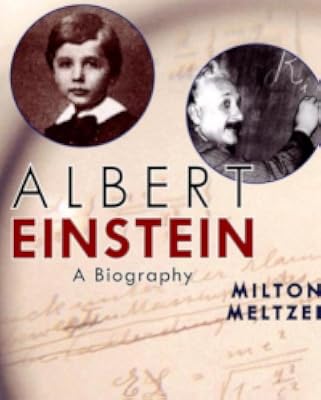
Albert Einstein: A Biography
by Milton Meltzer
On This Page
Description
Briefly explores the life of the famous physicist, who was also a peace activist and fighter for social justice.Tags
Recommendations






Member Reviews
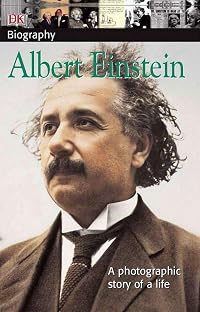
Milton Meltzer provides a brief yet comprehensive look into the life of Albert Einstein, one of the greatest scientists the world has known. In Albert Einstein, A Biography Meltzer manages to cover highlights from throughout Einstein’s life and career in just thirty-one pages. Meltzer’s book, complete with quotes, photographs, a timeline, excerpts from Einstein’s personal notes, and a letter that Einstein wrote to President Franklin D. Roosevelt, seems to bring Einstein to life.
Einstein was born in the small town of Ulm Germany in 1879. From early on in his life, Einstein displayed signs of being more intellectually advanced than his peers. He started speaking in full sentences before he turned three and began a lifelong love show more for playing music at age five. Einstein did not take well to the strict schools he attended and was labeled a dreamer by his teachers. A young Einstein was appalled at the lack of creativity and questioning allowed in his classes. He felt that what he learned in school was mostly “babbling from memory”. Einstein’s disdain for the way his teachers presented information prompted him to search for answers to his many questions outside of the classroom. At age sixteen, he wondered what it would be like to ride a beam of sunlight. Posing this question, which seemed ridiculous and impossible to answer by most, was the first step toward Einstein’s discovery of the Theory of Relativity.
Meltzer has given a great gift to children in writing this book. He provided an example of a brilliant man who insisted upon constantly questioning the world around him. This book would be a valuable addition to the library of any fourth or fifth student. After reading and reflecting on the book, the student will certainly feel motivated by Einstein’s persistence and questioning. show less
Einstein was born in the small town of Ulm Germany in 1879. From early on in his life, Einstein displayed signs of being more intellectually advanced than his peers. He started speaking in full sentences before he turned three and began a lifelong love show more for playing music at age five. Einstein did not take well to the strict schools he attended and was labeled a dreamer by his teachers. A young Einstein was appalled at the lack of creativity and questioning allowed in his classes. He felt that what he learned in school was mostly “babbling from memory”. Einstein’s disdain for the way his teachers presented information prompted him to search for answers to his many questions outside of the classroom. At age sixteen, he wondered what it would be like to ride a beam of sunlight. Posing this question, which seemed ridiculous and impossible to answer by most, was the first step toward Einstein’s discovery of the Theory of Relativity.
Meltzer has given a great gift to children in writing this book. He provided an example of a brilliant man who insisted upon constantly questioning the world around him. This book would be a valuable addition to the library of any fourth or fifth student. After reading and reflecting on the book, the student will certainly feel motivated by Einstein’s persistence and questioning. show less
Milton Meltzer, a renowned author of children's nonfiction for decades, makes Albert Einstein very accessible for young readers. Despite many adults having trouble understanding what his famous equation means, Meltzer breaks up E=mc2 into easily digestible chunks so that young readers can suss out the meaning. History teachers will appreciate that a letter from Einstein to President Roosevelt is in the text; it is never too early to introduce students to the concept of primary sources. Between that letter and the extensive bibliography, Meltzer's biography is a great resource to teachers of both history and science to introduce their students to Einstein.
The biography on Albert Einstein seemed to be a bit above the heads of many children. The focus on Einstein’s achievements was not brought into terms that are made easy to understand. Although it is difficult to put the Theory of Relativity into comprehendible terms, I believe a better job could have been done. The focus on Einstein’s normal background early in the book is something to be commended. As we are generally teaching students who are from rather ordinary backgrounds, it is great to show one of the most well-known scientists is from an average background. That said, I do not believe that I would use this book in a class.
This biography of Albert Einstein presents his advanced knowledge in a way that is easy for young students to understand. The book isn't too long or too dense, so I think that it is suitable for readers of any elementary level who want to learn about his life.
Summary:This children's book is a biography into the life of Albert Einstein. It discusses the journey that led him to be an influencial scientist and inventor that changed the realm of science as we know it. It discusses his family, his background, his career, and his views on certain topics such as World War I. This story teaches children of the life of an amazing individual who was instrumental in helping create the world today.
Argument: There were many reasons I felt this was a good read for young children. Most children today do not know who Albert Einstein is and this book allows them to take a look into the past of a brilliant scientist and inventor that changed the world for the better. I liked this book for its wealth of show more information. I enjoyed that the author not only wrote about Einstein's adult life where all of his theories/inventions took place but also his background and where he came from. I learned so many new things I never knew about a man so famous for his work. For example, on page 8 it discusses how Albert Einstein was the only Jewish boy in his class and felt like an outcast in his own school. Another reason I enjoyed this book was for its authentic documents on certain pages. On page, 25 there is a letter written by Albert Einstein to President Roosevelt discussing his feelings about the war and the atomic bomb. It was interesting to learn that his letter had an affect on the president creating the Manhattan Project to develop an atomic bomb. The last reason, I enjoyed this book was for its use of real photographs and images. These photographs truly helped me visualize all the work that Albert Einstein had done in a lifetime and his experiences as he got older. Having pictures makes the biography come to life before your very eyes.
The main theme of this book is to never stop being curious about the world around you and how it works. Albert Einstein's work thrived on his curiosity about the world and its many mysterious. His best ideas came out of discovery and learning. For example, his theory of relativity dealt with calculating mass and energy. show less
Argument: There were many reasons I felt this was a good read for young children. Most children today do not know who Albert Einstein is and this book allows them to take a look into the past of a brilliant scientist and inventor that changed the world for the better. I liked this book for its wealth of show more information. I enjoyed that the author not only wrote about Einstein's adult life where all of his theories/inventions took place but also his background and where he came from. I learned so many new things I never knew about a man so famous for his work. For example, on page 8 it discusses how Albert Einstein was the only Jewish boy in his class and felt like an outcast in his own school. Another reason I enjoyed this book was for its authentic documents on certain pages. On page, 25 there is a letter written by Albert Einstein to President Roosevelt discussing his feelings about the war and the atomic bomb. It was interesting to learn that his letter had an affect on the president creating the Manhattan Project to develop an atomic bomb. The last reason, I enjoyed this book was for its use of real photographs and images. These photographs truly helped me visualize all the work that Albert Einstein had done in a lifetime and his experiences as he got older. Having pictures makes the biography come to life before your very eyes.
The main theme of this book is to never stop being curious about the world around you and how it works. Albert Einstein's work thrived on his curiosity about the world and its many mysterious. His best ideas came out of discovery and learning. For example, his theory of relativity dealt with calculating mass and energy. show less
As far as biographies go, this one was really good. It was informative while it was entertaining. It included information about how Albert Einstein grew up, the things he was interested in, and the amazing advances he made in our world. This is a great informational read, and important for young readers to know. Einstein’s work with relativity was world famous and changed the face of science. This book also contains a timeline that sums up all the major events of his life from 1879 to 1955.
This book was written to interest children in grades 3-6 and is on a 6.9 reading level.
This book was written to interest children in grades 3-6 and is on a 6.9 reading level.
It is always interesting to read and learn about someone else's life, but Albert Einstein, he must have been intimidating to be around. He was so intelligent, witty, multi-cultural, and a math genius. He was one of the lucky ones who did escape Hitler, but what a scar that must have left on him. He blamed himself for the atomic bomb too. So Sad, someone so gifted didn't die a happier person.
Members
- Recently Added By
Author Information

127+ Works 5,252 Members
Historian Milton Meltzer was born in Worcester, Massachusetts in 1915. He attended Columbia University, but had to leave during his senior year because of the Great Depression. He got a job writing for the WPA Federal Theater Project. During World War II, he served as an air traffic controller in the Army Air Corps. After the war, he worked as a show more writer for CBS radio and in public relations for Pfizer. In 1956, he published his first book A Pictorial History of the Negro American, which was co-written by Langston Hughes. They also collaborated on Langston Hughes: A Biography, which was published in 1968 and received the Carter G. Woodson award. During his lifetime, he wrote more than 110 books for young people including Brother, Can You Spare a Dime? about the stock market crash that led to the Great Depression; Never to Forget about the Holocaust; and There Comes a Time about the Civil Rights movement. He also addressed such topics as crime, ancient Egypt, the immigrant experience, labor movements, photography, piracy, poverty, racism, and slavery. He wrote numerous biographies including ones on Mary McLeod Bethune, Lydia Maria Child, Dorothea Lange, Margaret Sanger, and Henry David Thoreau. He received the 2000 Regina Medal and the 2001 Laura Ingalls Wilder Award for his body of work and his lasting contribution to children's literature. He died of esophageal cancer on September 19, 2009 at the age of 94. (Bowker Author Biography) show less
Common Knowledge
- People/Characters
- Albert Einstein
Classifications
Statistics
- Members
- 55
- Popularity
- 554,372
- Reviews
- 19
- Rating
- (3.59)
- Languages
- English, French
- Media
- Paper
- ISBNs
- 3
- ASINs
- 1