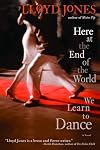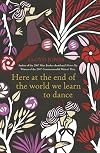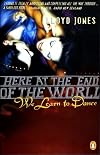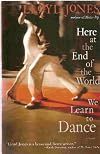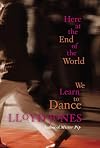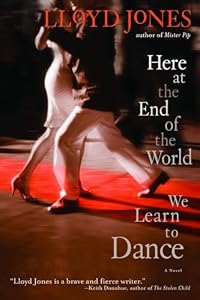
Here at the End of the World We Learn to Dance
by Lloyd Jones
On This Page
Description
"Intertwining two love stories across three generations, the Booker-shortlisted author of Mister Pip takes us to Buenos Aires, New Zealand and Sydney. Louise and Schmidt meet in a small town in New Zealand during World War I. When locals pursue them, stirred to violence against Schmidt for his German name, he and Louise take refuge in a cave overlooking the ocean. There, humming Argentinian songs into her ear, he teaches her the intimate rhythms of the tango the dance that will bind them show more forever. Years later, in her restaurant in Wellington, Rosa, Schmidt's granddaughter, tells Lionel the tale of her grandfather's affair with Louise. And she teaches him to dance"--Provided by publisher. show lessTags
Recommendations





















Member Reviews
Here at the End of the World We Learn to Dance is my final choice of #AYearOfNZLit, so it's a pity I didn't find it very convincing.
(In fact, it's the first-ever novel by Lloyd Jones that hasn't really engaged me.)
The novel is basically the coming-of-age story of a farm boy from limited horizons, but it's set in Argentina and New Zealand, with one time frame set during the Great War, and the other from a later generation. It begins with the sad death of an elderly gentleman, Paul Schmidt, who has been laying flowers at the grave of his beloved Louise for eleven years, but is knocked over by a truck when he's crossing the road to buy the flowers. It's only at his funeral that his wife learns about their relationship.
Mimicking the abrupt show more changes of direction of the tango, the novel then takes the reader back to New Zealand in 1916. Paul Schmidt (a piano tuner suddenly at risk of harassment or worse because of his German name) hides in a beach cave with locals Louise Cunningham and two Kiwi Quakers who didn't want to enlist. The enduring love story of Louise and Paul is forged in this cave as they dance the tango to while away the boring hours of isolation. In the end the sojourn doesn't last: Paul flees and Louise marries into the expected sort of life in that place and time. But she yearns for the passion of the dance. Eventually she makes her way to Paul's side in Buenos Aires.
The narrative darts about next to introduce the character of Schmidt's granddaughter Rosa, also an aficionado of the tango. When Lionel, destined to inherit the hard-scrabble farm, takes off to travel before the inevitable, he takes work in Rosa's restaurant, where he too falls captive to the seductions of the dance. She's married, and his ageing parents need him back in NZ, so in a repetition of bad timing for the passion of Louise and Paul, passion without possession is all there can be for Lionel and Rosa.
This novel might work for a reader more romantic than me. The NZ Herald was impressed. show less
(In fact, it's the first-ever novel by Lloyd Jones that hasn't really engaged me.)
The novel is basically the coming-of-age story of a farm boy from limited horizons, but it's set in Argentina and New Zealand, with one time frame set during the Great War, and the other from a later generation. It begins with the sad death of an elderly gentleman, Paul Schmidt, who has been laying flowers at the grave of his beloved Louise for eleven years, but is knocked over by a truck when he's crossing the road to buy the flowers. It's only at his funeral that his wife learns about their relationship.
Mimicking the abrupt show more changes of direction of the tango, the novel then takes the reader back to New Zealand in 1916. Paul Schmidt (a piano tuner suddenly at risk of harassment or worse because of his German name) hides in a beach cave with locals Louise Cunningham and two Kiwi Quakers who didn't want to enlist. The enduring love story of Louise and Paul is forged in this cave as they dance the tango to while away the boring hours of isolation. In the end the sojourn doesn't last: Paul flees and Louise marries into the expected sort of life in that place and time. But she yearns for the passion of the dance. Eventually she makes her way to Paul's side in Buenos Aires.
The narrative darts about next to introduce the character of Schmidt's granddaughter Rosa, also an aficionado of the tango. When Lionel, destined to inherit the hard-scrabble farm, takes off to travel before the inevitable, he takes work in Rosa's restaurant, where he too falls captive to the seductions of the dance. She's married, and his ageing parents need him back in NZ, so in a repetition of bad timing for the passion of Louise and Paul, passion without possession is all there can be for Lionel and Rosa.
This novel might work for a reader more romantic than me. The NZ Herald was impressed. show less
If you like intricate plots, interesting characters, foreign settings, and historical accuracy, this is a book for you. I knew absolutely nothing about Japanese/Chinese relations or Manchuria during the war and I must admit I had to reread chapters in the first part of the book to gather an understanding of the history of the times, but after that I was totally pulled in.
The first chapter is so compelling and demonstrates the effect stories and imagination can have on the human condition. And then as the book unfolds, one begins to see how stories (movies) can have an effect on an entire nation; are they stories for the imagination or propaganda or both.
Although Ri Koran (or Shirley Yamaguchi or whatever her name could be) is the center show more of the story, the three men that tell her story at three different times in her life are the most interesting. They provide perfect foils to her personality as she evolves from someone who is knowingly manipulated to someone who manipulates those around her. All of this set in three different parts of the world in vastly different circumstances.
I loved this book. I loved the fact that real historical characters play a part (Truman Capote comes to mind), and the authenticity of the historical events as they unfolded in China, Japan, United States, and Lebanon. There are so many characters in this book and so many little unique connections between them, it was a fascinating read. show less
The first chapter is so compelling and demonstrates the effect stories and imagination can have on the human condition. And then as the book unfolds, one begins to see how stories (movies) can have an effect on an entire nation; are they stories for the imagination or propaganda or both.
Although Ri Koran (or Shirley Yamaguchi or whatever her name could be) is the center show more of the story, the three men that tell her story at three different times in her life are the most interesting. They provide perfect foils to her personality as she evolves from someone who is knowingly manipulated to someone who manipulates those around her. All of this set in three different parts of the world in vastly different circumstances.
I loved this book. I loved the fact that real historical characters play a part (Truman Capote comes to mind), and the authenticity of the historical events as they unfolded in China, Japan, United States, and Lebanon. There are so many characters in this book and so many little unique connections between them, it was a fascinating read. show less
Draft dodging piano tuner on the run teaches tango in a cave. What more do you need to know?
A beautifully told story about two families, separated by a generation and an ocean, Here At the End of the World We Learn to Dance really captures the spirit of tango. And did I mention it stars a piano tuner?
A beautifully told story about two families, separated by a generation and an ocean, Here At the End of the World We Learn to Dance really captures the spirit of tango. And did I mention it stars a piano tuner?
Towards the more literary end of the spectrum, but not too erudite. An interesting story and not at all predictable.
"If you haven't fallen in love by the end of the dance, you haven't danced the tango."
A woman mirrors her grandfather's affair which was born of the tango and sustained by it. Argentina provides an exotic backdrop.
A woman mirrors her grandfather's affair which was born of the tango and sustained by it. Argentina provides an exotic backdrop.
This was a reread for me and I loved it the second time as well.
I didn't care for the style of writing. I never finished this book.
Members
- Recently Added By
Author Information

24+ Works 4,641 Members
Some Editions
Awards and Honors
Awards
Common Knowledge
- Original publication date
- 2001
- Epigraph
- The tango is man and woman in search of each other. It is a search for an embrace, a way to be together. - Juan Carlos Copes, Choreographer and Dancer
- First words
- For eleven years an elderly man with a silver-knobbed cane visited Louise's grave with flowers.
- Last words
- (Click to show. Warning: May contain spoilers.)"Here," I said. "I'm going to teach you to dance."
- Blurbers
- Donohue, Keith
Classifications
Statistics
- Members
- 171
- Popularity
- 190,882
- Reviews
- 7
- Rating
- (3.36)
- Languages
- English, German
- Media
- Paper, Ebook
- ISBNs
- 14
- ASINs
- 2