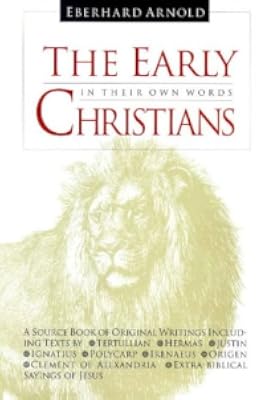
The Early Christians: In Their Own Words
by Eberhard Arnold
On This Page
Description
Ever wonder what Christianity was like before the churches got hold of it? Here are vital portraits of the early church drawn in the words of its own members, with additional material from a variety of contemporary sources: pagans and persecutors, politicians and emperors.A sourcebook of original writings with extensive historical notes. Includes extrabiblical sayings of Jesus; writings of Origen, Tertullian, Polycarp, Clement of Alexandria, Irenaeus, and many others; topical index, selected show more bibliographies, and illustrations of early Christian symbols.Larry D. Fourman, Ministers Book ClubAn invaluable resource for preaching, worship, teaching, and personal devotions. show lessTags
Recommendations







Member Reviews
Virtually every one of the early "Christians" is a Unitarian Universalist. The Trinitarian view was of course "acceptable" to most of them--since they were UUs ! In 1926, Arnold Eberhard collected and published this selection of sometimes difficult translations out of the tens of thousands of texts from the Classical Era of the Roman Empire. These are the voices of folks who were looking for beliefs -- a religion -- which would raise the conduct of humankind and their leaders. These men (women were rarely educated without fire) had realized that humankind was worshiping gods that were more immoral than humans. They wanted a better god !
Not all of the editorial comments are correct. For example, most of the "martyrdom" stories are show more sourced in Eusebius, who made them up. His "History of the Church" is a polemic with almost no corroboration. Or more often, he took the persecution of Jews throughout the Roman Empire, and substituted them for Christians. After all, they were Jews, a group he was trying to convert anyway.
Since Eberhard's day, scholarship has considerably advanced. The Ieusus Christo was very simply a synthesis of Messiah figures from the exciting period of religious ferment which exploded after the Roman conquest of the Hellenic Egyptian pantheon. The world was already worshiping "Ieus", known as Zeus or Jupiter, in Greece and Rome. The "son of Ieus" was his murdered son Dionysius who died, rose again, and brought redemption and boons to humankind - the "Ieusus" or Jesus.
The largest Jewish Temple in the world, in the biggest city in the world, was in Alexandria in Egypt. Cleopatra was a multi-lingual priestess of the trinitarian Egyptian pantheon. She was fluent in Hebrew and Aramaic (she came from Ptolemaic Syria to rule the Egyptian throne/temple). When Cleopatra went to Rome, she built the largest Temples in the world to "Ieusus". The Temples were franchised throughout the world.
So, quite frankly, much of the editorial material is simply uncorroborated and contrary to the records of other classical and prolific authors, such as Plutarch and Paul himself. While this does make me wonder if the original texts here have been "selected" or even translated with a polemic agenda, the fact remains that this book is a wonderful opportunity to hear the voice of the men who lived during a time of great spiritual quests. An example of this is in the selection quoting Celsus quoting a believer who claims "I am God, I am God's son," and the editors claim that this Believer was gripped in ecstacy and Christ was speaking through him. [24] Well, yes, but the belief of the Believer is that he as the speaker IS divine. And that, in a nutshell, is what the Messiahs of the "Christ" period were preaching.
http://www.plough.com/en/topics/faith/early-christians/early-christians show less
Not all of the editorial comments are correct. For example, most of the "martyrdom" stories are show more sourced in Eusebius, who made them up. His "History of the Church" is a polemic with almost no corroboration. Or more often, he took the persecution of Jews throughout the Roman Empire, and substituted them for Christians. After all, they were Jews, a group he was trying to convert anyway.
Since Eberhard's day, scholarship has considerably advanced. The Ieusus Christo was very simply a synthesis of Messiah figures from the exciting period of religious ferment which exploded after the Roman conquest of the Hellenic Egyptian pantheon. The world was already worshiping "Ieus", known as Zeus or Jupiter, in Greece and Rome. The "son of Ieus" was his murdered son Dionysius who died, rose again, and brought redemption and boons to humankind - the "Ieusus" or Jesus.
The largest Jewish Temple in the world, in the biggest city in the world, was in Alexandria in Egypt. Cleopatra was a multi-lingual priestess of the trinitarian Egyptian pantheon. She was fluent in Hebrew and Aramaic (she came from Ptolemaic Syria to rule the Egyptian throne/temple). When Cleopatra went to Rome, she built the largest Temples in the world to "Ieusus". The Temples were franchised throughout the world.
So, quite frankly, much of the editorial material is simply uncorroborated and contrary to the records of other classical and prolific authors, such as Plutarch and Paul himself. While this does make me wonder if the original texts here have been "selected" or even translated with a polemic agenda, the fact remains that this book is a wonderful opportunity to hear the voice of the men who lived during a time of great spiritual quests. An example of this is in the selection quoting Celsus quoting a believer who claims "I am God, I am God's son," and the editors claim that this Believer was gripped in ecstacy and Christ was speaking through him. [24] Well, yes, but the belief of the Believer is that he as the speaker IS divine. And that, in a nutshell, is what the Messiahs of the "Christ" period were preaching.
http://www.plough.com/en/topics/faith/early-christians/early-christians show less
Ratings
Members
- Recently Added By
Author Information

37+ Works 922 Members
Series
Belongs to Publisher Series
Common Knowledge
- Canonical title
- The Early Christians: In Their Own Words
- Original title
- Die ersten Christen nach dem Tode der Apostel
- Alternate titles
- Die Ersten Christen: Am Anfang war die Liebe; شهادة الكنيسة الأولى - شعلة خالدة لا تنطفئ
- Original publication date
- 1926
Classifications
- Genres
- Religion & Spirituality, Nonfiction, History
- DDC/MDS
- 270.1 — Religion History of Christianity History, geographic treatment, biography of Christianity Apostolic; Nativity to Constantine
- LCC
- BR63 .A713 — Philosophy, Psychology and Religion Christianity Christianity Early Christian literature. Fathers of the Church, etc.
- BISAC
Statistics
- Members
- 241
- Popularity
- 134,953
- Reviews
- 1
- Rating
- (3.79)
- Languages
- English, French, German
- Media
- Paper
- ISBNs
- 5
- UPCs
- 1
- ASINs
- 7