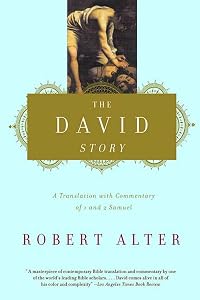
The David Story: A Translation with Commentary of 1 and 2 Samuel
by Robert Alter
Alter's Translations with Commentary
On This Page
Description
Acclaimed for its masterful new translation and insightful commentary, The David Story is a fresh, vivid rendition of one of the great works in Western literature. Robert Alter's brilliant translation gives us David, the beautiful, musical hero who slays Goliath and, through his struggles with Saul, advances to the kingship of Israel. But this David is also fully human: an ambitious, calculating man who navigates his life's course with a flawed moral vision. The consequences for him, his show more family, and his nation are tragic and bloody. Historical personage and full-blooded imagining, David is the creation of a literary artist comparable to the Shakespeare of the history plays. show lessTags
Recommendations





Member Reviews
50. The David Story: A Translation with Commentary of 1 and 2 Samuel by Robert Alter (1999, 414 pages, read July 4 – Sept 3)
Well...it's been since September 1 since I wrote a review and Sept 3 since I finished this book. So, I'm not quite sure what I can now say about it, or how to structure whatever that may be.
Briefly, this is the first book of the Bible since Genesis that I can truly say has some overall remarkable literary aspect to it. (Looking over the other books, I can pick and choose parts that stand out, notably the Song of Deborah in Judges.) What precisely I mean by that is not so easy to explain. There isn't a marked break from Judges to Samuel, or even from within Samuel, from, say, Saul to David. But there is an show more overall broad sense of complexity and build-up. There is something like character development, and, ever so subtly, some literary sparks.
1 & 2 Samuel follows three main characters, the final judge, Samuel, and the first two Israelite kings Saul and David. Each is met young and unformed, and each is developed slowly and irregularly and experiences something of a rise and fall. And then there are the multitude of fascinating supporting characters, ranging from Eli the failed judge and holy man who is repetitively exposed indirectly by the text to Joab, David's rogue and ruthless nephew, one of the worst and most bloodstained characters to ever become a book's accidental hero. (I can't cover them all: Abner, Jonathan, Abimelech, Abigail, the witch of Endor, Nathan, Bathsheba, Uriah, Amnon, Tamar, Absalom, Ahitophel, Amasa and so on. Oddly, there just isn't much on Solomon's character, here or in Kings)
The first hint to me that something extra was going on here was in 1 Samuel chapter 3 where the author utilizes a very rare sense of biblical humor. At the time the young Samuel, whose life is dedicated to serving the LORD, is serving under the holy man Eli. Three times Samuel hears a voice call his name and each time he obediently rushes out to the Eli to find out what he wanted, saying "Here I am, for you called me." But, it wasn't Eli, this was God speaking to Samuel instead of Eli. Cute, and clever how Eli is exposed, since God does not speak to him. God's message to Samuel is a curse on Eli and his sons, permanently ending his line. Samuel is forced to tell Eli of the curse, and Eli responds with stoic dignity, "He is the LORD. What is good in His eyes let him do." What the text does, and what I fail to capture here, is stagger us with the tragedy and Eli's dignified response. But it only works so well because of that humor the opens our emotions up. That is the story is one complex piece that is constructed to, and successfully does, work our emotions.
Later, I found when I was reading about Absalom's rebellion I could not put the book down. Now, I knew what was going to happen, in some detail. But experiencing it was powerful enough to fully draw me to this most dry of texts. That is something that had never before happened while reading the bible. I don't fully understand why I was so attached to this, or why I was so moved by David's breakdown and final days (covered in 1 Kings chapters 1 & 2) What seems to have happened is that as I followed David and his odd rise, watched how the authors carefully undermined him through every step of his meteoric rise, and learned about all these fundamental character flaws, I somehow became very attached to him.
Between 1 Kings Chapter 2 where David dies, and Chapter 3 about the start of Solomon's reign is a striking textual change. There is nothing literary about Solomon, his reign and successes and failures are merely reported with laconic detail. Outside the Queen of Sheba, there are no characters to become attached to.
In a discussion about whether or not the story of David has any true factual sense to it, beyond the archeologically proven existence of a king named David, one author claims that the internal consistency within the David story seems to argue for some factual validity. I could argue just the opposite, that the literary color brought out by this story and the overall impact constructed through the books entirety, is simply too artistic and elegant to have possibly been true. I would say that regardless of the factual truth of David, this is the work of master of literature, albeit of an odd type of literature.
2012
http://www.librarything.com/topic/138560#3698957 show less
Well...it's been since September 1 since I wrote a review and Sept 3 since I finished this book. So, I'm not quite sure what I can now say about it, or how to structure whatever that may be.
Briefly, this is the first book of the Bible since Genesis that I can truly say has some overall remarkable literary aspect to it. (Looking over the other books, I can pick and choose parts that stand out, notably the Song of Deborah in Judges.) What precisely I mean by that is not so easy to explain. There isn't a marked break from Judges to Samuel, or even from within Samuel, from, say, Saul to David. But there is an show more overall broad sense of complexity and build-up. There is something like character development, and, ever so subtly, some literary sparks.
1 & 2 Samuel follows three main characters, the final judge, Samuel, and the first two Israelite kings Saul and David. Each is met young and unformed, and each is developed slowly and irregularly and experiences something of a rise and fall. And then there are the multitude of fascinating supporting characters, ranging from Eli the failed judge and holy man who is repetitively exposed indirectly by the text to Joab, David's rogue and ruthless nephew, one of the worst and most bloodstained characters to ever become a book's accidental hero. (I can't cover them all: Abner, Jonathan, Abimelech, Abigail, the witch of Endor, Nathan, Bathsheba, Uriah, Amnon, Tamar, Absalom, Ahitophel, Amasa and so on. Oddly, there just isn't much on Solomon's character, here or in Kings)
The first hint to me that something extra was going on here was in 1 Samuel chapter 3 where the author utilizes a very rare sense of biblical humor. At the time the young Samuel, whose life is dedicated to serving the LORD, is serving under the holy man Eli. Three times Samuel hears a voice call his name and each time he obediently rushes out to the Eli to find out what he wanted, saying "Here I am, for you called me." But, it wasn't Eli, this was God speaking to Samuel instead of Eli. Cute, and clever how Eli is exposed, since God does not speak to him. God's message to Samuel is a curse on Eli and his sons, permanently ending his line. Samuel is forced to tell Eli of the curse, and Eli responds with stoic dignity, "He is the LORD. What is good in His eyes let him do." What the text does, and what I fail to capture here, is stagger us with the tragedy and Eli's dignified response. But it only works so well because of that humor the opens our emotions up. That is the story is one complex piece that is constructed to, and successfully does, work our emotions.
Later, I found when I was reading about Absalom's rebellion I could not put the book down. Now, I knew what was going to happen, in some detail. But experiencing it was powerful enough to fully draw me to this most dry of texts. That is something that had never before happened while reading the bible. I don't fully understand why I was so attached to this, or why I was so moved by David's breakdown and final days (covered in 1 Kings chapters 1 & 2) What seems to have happened is that as I followed David and his odd rise, watched how the authors carefully undermined him through every step of his meteoric rise, and learned about all these fundamental character flaws, I somehow became very attached to him.
Between 1 Kings Chapter 2 where David dies, and Chapter 3 about the start of Solomon's reign is a striking textual change. There is nothing literary about Solomon, his reign and successes and failures are merely reported with laconic detail. Outside the Queen of Sheba, there are no characters to become attached to.
In a discussion about whether or not the story of David has any true factual sense to it, beyond the archeologically proven existence of a king named David, one author claims that the internal consistency within the David story seems to argue for some factual validity. I could argue just the opposite, that the literary color brought out by this story and the overall impact constructed through the books entirety, is simply too artistic and elegant to have possibly been true. I would say that regardless of the factual truth of David, this is the work of master of literature, albeit of an odd type of literature.
2012
http://www.librarything.com/topic/138560#3698957 show less
Alter, whose reputation as a translator of Hebrew narrative has long been established, achieves the miraculous end of placing the David narrative on a par with the great narratives of Homer, or the timeless legends of, for example, Maui, at a time when Judaeo-Christian narratives are lrgely passe.
In one respect it is almost necessary to use Atler's own technique to review this masterpiece: Atler places his stunningly clear and literary yet accessible translation of the narrative at the top of the page, and his explanation beneath it. In reviewing his achievement there are two distinct facets: above the line (as it were) is his translation, which compels the reader onwards through a text that many biblical translators have rendered show more soporific. Below the line he explains his linguistic choices, comments on detail, or makes links between the Davidic narrative and parallel biblical and other near eastern narratives. Yet this technical commentary is as distinctively compelling as the translation: I found myself reading Atler's comments as compulsively as I devoured the text. Above the line his re-presentation of an ancient narrative is outstanding.Below the line his explanations are no less addictive!
Atler has achieved for the Judaeo-Christian tradition a remarkable feat: in a post Judaeo-Christendom world (to coin a phrase) he has re-provided and explained a profound ur-narrative that can be once more as socially seminal as it should always have been. This is a story - not of Atler's making - of the workings of the Divine through the foibles of humanity. Atler is a conduit for potential rediscovery of Judaeo-Christendom's fundamental narrative: this version of this story should be compulsory reading on every final year High School syllabus! show less
In one respect it is almost necessary to use Atler's own technique to review this masterpiece: Atler places his stunningly clear and literary yet accessible translation of the narrative at the top of the page, and his explanation beneath it. In reviewing his achievement there are two distinct facets: above the line (as it were) is his translation, which compels the reader onwards through a text that many biblical translators have rendered show more soporific. Below the line he explains his linguistic choices, comments on detail, or makes links between the Davidic narrative and parallel biblical and other near eastern narratives. Yet this technical commentary is as distinctively compelling as the translation: I found myself reading Atler's comments as compulsively as I devoured the text. Above the line his re-presentation of an ancient narrative is outstanding.Below the line his explanations are no less addictive!
Atler has achieved for the Judaeo-Christian tradition a remarkable feat: in a post Judaeo-Christendom world (to coin a phrase) he has re-provided and explained a profound ur-narrative that can be once more as socially seminal as it should always have been. This is a story - not of Atler's making - of the workings of the Divine through the foibles of humanity. Atler is a conduit for potential rediscovery of Judaeo-Christendom's fundamental narrative: this version of this story should be compulsory reading on every final year High School syllabus! show less
I have just finished the David story which is an Robert Alter translation of Samuel I and II of the Bible. Prior to this I read his translation of the first five books. From that prior translation my favorite parts were in Genesis, the creation story, and perhaps the story of Joseph and his brothers. I found it hard to push through Numbers and Deuteronomy. The book of Joshua could have been renamed the book of Genocide, although according to research into biblical history, all the massacres of people that the Israelites ran into once they had crossed the Jordan did not really happen. Still, it is hard to think that the bible could seriously be a guide to moral conduct. God in the old testament seems to order as many cruelties as show more kindnesses. Yaweh had supposedly told the Israelites to wipe out the worshippers of other gods and even was angered if they were not thorough enough, though they were told to be kind to orphans, widows and the strangers among them.
It makes more sense to me to take these books more as a set of stories about a people, and not as a moral guide. And, regarded this way, the David story is rather impressive. The two main dramas are David's relationship to Saul - the prior king who had been chosen by Yaweh, and then dropped in favor of David, but who also was in a sort of father role to David - and David's relationship with his own son, Absolom. It is not always clear what David's motivations are, whether his relationships win out over his drive to power or the other way round. At times, in fact, he seems a passive character, letting those around him take actions for him or simply not opposing them strongly enough. It feels like this could be fleshed out into a full-fledged novel, which, presumably is what Faulkner did in Absolom, Absolom, but I think that is one Faulkner I haven't read. show less
It makes more sense to me to take these books more as a set of stories about a people, and not as a moral guide. And, regarded this way, the David story is rather impressive. The two main dramas are David's relationship to Saul - the prior king who had been chosen by Yaweh, and then dropped in favor of David, but who also was in a sort of father role to David - and David's relationship with his own son, Absolom. It is not always clear what David's motivations are, whether his relationships win out over his drive to power or the other way round. At times, in fact, he seems a passive character, letting those around him take actions for him or simply not opposing them strongly enough. It feels like this could be fleshed out into a full-fledged novel, which, presumably is what Faulkner did in Absolom, Absolom, but I think that is one Faulkner I haven't read. show less
Five stars for the translation, which is wonderfully readable. But the commentary often sounds like special-pleading rather than than information and feels too in-depth for what is, at the end of the day, a story able to stand on its own (compare Alter's 'Genesis,' the commentary to which is extremely helpful and never feels forced).
On the road again, no time to write a proper review, so I'll just say that if you want to read/understand these books I've not encountered a better, more gripping, more fulsomely annotated, less irksomely "biblical," translation/way.
This book hardly needs another rave review. However, avoid the Kindle version, as the formatting for the footnotes and clumsy and in some places left undone.
location-WellesleyPL, Jewish, Judaica, Tanach, Prophets, Nach, Samuel, Saul, David, Hannah, translation, commentary,
Members
- Recently Added By
Author Information

40+ Works 10,010 Members
Robert Alter is Class of 1937 Professor of Hebrew & Comparative Literature at the University of California, Berkeley. (Bowker Author Biography)
Series

Work Relationships
Common Knowledge
- Original publication date
- 1999
- People/Characters
- David, King of Israel; Saul, King of Israel; Samuel, the prophet
- Important places
- Israel
- Dedication
- In memory of Judah M. Eisenberg
(1938-1998)
Man of science and humane culture
Cherished friend of my youth - First words
- The major sequence that runs, according to the conventional book and chapter divisions of later editorial traditions, from 1 Samuel 1 to 1 Kings 2 is one of the most astounding pieces of narrative that has come down to us fro... (show all)m the ancient world.
- Last words
- (Click to show. Warning: May contain spoilers.)And the kingdom was unshaken in Solomon's hand.
Classifications
Statistics
- Members
- 635
- Popularity
- 45,989
- Reviews
- 7
- Rating
- (4.42)
- Languages
- English
- Media
- Paper, Ebook
- ISBNs
- 3
- ASINs
- 3