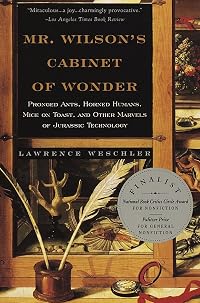
Mr. Wilson's Cabinet Of Wonder: Pronged Ants, Horned Humans, Mice on Toast, and Other Marvels of Jurassic Technology
by Lawrence Weschler
On This Page
Description
Finalist for Pulitzer Prize for General Nonfiction Finalist for National Book Critics Circle Award for Nonfiction Pronged ants, horned humans, a landscape carved on a fruit pit--some of the displays in David Wilson's Museum of Jurassic Technology are hoaxes. But which ones? As he guides readers through an intellectual hall of mirrors, Lawrence Weschler revisits the 16th-century "wonder cabinets" that were the first museums and compels readers to examine the imaginative origins of both art show more and science. show lessTags
Recommendations










Member Reviews
Mr. Wilson’s Cabinet of Wonder: Pronged Ants, Horned Humans, Mice on Toast, and Other Marvels of Jurassic Technology, by Lawrence Weschler
Vintage Books (1995)
“[A] small nondescript storefront operation located along the main commercial drag of downtown Culver City in the middle of West Los Angeles’s endless pseudo-urban sprawl: the Museum of Jurassic Technology, according to the fading blue banner facing the street.” Lawrence Weschler, a staff writer for The New Yorker, describes the otherwise anonymous location for one of the oddest museums on the American landscape. He details the exhibits of the Museum and the life of its creator, David Wilson, in Mr. Wilson’s Cabinet of Wonder: Pronged Ants, Horned Humans, Mice on Toast, show more and Other Marvels of Jurassic Technology.
After reading this book, I had to ask, “Where has this book been all my life?” Despite majoring in Public History, the intellectual adjunct to academic history focusing on museums, historical societies, and the like, I had never encountered this book. Even with my Museum Studies classes taken at the Milwaukee Public Museum this was never on the mandatory reading list. It should be.
For an otherwise short book – the paperback text is only 108 pages, albeit with a lengthy section of endnotes – there is a lot to unpack. Weschler divides the book into two sections. The first, “Inhaling the Spore,” is a lengthy narrative tour through the Museum of Jurassic Technology. The second, “Cerebral Growth,” is a combination biography of David Wilson and the history of modern museums. The second sections explores the digressive route Wilson took to eventually become head of his own idiosyncratic museum. This digression is combined with a digressive exploration of the kunst- and wunderkammern (German for “art- and wonder cabinets”).
Wonder cabinets became popular around the sixteenth and seventeenth century. During this time (early modern Europe in academic parlance) Europe experienced an extended period of culture shock due to the discoveries made through contact and exploration with North America. The culture shock was coupled with a revival of classical learning and a fascinating with esoteric and occult knowledge. Curiosity cabinets reflected this simultaneous combination of global exploration and interior contemplation. Prior to the time, Europe was dominated by a medieval mindset. The curiosity cabinet fell out of favor when the Enlightenment popularized a more scientific and rational mentality.
Granted, the statement above is a broad-brush generalization. Weschler also concedes that despite the new people, places, and things discovered during early modern times, it was also a period of cruelty and barbarism.
All this is a roundabout introduction to what David Wilson is attempting with his Museum of Jurassic Technology. In his own way, he has created a modern curiosity cabinet. A tiny jewel box museum mixing fantasy and fact. Wilson’s brilliance comes from the Museum’s admixing of parody, homage, and critique of modern museum practice. A visitor can’t readily distinguish between a factual exhibit or one created by Wilson’s imagination. He has mimicked to the voice of Institutional Authority with incredible precision. In his interactions with visitors and at museum conferences, he never “breaks character.” Everything is done with a straight face and with the utmost serious. (Contrast this with The Church of the SubGenius, which is a parody religion, except when it isn’t.)
After reading the book, I realized it was one of my top favorite non-fiction works. Unlike fiction, non-fiction is so broad and varied, it is hard to label something an all-time favorite. Like the House on the Rock and the Salt Lake City Temple, the Museum of Jurassic Technology will go on my list for an American Odd Pilgrimage.
The Museum of Jurassic Technology is yet another example of California as American laboratory of weirdness and idiosyncrasy.
https://driftlessareareview.com/2021/04/09/american-odd-mr-wilsons-cabinet-of-wo... show less
Vintage Books (1995)
“[A] small nondescript storefront operation located along the main commercial drag of downtown Culver City in the middle of West Los Angeles’s endless pseudo-urban sprawl: the Museum of Jurassic Technology, according to the fading blue banner facing the street.” Lawrence Weschler, a staff writer for The New Yorker, describes the otherwise anonymous location for one of the oddest museums on the American landscape. He details the exhibits of the Museum and the life of its creator, David Wilson, in Mr. Wilson’s Cabinet of Wonder: Pronged Ants, Horned Humans, Mice on Toast, show more and Other Marvels of Jurassic Technology.
After reading this book, I had to ask, “Where has this book been all my life?” Despite majoring in Public History, the intellectual adjunct to academic history focusing on museums, historical societies, and the like, I had never encountered this book. Even with my Museum Studies classes taken at the Milwaukee Public Museum this was never on the mandatory reading list. It should be.
For an otherwise short book – the paperback text is only 108 pages, albeit with a lengthy section of endnotes – there is a lot to unpack. Weschler divides the book into two sections. The first, “Inhaling the Spore,” is a lengthy narrative tour through the Museum of Jurassic Technology. The second, “Cerebral Growth,” is a combination biography of David Wilson and the history of modern museums. The second sections explores the digressive route Wilson took to eventually become head of his own idiosyncratic museum. This digression is combined with a digressive exploration of the kunst- and wunderkammern (German for “art- and wonder cabinets”).
Wonder cabinets became popular around the sixteenth and seventeenth century. During this time (early modern Europe in academic parlance) Europe experienced an extended period of culture shock due to the discoveries made through contact and exploration with North America. The culture shock was coupled with a revival of classical learning and a fascinating with esoteric and occult knowledge. Curiosity cabinets reflected this simultaneous combination of global exploration and interior contemplation. Prior to the time, Europe was dominated by a medieval mindset. The curiosity cabinet fell out of favor when the Enlightenment popularized a more scientific and rational mentality.
Granted, the statement above is a broad-brush generalization. Weschler also concedes that despite the new people, places, and things discovered during early modern times, it was also a period of cruelty and barbarism.
All this is a roundabout introduction to what David Wilson is attempting with his Museum of Jurassic Technology. In his own way, he has created a modern curiosity cabinet. A tiny jewel box museum mixing fantasy and fact. Wilson’s brilliance comes from the Museum’s admixing of parody, homage, and critique of modern museum practice. A visitor can’t readily distinguish between a factual exhibit or one created by Wilson’s imagination. He has mimicked to the voice of Institutional Authority with incredible precision. In his interactions with visitors and at museum conferences, he never “breaks character.” Everything is done with a straight face and with the utmost serious. (Contrast this with The Church of the SubGenius, which is a parody religion, except when it isn’t.)
After reading the book, I realized it was one of my top favorite non-fiction works. Unlike fiction, non-fiction is so broad and varied, it is hard to label something an all-time favorite. Like the House on the Rock and the Salt Lake City Temple, the Museum of Jurassic Technology will go on my list for an American Odd Pilgrimage.
The Museum of Jurassic Technology is yet another example of California as American laboratory of weirdness and idiosyncrasy.
https://driftlessareareview.com/2021/04/09/american-odd-mr-wilsons-cabinet-of-wo... show less
The first half of this book describes the author's explorations and investigations of Los Angeles's Museum of Jurassic technology and encounters with its proprietor, David Wilson. And a weird, weird place this is. Weird enough that I felt compelled to look it up and make sure it was actually a real establishment, and not some sort of elaborate prank or fantasy. Turns out, it is real, and despite the fact that this book was published in 1995, it's still there, and still doing... whatever the heck it is that it's doing.
Because, the way Weschler describes it, it's hard to tell to what extent this place qualifies as a museum and to what extent it's some kind of bizarre art project. It contains exhibits and information that are strange, and show more strangely presented, but perfectly real, and others that are completely made up. Or partly made up. Or completely crackpotty. Or something. It can be very hard to tell the difference, and very hard to tell when Wilson is being serious and when he's being ironic.
Weschler clearly falls down quite a rabbit hole here, and the main effect is to leave one blinking and going, "What the heck did I just read?" Which seems entirely appropriate to the subject matter.
The second half mostly consists of a little historical exploration of the wunderkammer, or cabinet of wonder, a tradition in whose footsteps the Wilson's odd collection certainly follows. The subject matter here is interesting, but the disjointed writing style which did such a good job capturing the feel of the Museum works less well here, and the rambling footnotes are more than a little distracting. show less
Because, the way Weschler describes it, it's hard to tell to what extent this place qualifies as a museum and to what extent it's some kind of bizarre art project. It contains exhibits and information that are strange, and show more strangely presented, but perfectly real, and others that are completely made up. Or partly made up. Or completely crackpotty. Or something. It can be very hard to tell the difference, and very hard to tell when Wilson is being serious and when he's being ironic.
Weschler clearly falls down quite a rabbit hole here, and the main effect is to leave one blinking and going, "What the heck did I just read?" Which seems entirely appropriate to the subject matter.
The second half mostly consists of a little historical exploration of the wunderkammer, or cabinet of wonder, a tradition in whose footsteps the Wilson's odd collection certainly follows. The subject matter here is interesting, but the disjointed writing style which did such a good job capturing the feel of the Museum works less well here, and the rambling footnotes are more than a little distracting. show less
The books begins when Lawrence Weschler wanders into the Museum of Jurassic Technology in Culver City, California, where he encounters an oddly fascinating collection of exhibits. Beginning with the Cameroonian stink ant and the spores of a fungus, which when inhaled, cause the ant to climb upward, eventually grabbing onto the vine or trunk with his mandible, where he dies. The fungus then sprouts from the ant's forehead, raining spores down on the unsuspecting ants below. Other exhibits include a theory of memory, a very small bat and a collection of antlers, which includes the horn of Mary Davis of Saughall.
Weschler is understandably intrigued, and speaking with David Wilson, the museum's owner and curator, adds to his curiosity. show more Professionally presented, the museum nonetheless awakens seeds of doubt in his mind, which sprout when he researches the exhibits. Mr. Wilson's Cabinet of Wonder looks at our ideas about museums and looks at how museums came to be; originating from the wunderkammern of the early enlightenment, where wealthy men collected interesting items and grouped them together in a room or cabinet for the wonderment of his guests. Classification was optional and certainly different, with one collection including
two huge ribs from a whale (out in the courtyard); "a goose which has grown in Scotland in a tree"; "a number of things changed into stone" (in other words, fossils); the hand of a mermaid; the hand of a mummy; a small piece of wood from the cross of Christ"; "pictures from the church of S. Sofia in Constantinople copies by a Jew into a book"; "a bat as large as a pigeon"...
There is a lot packed into this slender book, from the nature of wonder itself to the history of those fascinating and eclectic cabinets of curiosity, which sprang up when explorers to the far east and the Americas began returning with things never before seen and as superstition gave way to reason. show less
Weschler is understandably intrigued, and speaking with David Wilson, the museum's owner and curator, adds to his curiosity. show more Professionally presented, the museum nonetheless awakens seeds of doubt in his mind, which sprout when he researches the exhibits. Mr. Wilson's Cabinet of Wonder looks at our ideas about museums and looks at how museums came to be; originating from the wunderkammern of the early enlightenment, where wealthy men collected interesting items and grouped them together in a room or cabinet for the wonderment of his guests. Classification was optional and certainly different, with one collection including
two huge ribs from a whale (out in the courtyard); "a goose which has grown in Scotland in a tree"; "a number of things changed into stone" (in other words, fossils); the hand of a mermaid; the hand of a mummy; a small piece of wood from the cross of Christ"; "pictures from the church of S. Sofia in Constantinople copies by a Jew into a book"; "a bat as large as a pigeon"...
There is a lot packed into this slender book, from the nature of wonder itself to the history of those fascinating and eclectic cabinets of curiosity, which sprang up when explorers to the far east and the Americas began returning with things never before seen and as superstition gave way to reason. show less
A fascinating subject: a museum which blurs the lines between factual exhibits and less verifiably truthful ones, but seeks to inspire wonder at all times. Much like the Museum of Jurassic Technology itself seems to be, based on the descriptions here, the book is a bit of a strange journey, with fits and stops and digressions.
A tour of a small museum in Los Angeles provides an opportunity to consider the hazy lines between the real and the imaginary. Weschler honors weird and wonderful obsessions and affirms the sublime pleasures of the odd and unexpected. The world is a curio cabinet. Doubt is not to be feared, but welcomed.
The visitor to the Museum of Jurassic Technology continuously finds himself shimmering between wondering at (the marvels of nature) and wondering whether (any of this could possibly be true). And it’s that very shimmer, the capacity for such delicious confusion, that may constitute the most blessedly wonderful thing about being human.
Lagunitas Hairy Eyeball
Wild Blue Blueberry Lager
The visitor to the Museum of Jurassic Technology continuously finds himself shimmering between wondering at (the marvels of nature) and wondering whether (any of this could possibly be true). And it’s that very shimmer, the capacity for such delicious confusion, that may constitute the most blessedly wonderful thing about being human.
Lagunitas Hairy Eyeball
Wild Blue Blueberry Lager
Highly recommended.
As a boy I wandered the halls of London's British Museum, Victoria and Albert Museum, and other massive dusty relics of empire, and Weschler entertainingly and convincingly connects the dots between an arguably insane collector of bizarre scientific trivia in Los Angeles, and the important history of collecting that is the foundation of much scientific, archaeological and anthropological knowledge.
The world is an exceedingly strange place; and though modern credulity will no longer accept narwhal tusks as unicorn horns, there are still wonders out there. And who can say which freakish quirks of nature are important glimpses of truth, and which are merely roadside ephemera?
(john)
As a boy I wandered the halls of London's British Museum, Victoria and Albert Museum, and other massive dusty relics of empire, and Weschler entertainingly and convincingly connects the dots between an arguably insane collector of bizarre scientific trivia in Los Angeles, and the important history of collecting that is the foundation of much scientific, archaeological and anthropological knowledge.
The world is an exceedingly strange place; and though modern credulity will no longer accept narwhal tusks as unicorn horns, there are still wonders out there. And who can say which freakish quirks of nature are important glimpses of truth, and which are merely roadside ephemera?
(john)
This turned out to be better than I expected. Quite good actually. It attempts to share a taste of the Museum of Jurassic Technology with the reader. I've been to the Museum (located in Los Angeles) which is not like any other museum I've been to. The book does a good job reproducing the seamless blending a fact with fantasy that happens there even as the author retells his attempt to sort the truth from the fiction in the museum's exhibits and history. I can't imagine a more perfect approach to a book about a contemporary wunderkammen.
Members
- Recently Added By
Lists

David Bowie's Top 100
97 works; 23 members

David Bowie's List of Top 100 Books
94 works; 6 members
David Bowie’s Top 100 Favourite Reads
100 works; 3 members

Slightly Foxed 2
20 works; 1 member
Author Information

35+ Works 3,319 Members
Lawrence Weschler is regarded as one of the leading practitioners of literary nonfiction. His essays have appeared in The New Yorker for over twenty years, and his series of "Convergences" is a regular feature in McSweeney's Quarterly. The recepient of a Lannan Literary Award and the National Book Critics Circle Award for Criticism, he currently show more teaches at New York University. show less
Awards and Honors
Awards
Notable Lists
Common Knowledge
- Canonical title
- Mr. Wilson's Cabinet Of Wonder: Pronged Ants, Horned Humans, Mice on Toast, and Other Marvels of Jurassic Technology
- Original publication date
- 1995
- Important places
- California, USA; Culver City, California, USA; Los Angeles County, California, USA; Museum of Jurassic Technology (Culver City, Los Angeles, California, USA)
- Epigraph
- Nothing is too wonderful to be true. -- Michael Faraday
- Dedication
- For Sara
my own living wonder - First words
- Deep in the Cameroonian rain forests of west-central Africa there lives a floor-dwelling ant known as Megaloponera foetens, or more commonly, the stink ant.
- Last words
- (Click to show. Warning: May contain spoilers.)So, go figure.
- Blurbers
- Sacks, Oliver; Frazier, Ian; Auster, Paul; Spiegelman, Art
Classifications
Statistics
- Members
- 1,292
- Popularity
- 18,805
- Reviews
- 19
- Rating
- (3.92)
- Languages
- English, German, Italian, Spanish
- Media
- Paper, Ebook
- ISBNs
- 8
- ASINs
- 8