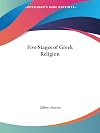
Five Stages of Greek Religion
by Gilbert Murray
On This Page
Description
Beginning with Greece's earliest rites, this volume traces the development of the classic religion of the Olympian gods and discusses the religion of the philosophic schools of the fourth century BC. It portrays the emergence of Christianity and concludes with an account of the efforts of Julian the Apostate to restore a new variety of paganism.Tags
Recommendations


















Member Reviews
A self-admittedly incomplete history of (pagan) Greek religion from Archaic times to late antiquity and the triumph of Christianity. The titular five stages are "primitive" early Greek religion (allegedly) characterized by agricultural cults; the "classical" worship of the Olympian pantheon; the religio-philosophical schools of Cynicism, Stoicism, and Epicureanism; the eclectic, mysticizing and generally ascetical cults of the Hellenistic era; and the abortive pagan revival under Emperor Julian in the fourth century AD.
It's a book that could hardly have been written today, with its matter-of-fact pronouncement that this or that religious conception is high or progressive, or the opposite, that this or that superstition is typical of show more primitive man*. Yet Murray is erudite** and fair-minded, attempting to understand the ancients on their own terms, render their ideas understandable if not agreeable. I don't quite know what I think about the book overall; it's hardly what I'd recommend to anyone wanting to learn about Greek paganism, whether they want something popularly accessible or more academic, yet it was not an unpleasant read.
* Murray takes for granted that Greeks of the earlier Archaic period were "primitive", at least as far as their religious ideas were concerned. Just what "primitive" means to him here is not obvious - presumably not simply primordial, characteristic of the earliest men, since he must have been aware that the cities, metallurgy, sea-going ships, etc of the Archaic Greeks were pretty new things in the grand scheme of human existence. In particular, agricultural cults cannot be primitive in such a sense because agriculture itself is a relative novelty.
** Despite an embarassing lapse where he twice refers to the battle of Cynoscephalae when he obviously means that of Aegospotami. show less
It's a book that could hardly have been written today, with its matter-of-fact pronouncement that this or that religious conception is high or progressive, or the opposite, that this or that superstition is typical of show more primitive man*. Yet Murray is erudite** and fair-minded, attempting to understand the ancients on their own terms, render their ideas understandable if not agreeable. I don't quite know what I think about the book overall; it's hardly what I'd recommend to anyone wanting to learn about Greek paganism, whether they want something popularly accessible or more academic, yet it was not an unpleasant read.
* Murray takes for granted that Greeks of the earlier Archaic period were "primitive", at least as far as their religious ideas were concerned. Just what "primitive" means to him here is not obvious - presumably not simply primordial, characteristic of the earliest men, since he must have been aware that the cities, metallurgy, sea-going ships, etc of the Archaic Greeks were pretty new things in the grand scheme of human existence. In particular, agricultural cults cannot be primitive in such a sense because agriculture itself is a relative novelty.
** Despite an embarassing lapse where he twice refers to the battle of Cynoscephalae when he obviously means that of Aegospotami. show less
Well written but something of a relic of now discarded theories of cultural evolution. Does include a complete translation of Sallustius "On the Gods".
Great but short book detailing the fall of the pagan religion of Greece. Does not cover the rise of Christianity, except as it relates directly to the abandonment of polytheistic worship. Also included is a complete translation of the treatise of Sallustius ('On the Gods and the World'), as possibly a last-ditch effort to justify the worship of the Olympian gods, clearly in their twilight as the Christian star rises to absorb and scorch all it touches.
Edition: // Descr: xvi, 221 p. 18 cm. // Series: Call No. { 948 M86 } Contains Appendix and Index. // //
Ratings
Members
- Recently Added By
Author Information

82+ Works 979 Members
All Editions
Some Editions
Awards and Honors
Notable Lists
Series
Belongs to Publisher Series
Work Relationships
Contains
Is an expanded version of
Common Knowledge
- Original publication date
- 1924
- Important events
- Diasia
Classifications
- Genres
- Nonfiction, Religion & Spirituality, History, General Nonfiction, Philosophy
- DDC/MDS
- 292 — Religion Other religions Greek & Roman Mythology
- LCC
- BL781 .M8 — Philosophy, Psychology and Religion Religions. Mythology. Rationalism Religions. Mythology. Rationalism History and principles of religions European. Occidental Classical (Etruscan, Greek, Roman)
- BISAC
Statistics
- Members
- 290
- Popularity
- 111,462
- Reviews
- 5
- Rating
- (3.76)
- Languages
- English, Greek, Japanese
- Media
- Paper, Ebook
- ISBNs
- 17
- UPCs
- 1
- ASINs
- 15