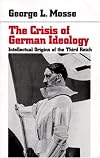
The Crisis of German Ideology: Intellectual Origins of the Third Reich
by George L. Mosse
On This Page
Description
This new edition revisits the renowned historian George L. Mosse's landmark work exploring the ideological foundations of Nazism in Germany. First published in 1964, this volume was among the first to examine the intellectual origins of the Third Reich. Mosse introduced readers to what is known as the vÖlkisch ideal-the belief that the German people were united through a transcendental essence. This mindset led to the exclusion of Jews and other groups, eventually allowing Nazi leaders to show more take their beliefs to catastrophic extremes. The critical introduction by Steven E. Aschheim, the author of Beyond the Border: The German-Jewish Legacy Abroad and many other books, brings Mosse's work into the present moment. George L. Mosse (1918-99) was a legendary scholar, teacher, and mentor. A refugee from Nazi Germany, in 1955 he joined the Department of History at the University of Wisconsin-Madison, where he was both influential and popular. Mosse was an early leader in the study of modern European cultural and intellectual history, fascism, and the history of sexuality and masculinity. Over his career he authored more than two dozen books. show lessTags
Recommendations

































Member Reviews
Not for the faint of heart, but essential for those who want a stronger historical mind and spirit. My caveat is simply based on the inevitable density and complexity of intellectial history, though it should be added that Mosse at best could write with a vigor and clarity recalling the best of the Enlightenment. The sub-title of the book is self-explanatory -- and yet wasn't assumed to be that when he was writing this book. The preponderant opinion then, both on the street and in the academy, was that Nazism had no intellectural pedigree, that its practitioners were all either sub-intellectual sadists, or pitiful mis-understanders of high-culture figures like Wagner. Up to this time, the only English-language compettiton Mosse had show more faced was Peter Viereck's METAPOLITICS: energetic, righteous, entertaining -- and often wildly misleading. Shortly afterward, left-wing hippies were t'rilled and delighted by the appearance of the English-language edition of THE MORNING OF THE MAGICIANS, which suggested, with little scholarshiop and less subtelty, that the Nazis had been right-wing hippies, avant le lettre. Anyway, Mosse's work was pioneering at the time, and has stood the test of time extremely well. After all, his thesis is fairly simple: elitist (and ultimately racist) and authoritarian value were the common intellectual property of many too many people who formed the minds of Germasn youth, in the schools and in the enormous youth-movement.
A few words about the main title, which is far less self-explanatory than the sub-title. Mosse explains it himself in the course of its argument, but it it may be helpful to understand it a little earlier. The crisis was not simply the crumbling of earlier belief-sets but the flooding-in of newly-ascendant irrational systems to replace the old certainties of Christianity, conventional patriotism, the new science, bourgeois accumulation, Marxism, aestheticism and the rest. In this story, the stars are not people like Nietzsche, but obscurities like Langbehn, Lagarde, and Liebenfels. show less
A few words about the main title, which is far less self-explanatory than the sub-title. Mosse explains it himself in the course of its argument, but it it may be helpful to understand it a little earlier. The crisis was not simply the crumbling of earlier belief-sets but the flooding-in of newly-ascendant irrational systems to replace the old certainties of Christianity, conventional patriotism, the new science, bourgeois accumulation, Marxism, aestheticism and the rest. In this story, the stars are not people like Nietzsche, but obscurities like Langbehn, Lagarde, and Liebenfels. show less
Ratings
Members
- Recently Added By
Lists

All Things Germany
321 works; 4 members
Author Information

52+ Works 1,859 Members
George L. Mosse (1918-99) was an influential historian, legendary teacher, and generous mentor. Over his career he authored more than two dozen books on the study of modern European cultural and intellectual history, the study of fascism, and the history of sexuality and masculinity.
Some Editions
Series
Belongs to Publisher Series
Common Knowledge
- Canonical title
- The Crisis of German Ideology: Intellectual Origins of the Third Reich
- Original title
- The Crisis of German Ideology. Intellectual Origins of the Third Reich
- Original publication date
- 1964
- Important places
- Germany
- Original language
- English
Classifications
- Genres
- History, Nonfiction, General Nonfiction
- DDC/MDS
- 943.08 — History & geography History of Europe Central Europe: Germany, Austria, Switzerland, Czech, Poland, Hungary Historical periods of Germany Germany 1866-
- LCC
- DD232 .M6 — History of Europe, Asia, Africa and Oceania Germany History of Germany History By period Modern, 1519- 19th-20th centuries
- BISAC
Statistics
- Members
- 258
- Popularity
- 125,937
- Reviews
- 2
- Rating
- (4.24)
- Languages
- 5 — Czech, English, French, German, Italian
- Media
- Paper, Ebook
- ISBNs
- 17
- ASINs
- 4