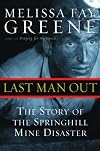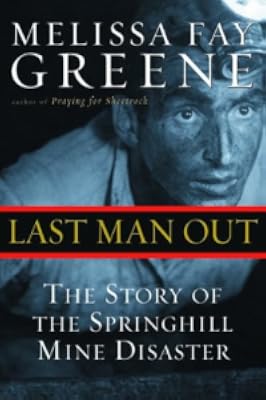
Last Man Out: The Story of the Springhill Mine Disaster
by Melissa Fay Greene
On This Page
Description
One evening in late October 1958, the deepest coal mine in North America "bumped"-its rock floors heaved up and smashed into rock ceilings. Most of the men on the shift perished. But nineteen men were trapped alive a mile below the earth's surface, struggling to survive without food, water, light, or fresh air. Almost a week passed without rescue. Hopes of finding life dwindled; then a miracle happened: Rescuers stumbled across a broken pipe that led to the cave of survivors. In the media show more circus that followed, the survivors' endurance was mythologized and twisted, and the state of Georgia's tourism ploy-inviting the survivors to recuperate on a Georgia beach-turned racist and pitted the miners against each other.Using long-lost stories and interviews with survivors, Greene has reconstructed an extraordinary drama of their struggle and miraculous rescue. show lessTags
Recommendations























Member Reviews
I have come late to Melissa Greene's 2003 Last Man Out, having found it in the bibliography of Ken Cuthbertson's 2023 Blood on the Coal. My curiosity was piqued: Why re-write the history of the 1958 Springhill, Nova Scotia coal mine disaster twenty years after its history had already been written? I determined to read the older account as well so that I could compare the two. Greene's book is, perplexedly, out of print, but a simple Internet search reveals a plethora of sources from which used copies can be ordered, and the more I read in the older book, the poorer the newer one appeared, not because of faulty scholarship or literary quality but simply because of necessity. Greene's book tells of the tragedy and its impact on the people show more involved, and Cuthbertson's adds little to the account. Were it a question of voting by readers of history, I'd certainly have cast my vote in favor of reprinting Greene's book rather than printing an entirely new one that essentially retells the same story in the words of another raconteur. I'm sure that the answer lies somewhere in the arcane economy of the publishing industry, but I am reminded of an observation that I've made before—regardless of its publication date, a book is always new to the reader who comes to it for the first time.
For what it's worth, Greene's bibliography includes a yet older published work on the subject, Roger David Brown's Blood on the Coal: The Story of the Springhill Mining Disasters published in 1994. This seems almost certainly to be the source of Cuthbertson's only slightly amended 2023 title, Blood on the Coal: The True Story of the Great Springhill Mine Disaster. From the title's wording, I assume that Brown spends some pages (as does Greene) on the 1891 fire and the 1956 explosion as well as the 1958 “bump” that features most prominently in Greene's and Cuthbertson's books. It appears as though I must now seek out a copy of Brown's book and see how it compares.
Oh dear, this is supposed to be a review of Greene's book, and so far I haven't said much specifically about it. It is quite readable, and I find Greene a captivating story teller even when her subject is historical fact. As a reader, I do tend to get a bit picky, however, and every now and then Greene allows her gift of narration to transcend certain boundaries, for example when she writes, “All day and all night they chiseled toward the earth's core. . . .” Technically, no mine has ever penetrated the outermost crust of the Earth, never approaching the mantle, much less the core. Even poorer wording comes on page 22 where we find, “Manmade pockets and tunnels and rooms of air between the core of the earth and the crust would not be tolerated indefinitely.” Mines, of course, are totally within the upper levels of the crust, not between the crust and the core. Elsewhere, Greene refers to “the coal mine yawning open under Springhill.” As an underground, not an open pit, mine, no part of it would have been “yawning open.”
Beyond her occasional geological inaccuracies, Greene shows herself capable of a rare but gallingly common error in word usage. On page 73, referring to televisions in miners' homes, one reads, “During the canned laughter, the ground beneath the housewives had dropped away, literally.” Inasmuch as the ground had bumped upward in the subterranean mine, not even reportedly damaging surface structures, no ground “literally” dropped beneath any housewife. Any ground dropping for the wives at home was figurative at best.
Similes and metaphors pose a special danger for writers, who sometimes leave readers with mental images that are not exactly what the authors wish to create. Here's one of Greene's that appears to equate being buried alive with loitering in some alley from a crime novel: “The men's sooty faces were visible, then gone, then visible again, as if they stood on a seedy urban sidewalk late at night, with a half-blown-out VACANCY sign buzzing on and off overhead.” Later, a simile on page 138 left me wondering why raw dough would be sad: “But the sad feeling in his stomach, like a lump of raw dough, remained cold and heavy.”
I did greatly appreciate Greene's explanation—missing from Cuthbertson's book—of the mine levels. When one reads of the “13,400 level,” for example, we understand that 13,400 feet of mine cart rail were required to reach it from the pithead; i.e., the name does not refer to vertical depth from the surface. In that regard, we must credit Cuthbertson for telling us “that the “mine's vertical depth from the pithead down to its nethermost reaches was 4,600 feet,” a clarifying fact that did not make it into Greene's book.
Both books carry the history beyond the geological bump in the mine and the rescue efforts, giving readers a fairly clear glimpse of the aftermath, the impacts on surviving miners and their families as well as on the widows left behind, the psychological crashes that came when the news stories and the resulting celebrity died, and especially the boondoggle created by the Georgia governor and his public relations aide, who invited survivors to vacation at a new resort in the strictly segregated state only to discover that one of those survivors was mulatto! Greene's book does, I think, deliver a much more thorough job of these aftermath events than does Cuthbertson's.
Despite the nits that I have obviously picked with scattered parts of Greene's book, I found Last Man Out both readable and instructive. I believe that I said much the same for Cuthbertson's Blood on the Coal. Readers should find both books of interest, but if a choice must be made, I'd hunt down a used copy of Last Man Out and go with that one. show less
For what it's worth, Greene's bibliography includes a yet older published work on the subject, Roger David Brown's Blood on the Coal: The Story of the Springhill Mining Disasters published in 1994. This seems almost certainly to be the source of Cuthbertson's only slightly amended 2023 title, Blood on the Coal: The True Story of the Great Springhill Mine Disaster. From the title's wording, I assume that Brown spends some pages (as does Greene) on the 1891 fire and the 1956 explosion as well as the 1958 “bump” that features most prominently in Greene's and Cuthbertson's books. It appears as though I must now seek out a copy of Brown's book and see how it compares.
Oh dear, this is supposed to be a review of Greene's book, and so far I haven't said much specifically about it. It is quite readable, and I find Greene a captivating story teller even when her subject is historical fact. As a reader, I do tend to get a bit picky, however, and every now and then Greene allows her gift of narration to transcend certain boundaries, for example when she writes, “All day and all night they chiseled toward the earth's core. . . .” Technically, no mine has ever penetrated the outermost crust of the Earth, never approaching the mantle, much less the core. Even poorer wording comes on page 22 where we find, “Manmade pockets and tunnels and rooms of air between the core of the earth and the crust would not be tolerated indefinitely.” Mines, of course, are totally within the upper levels of the crust, not between the crust and the core. Elsewhere, Greene refers to “the coal mine yawning open under Springhill.” As an underground, not an open pit, mine, no part of it would have been “yawning open.”
Beyond her occasional geological inaccuracies, Greene shows herself capable of a rare but gallingly common error in word usage. On page 73, referring to televisions in miners' homes, one reads, “During the canned laughter, the ground beneath the housewives had dropped away, literally.” Inasmuch as the ground had bumped upward in the subterranean mine, not even reportedly damaging surface structures, no ground “literally” dropped beneath any housewife. Any ground dropping for the wives at home was figurative at best.
Similes and metaphors pose a special danger for writers, who sometimes leave readers with mental images that are not exactly what the authors wish to create. Here's one of Greene's that appears to equate being buried alive with loitering in some alley from a crime novel: “The men's sooty faces were visible, then gone, then visible again, as if they stood on a seedy urban sidewalk late at night, with a half-blown-out VACANCY sign buzzing on and off overhead.” Later, a simile on page 138 left me wondering why raw dough would be sad: “But the sad feeling in his stomach, like a lump of raw dough, remained cold and heavy.”
I did greatly appreciate Greene's explanation—missing from Cuthbertson's book—of the mine levels. When one reads of the “13,400 level,” for example, we understand that 13,400 feet of mine cart rail were required to reach it from the pithead; i.e., the name does not refer to vertical depth from the surface. In that regard, we must credit Cuthbertson for telling us “that the “mine's vertical depth from the pithead down to its nethermost reaches was 4,600 feet,” a clarifying fact that did not make it into Greene's book.
Both books carry the history beyond the geological bump in the mine and the rescue efforts, giving readers a fairly clear glimpse of the aftermath, the impacts on surviving miners and their families as well as on the widows left behind, the psychological crashes that came when the news stories and the resulting celebrity died, and especially the boondoggle created by the Georgia governor and his public relations aide, who invited survivors to vacation at a new resort in the strictly segregated state only to discover that one of those survivors was mulatto! Greene's book does, I think, deliver a much more thorough job of these aftermath events than does Cuthbertson's.
Despite the nits that I have obviously picked with scattered parts of Greene's book, I found Last Man Out both readable and instructive. I believe that I said much the same for Cuthbertson's Blood on the Coal. Readers should find both books of interest, but if a choice must be made, I'd hunt down a used copy of Last Man Out and go with that one. show less
On October 23, 1958, a devastating "bump" occurred at the 13,400 foot level of a coal mine in Springhill, Nova Scotia, Canada. It killed or trapped 174 miners. This book starts with a history of coal mining in Nova Scotia and specifically Springhill and then describes the life of a coal miner and his family.
Greene did years of research including interviewing survivors, children of miners and wives of survivors and victims of the bump. Her descriptions of what the miners experienced during the seven to nine days they waited for rescue make for tough reading. This especially true of the miner whose arm was caught under huge timbers and rocks and could not be freed. Greene described how the experienced destroyed some of the men as they show more never attained their pre disaster personalities becoming poor fathers and husbands.
One unexpected topic the book covers, is the Segregation laws of Georgia and the American deep South. The survivors were given a free holiday on Jekyll Island in Georgia as a tourism promotion. Planning was well on the way when the Governor's assistant discovered there was a black miner in the group. The scrambling to solve this political nightmare for the Georgians makes for interesting reading.
While I was reading, it disturbed me that Greene had included conversations in quotation marks of what took place underground. In her end notes she answers my concern by explaining that the quotes are from transcripts of interviews that were done with the miners immediately after they were rescued.
This is a very complete description of the disaster by a woman from the State of Georgia. show less
Greene did years of research including interviewing survivors, children of miners and wives of survivors and victims of the bump. Her descriptions of what the miners experienced during the seven to nine days they waited for rescue make for tough reading. This especially true of the miner whose arm was caught under huge timbers and rocks and could not be freed. Greene described how the experienced destroyed some of the men as they show more never attained their pre disaster personalities becoming poor fathers and husbands.
One unexpected topic the book covers, is the Segregation laws of Georgia and the American deep South. The survivors were given a free holiday on Jekyll Island in Georgia as a tourism promotion. Planning was well on the way when the Governor's assistant discovered there was a black miner in the group. The scrambling to solve this political nightmare for the Georgians makes for interesting reading.
While I was reading, it disturbed me that Greene had included conversations in quotation marks of what took place underground. In her end notes she answers my concern by explaining that the quotes are from transcripts of interviews that were done with the miners immediately after they were rescued.
This is a very complete description of the disaster by a woman from the State of Georgia. show less
This is a compelling story of miners who were trapped underground. In [Last Man Out] [Melissa Fay Greene] does an excellent job of capturing the emotions of those trapped as well as the families above ground. She also connects the political and economic climate of the time by telling the story of how these Canadian miners ended up connected to Georgia's fight for tourist dollars and caught experiencing segregation first hand. This is an emotional and well told story on many levels.
All her books are great. This could have been a standard disaster-survival tome. Instead it turns out to be about race relations. Don't want to give it away, read it, you won't regret your decision.
This is a rivetting story of a great mine disaster that became a miracle rescue operation. The author has captured the tension, drama, and elation as events unfold, day by day by day. The events of the trip to Georgia, where the hero of the bump was excluded from hotels and dinners because he happened to be black, has been told, and how he encouraged the others to go. A great story.
rabck from quiet orchid; the story of the 1958 Springhill Nova Scotia coal mine "bump" - I would call it a cave in. 174 miners were trapped and a group of 7 and a group of 12 miners were found alive. It was the beginning of "breaking news" journalism, which turned the episode into a fiasco. Author did a good job of bringing together the facts, including a bit of the history of this mine and the miners and their families. A good read
This book is a heroic tale of coal miners surviving a mine disaster in Nova Scotia in 1958. Hardened, veteran coal miners toiling in the depths of darkness would battle for their very essence of life when the coal mine collapsed one fateful day. Nineteen miners would struggle to survive in the cavernous underground tomb; so black, so gaseous, that it is a miracle the miners would live to see daylight. Sadly, some did not.
This book is rivoting, gripping, and it pulls at your very heart strings.
The author, Melissa Faye Greene superbly leaves out no details about the disaster, the miners, their families, the town, the mining company, and the aftermath when the dust settles. Additionally, Greene captures raw emotions including love, show more courage, anger, despair, pain, and ultimately the test of humanities strength and comradirie in the face of doom.
This is a must read for reader's that love true life accounts of humanity's struggle to survive in the face of adversity.
I recommend it highly. show less
This book is rivoting, gripping, and it pulls at your very heart strings.
The author, Melissa Faye Greene superbly leaves out no details about the disaster, the miners, their families, the town, the mining company, and the aftermath when the dust settles. Additionally, Greene captures raw emotions including love, show more courage, anger, despair, pain, and ultimately the test of humanities strength and comradirie in the face of doom.
This is a must read for reader's that love true life accounts of humanity's struggle to survive in the face of adversity.
I recommend it highly. show less
Members
- Recently Added By
Lists

Accidents, Disasters, and Tragedies
175 works; 7 members
Author Information

8 Works 1,591 Members
Melissa Fay Greene was a paralegal with Legal Services in McIntosh County, Georgia, when the events that make up her award-winning book Praying for Sheetrock (1991) took place. A recipient of the National Book Critics Circle Award, and a National Book Award finalist, Praying for Sheetrock is set in the early 1970s, when the struggle for civil show more rights that had been going on for years in other parts of the U.S. finally came to McIntosh County. Greene's next book, The Temple Bombing (1996) was the winner of the 1996 Southern Book Critics Award, was named a New York Times Notable Book, and was also a National Book Award finalist. It concerns the 1958 bombing of the Temple, the oldest synagogue in Atlanta. (Bowker Author Biography) show less
Common Knowledge
- Original publication date
- 2003
- People/Characters
- Harold Brine; Arnold Burden; Sam Caldwell; Garnet Clarke; Marvin Griffin; Hughie Guthro (show all 26); Margie Guthro; Joseph Holloway; Frank Hunter; Fred "Teddy" Hunter; Doug Jewkes; Gorley Kempt; Margie Kempt; Larry Leadbetter; Eldred Lowther; Bowman Maddison; Joseph McDonald; Ted Michniak; Levi Milley; Herb Pepperdine; Percy Rector; Maurice Ruddick; Norma Ruddick; Caleb Rushton; Currie Smith; Elaine Turnbull
- Important places
- Springhill, Nova Scotia, Canada; Jekyll Island, Georgia, USA
- Important events
- Springhill Mine Explosions
- Dedication
- To our kids:
Molly, Seth, Lee,
Lily, Jesse, and Helen - First words
- In the town of Springhill, Nova Scotia, in 1958, coal-mining men dropped through to crust of the earth to a few of the deepest roads on the planet.
Classifications
- Genres
- Nonfiction, General Nonfiction, History, Biography & Memoir
- DDC/MDS
- 363.11 — Society, government, & culture Social problems and social services Public Safety - Police, Crime Investigation Public safety from hazards Occupational and industrial hazards
- LCC
- TN806 .C2 .G74 — Technology Mining engineering. Metallurgy Mining engineering. Metallurgy Nonmetallic minerals
- BISAC
Statistics
- Members
- 129
- Popularity
- 253,328
- Reviews
- 8
- Rating
- (4.04)
- Languages
- English
- Media
- Paper, Audiobook
- ISBNs
- 7
- ASINs
- 1