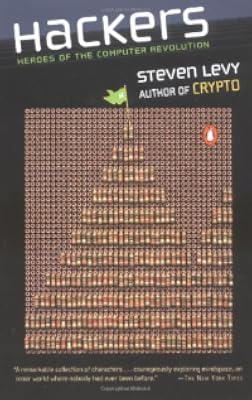
Hackers: Heroes of the Computer Revolution
by Steven Levy
On This Page
Description
This 25th anniversary edition of Steven Levy's classic book traces the exploits of the computer revolution's original hackers -- those brilliant and eccentric nerds from the late 1950s through the early '80s who took risks, bent the rules, and pushed the world in a radical new direction. With updated material from noteworthy hackers such as Bill Gates, Mark Zuckerberg, Richard Stallman, and Steve Wozniak, Hackers is a fascinating story that begins in early computer research labs and leads to show more the first home computers. Levy profiles the imaginative brainiacs who found clever and unorthodox solutions to computer engineering problems. They had a shared sense of values, known as "the hacker ethic," that still thrives today. Hackers captures a seminal period in recent history when underground activities blazed a trail for today's digital world, from MIT students finagling access to clunky computer-card machines to the DIY culture that spawned the Altair and the Apple II. show lessTags
Recommendations








Member Recommendations
Member Reviews
A classic account of the anarchic American programmers who shaped the computer revolution in the 1960s and 70s with their poor social skills and personal hygiene, thirty-hour days at the keyboard, and conviction that information should be free. Or at least we like to think that it was the hackers who made it all possible, not the corporate dogsbodies in suits who worked office hours and documented everything they did according to the rules.
Levy is a tech journalist; he wrote the book in 1984, based on numerous interviews with the people involved, and it reads more like an overgrown magazine feature than a history, but that’s not necessarily a bad thing. He is writing about people he knows, and there’s a lot of freshness and show more sympathy in the way he describes them. We get to see how people with a real passion for what they were doing simply went ahead and achieved things that sober business or engineering analysts would have ruled out as impracticable.
But of course it’s also a very partial story — Levy looks at the corners of the industry that were sexy at any given moment but doesn’t give us much real context for the other things that were going on at the same time in hardware development and programming. He is also completely blind to anything happening anywhere else in the world than Massachusetts or California. It’s very interesting as far as it goes, but don’t expect a complete history of computing.
I read the 2010 edition, which also comes with a couple of short “where are they now” epilogues and a little bit of reflection on the legacy of the “hacker ethic”, which of course is mainly visible now in the open-source software movement and Linux. Levy laments the way that journalists have taken the word “hacker” and associated it in our imagination with the criminal or destructive misuse of computer systems, something that would have horrified the original hacker generation at MIT. show less
Levy is a tech journalist; he wrote the book in 1984, based on numerous interviews with the people involved, and it reads more like an overgrown magazine feature than a history, but that’s not necessarily a bad thing. He is writing about people he knows, and there’s a lot of freshness and show more sympathy in the way he describes them. We get to see how people with a real passion for what they were doing simply went ahead and achieved things that sober business or engineering analysts would have ruled out as impracticable.
But of course it’s also a very partial story — Levy looks at the corners of the industry that were sexy at any given moment but doesn’t give us much real context for the other things that were going on at the same time in hardware development and programming. He is also completely blind to anything happening anywhere else in the world than Massachusetts or California. It’s very interesting as far as it goes, but don’t expect a complete history of computing.
I read the 2010 edition, which also comes with a couple of short “where are they now” epilogues and a little bit of reflection on the legacy of the “hacker ethic”, which of course is mainly visible now in the open-source software movement and Linux. Levy laments the way that journalists have taken the word “hacker” and associated it in our imagination with the criminal or destructive misuse of computer systems, something that would have horrified the original hacker generation at MIT. show less
I'm still sort of processing this book a week later. All the status updates I posted are notes I wrote on paper while I was reading, alas I ran out of scraps while sick in bed, somewhere around pg 350. (the goodreads entry says this has more pages than the copy I have, btw.)
Note: this is a really long and somewhat rambling review.
A few themes stick out, notably West coast vs East coast. No, seriously. The first section is all MIT hackers, the other two are west coast focused (hippie hackers and the gaming biz). Shockingly, the hippie hacker community actually manage to get more shit done.
My pet theory is that it relates to engagement with the rest of the world. Those MIT guys really got to lock themselves away from everything, and they show more really liked it that way. (There's some interesting moments of cognitive dissonance of the radical openness within the lab vs the military funding for the lab.) Which meant they were doing fascinating crazy stuff, but it didn't necessarily have any effect on the masses. Whereas the hippies -- or at least some of the influential folks in that scene -- actually cared about the rest of the world. And of course the gamers were out to make money. So they were the ones who got computing and the hacker ethos out into the world.
Another thing that I kept running into: I'd be excited about the hackers' excitement, totally understanding that sense of flow...and then: ugh, thoroughly unpleasant people. Not just unpleasant individuals, but a repellent culture. I found that most true of the MIT hackers and the gamers, FWIW.
Possibly related: the overwhelming maleness of the hacker culture throughout the entire book. A lack of balance?
Also possibly related: a quote about Stallman (p 438) - "He recognized that his personality was unyielding to the give-and-take of common human interaction." (That line? Made me bust up laughing.)
Another somewhat random observation: baby boomers. Didn't occur to me until reading the last afterword, and the conversation between Levy & Gates, that all these hackers were boomers. I'd never really thought about the hacker ethos/community as also being a creation of that generation. Huh.
What does all this mean to the things I've ranted about on my blog? (I had that in the back of my head while I was reading, based on an email conversation with the person who sent me the book.) I'm still not sure. It does make the underlying ethos of Facebook make more sense, although not any less repellent. In fact, maybe it's more so, because there's a historical thread connecting it to guys crawling through the ceiling to steal keys out of desks. (WTF? That still blows my mind.) And thus, a lack of learning how the rest of the world perceives reality.
And for the gender thing? I see it even more, and I keep wondering how much of our current situation is "inevitable" given the history, what would have happened if the history had been different, etc. It also contexualizes the history of sexism in computing against the history of sexism in general (wait, did that sentence make any sense?) - the whole damn world was sexist then. My mother was one of three women in her high school trig class, and IIRC she was the only one who finished. Whereas when I took higher math in high school, I'd say the class was split more like 50/50. So the idea of the MIT hackers that there's some biological difference that kept women out of their world is nuts. Their world -- despite its lack of football -- was hyper-masculine, disconnected from anything that wasn't the guys and the machines. The story of the woman whose program got screwed up because of an unauthorized upgrade by hackers -- and she was doing something "real" -- made a impression on me as far as that's concerned. But that impression of hackerdom being a male province only fed on itself, so that women who were interested in computers were an oddity. (For example, what happened to the "housewives" who disappeared into the community center computer? Why weren't they able to become part of the hacker community?)
As I said, I'm still processing.
And that said, it was a well-written book; fantastic story-telling. The follow-ups were interesting as well, given that the book ends basically with a reference to the movie Wargames. Good stuff, overall, and definitely recommended. show less
Note: this is a really long and somewhat rambling review.
A few themes stick out, notably West coast vs East coast. No, seriously. The first section is all MIT hackers, the other two are west coast focused (hippie hackers and the gaming biz). Shockingly, the hippie hacker community actually manage to get more shit done.
My pet theory is that it relates to engagement with the rest of the world. Those MIT guys really got to lock themselves away from everything, and they show more really liked it that way. (There's some interesting moments of cognitive dissonance of the radical openness within the lab vs the military funding for the lab.) Which meant they were doing fascinating crazy stuff, but it didn't necessarily have any effect on the masses. Whereas the hippies -- or at least some of the influential folks in that scene -- actually cared about the rest of the world. And of course the gamers were out to make money. So they were the ones who got computing and the hacker ethos out into the world.
Another thing that I kept running into: I'd be excited about the hackers' excitement, totally understanding that sense of flow...and then: ugh, thoroughly unpleasant people. Not just unpleasant individuals, but a repellent culture. I found that most true of the MIT hackers and the gamers, FWIW.
Possibly related: the overwhelming maleness of the hacker culture throughout the entire book. A lack of balance?
Also possibly related: a quote about Stallman (p 438) - "He recognized that his personality was unyielding to the give-and-take of common human interaction." (That line? Made me bust up laughing.)
Another somewhat random observation: baby boomers. Didn't occur to me until reading the last afterword, and the conversation between Levy & Gates, that all these hackers were boomers. I'd never really thought about the hacker ethos/community as also being a creation of that generation. Huh.
What does all this mean to the things I've ranted about on my blog? (I had that in the back of my head while I was reading, based on an email conversation with the person who sent me the book.) I'm still not sure. It does make the underlying ethos of Facebook make more sense, although not any less repellent. In fact, maybe it's more so, because there's a historical thread connecting it to guys crawling through the ceiling to steal keys out of desks. (WTF? That still blows my mind.) And thus, a lack of learning how the rest of the world perceives reality.
And for the gender thing? I see it even more, and I keep wondering how much of our current situation is "inevitable" given the history, what would have happened if the history had been different, etc. It also contexualizes the history of sexism in computing against the history of sexism in general (wait, did that sentence make any sense?) - the whole damn world was sexist then. My mother was one of three women in her high school trig class, and IIRC she was the only one who finished. Whereas when I took higher math in high school, I'd say the class was split more like 50/50. So the idea of the MIT hackers that there's some biological difference that kept women out of their world is nuts. Their world -- despite its lack of football -- was hyper-masculine, disconnected from anything that wasn't the guys and the machines. The story of the woman whose program got screwed up because of an unauthorized upgrade by hackers -- and she was doing something "real" -- made a impression on me as far as that's concerned. But that impression of hackerdom being a male province only fed on itself, so that women who were interested in computers were an oddity. (For example, what happened to the "housewives" who disappeared into the community center computer? Why weren't they able to become part of the hacker community?)
As I said, I'm still processing.
And that said, it was a well-written book; fantastic story-telling. The follow-ups were interesting as well, given that the book ends basically with a reference to the movie Wargames. Good stuff, overall, and definitely recommended. show less
I originally read Hackers when it was new, as I'd already been reading Levy's computer explorations elsewhere. Rereading it was great fun.
Steven Levy pretty much framed the way we remember the early personal computing days with this book. This is a collection of stories--three main ones, and a host of smaller tales within the large ones. The main stories cover the MIT hackers of the 60s and 70s, the Bay Area folks revolving around the Homebrew club who perfected the modern personal computer, and Sierra Online's birth as an important gaming company. The smaller stories are mainly about individuals and events. Over the course of the book the emphasis changes from truly personal hacking to the ways hackers interacted with the development show more of their obsession into an important industry. This journey into business defines the book.
Then the first appendix circles back to MIT, and Richard Stallman, and the nature and culture of hacking. Two other appendices, written for the tenth and twenty-fifth anniversary editions, do some updating--and muse, once again, about the nature, costs, and benefits of the changes the main book sketches.
Levy managed to identify many the key figures in the computing revolution while that revolution was occurring, and they make appearances in the story. But most of the book's characters are minor actors on the world's stage, and could be seen as representative types were they not so clearly individuals. We see, again and again, youngsters (almost always boys) mastering machines (or code, or both), then trying to master themselves. The outcomes vary enormously.
Levy might have written a different book--perhaps Berkeley rather than MIT, ARPANET instead of Homebrew, Peachtree might replace Sierra--and reached similar conclusions. I knew midwestern PDP-7 hackers every bit as obsessed as any described here, and they'd have made fine fodder for Levy's musings. And he'd have found hackers in IBM, had he looked. But Levy's story works, and we've largely internalized it.
Terrific book. Well worth your time, if you've not read it.
Late note 8/22/10: Freiberger and Swaine's Fire in the Valley approximates the alternative book I describe a couple paragraphs up, at least in part. Both books are worth reading; in fact, I'd call them both essential to understanding this industry's roots.
This review has also been published on a dabbler's journal. show less
Steven Levy pretty much framed the way we remember the early personal computing days with this book. This is a collection of stories--three main ones, and a host of smaller tales within the large ones. The main stories cover the MIT hackers of the 60s and 70s, the Bay Area folks revolving around the Homebrew club who perfected the modern personal computer, and Sierra Online's birth as an important gaming company. The smaller stories are mainly about individuals and events. Over the course of the book the emphasis changes from truly personal hacking to the ways hackers interacted with the development show more of their obsession into an important industry. This journey into business defines the book.
Then the first appendix circles back to MIT, and Richard Stallman, and the nature and culture of hacking. Two other appendices, written for the tenth and twenty-fifth anniversary editions, do some updating--and muse, once again, about the nature, costs, and benefits of the changes the main book sketches.
Levy managed to identify many the key figures in the computing revolution while that revolution was occurring, and they make appearances in the story. But most of the book's characters are minor actors on the world's stage, and could be seen as representative types were they not so clearly individuals. We see, again and again, youngsters (almost always boys) mastering machines (or code, or both), then trying to master themselves. The outcomes vary enormously.
Levy might have written a different book--perhaps Berkeley rather than MIT, ARPANET instead of Homebrew, Peachtree might replace Sierra--and reached similar conclusions. I knew midwestern PDP-7 hackers every bit as obsessed as any described here, and they'd have made fine fodder for Levy's musings. And he'd have found hackers in IBM, had he looked. But Levy's story works, and we've largely internalized it.
Terrific book. Well worth your time, if you've not read it.
Late note 8/22/10: Freiberger and Swaine's Fire in the Valley approximates the alternative book I describe a couple paragraphs up, at least in part. Both books are worth reading; in fact, I'd call them both essential to understanding this industry's roots.
This review has also been published on a dabbler's journal. show less
An lively and detailed account of the early years of the computer revolution told from the perspective of the ambitious, sleep-deprived nerds who helped make it happen. Levy seems to have conducted extensive interviews with many of his story's leading protagonists, which allows him to capture their quirkiest aspects and probe their often complicated personal lives. He's also good about making the world of computing seem accessible to lay readers who do not have any previous knowledge of computer science. "Hackers" is reminiscent of a rock documentary in which tech geeks have replaced lead guitarists. Businesses are started in garages, unbelievably talented amateur engineers "hack," or improvise and code, into the wee hours of the show more morning, creativity explodes, and fortunes get made. Some of these poindexters even manage to get laid. Levy makes the technical feats that early computer fans achieved seem impressive and their boundless enthusiasm infectious, and it's amazing to realize that the computing power of yesterday's "supercomputers" is now available in today's pocket-size devices. Reading stories of how the home computer users of the late seventies tore their fingers to shreds on the Altair's switches made me more grateful than ever for my idiot-proof Mac Mini.
Sadly, the author's tone also contributes to the novel's biggest failing. Levy has well-defined ideas about how computer technology should be advanced. He's all for collaboration and "open source" sharing and dislikes bureaucracy and standardization. When many of the companies he chronicles go big and adapt standard corporate structures, his regret, and even disapproval, is palpable. Still, it's hard to imagine that the computer revolution could have grown beyond a small circle of enthusiasts without a large injection of capital and the introduction of standard, user-friendly machines aimed at the non-egghead. While Levy sometimes pauses to acknowledge this, his book sometimes threatens to turn into more of a screed than a history. At four hundred and fifty pages, "Hackers" could also be said to run a bit long, but it provides up-close reportage on an exciting and transformative time that readers are unlikely to find elsewhere. show less
Sadly, the author's tone also contributes to the novel's biggest failing. Levy has well-defined ideas about how computer technology should be advanced. He's all for collaboration and "open source" sharing and dislikes bureaucracy and standardization. When many of the companies he chronicles go big and adapt standard corporate structures, his regret, and even disapproval, is palpable. Still, it's hard to imagine that the computer revolution could have grown beyond a small circle of enthusiasts without a large injection of capital and the introduction of standard, user-friendly machines aimed at the non-egghead. While Levy sometimes pauses to acknowledge this, his book sometimes threatens to turn into more of a screed than a history. At four hundred and fifty pages, "Hackers" could also be said to run a bit long, but it provides up-close reportage on an exciting and transformative time that readers are unlikely to find elsewhere. show less
One of my absolute favorite tech-related books of all time. Read it a half-dozen times, at least.
It's somewhat better-written than most of Levy's books (like the painful "In the Plex"), though it bears the same biases that his other work does. I don't know if it's a long-form journalist tendency, but Levy's books and articles all seem to be written as if they're telling The Whole Story, though they are heavily skewed by the people who were most willing to be interviewed extensively. Any writer has to work with the material he can uncover, but it would be nice if it were a little more openly acknowledged that a lot of the story told as history is really personal recollection on the part of a participant who *might* still have an axe to show more grind.
But this one is so, SO good in spite of all of that, and what a golden and glorious age it covers! show less
It's somewhat better-written than most of Levy's books (like the painful "In the Plex"), though it bears the same biases that his other work does. I don't know if it's a long-form journalist tendency, but Levy's books and articles all seem to be written as if they're telling The Whole Story, though they are heavily skewed by the people who were most willing to be interviewed extensively. Any writer has to work with the material he can uncover, but it would be nice if it were a little more openly acknowledged that a lot of the story told as history is really personal recollection on the part of a participant who *might* still have an axe to show more grind.
But this one is so, SO good in spite of all of that, and what a golden and glorious age it covers! show less
History, myth, manifesto and an almost universal touchstone for hackers (software engineer kind not trenchcoat wearing blue haired credit card stealing criminals).
It's really sad to read the 25th anniversary edition with the 2010 addendum to see it go from homebrew computer club to facebook. I wish the addendum was more upbeat but I guess it faithfully represents the reality. The consumers remained just that and the software running on their devices is made by corporations like Microsoft. The revolution happened differently to how the original hackers imagined it would but it's not over yet. It lives on in FSF and open source software.
It's really sad to read the 25th anniversary edition with the 2010 addendum to see it go from homebrew computer club to facebook. I wish the addendum was more upbeat but I guess it faithfully represents the reality. The consumers remained just that and the software running on their devices is made by corporations like Microsoft. The revolution happened differently to how the original hackers imagined it would but it's not over yet. It lives on in FSF and open source software.
Being younger than the original edition of this book, I never lived through the personal computer revolution. For someone like me this book therefore provides a valuable history lesson in the development of the hacker culture which emerged not long after the computers were conceived. In essence it is the story of evolution of computing leading to the emergence of PCs, told through stories of the leaders in this field. It is well-written and I found the pacing well suited to the material.
The stories contained here would be inspirational for anyone dealing with computing today - the levels of enthusiasm, creativity and devotion of the protagonists as described in the book are quite frankly infectious. The dangers of computer obsession and show more the industry are also well conveyed.
I would have been interested in reading more updated material in the 25th anniversary edition about the recent developments in computing. show less
The stories contained here would be inspirational for anyone dealing with computing today - the levels of enthusiasm, creativity and devotion of the protagonists as described in the book are quite frankly infectious. The dangers of computer obsession and show more the industry are also well conveyed.
I would have been interested in reading more updated material in the 25th anniversary edition about the recent developments in computing. show less
Members
- Recently Added By
Published Reviews
ThingScore 100
"Part of the success of this book is down to the great writing, which makes it exciting finding out how being able to pick a lock became every bit as important as programming in the early years of hacking culture. ... 10/10"
added by legallypuzzled
Lists

Non-Fiction Worth Reading
1,016 works; 262 members
Author Information

13 Works 5,480 Members
Steven Levy is a senior editor for "Newsweek." For ten years he wrote the "Iconoclast" column for "MacWorld" magazine. His previous books include "Hackers" & "Artificial Life." (Bowker Author Biography)
Awards and Honors
Notable Lists
Series
Belongs to Publisher Series
Common Knowledge
- Original publication date
- 1984-11-02
- People/Characters
- Bill Gosper; Richard Greenblatt; John Draper; Bill Gates; Steve Jobs; Marvin Minsky (show all 14); Peter Samson; Alan Kotok; Jack Dennis; Bob Saunders; Steve Russell; Hubert Dreyfus; Stew Nelson; Ed Fredkin
- Important places
- Cyberspace; Massachusetts Institute of Technology; Cambridge, Massachusetts, USA; Vril-ya Country
Classifications
- Genres
- Technology, Nonfiction, General Nonfiction, History, Biography & Memoir
- DDC/MDS
- 005 — Computer science, information & general works Computer science, knowledge & systems Artificial Intelligence/Virtual Reality
- LCC
- QA76.6 .L469 — Science Mathematics Mathematics Instruments and machines Calculating machines Electronic computers. Computer science
- BISAC
Statistics
- Members
- 1,939
- Popularity
- 10,978
- Reviews
- 22
- Rating
- (4.23)
- Languages
- 6 — English, French, Italian, Korean, Russian, Turkish
- Media
- Paper, Audiobook, Ebook
- ISBNs
- 18
- ASINs
- 12