
On This Page
Description
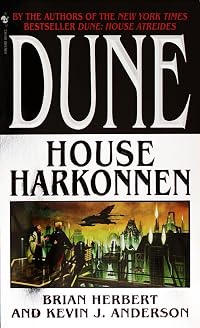
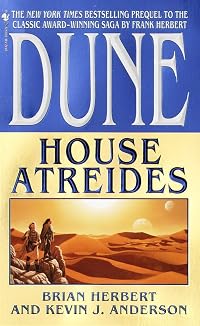
Brian Herbert and Kevin J. Anderson return to the vivid universe of Frank Herbert's Dune, bringing a vast array of rich and complex characters into conflict to shape the destiny of worlds.As Shaddam sits at last on the Golden Lion Throne, Baron Vladimir Harkonnen plots against the new Emperor and House Atreides-and against the mysterious Sisterhood of the Bene Gesserit. For Leto Atreides, grown complacent and comfortable as ruler of his House, it is a time of momentous choice: between show more friendship and duty, safety and destiny. But for the survival of House Atreides, there is just one choice: strive for greatness or be crushed. show lessTags
Recommendations










Member Reviews
It's often said that the definition of insanity is doing the same thing over and over again, yet expecting different results.
When I read Dune: House Atreides by Brian Herbert and Kevin J. Anderson, I was disappointed by a book that could in no way, shape, or form, even begin to slake the thirst that Frank Herbert's Dune books created. Brian and KJA gave us what you would expect from them: expository text that is at times insulting to the reader, stuffed to the gills with flowery prose (so you don't notice the smell), and an acute case of thesaurusitis.
So, I must have been insane, at least, temporarily, when I thought that House Harkonnen would be different. Were I the authors of this book, I would have followed that statement with a "It show more wasn't," because that's just what you can come to expect from the son of a great writer and a professional fan fiction author.
The only redeeming quality of this book is that you don't actually have to pay attention to what you're reading when you're reading. Any guns of Chekhov's that are seeded on page 10 don't need to be noticed by the reader, because before it's fired, you'll get reminded of its presence and told its significance, and why you should care.
In a few more years, I may give another non-Frank Dune book a shot, but in my sampling of the crap that these two jokers produced and are still producing (and surprisingly, people are still buying) there is no point in reading these books. The synopses of these books are better written, and cut out most of the fluffy fat that you can come to expect from these two "authors."
Highly unrecommended. show less
When I read Dune: House Atreides by Brian Herbert and Kevin J. Anderson, I was disappointed by a book that could in no way, shape, or form, even begin to slake the thirst that Frank Herbert's Dune books created. Brian and KJA gave us what you would expect from them: expository text that is at times insulting to the reader, stuffed to the gills with flowery prose (so you don't notice the smell), and an acute case of thesaurusitis.
So, I must have been insane, at least, temporarily, when I thought that House Harkonnen would be different. Were I the authors of this book, I would have followed that statement with a "It show more wasn't," because that's just what you can come to expect from the son of a great writer and a professional fan fiction author.
The only redeeming quality of this book is that you don't actually have to pay attention to what you're reading when you're reading. Any guns of Chekhov's that are seeded on page 10 don't need to be noticed by the reader, because before it's fired, you'll get reminded of its presence and told its significance, and why you should care.
In a few more years, I may give another non-Frank Dune book a shot, but in my sampling of the crap that these two jokers produced and are still producing (and surprisingly, people are still buying) there is no point in reading these books. The synopses of these books are better written, and cut out most of the fluffy fat that you can come to expect from these two "authors."
Highly unrecommended. show less
While the House Trilogy had a few nice scenes, it was an ultimately unneccessary trilogy which was only exacerbated by the fact that Brian and Kevon chose to write this and another McDune trilogy BEFORE they finally did Dune 7 (and what a HUGE disappointment that was!)
Baron Harkonnen is getting fatter and fatter and he hates it and it makes him mad at the Bene Gesserit. In the real Dune books, he isn't bothered by this and seems to enjoy it, so Brian and Kevin basically ruined it for us by retconning the character of Harkonnen to make him more pathetic and almost clownishly evil instead of the brilliant mastermind he was in the real Dune books. This is only one of many, many problems which plague the trilogy.
Leto's romance with Kailea show more and what ensues was just silly. In the Dune books, Ix wasn't ruled by a royal family. I did enjoy the intrigue of the Corrino royal family with what happened to Elrood, but there are very few enjoyable parts in this book and the other McDune books. Stick with the real Dune books by Frank Herbert. show less
Baron Harkonnen is getting fatter and fatter and he hates it and it makes him mad at the Bene Gesserit. In the real Dune books, he isn't bothered by this and seems to enjoy it, so Brian and Kevin basically ruined it for us by retconning the character of Harkonnen to make him more pathetic and almost clownishly evil instead of the brilliant mastermind he was in the real Dune books. This is only one of many, many problems which plague the trilogy.
Leto's romance with Kailea show more and what ensues was just silly. In the Dune books, Ix wasn't ruled by a royal family. I did enjoy the intrigue of the Corrino royal family with what happened to Elrood, but there are very few enjoyable parts in this book and the other McDune books. Stick with the real Dune books by Frank Herbert. show less
I got a hundred pages in before saying to myself, "What was I thinking?" Brian Herbert's half (what there was of it that was detectable; I severely suspect that the only reason his name is on the dust jacket was for marketing purposes) barely covers up the stink of Kevin Anderson's goopy, vapid, deliberate "prose."Contrary to the reviewer's blurbs, this cash cow in the shape of a book is painfully contrived, insultingly predictable, and completely not in the spirit of Dune.Dropped it like it was hot and didn't finish it. Why bother?
Interesting from the point of view of getting background on characters in Dune but the writing in places is somewhat stilted. I enjoyed reading it but would not recommend reading it to the casual reader.
Interesting book, with one big issue - a nice Harkonnen. This needs to be written in words of fire - HARKONNENS ARE BAD, THEY HAVE ALWAYS BEEN BAD, THEY WILL ALWAYS BE BAD! So Abulard, the thoroughly nice but totally ineffectual half-brother of the Baron, ruined the book for me.
(Note - I have not read other Dune prequels than this one.)
I'd had this book sitting in my bookshelf for a couple of years now, but hadn't previously gotten past the first page. I originally picked it up despite some misgivings - one of the two authors was Kevin J. Anderson, widely reviled for having written some of the most mediocre and uninteresting additions to the Star Wars universe. Still, it was a cheap paperback and I've always loved reading about the bad guys (who hasn't?), so I ended up buying the thing. But then I never got around reading it, partly because of my distrust towards the author, partly because the first couple of pages started off with such an uninteresting scene. But I finally got around reading it last show more weekend.
Unlike you'd assume from the title, it doesn't really concentrate on the Harkonnens. While they certainly do get a respectable amount of attention, the Atreides get as much if not more, and the same goes for a couple of unaffiliated characters. I found the structure of the book to be interesting: the chapters were all pretty short, averaging maybe 5-10 pages each, giving a tensely packed share of one character's doings and then switching to another in the next chapter. While this helped keep the pace fast and the book easy to read, I found that the atmosphere suffered somewhat. I simply didn't have the time to get emotionally involved in each scene before it already switched to the next.
From a book named "House Harkonnen", I'd have expected it to deepen the personalities of the Harkonnen characters, tell us more about their house and the society of the planets they ruled, and so on. Not so. Over on tvtropes.org, there's a trope called Kick the Dog. It's that moment where an author wants to make it obvious to even the most dim-witted reader that his villain is really evil, and has the character do something blatantly cold and cruel, like kicking an innocent dog for no reason. With the exception of one character - who's viewed as an incompetent black sheep by the others, and who eventually ends up annoying even the reader for his repeated inability to look enough ahead - Kick the Dog moments are the only kind of scenes that the Harkonnen characters seem to get in the book. They get absolutely no character development of any kind, and seem more like caricatures than real people. By the time you get to the last pages, Vladimir Harkonnen's habit of executing anybody who fails him - whether by their own fault or not - has reached such exaggareted proportions that you feel more like you were watching a children's comic with a cardboard villain than reading a serious book.
The book also has the general problem that prequels easily have - you know how things will be by the time of the original series, and thus you know what world-changing plans are doomed to fail. Throughout the book, there are plans that can't succeed, characters that have to die, events that must come to nothing. At one point, a character has a ploy for assassinating both the Emperor and his whole family, an event that would be so cataclysmic and wide-reaching that you're rooting him to succeed just so you'd get to see the consequences - but then you also know that he simply cannot succeed, no matter what. It's all quite frustrating: a good prequel could give entirely new twists to what you thought you knew, giving an entire new dimension to the events in the original books. House Harkonnen does none of that - it takes tidbits mentioned in the original books and expands on them, but not enough to make them really interesting, not adding anything on them that we couldn't have easily imagined from their original description. To top it off, some of the events by which such loose threads are terminated feel all too convenient and contrived.
Despite all of this, there's something odd in the book that kept me turning the pages and wouldn't easily allow me to put it down after having started reading it. It feels a bit like the Harry Potter books - you know their literary merits aren't all that special, but you still have to keep reading. (Though I'd note that the HP books are better than this book.) Regardless of all the flaws, I'd still give it four stars out of five - simply because any 700+ page book that's good enough for me to finish in about five days deserves that amount. show less
I'd had this book sitting in my bookshelf for a couple of years now, but hadn't previously gotten past the first page. I originally picked it up despite some misgivings - one of the two authors was Kevin J. Anderson, widely reviled for having written some of the most mediocre and uninteresting additions to the Star Wars universe. Still, it was a cheap paperback and I've always loved reading about the bad guys (who hasn't?), so I ended up buying the thing. But then I never got around reading it, partly because of my distrust towards the author, partly because the first couple of pages started off with such an uninteresting scene. But I finally got around reading it last show more weekend.
Unlike you'd assume from the title, it doesn't really concentrate on the Harkonnens. While they certainly do get a respectable amount of attention, the Atreides get as much if not more, and the same goes for a couple of unaffiliated characters. I found the structure of the book to be interesting: the chapters were all pretty short, averaging maybe 5-10 pages each, giving a tensely packed share of one character's doings and then switching to another in the next chapter. While this helped keep the pace fast and the book easy to read, I found that the atmosphere suffered somewhat. I simply didn't have the time to get emotionally involved in each scene before it already switched to the next.
From a book named "House Harkonnen", I'd have expected it to deepen the personalities of the Harkonnen characters, tell us more about their house and the society of the planets they ruled, and so on. Not so. Over on tvtropes.org, there's a trope called Kick the Dog. It's that moment where an author wants to make it obvious to even the most dim-witted reader that his villain is really evil, and has the character do something blatantly cold and cruel, like kicking an innocent dog for no reason. With the exception of one character - who's viewed as an incompetent black sheep by the others, and who eventually ends up annoying even the reader for his repeated inability to look enough ahead - Kick the Dog moments are the only kind of scenes that the Harkonnen characters seem to get in the book. They get absolutely no character development of any kind, and seem more like caricatures than real people. By the time you get to the last pages, Vladimir Harkonnen's habit of executing anybody who fails him - whether by their own fault or not - has reached such exaggareted proportions that you feel more like you were watching a children's comic with a cardboard villain than reading a serious book.
The book also has the general problem that prequels easily have - you know how things will be by the time of the original series, and thus you know what world-changing plans are doomed to fail. Throughout the book, there are plans that can't succeed, characters that have to die, events that must come to nothing. At one point, a character has a ploy for assassinating both the Emperor and his whole family, an event that would be so cataclysmic and wide-reaching that you're rooting him to succeed just so you'd get to see the consequences - but then you also know that he simply cannot succeed, no matter what. It's all quite frustrating: a good prequel could give entirely new twists to what you thought you knew, giving an entire new dimension to the events in the original books. House Harkonnen does none of that - it takes tidbits mentioned in the original books and expands on them, but not enough to make them really interesting, not adding anything on them that we couldn't have easily imagined from their original description. To top it off, some of the events by which such loose threads are terminated feel all too convenient and contrived.
Despite all of this, there's something odd in the book that kept me turning the pages and wouldn't easily allow me to put it down after having started reading it. It feels a bit like the Harry Potter books - you know their literary merits aren't all that special, but you still have to keep reading. (Though I'd note that the HP books are better than this book.) Regardless of all the flaws, I'd still give it four stars out of five - simply because any 700+ page book that's good enough for me to finish in about five days deserves that amount. show less
There's no need to chastise Brian Herbert and Kevin J. Anderson for not slavishly imitating the beloved original Dune novels — but couldn't they have peeled back the covers on Frank Herbert's grand mythic and ecologic themes, just a little bit? Instead we get gore, buckets of it. Alongside the gore the authors meticulously develop plots and counter-plots over hundreds of pages. Much of the royal intrigue is quite clever, but like the bloodshed, excessive.
Full review: http://www.davidlouisedelman.com/reviews/herbert.cfm
Full review: http://www.davidlouisedelman.com/reviews/herbert.cfm
Members
- Recently Added By
Lists

Epic Science Fiction
15 works; 4 members

Books Read in 2018
4,360 works; 110 members
Author Information

137+ Works 35,378 Members
Brian Herbert is an author and the son of Frank Herbert, the creator of the Dune series. Brian Herbert has had several stand-alone novels published but he is perhaps most well-known for his books that expand on his father's Dune novels. Written with author Kevin J. Anderson, these novels have been commercially successful and generally well show more received by the public. Brian Herbert is the co-author of the Dune novels House Atreides, House Harkonnen, House Corrino, The Butlerian Jihad, The Machine Crusade, The Battle of Corrin, The Road To Dune, Hunters of Dune, Sandworms Of Dune, Paul Of Dune, The Winds Of Dune, and Sisterhood of Dune. Brian Herbert has also edited several works relating to the Dune universe and to his father. In 2003, he authored Dreamer of Dune, the biography of Frank Herbert, a Hugo Award finalist nomination. (Bowker Author Biography) show less

461+ Works 86,449 Members
Kevin J. Anderson was born on March 27, 1962. Before becoming a full-time author, he worked in California for twelve years as a technical writer and editor at the Lawrence Livermore National Laboratory. His science fiction books include Resurrection, Inc., the Star Wars Jedi Academy Trilogy, the Young Jedi Knights series, Ground Zero, Ruins, show more Climbing Olympus, Blindfold, and The Dark Between the Stars. He has also written several books with Doug Beason including Ignition, Virtual Destruction, Fallout, and Ill Wind. (Bowker Author Biography) Kevin J. Anderson has written twenty seven bestsellers and has been nominated for the Nebula Award, the Bram Stoker Award, and the SFX Reader's Choice Award. He also holds the Guinness world record for "The Largest Single-Author Signing". (Publisher Provided) show less
Some Editions
Awards and Honors
Awards
Distinctions
Series

Belongs to Publisher Series
Work Relationships
Is contained in
Contains
Is abridged in
Common Knowledge
- Canonical title
- Dune: House Harkonnen
- Original title
- Dune: House Harkonnen
- Original publication date
- 2000-10-03
- People/Characters
- Leto Atreides I; Vladimir Harkonnen; Shaddam Corrino IV; Anirul Corrino; Hasimir Fenring; Hidar Fen Ajidica (show all 25); Duncan Idaho; Kailea; Rhombur Vernius; Tessia; C'tair Pilru; Victor Atreides; Jessica Atreides; Gaius Helen Mohiam; Wellington Yueh; Abulurd Harkonnen; Glossu Rabban; Feyd-Rautha Harkonnen; Liet-Kynes; Pardot Kynes; Margot Fenring; Reverend Mother Ramallo; Gurney Halleck; Bheth Halleck; Dominic Vernius
- Important places
- Dune; Arrakis; Ix; Giedi Prime; Lankiveil; Arrakeen, Arrakis
- Important events
- Project Amal
- Dedication
- To our mutual friend Ed Kramer,
without whom this project would never have come to fruition.
He provided the spark that brought us together. - First words
- When the sandstorm came howling up from the south, Perdot Kynes was more interested in taking meteorological readings than in seeking safety.
- Last words
- (Click to show. Warning: May contain spoilers.)I am an island, he thought.
- Publisher's editor
- LoBrutto, Pat
- Blurbers
- Koontz, Dean (Ger ∙ Heyne) (Ger ∙ | Heyne)
- Original language
- English
- Canonical DDC/MDS
- 813.087625
Classifications
- Genres
- Science Fiction, Fiction and Literature
- DDC/MDS
- 813.087625 — Literature & rhetoric American literature in English American fiction in English By type Genre fiction Adventure fiction Speculative fiction Science fiction Space opera
- LCC
- PS3558 .E617 .D87 — Language and Literature American literature American literature Individual authors 1961-
- BISAC
Statistics
- Members
- 3,461
- Popularity
- 4,803
- Reviews
- 31
- Rating
- (3.36)
- Languages
- 14 — Czech, Dutch, English, French, German, Hungarian, Italian, Polish, Romanian, Russian, Slovak, Spanish, Turkish, No linguistic content
- Media
- Paper, Audiobook, Ebook
- ISBNs
- 45
- ASINs
- 21