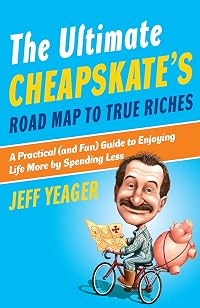
The Ultimate Cheapskate's Road Map to True Riches: A Practical (and Fun) Guide to Enjoying Life More by Spending Less
by Jeff Yeager
On This Page
Description
It used to be that “stuff” made you cool. That is so twentieth century. Jeff Yeager, the man dubbed The Ultimate Cheapskate by Matt Lauer on Today, offers a completely fresh take on personal finance, teaching us how to enjoy life more by spending less. He will show you how to buy less stuff, retire young, and live financially free, while you make a positive difference in people’s lives and save the planet along the way. The Ultimate Cheapskate’s Road Map to True Riches lays out the show more practices and principles that have made cheap the new cool. Live within your means at thirty and stay there. The Ultimate Cheapskate was living well on what he earned at thirty, so when he made more money, he saved every penny. Now he is “selfishly” employed, doing work he loves and helping others. Do for yourself what you could have others do for you. Cheapskates are die-hard do-it-yourselfers. It’s all about having the right tools, and The Ultimate Cheapskate will get you started. Pinch the dollars and the pennies will pinch themselves. It’s not the $3 cup of coffee; it’s the big-ticket decisions that determine whether you’ll be financially free. So buy a house, not a castle. The Ultimate Cheapskate’s Road Map to True Riches promises a quality of life you cannot buy, a sense of satisfaction you cannot fake, and an appreciation for others and for the planet that gives life value. Open your road map and prepare to discover the true joys of financial freedom. show lessTags
Recommendations

Member Reviews
I listened to the audio edition of this book and truly enjoyed it. Jeff Yeager is proud to be cheap and with his book he wants to teach us how we too can live cheap and be happy.
Even though his ideas weren't all that radical just one or two generations ago, nowadays they may sound like crazy talk to some of us. Unfortunately our society is all about consumerism yet it fails to make us truly happy. That's why a new way of thinking might be in order.
Jeff's proposal is simple: Instead of striving to earn more and more so that we can spend more and more, why not learn to spend less and be happy with less?
He offers a variety of tips in his book how we can accomplish this. From never spending more than $1 per pound on food, to getting an show more oil change only every 7500 miles instead of the usual 3000 miles. There are some good insights in every chapter and even if you don't implement all of them, just one or two can make a difference in your life. show less
Even though his ideas weren't all that radical just one or two generations ago, nowadays they may sound like crazy talk to some of us. Unfortunately our society is all about consumerism yet it fails to make us truly happy. That's why a new way of thinking might be in order.
Jeff's proposal is simple: Instead of striving to earn more and more so that we can spend more and more, why not learn to spend less and be happy with less?
He offers a variety of tips in his book how we can accomplish this. From never spending more than $1 per pound on food, to getting an show more oil change only every 7500 miles instead of the usual 3000 miles. There are some good insights in every chapter and even if you don't implement all of them, just one or two can make a difference in your life. show less
This had some good tips and practical advice. I realize that my enoughosaurus, as the author puts it, isn't quite ready to be slain yet, but it's getting there. I've successfully managed to avoid the ad branding that we're all exposed to, in large part to my education. Studying social trends and capitalism will do that for a person though I suppose. The most challenging section of the book was the last one, on financial planning. This is something that I know I need to be concerned with, I'm just not at a point to be making investments, for lack of knowledge and money to invest.
Although this book gets goofy and self-congratulatory sometimes, the information is often useful. I particularly like his attitude of living below his means in spite of pressure from this society to buy, buy, buy. I re-evaluated my own spending behavior and said "No!" to myself on several occasions. I got this book from the library, and it is well-worn and falling apart, so well used. Worth a read for anyone interested in living a more simple and frugal lifestyle.
I'm fine with the fact that most of this book was common sense. That's the only kind of personal finance book I'm going to trust anyway. The fact that everyone knows how they *should* spend/save/eat/etc doesn't magically make it happen and regular reminders and reinforcements are very useful.
What made the book almost unendurable for me (but I did finish it) was the cheesy sense of humor, especially when it crossed over into repeated requests for sexy photos from female readers and regular slams of Suze Orman. Not even her advice -- just her appearance. I've never watched her shows or whatever, but that's just inappropriate on general principle. Several principles, really.
I also get plenty of Stan Lee's style from Stan Lee himself, but show more that's just tiring, not offensive. Also charming - Every chapter begins with a handful of 'clever' quotes and at least one in each batch is from the author.
There were some valid points mixed into all that. Thinking in terms of choices rather than sacrifices. Settling for less beats being unsettled. Fiscal fasting and 'What was I thinking?' audits. References to Dominguez and Robin. And a really tasty sounding pasta and sausage dish.
I disagree that small savings (like the popular Starbucks ban) are useless. It all depends on what you do with the funds instead, and some people really can accumulate them for a useful purpose. Staying in the first house that you buy makes all kinds of fiscal and psychological sense if you can do it (I particularly liked the part about being able to decorate for yourself rather than for the market) but many of us have careers that require regular relocation. Not to mention aging parents, etc. I do agree that giving up a car is easier than people realize because I don't have one myself; and that's in an area with no public transportation. Asking to telecommute in lieu of a raise, however, is very creative thinking but unlikely to work out for most readers.
Unavoidable with his nonprofit background, but the advice to regularly read books about people who are truly suffering to help keep perspective isn't going to be attempted by many readers. It's not even particularly relevant. He's also a terrible travel snob. show less
What made the book almost unendurable for me (but I did finish it) was the cheesy sense of humor, especially when it crossed over into repeated requests for sexy photos from female readers and regular slams of Suze Orman. Not even her advice -- just her appearance. I've never watched her shows or whatever, but that's just inappropriate on general principle. Several principles, really.
I also get plenty of Stan Lee's style from Stan Lee himself, but show more that's just tiring, not offensive. Also charming - Every chapter begins with a handful of 'clever' quotes and at least one in each batch is from the author.
There were some valid points mixed into all that. Thinking in terms of choices rather than sacrifices. Settling for less beats being unsettled. Fiscal fasting and 'What was I thinking?' audits. References to Dominguez and Robin. And a really tasty sounding pasta and sausage dish.
I disagree that small savings (like the popular Starbucks ban) are useless. It all depends on what you do with the funds instead, and some people really can accumulate them for a useful purpose. Staying in the first house that you buy makes all kinds of fiscal and psychological sense if you can do it (I particularly liked the part about being able to decorate for yourself rather than for the market) but many of us have careers that require regular relocation. Not to mention aging parents, etc. I do agree that giving up a car is easier than people realize because I don't have one myself; and that's in an area with no public transportation. Asking to telecommute in lieu of a raise, however, is very creative thinking but unlikely to work out for most readers.
Unavoidable with his nonprofit background, but the advice to regularly read books about people who are truly suffering to help keep perspective isn't going to be attempted by many readers. It's not even particularly relevant. He's also a terrible travel snob. show less
Eh - preaching to the converted here. More of a presentation of a philosophy of a frugal way of life than actual tips - but the tips he does have are ones we haven't seen everywhere else. Enough humor to keep me reading almost every page. Only you can judge for yourself whether you can use his advice or not - but I do think you should check out at least one of his works or his website.
Not your typical financial guide--influenced by the wonderful book Your Money or Your Life, Yeager encourages really thinking about whether spending money is worth it in the big picture of your life/values. Thought provoking, and a good reminder...
Good book with some helpful advice, but kind of goes off the deep end in a few places. Overall, fairly practical. Presents the thought that sometimes the way to riches involves working and earning less and enjoying life more.
Members
- Recently Added By
Author Information

4 Works 394 Members
Jeff Yeager is the author of The Ultimate Cheapskate's Road Map to True Riches and has appeared as a guest correspondent on NBC's Today show and Discovery's Planet Green channel. He is also the author of the popular blog The Green Cheapskate at www.TheDailyGreen.com.
Classifications
Statistics
- Members
- 141
- Popularity
- 231,432
- Reviews
- 14
- Rating
- (3.57)
- Languages
- English
- Media
- Paper, Audiobook, Ebook
- ISBNs
- 6
- ASINs
- 1