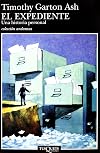
The File: A Personal History
by Timothy Garton Ash
On This Page
Description
Timothy Garton Ash reported on Eastern Europe for the Spectator. He visited the East German secret police headquarter in 1992 to look at his own file compiled against him by people whom he believed to be friends during the cold war era.Tags
Recommendations













































Member Recommendations


Member Reviews
In 1980-1981, the young Timothy Garton Ash, who still hadn't quite made up his mind between being a journalist or a historian, went to study in East Berlin under an academic exchange scheme between Oxford and the Humboldt University. He was supposed to be doing research on communist resistance movements during the Nazi period, but ended up spending a lot of time with dissident writers, academics and clergy, gathering material for a book on the DDR of the early eighties. Not surprisingly, all this attracted the attention of the Ministry for State Security (Stasi), which had built up quite a dossier on him by the end of his stay.
The whole thing has its comic side — the file is full of unimportant details, he was assigned the unlikely show more codename "Romeo" (because he drove an Italian sports car, he hastens to tell us), and the cumbersome bureaucracy didn't come to any conclusion about what action to take until he had returned to the West and his book was being serialised in Der Spiegel. But of course it could easily have turned out badly for him and much worse for the DDR citizens he was in contact with, as it did for thousands of other people.
Garton Ash uses this book to look in detail at that file and at the whole post-Wende system for reviewing Stasi records — the BStU, or "Gauck Agency" — with a historian's sharp eyes. He tracks down the informers ("Informal collaborators", or IMs) who reported on him, he talks to them and to the former Stasi officers who worked on his case, as well as to Gauck Agency staff and to some of his former contacts in the DDR. He talks about some of the pitfalls in the process — an ambiguously worded record makes it sound as though his academic supervisor at the Humboldt University was an IM, when in fact it was another university staff member who was reporting on a conversation with the supervisor.
He finds out how pressure was put on people to cooperate: some were being blackmailed over minor offences, some were being bribed with rewards like foreign trips, a couple were still convinced communists who remembered the thirties and felt a duty to protect the DDR state. Similarly the Stasi officers were mostly men who had grown up during or shortly after the war in an atmosphere of idealistic socialist reconstruction, and been recruited straight out of the FDJ. One of the officers he talks to unexpectedly strikes Garton Ash as a good and moral man who got trapped in a system he knew was working in bad ways, and was doing what he could to mitigate the harm around him; others seem more like simple careerists who had lost their illusions on their way through the system.
As a kind of postscript, and to forestall obvious comparisons, he also goes to talk to various people in British counterintelligence agencies. They stress to him the huge difference in scale between the counterintelligence effort in the DDR and in any normal country, in terms of staff members and number of files per head of population. And he says himself that there is no comparison between the UK, security-obsessed and secretive though it is, and a state like the DDR where there was no free press and no independent judiciary or parliament to review what the Stasi was doing. It turns out, though, that he does have a file there too, which of course he is not allowed to look at, but he's told that it is a "non-hostile" one: merely a record of occasional contacts such as the present one. They tell him. show less
The whole thing has its comic side — the file is full of unimportant details, he was assigned the unlikely show more codename "Romeo" (because he drove an Italian sports car, he hastens to tell us), and the cumbersome bureaucracy didn't come to any conclusion about what action to take until he had returned to the West and his book was being serialised in Der Spiegel. But of course it could easily have turned out badly for him and much worse for the DDR citizens he was in contact with, as it did for thousands of other people.
Garton Ash uses this book to look in detail at that file and at the whole post-Wende system for reviewing Stasi records — the BStU, or "Gauck Agency" — with a historian's sharp eyes. He tracks down the informers ("Informal collaborators", or IMs) who reported on him, he talks to them and to the former Stasi officers who worked on his case, as well as to Gauck Agency staff and to some of his former contacts in the DDR. He talks about some of the pitfalls in the process — an ambiguously worded record makes it sound as though his academic supervisor at the Humboldt University was an IM, when in fact it was another university staff member who was reporting on a conversation with the supervisor.
He finds out how pressure was put on people to cooperate: some were being blackmailed over minor offences, some were being bribed with rewards like foreign trips, a couple were still convinced communists who remembered the thirties and felt a duty to protect the DDR state. Similarly the Stasi officers were mostly men who had grown up during or shortly after the war in an atmosphere of idealistic socialist reconstruction, and been recruited straight out of the FDJ. One of the officers he talks to unexpectedly strikes Garton Ash as a good and moral man who got trapped in a system he knew was working in bad ways, and was doing what he could to mitigate the harm around him; others seem more like simple careerists who had lost their illusions on their way through the system.
As a kind of postscript, and to forestall obvious comparisons, he also goes to talk to various people in British counterintelligence agencies. They stress to him the huge difference in scale between the counterintelligence effort in the DDR and in any normal country, in terms of staff members and number of files per head of population. And he says himself that there is no comparison between the UK, security-obsessed and secretive though it is, and a state like the DDR where there was no free press and no independent judiciary or parliament to review what the Stasi was doing. It turns out, though, that he does have a file there too, which of course he is not allowed to look at, but he's told that it is a "non-hostile" one: merely a record of occasional contacts such as the present one. They tell him. show less
I've never read a book quite like this before, a truly extraordinary personal history. Garton Ash lived in East Germany in the early 1980s and after the Berlin Wall fell decided to investigate his secret police file. While I was vaguely aware that the Stasi files were made available to their subjects, this is the first book I’ve read to convey what that actually meant in practise. Garton Ash compares his recollections with the surveillance records in his file and tracks down all those mentioned in it: friends, informants, and secret police. The result is a very powerful account of life in East Germany’s surveillance state and the moral compromises made by its citizens. Taking a personal, ethnographic approach allows Garton Ash to show more convey the nuance, complexity, and depth of emotion involved. This book was first published in 1997 and its conclusions are still important today. As the 2008 afterword discusses, surveillance is now automated by technology and its significance downplayed. Every train I take tells me to report anything that “doesn’t look right”, without any indication of how I should make that judgement. This has become part of the background noise of daily life, without consideration of what that means. ‘The File’ forced me to think about these matters and, honestly, it wasn’t very comfortable.
A friend and I were recently discussing how ‘normal’ people can participate and be complicit in acts of horrifying evil, likely prompted by the images of the concentration camps in America. Garton Ash has a great deal of insight to offer here. He was researching the Gestapo’s files while the Stasi kept a file on him:
There is no simple answer, but the book comes up with much more complex insights. Garton Ash examines his fascination with the glamour of spying in light of the sordid reality of East Germany’s informer army:
Garton Ash discovered from his file that five informers had reported on him and tracked each down to ask them about it. Their reactions are revealing and alarming. The woman codenamed Michaela was thrown into confusion:
Garton Ash was left unsettled by all these meetings, as well he might be. It’s very difficult to establish the direct harm caused by informers like Michaela, as most of their material was petty, seemingly harmless detail. Yet in combination, reports like hers were used to justify exile, prison, even death sentences. In return, the informers gained little privileges, like freedom to travel. Informers weren’t necessarily volunteers, however. Another of those he traced, only to find he’d died, was blackmailed by the Stasi into informing after being denounced for hitting on a male student. A third, a British communist married to a German woman and living in East Germany, told Garton Ash he’d been threatened by the Stasi into informing. His self-justifications are striking:
Subsequently interactions with Garton Ash suggested he'd abstracted his informing in order to elide his personal responsibility for it. The ambivalence and rationalisations of the informers aren’t entirely different to those of the Stasi officers Garton Ash also traced, although the latter discussions are more chilling. After interviewing Kurt Zeisweis, deputy head of the Stasi in Berlin:
It wasn’t quite as simple as that for several of the more junior Stasi officers, but the same theme predominated. And once the regime had fallen:
I’m quoting a great deal because I found Garton Ash’s writing so compelling and powerful. He points out that East Germany is in a unique position, with the horrors of two very different regimes to reckon with, one of which is now passing out of living memory:
Although Garton Ash editorialises in the first person, in places his approach reminded me of [a:Svetlana Alexievich|7728207|Svetlana Alexievich|https://images.gr-assets.com/authors/1473846978p2/7728207.jpg]: quoting people’s reflections on what they did in the past, which collectively prove both moving and revealing. This kind of personal narrative history seems very fitting for the historical topic of personal surveillance. I wonder what kind of memoirs will be written in the future on how electronic surveillance has damaged lives under repressive regimes. The technology might have changed, but I don't think the psychological impacts are so very different:
Garton Ash states firmly that only the victims of the Stasi have the right to forgive, or not. Rather than wondering what we might have done had we been born into totalitarian regimes of the past, it seems better to consider what we’re doing today. We can judge the past with comfortable detachment, but should not forget that the future will judge us too. show less
A friend and I were recently discussing how ‘normal’ people can participate and be complicit in acts of horrifying evil, likely prompted by the images of the concentration camps in America. Garton Ash has a great deal of insight to offer here. He was researching the Gestapo’s files while the Stasi kept a file on him:
Amidst the ghosts of secret Germany I was searching for the answer to a personal question. What is it that makes one person a resistance fighter and another the faithful servant of a dictatorship? This man a Stauffenberg, that a Speer. Today, after years of study, and after knowing personally many resisters and many servants of dictatorships, I am searching still.
There is no simple answer, but the book comes up with much more complex insights. Garton Ash examines his fascination with the glamour of spying in light of the sordid reality of East Germany’s informer army:
In 1988 - the last ‘normal’ year of the GDR - the Ministry of State Security had more than 170,000 ‘official collaborators’. [...] The Ministry itself had over 90,000 employees, of whom less than 5,000 were in the HVA foreign intelligence wing. Setting the total figure against the adult population in the same year, this means that about one out of every fifty adult East Germans had a direct connection to the secret police. Allow just one dependent per person, and you’re up to one in twenty-five.
The Nazis had nothing like as many.
Garton Ash discovered from his file that five informers had reported on him and tracked each down to ask them about it. Their reactions are revealing and alarming. The woman codenamed Michaela was thrown into confusion:
She is buffeted by conflicting thoughts and emotions. One moment she says, “Really, it’s good that you’ve shown me this.” The next, “Ah well, perhaps I can sue you and I’ll win a lot of money… No, no, sorry, that was only a joke… But perhaps there is some protection.”
“We repressed so much… Why didn’t I apply to see my file? Because I didn’t want to know what was in it… and about my husband… Who knows what else there is… I think this was the only time I reported so extensively on private matters. I thought it was dienstlich [official?] but… Well, I hope if you do write you’ll try to explain the subjective as well as the objective conditions. How it was then. But probably that’s impossible. Even I can’t really remember now…”
Garton Ash was left unsettled by all these meetings, as well he might be. It’s very difficult to establish the direct harm caused by informers like Michaela, as most of their material was petty, seemingly harmless detail. Yet in combination, reports like hers were used to justify exile, prison, even death sentences. In return, the informers gained little privileges, like freedom to travel. Informers weren’t necessarily volunteers, however. Another of those he traced, only to find he’d died, was blackmailed by the Stasi into informing after being denounced for hitting on a male student. A third, a British communist married to a German woman and living in East Germany, told Garton Ash he’d been threatened by the Stasi into informing. His self-justifications are striking:
He thought of the Stasi as a channel of communication with the state. In a small way, he says, he was trying to [...] get a political message to the top. The trouble with a communist state like East Germany was that it had ‘no civil society framework’. He was making up for that lack.
Subsequently interactions with Garton Ash suggested he'd abstracted his informing in order to elide his personal responsibility for it. The ambivalence and rationalisations of the informers aren’t entirely different to those of the Stasi officers Garton Ash also traced, although the latter discussions are more chilling. After interviewing Kurt Zeisweis, deputy head of the Stasi in Berlin:
When he has left, Werner and I look at each other, shake our heads and start quietly laughing. Otherwise we would have to cry. Here, in that chair, sat before us a perfect textbook example of a petty bureaucratic executor of evil. A good family man. Proud of his correctness, loyalty, hard work, decency - all those ‘secondary virtues’ which have been identified as key to collaboration with Nazism (and which the Prussian Association now hopes to revive). He is incapable of acknowledging, to this day, the systemic wrong of which he was a loyal servant, yet filled with remorse for having stolen a couple of Matchbox cars.
It wasn’t quite as simple as that for several of the more junior Stasi officers, but the same theme predominated. And once the regime had fallen:
So everyone I talk to has someone else to blame. Those who worked for the state say ‘it was not us, it was the Party’. Those who worked for the Party say, ‘it was not us, it was the Stasi’. Come to the Stasi, and those who worked for foreign intelligence say, ‘it was not us, it was the others.’ Talk to them, and they say, ‘it was not our department, it was XX’. Talk to Herr Zeisweis from department XX and he says, ‘but it wasn’t me’.
When the communists seized power in central Europe, they talked of using ‘salami tactics’ to cut away the democratic opposition, slice by slice. Here, after communism, we have the salami tactics of denial.
I’m quoting a great deal because I found Garton Ash’s writing so compelling and powerful. He points out that East Germany is in a unique position, with the horrors of two very different regimes to reckon with, one of which is now passing out of living memory:
Only the new Germany has done it all. Germany has had trials and purges and truth commissions and has systematically opened the secret police files to each and every individual who wants to know what was done to him or her - or what he or she did to others. This is unique. Apart from anything else, what other post-communist country would have the money to do it? The Gauch Authority’s budget for 1996 was DM234 million - about £100 million.
[...]
It must be right that the Germans, and not just the Germans, should really understand how in the second half of the twentieth century there was again built, on German soil, a totalitarian police state, less brutal than the Third Reich, to be sure, far less damaging to its neighbours, and not genocidal, but more quietly pervasive in its domestic control. How this state exploited the very same mental habits, social disciplines, and cultural appeals on which Nazism had drawn.
Although Garton Ash editorialises in the first person, in places his approach reminded me of [a:Svetlana Alexievich|7728207|Svetlana Alexievich|https://images.gr-assets.com/authors/1473846978p2/7728207.jpg]: quoting people’s reflections on what they did in the past, which collectively prove both moving and revealing. This kind of personal narrative history seems very fitting for the historical topic of personal surveillance. I wonder what kind of memoirs will be written in the future on how electronic surveillance has damaged lives under repressive regimes. The technology might have changed, but I don't think the psychological impacts are so very different:
But I can understand each of the informers on my file, and the officers too, even Kratsch. For when they tell their stories you can see so clearly how they came to do what they did: in a different time, a different place, a different world.
What you find here, in the files, is how deeply our conduct is influenced by our circumstances. How large of all that human hearts can endure, that part which laws or kings can cause or cure. What you find is less malice than human weakness, a vast anthology of human weakness. And when you talk to those involved, what you find is less deliberate dishonesty than our almost infinite capacity for self-deception.
If only I had met, on this search, a single clearly evil person. But they were all just weak, shaped by circumstance, self-deceiving; human, all too human. Yet the sum of their actions was a great evil.
Garton Ash states firmly that only the victims of the Stasi have the right to forgive, or not. Rather than wondering what we might have done had we been born into totalitarian regimes of the past, it seems better to consider what we’re doing today. We can judge the past with comfortable detachment, but should not forget that the future will judge us too. show less
I was enthralled by the Academy Award winning German film The Lives of Others and discovered this slim book about the Stasi and their aftermath by Timothy Garton Ash. Ash was a British student in East Germany and after the fall of communism and the making public of the Stasi records he returns to Germany to read his own file and interview those individuals who informed on him. It is a striking exploration of a police state and how individuals justify their behavior after the fact. My only disappointment is that it is still the book of an outsider, Ash was free to leave East Germans were not. I would love to see a book from the German perspective. That said, it is well-worth reading and a good investigation of an episode in German show more history that is often neglected. It is also worth finding Timothy Garton Ash's essay on Salon.com about the Lives of Others. show less
In the 1980’s Mr. Garton Ash lived in both East and West Berlin to do research about pre-war Germany. As such he was an object of interest of the Stasi. After the evaporation of the German Democratic Republic, Mr. Garton Ash was one of the many people who requested to see their Stasi file.
In this book Mr. Garton Ash compares the data he finds in the file with his own diary. He mixes this with a description of Central Europe in that decade, with pressure from Western peace movements and Polish and other dissident movements like Solidarnosc. Plus he looks up some of the former Stasi workers and informers found in his file.
I found that the book was averagely interesting read. The “chilling portrait of treachery and compromise” show more promised on the cover had a limited impact, as Mr. Garton Ash was a foreign subject and could only be evicted from the country. It does vividly portray however the undistinguished character (or the banality) of the people involved, and how the “uninteresting” elements of a conversation were just what the Stasi was after. show less
In this book Mr. Garton Ash compares the data he finds in the file with his own diary. He mixes this with a description of Central Europe in that decade, with pressure from Western peace movements and Polish and other dissident movements like Solidarnosc. Plus he looks up some of the former Stasi workers and informers found in his file.
I found that the book was averagely interesting read. The “chilling portrait of treachery and compromise” show more promised on the cover had a limited impact, as Mr. Garton Ash was a foreign subject and could only be evicted from the country. It does vividly portray however the undistinguished character (or the banality) of the people involved, and how the “uninteresting” elements of a conversation were just what the Stasi was after. show less
Fascinating book. Thought-provoking. How would one behave if one had lived in East Germany? How easy it is to judge from outside a situation or post an event. Analysis of spy agencies in dictatorships and democracies. What makes a person a "Stauffenberg or a Speer? Victims, perpetrators.
I never expected to enjoy this so much. It's a great read - try not to read it in one sitting! The small, petty, and ultimately horrific, way that small inconsequential details could be sown together by the paranoid Stasi could, and did, ruin lives. Everyone seems to have been spied on, and extensive records were kept. Uniquely Germany has allowed people to view their secret police files (unlike Poland, Russia, etc etc).
I am studying Recordkeeping Concepts and Practices at the moment and this was recommended reading. It is a slim volume - 227 pages all up. Not onerous and fascinating for anyone who is interested in modern history, spying, archives and Germany - East and West - not to mention diaries and reconstructing one's own personal history and the challenges of reporting/writing.
Such powerful lines....here are some examples....
"What we call 'my life' is but a constantly rewritten version of our own past. 'My life' is the mental autobiography with which and by which we all live. What really happened is quite another matter. " (p.20)
and
"..a file opens the door to a vast sunken labyrinth of the forgotten past...the very act of opening the door itself show more changes the buried artefacts....for these are not simply past experiences rediscovered in their original state. Even without the fresh light from a new document or another's recollection - the opened door - our memories decay or sharpen, mellow or sour, with the passage of time and the change of circumstances....A door opens, but another closes. There is no way back now to your own earlier memory of that person, that event....so what we have is nothing less than an infinty of memories of any moment, event or person." (p.96)
and
"The domestic spies in a free country live this professional paradox: they infringe our liberties in order to protect them. But we have another paradox: we support the system by questioning it." (p. 220) show less
Such powerful lines....here are some examples....
"What we call 'my life' is but a constantly rewritten version of our own past. 'My life' is the mental autobiography with which and by which we all live. What really happened is quite another matter. " (p.20)
and
"..a file opens the door to a vast sunken labyrinth of the forgotten past...the very act of opening the door itself show more changes the buried artefacts....for these are not simply past experiences rediscovered in their original state. Even without the fresh light from a new document or another's recollection - the opened door - our memories decay or sharpen, mellow or sour, with the passage of time and the change of circumstances....A door opens, but another closes. There is no way back now to your own earlier memory of that person, that event....so what we have is nothing less than an infinty of memories of any moment, event or person." (p.96)
and
"The domestic spies in a free country live this professional paradox: they infringe our liberties in order to protect them. But we have another paradox: we support the system by questioning it." (p. 220) show less
Members
- Recently Added By
Author Information

74+ Works 2,383 Members
Timothy Garton Ash is a fellow of St. Anthony's College, Oxford, and of the Hoover Institution, Stanford.
Some Editions
Awards and Honors
Notable Lists
Common Knowledge
- Canonical title
- The File: A Personal History
- Original title
- The File: A Personal History
- Original publication date
- 1997 (England) (England); 1997 (The Netherlands) (The Netherlands)
- People/Characters
- Joachim Gauck; Lech Walesa; Danuta Garton Ash; Wolf Biermann; Helmut Kohl; Erich Honecker (show all 10); Vaclav Havel; Isaiah Berlin; Erich Mielke; Markus Wolf
- Important places
- East Berlin, German Democratic Republic; West Berlin, Germany; Gdańsk, Pomerania, Poland; Warsaw, Poland; Oxford, Oxfordshire, England, UK; Bonn, North Rhine-Westphalia, Germany (show all 13); Berlin, Germany; Prague, Czech Republic (as Czechoslovakia); German Democratic Republic (East Germany); Federal Republic of Germany (West Germany); German Democratic Republic; West Germany; Germany
- Important events
- The Fortieth anniversary of German Democratic Republic ([1989-10-07])
- Dedication
- For
D., T. AND A. - First words
- "Guten Tag," say bustling Frau Schulz, "You have a very interesting file."
Classifications
- Genres
- History, Nonfiction, Biography & Memoir, General Nonfiction
- DDC/MDS
- 943.1 — History & geography History of Europe Central Europe: Germany, Austria, Switzerland, Czech, Poland, Hungary Northeastern Germany
- LCC
- DD286.4 .G37 — History of Europe, Asia, Africa and Oceania Germany History of Germany East Germany
- BISAC
Statistics
- Members
- 494
- Popularity
- 60,910
- Reviews
- 11
- Rating
- (3.73)
- Languages
- 8 — Danish, Dutch, English, German, Italian, Polish, Spanish, Swedish
- Media
- Paper, Ebook
- ISBNs
- 21
- ASINs
- 1