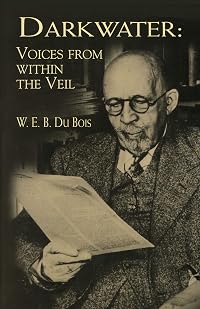
Darkwater: Voices from Within the Veil
by W. E. B. Du Bois
On This Page
Description
The distinguished American civil rights leader, W. E. B. Du Bois first published these fiery essays, sketches, and poems individually in 1920 in the Atlantic, the Journal of Race Development, and other periodicals. Reflecting the author's ideas as a politician, historian, and artist, this volume has long moved and inspired readers with its militant cry for social, political, and economic reform. It is essential reading for all students of African American history.Tags
Recommendations


























Member Reviews
A sometimes curious collection of writing from W.E.B. Du Bois, first published in 1920 and consisting of political essays, autobiographical content, allegorical poetry, and short stories, republished in 2022 by Flame Tree 451 rather oddly in their “Essential Gothic, Science Fiction & Dark Fantasy” series, complete with a useless glossary of Victorian terms. It’s at its best when Du Bois writes of his life and speaks such searing truth about racism, capitalistic excess, and world events, but it’s tortured and rather overwrought when he ventures into poetry and fiction. If I were to re-read it, or recommend it, I would say to simply skip this latter stuff.
Du Bois’ non-fiction essays were like a beacon at a time when America was show more mired in the nadir of race relations; this was a time of lynchings, massacres, segregation, sundown towns, and the President enthusiastically watching The Birth of a Nation in the White House. He is insightful and presages the rise of White Nationalism and Hitler in his brilliant chapter The Souls of White Folk. He points out America’s hypocrisy in making the “World Safe for Democracy” and condemning Germany for things like the Rape of Belgium in 1918 when it was committing its own atrocities all over the country. He criticizes colonialism and the teaching of world history in ways that are skewed towards white people and Western European nations. He speaks up for the working man against greedy businessmen, and points out the irony of white blue collar workers thinking their black counterparts were the enemy. He speaks up for women, and black women in particular. A great deal of it is still highly relevant today.
Du Bois was very well read and abreast of current events, which he often references without full explanation. A better modern edition would have included footnotes for the reader, but I didn’t mind pausing to look things up as I went. Reading The Shadow of Years had me referencing the lynching of Sam Hose in 1899, Of Work and Wealth spurs a reading on the massacres of black people in East St. Louis over May-July 1917, and The Second Coming the May 1918 lynchings and horrifying brutality in Valdosta Georgia (including to Mary Turner and her unborn baby).
On a lighter note, The Immortal Child had me sampling composer Samuel Coleridge-Taylor’s works. And in one of his more extraordinary moments, after describing a litany of ways everyday racism may be encountered in Of Beauty and Death, he points out that “we cannot forget that this world is beautiful,” which gave me goosebumps.
Just this quote, on the wealth gap:
“Thus the shadow of hunger, in a world which never needs to be hungry, drives us to war and murder and hate. But why does hunger shadow so vast a mass of men? Manifestly because in the great organizing of men for work a few of the participants come out with more wealth than they can possibly use, while a vast number emerge with less they can decently support life. In earlier economic stages we defended this as the reward of Thrift and Sacrifice, and the punishment of Ignorance and Crime. To this the answer is sharp: Sacrifice calls for no such reward and Ignorance deserves no such punishment.” show less
Du Bois’ non-fiction essays were like a beacon at a time when America was show more mired in the nadir of race relations; this was a time of lynchings, massacres, segregation, sundown towns, and the President enthusiastically watching The Birth of a Nation in the White House. He is insightful and presages the rise of White Nationalism and Hitler in his brilliant chapter The Souls of White Folk. He points out America’s hypocrisy in making the “World Safe for Democracy” and condemning Germany for things like the Rape of Belgium in 1918 when it was committing its own atrocities all over the country. He criticizes colonialism and the teaching of world history in ways that are skewed towards white people and Western European nations. He speaks up for the working man against greedy businessmen, and points out the irony of white blue collar workers thinking their black counterparts were the enemy. He speaks up for women, and black women in particular. A great deal of it is still highly relevant today.
Du Bois was very well read and abreast of current events, which he often references without full explanation. A better modern edition would have included footnotes for the reader, but I didn’t mind pausing to look things up as I went. Reading The Shadow of Years had me referencing the lynching of Sam Hose in 1899, Of Work and Wealth spurs a reading on the massacres of black people in East St. Louis over May-July 1917, and The Second Coming the May 1918 lynchings and horrifying brutality in Valdosta Georgia (including to Mary Turner and her unborn baby).
On a lighter note, The Immortal Child had me sampling composer Samuel Coleridge-Taylor’s works. And in one of his more extraordinary moments, after describing a litany of ways everyday racism may be encountered in Of Beauty and Death, he points out that “we cannot forget that this world is beautiful,” which gave me goosebumps.
Just this quote, on the wealth gap:
“Thus the shadow of hunger, in a world which never needs to be hungry, drives us to war and murder and hate. But why does hunger shadow so vast a mass of men? Manifestly because in the great organizing of men for work a few of the participants come out with more wealth than they can possibly use, while a vast number emerge with less they can decently support life. In earlier economic stages we defended this as the reward of Thrift and Sacrifice, and the punishment of Ignorance and Crime. To this the answer is sharp: Sacrifice calls for no such reward and Ignorance deserves no such punishment.” show less
Part memoir, part manifesto, Du Bois lays bare the USA in 1920. Lo, this century later, so many echoes ringing across our sickly land. But it is the one we have & perhaps we improve things for those doomed to follow.
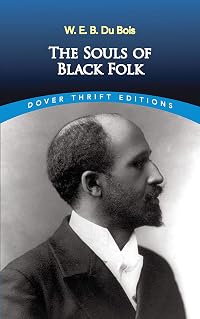
The Souls of Black Folk is far more famous, but I think this is a superior piece of work. It represents Du Bois at his most complex -- he's not starry-eyed over the promise of liberalism anymore, but nor has he given up hope entirely on America. The resulting ambiguity gives us some fantastic chapters of work that are must-reads for anyone interested in race in America.
Lyrical and quite moving at points.
Ratings
Members
- Recently Added By
Lists

top 100
39 works; 1 member

Books in Riverdale
123 works; 3 members
Works Cited in The History of White People by Nell Irvin Painter
321 works; 2 members
Author Information

185+ Works 13,008 Members
Civil rights leader and author, William Edward Burghardt Du Bois was born in Great Barrington, Massachusetts on February 23, 1868. He earned a B.A. from both Harvard and Fisk universities, an M.A. and Ph.D. from Harvard, and studied at the University of Berlin. He taught briefly at Wilberforce University before he came professor of history and show more economics at Atlanta University in Ohio (1896-1910). There, he wrote The Souls of Black Folk (1903), in which he pointed out that it was up to whites and blacks jointly to solve the problems created by the denial of civil rights to blacks. In 1905, Du Bois became a major figure in the Niagara Movement, a crusading effort to end discrimination. The organization collapsed, but it prepared the way for the founding of the National Association for the Advancement of Colored People (NAACP), in which Du Bois played a major role. In 1910, he became editor of the NAACP magazine, a position he held for more than 20 years. Du Bois returned to Atlanta University in 1932 and tried to implement a plan to make the Negro Land Grant Colleges centers of black power. Atlanta approved of his idea, but later retracted its support. When Du Bois tried to return to NAACP, it rejected him too. Active in several Pan-African Congresses, Du Bois came to know Fwame Nkrumah, the first president of Ghana, and Jono Kenyatta the president of Kenya. In 1961, the same year Du Bois joined the Communist party, Nkrumah invited him to Ghana as a director of an Encyclopedia Africana project. He died there on August 27, 1963, after becoming a citizen of that country. (Bowker Author Biography) show less
Awards and Honors
Awards
Series
Belongs to Publisher Series
Work Relationships
Is contained in
Contains
Common Knowledge
- Canonical title
- Darkwater: Voices from Within the Veil
Classifications
- Genres
- Nonfiction, History, Biography & Memoir
- DDC/MDS
- 305.896 — Society, government, & culture Social sciences, sociology & anthropology Social group - Age, Gender, Ethnicity Ethnic and national groups Other ethnic and national groups Africans and people of African descent; Blacks of African origin
- LCC
- E185.61 .D83 — History of the United States United States Elements in the population Afro-Americans Status and development since emancipation
- BISAC
Statistics
- Members
- 504
- Popularity
- 59,849
- Reviews
- 4
- Rating
- (4.13)
- Languages
- English
- Media
- Paper, Audiobook, Ebook
- ISBNs
- 54
- UPCs
- 1
- ASINs
- 20