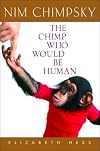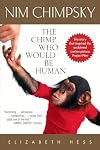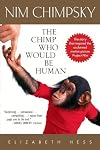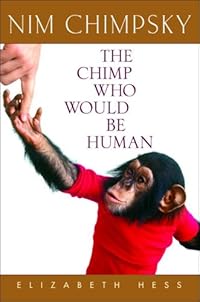
Nim Chimpsky: The Chimp Who Would Be Human
by Elizabeth Hess
On This Page
Description
Could a chimpanzee raised from infancy by a human family bridge the gap between species--and change the way we think about the boundaries between animal and human? Here is the strange and moving account of an experiment intended to answer these questions, and of the chimp who was chosen to see it through. Columbia University psychologist Herbert S. Terrace's goal was to teach a chimpanzee American Sign Language in order to refute Noam Chomsky's assertion that language is an exclusively human show more trait. Nim Chimpsky, the baby chimp, was "adopted" by a graduate student. At first his progress exceeded all expectations--his charm and mischievous sense of humor endeared him to everyone. But no one had thought through the long-term consequences of raising a chimp in the human world. Nim's story will move and entertain at the same time that it challenges us to ask what it means to be human.--From publisher description. show lessTags
Recommendations









Member Reviews
I read this because I’d just finished the novel We Are All Completely Beside Ourselves about a chimpanzee raised in a human family, and I happened to have this book around, apparently picked up while browsing bargain shelves some years ago. I’m sorry that I waited so long; it is excellent.
Nim Chimpsky was born in 1973 in the Institute for Primate Studies at the Oklahoma University, torn from his mother (who’d been through this before and was resigned to the routine) within weeks and sold to Columbia University for an experiment: would a chimpanzee raised in a human family communicate with a linguistic complexity that could be distinguished from mere mimicry. By then other experiments had established that chimpanzees lack the show more mechanics to vocalize human language, but can learn signs and symbols. Trouble ensued from the start. Nobody initially knew ASL so a window of developmental opportunity was missed. Nim did not live with the primary scientist; he lived with the family of a former student, and perspectives on caretaking differed, the rigorous requirements of a formal study vs the free-spirit style of the family. And chimpanzees occupy a space of almost-but-not-quite; not a pet, not a child. Nim was attached to the family and vice versa, engaging and clever, holding up his end of the deal with ASL, but his manners were far from impeccable. This was not unprecedented. Although chimpanzees are adorable as infants, within a few years they are too strong, too agile, too emotionally unconstrained for a household; they wreak havoc by accident or intention, and they bite. The family agonized but couldn’t cope, and Nim was moved to a university facility. In 1977, after further trouble and diminishing returns, the experiment was officially ended and he was sent back to Oklahoma University.
The book covers the two dozen plus years of Nim’s life as he is shunted around the country, caged and often isolated, a failed experiment and ruined for any other, his need for social interaction and communication not always recognized even by the most sympathetic caretakers. Just about everyone involved was interviewed for this book, which paints a detailed picture of affairs and animosities, a soap opera of psychologists. The chimpanzees seem quite civilized in comparison. Good things happen, and there are heroes you’ve never heard of, along with prominent names who are less savory than you might wish. An appendix gives a where-are-they-now (2008) update. An associated documentary film has numerous clips and summaries online.
(read 5 Nov 2013) show less
Nim Chimpsky was born in 1973 in the Institute for Primate Studies at the Oklahoma University, torn from his mother (who’d been through this before and was resigned to the routine) within weeks and sold to Columbia University for an experiment: would a chimpanzee raised in a human family communicate with a linguistic complexity that could be distinguished from mere mimicry. By then other experiments had established that chimpanzees lack the show more mechanics to vocalize human language, but can learn signs and symbols. Trouble ensued from the start. Nobody initially knew ASL so a window of developmental opportunity was missed. Nim did not live with the primary scientist; he lived with the family of a former student, and perspectives on caretaking differed, the rigorous requirements of a formal study vs the free-spirit style of the family. And chimpanzees occupy a space of almost-but-not-quite; not a pet, not a child. Nim was attached to the family and vice versa, engaging and clever, holding up his end of the deal with ASL, but his manners were far from impeccable. This was not unprecedented. Although chimpanzees are adorable as infants, within a few years they are too strong, too agile, too emotionally unconstrained for a household; they wreak havoc by accident or intention, and they bite. The family agonized but couldn’t cope, and Nim was moved to a university facility. In 1977, after further trouble and diminishing returns, the experiment was officially ended and he was sent back to Oklahoma University.
The book covers the two dozen plus years of Nim’s life as he is shunted around the country, caged and often isolated, a failed experiment and ruined for any other, his need for social interaction and communication not always recognized even by the most sympathetic caretakers. Just about everyone involved was interviewed for this book, which paints a detailed picture of affairs and animosities, a soap opera of psychologists. The chimpanzees seem quite civilized in comparison. Good things happen, and there are heroes you’ve never heard of, along with prominent names who are less savory than you might wish. An appendix gives a where-are-they-now (2008) update. An associated documentary film has numerous clips and summaries online.
(read 5 Nov 2013) show less
Nothing could have been further from the truth. I was shocked and at times appalled by the physical and emotional hardships Nim was forced to endure. Some of these hardships were caused by simple cold
That being the case, it is in my mind, absolutely inexcusable, if not down right criminal, to place a chimpanzee, who was raised in human homes, as a member of the family from infancy, into a primate medical research lab, after the language acquisition experiment was terminated.
The press eventually got wind of Nim's plight and the famous animal rights activist Cleveland Amory, got involved and was able to secure Nim's release. Nim was sent to Armory's ranch in Texas populated with numerous and varied hoofed animals such as burros, retired thourobreds, buffaloes, even elephants. But for over a year Nim was kept isolated in a small cage devoid of any sunshine or chimpanzee company. Nim suffered terribly under these conditions until somebody finally got the bright idea to provide him with another chimp for company. Duh ? Eventually three more chimps were brought to the ranch and by all accounts Nim was finally provided with the type of physical and emotional environment he needed to thrive. Unfortunately he only had a few years to enjoy them before suffering a massive heart attack.
It was a gut wrenching read , but well worth it.
If there's anyone left on the planet who needs convincing that chimpanzees are more like us (or we're like them) than they'd care to think they need to read Elizabeth Hess's biography of Nim Chimpsky, the chimpanzee who was taught to communicate in American Sign Language (ASL).
Animal biographies are a publishing curiosity. Me Cheeta: The autobiography, the memoir of Cheeta, the celebrity chimpanzee who swung from tree to fame in the Tarzan movies, was recently published. As clever as chimpanzees are no one really believes it was Cheeta who wrote it (it was James Lever). American Presidential pets are also notorious for writing books. Socks, the Clinton's cat, wrote Dear Socks, Dear Buddy: Kids' Letters to the First Pets (well, Hillary show more claims to have written it which is just as likely as Socks writing it). Bush Senior's dog, Millie, wrote Millie's Book; As Dictated to Barbara Bush (debatable, again, as to whether it was Millie or Barbara who wrote it). We look forward to the literary delights of Barney (Bush Junior's dog), who will presumably write from his residential retreat in Midland, Texas. (Barney already has his own page on the White House website.
Writing a serious biography of an animal is a formidable challenge, as I know from working with the artist, Sue Coe, on a project about Topsy, the elephant electrocuted by Edison in 1903. Human lives, unlike animal lives, are documented from birth to death. Hess's accomplishment in Nim Chimpsky: The chimp who would be human is framing the biography to address his life and the lives of the humans and chimpanzees who shaped his life, starting as a controversial research tool and ending as a rescued celebrity.
From this beginning to the final years at The Fund for Animals' Black Beauty Ranch in Murchison, Texas, Hess recounts Nim's life and the cast of human and chimpanzee characters (there's even a "Where They Are Now" for the people) with discipline and diligence.
Born at the Institute for Primate Studies in Norman, Oklahoma and taken from his mother 10 days after his birth, Nim was given to an affluent white family to be raised in an Upper West Side Manhattan brownstone. Diapered and dressed like a human baby, he was taught American Sign Language in order to prove we are not the only ones with the capacity to learn language.
I reacted to Nim's biography with anger and despair as well as a deeper appreciation of how unscientific science really can be when it wants to be. For example, the name, Nim Chimpsky, is a silly reworking of Noam Chomsky, the Massachusetts Institute of Technology linguist who maintains only humans are capable of language. Science and anthropomorphism were conveniently cast aside throughout Nim's life. He was raised as a human baby by people who had no relevant experience or professional training in chimpanzees and their welfare. He was taught ASL primarily by people who were either learning it for the first time or picked it up as they went along. The research proceeded without a secure financial foundation thereby putting the chimpanzees' lives at continuous risk.
Thankfully, Hess doesn't let her emotions interfere with her remarkable ability to retell (and research) Nim's story. Every now and then, however, she let us know what she really thinks. These few moments underscore the understated approach she takes. Nim's tragedy speaks for itself, as do all the other chimpanzees mentioned in the book, including Kitty, Midge, Lulu and Sally.
The recently published revised European Commission Council Directive (86/609/EEC) on animal research proposed a ban on the use of great apes (orang-utans, gorillas, chimpanzees and bonobos). Animal advocates say this is an empty gesture. Apes are not used in the European Union for research. If there's anyone left on the planet who needs convincing that this shouldn't be the case for the rest of the world should read Elizabeth Hess's biography of Nim, the chimp who endured the tragedy of being almost human. show less
Animal biographies are a publishing curiosity. Me Cheeta: The autobiography, the memoir of Cheeta, the celebrity chimpanzee who swung from tree to fame in the Tarzan movies, was recently published. As clever as chimpanzees are no one really believes it was Cheeta who wrote it (it was James Lever). American Presidential pets are also notorious for writing books. Socks, the Clinton's cat, wrote Dear Socks, Dear Buddy: Kids' Letters to the First Pets (well, Hillary show more claims to have written it which is just as likely as Socks writing it). Bush Senior's dog, Millie, wrote Millie's Book; As Dictated to Barbara Bush (debatable, again, as to whether it was Millie or Barbara who wrote it). We look forward to the literary delights of Barney (Bush Junior's dog), who will presumably write from his residential retreat in Midland, Texas. (Barney already has his own page on the White House website.
Writing a serious biography of an animal is a formidable challenge, as I know from working with the artist, Sue Coe, on a project about Topsy, the elephant electrocuted by Edison in 1903. Human lives, unlike animal lives, are documented from birth to death. Hess's accomplishment in Nim Chimpsky: The chimp who would be human is framing the biography to address his life and the lives of the humans and chimpanzees who shaped his life, starting as a controversial research tool and ending as a rescued celebrity.
From this beginning to the final years at The Fund for Animals' Black Beauty Ranch in Murchison, Texas, Hess recounts Nim's life and the cast of human and chimpanzee characters (there's even a "Where They Are Now" for the people) with discipline and diligence.
Born at the Institute for Primate Studies in Norman, Oklahoma and taken from his mother 10 days after his birth, Nim was given to an affluent white family to be raised in an Upper West Side Manhattan brownstone. Diapered and dressed like a human baby, he was taught American Sign Language in order to prove we are not the only ones with the capacity to learn language.
I reacted to Nim's biography with anger and despair as well as a deeper appreciation of how unscientific science really can be when it wants to be. For example, the name, Nim Chimpsky, is a silly reworking of Noam Chomsky, the Massachusetts Institute of Technology linguist who maintains only humans are capable of language. Science and anthropomorphism were conveniently cast aside throughout Nim's life. He was raised as a human baby by people who had no relevant experience or professional training in chimpanzees and their welfare. He was taught ASL primarily by people who were either learning it for the first time or picked it up as they went along. The research proceeded without a secure financial foundation thereby putting the chimpanzees' lives at continuous risk.
Thankfully, Hess doesn't let her emotions interfere with her remarkable ability to retell (and research) Nim's story. Every now and then, however, she let us know what she really thinks. These few moments underscore the understated approach she takes. Nim's tragedy speaks for itself, as do all the other chimpanzees mentioned in the book, including Kitty, Midge, Lulu and Sally.
The recently published revised European Commission Council Directive (86/609/EEC) on animal research proposed a ban on the use of great apes (orang-utans, gorillas, chimpanzees and bonobos). Animal advocates say this is an empty gesture. Apes are not used in the European Union for research. If there's anyone left on the planet who needs convincing that this shouldn't be the case for the rest of the world should read Elizabeth Hess's biography of Nim, the chimp who endured the tragedy of being almost human. show less
In Nim Chimpsky: The Chimp Who Would Be Human, author Elizabeth Hess chronicles the awkward but innovative experiment in which a chimpanzee was raised as a human in order to test the long held ideal that language is a uniquely human trait. Named in parody of linguist Noam Chomsky, Nim Chimpsky is the center of "Project Nim" and thus the book surrounding his life.
Delving into the details of the primate facility in Oklahoma where he was born to the home of his foster family and the research university in New York, Hess unravels a story that fluctuates between humorous, sweet, appalling, and unbelievable. I found myself exceptionally interested in the scientific side of this story but was shocked at the lack of ethics and standards in show more raising of Nim. Though expected to learn ASL, the family he lived with was not fluent in sign language and few of his numerous handlers were intent on keeping records of his progress. Also, when the project began very little thought was given to the long term ramification of teaching a chimpanzee to behave as a human and predictably, the adolescent Nim quickly becomes too much to handle. The tragedy of the personable chimp left without a home or a purpose - and the greater story of research animals in general - is ultimately the most stunning part of Hess's work.
It's impossible to approach this book without falling a little bit in love with the precocious Nim. The photographic documentation of the tiny baby chimp who dresses in toddler clothes; growing into a midsized animal with enough sense to wash dishes and play with pets; and finally a full grown ape with a deep intelligence in his all-too-human eyes reveal the closeness of chimpanzees to homo sapiens in a way that statistics about genetic similarity will never match. Though it may not conclusively answer the questions of animals' ability to use language what Nim's story does is raise even more questions about our compassion towards other species. This is a book for lovers of animals and fans of science and anyone who enjoys an out of the ordinary biography. show less
Delving into the details of the primate facility in Oklahoma where he was born to the home of his foster family and the research university in New York, Hess unravels a story that fluctuates between humorous, sweet, appalling, and unbelievable. I found myself exceptionally interested in the scientific side of this story but was shocked at the lack of ethics and standards in show more raising of Nim. Though expected to learn ASL, the family he lived with was not fluent in sign language and few of his numerous handlers were intent on keeping records of his progress. Also, when the project began very little thought was given to the long term ramification of teaching a chimpanzee to behave as a human and predictably, the adolescent Nim quickly becomes too much to handle. The tragedy of the personable chimp left without a home or a purpose - and the greater story of research animals in general - is ultimately the most stunning part of Hess's work.
It's impossible to approach this book without falling a little bit in love with the precocious Nim. The photographic documentation of the tiny baby chimp who dresses in toddler clothes; growing into a midsized animal with enough sense to wash dishes and play with pets; and finally a full grown ape with a deep intelligence in his all-too-human eyes reveal the closeness of chimpanzees to homo sapiens in a way that statistics about genetic similarity will never match. Though it may not conclusively answer the questions of animals' ability to use language what Nim's story does is raise even more questions about our compassion towards other species. This is a book for lovers of animals and fans of science and anyone who enjoys an out of the ordinary biography. show less
Nim Chimpsky was part of a rather scientifically dubious experiment intended to study the ability of chimps to learn language. As part of this experiment, he was raised by humans, lived with humans, and many ways acted like a human... except, of course, for the all ways in which he was still very much a chimp.
Nim's story is an interesting and often emotionally affecting one, and it raises a number of thought-provoking questions about the ethics and the underlying assumptions of experiments like this, and of animal experimentation in general. But Hess often seems much less interested in the chimp, or in the science, than she is in the researchers. A disproportionate amount of the book involves gossipy details of their personal lives: who show more had an out-of-control ego, who was feuding with whom, who was sleeping with whom, who was smoking pot, etc., etc. etc. (The answer, by the way, is that everybody was smoking pot and everybody was sleeping with everybody else. Because it was the 70s.) I suppose this might have been vaguely interesting, in a tawdry reality TV kind of way, if Hess were really bringing these people vividly to life with her prose, but mostly I just found it dull and kept wishing she'd get back to more worthwhile topics. show less
Nim's story is an interesting and often emotionally affecting one, and it raises a number of thought-provoking questions about the ethics and the underlying assumptions of experiments like this, and of animal experimentation in general. But Hess often seems much less interested in the chimp, or in the science, than she is in the researchers. A disproportionate amount of the book involves gossipy details of their personal lives: who show more had an out-of-control ego, who was feuding with whom, who was sleeping with whom, who was smoking pot, etc., etc. etc. (The answer, by the way, is that everybody was smoking pot and everybody was sleeping with everybody else. Because it was the 70s.) I suppose this might have been vaguely interesting, in a tawdry reality TV kind of way, if Hess were really bringing these people vividly to life with her prose, but mostly I just found it dull and kept wishing she'd get back to more worthwhile topics. show less
This book is the biography of chimp, and an examination of the circumstances surrounding his life and death. The animal in question was called "Nim Chimpsky" and he was raised in a human home and taught sign language from birth as part of an experiment to try and refute linguist Noam Chomsky's teachings that animals can't really learn language. (NB: This isn't "learn language" as a layman like me might mean it. The question at issue here isn't whether or not animals can learn words. There's no question that a chimp can learn to sign "banana give me eat." Chomsky's argument is more involved than that. To express it very crudely, his assertion is that animals can't employ syntax ). The book is much less about the question of linguistics, show more though, and much more focused on the life of the chimp. Here was an extraordinarily smart creature. He was brought up like a child -- taught to hang his jacket on a hook, to help to wash the dishes, and to watch TV and munch snacks with the family. Then, at the end of the experiment, he's back to being just another expendable animal, locked in a tiny cage uselessly begging his captors in sign language to be let out.
It's a frustrating history to read, full of sloppy experiments, of people who are caring but who have no idea how to deal with a chimp, and of people experienced in dealing with chimps but who regard them as no more deserving of sympathy than a lab rat. The real tragedy, as Hess paints it is of well-meaning people who mostly just have no idea how hard it will be to care for him: people who assume that he'll be as easy as a dog, or maybe as easy as a human child, and simple questions of money, since for most of Nim's life, the funds to keep him were in short supply.
Further, it can be, at times, horrifying, as this humanized creature is treated in ways that make you cringe.
Hess' book is very informal, is opinionated and I don't know how rigorously it was researched. So, I won't treat it as a gospel truth. But, having never read in detail about these Ape Language Acquisition experiments before, I found it very interesting show less
It's a frustrating history to read, full of sloppy experiments, of people who are caring but who have no idea how to deal with a chimp, and of people experienced in dealing with chimps but who regard them as no more deserving of sympathy than a lab rat. The real tragedy, as Hess paints it is of well-meaning people who mostly just have no idea how hard it will be to care for him: people who assume that he'll be as easy as a dog, or maybe as easy as a human child, and simple questions of money, since for most of Nim's life, the funds to keep him were in short supply.
Further, it can be, at times, horrifying, as this humanized creature is treated in ways that make you cringe.
Hess' book is very informal, is opinionated and I don't know how rigorously it was researched. So, I won't treat it as a gospel truth. But, having never read in detail about these Ape Language Acquisition experiments before, I found it very interesting show less
This book is scarcely about Nim Chimpsky at all, its far more about all the humans in his life. Its about the person who bought him, the many people who raised him as a human child - although they would never have given up on the job as they all did so quickly with Nim - and all the people who were part of the various experiments on him. Finally it is about the people who looked after him in his retirement.
As a book about an animal, animal behaviour and language acquisition, this book fails miserably - Vince Smith, Roger Fouts and Sue Savage-Rumbaugh have all written much more interestingly on these subjects. However, it was interesting to see the wheeling and dealing and politicking of the world that lives on research grants and where show more jealousy rather than co-operation is the name of the game for these scientists. show less
As a book about an animal, animal behaviour and language acquisition, this book fails miserably - Vince Smith, Roger Fouts and Sue Savage-Rumbaugh have all written much more interestingly on these subjects. However, it was interesting to see the wheeling and dealing and politicking of the world that lives on research grants and where show more jealousy rather than co-operation is the name of the game for these scientists. show less
Members
- Recently Added By
Author Information

9+ Works 420 Members
Work Relationships
Has the adaptation
Classifications
- Genres
- Nonfiction, General Nonfiction, Anthropology, Science & Nature, Biography & Memoir
- DDC/MDS
- 636.98850929 — Applied Science & Technology Agriculture Farm Animals & Pets Small Mammal Pets: Hamsters, Guinea Pigs Monkeys--animal husbandry Apes--animal husbandry Chimpanzees--animal husbandry
- LCC
- QL737 .P96 .H465 — Science Zoology Zoology Chordates. Vertebrates Mammals
- BISAC
Statistics
- Members
- 201
- Popularity
- 162,164
- Reviews
- 11
- Rating
- (3.89)
- Languages
- Chinese, English
- Media
- Paper, Ebook
- ISBNs
- 5
- ASINs
- 2