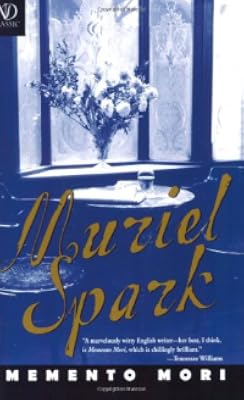
Memento Mori
by Muriel Spark
On This Page
Description
Elderly Lettie Colston receives an anonymous phone call reminding her that she must die. Soon ten of Lettie's friends also get the call. A bizarre investigation reveals a network of deception that binds together the group of aging eccentrics.Tags
Recommendations
















Member Recommendations

Member Reviews
This is not a mystery novel, although it does center around anonymous phone calls made to seniors, with the stark message, "Remember, you must die."
Filled with a dizzying number of septuagenarians and octogenarians who cope with ailments, arguments, old love affairs, and with wills -- both the threatening and the actual rewriting of them -- it is remarkably entertaining throughout.
Spark was just 41 when this novel came out. She showed uncanny insight toward her aged characters as they headed toward death. But death, even for those so closely approaching it, remains an abstraction for them in spite of the advice of the phone caller to "remember." As one of the more philosophical characters, Taylor, says this near the end of the show more novel,
"We all appear to ourselves frustrated in our old age, Alec, because we cling to everything so much. But in reality we are still fulfilling our lives."
Even as a mere sexagenarian, I love that line. A wonderful, funny, thought-provoking novel. It may become one of my all-time favorites. show less
Filled with a dizzying number of septuagenarians and octogenarians who cope with ailments, arguments, old love affairs, and with wills -- both the threatening and the actual rewriting of them -- it is remarkably entertaining throughout.
Spark was just 41 when this novel came out. She showed uncanny insight toward her aged characters as they headed toward death. But death, even for those so closely approaching it, remains an abstraction for them in spite of the advice of the phone caller to "remember." As one of the more philosophical characters, Taylor, says this near the end of the show more novel,
"We all appear to ourselves frustrated in our old age, Alec, because we cling to everything so much. But in reality we are still fulfilling our lives."
Even as a mere sexagenarian, I love that line. A wonderful, funny, thought-provoking novel. It may become one of my all-time favorites. show less
This is an unusual book, in that almost all the protagonists are over the age of 70. They are also all treated with respect and individuality. There are the tropes of the elderly in here, but they are each more than that. I did end up caring what happened to them. They each receive, at various time, a telephone call which consists of the words "Remember you will die" and then the phone is put down. The voice appears to each of them differently, to most it is a man, to one it is a woman. Who it is remains unsolved (although I did wonder a few times about one or two of them). Towards the ends events spiral out of control of the individuals concerned and that is quite shocking. But on the whole a compassionate portrait of a selection of show more people who have lived their lives and are dealing with the hand they have been dealt. show less
This is a subtle but fierce book, the kind of story that sneaks up on you and then, like one of the protagonists, gives you a firm whack on the head. Spark's writing is terse, clipped--but incredibly expressive for that. In 224 pages you're roped into the lives of this elderly cast of characters, and tightly bound; by the end, you don't want to let go, even as they all do.
In a typically contrary move, Spark chose to write her definitive novel about old age when she was barely forty, thus leaving herself free to write about teenagers when she was in her eighties...
Most of the characters in this book are at least twice the author's age, but you wouldn't think it: this is a book that seems to convey what it's like to be very old just as powerfully and convincingly as Mrs Palfrey at the Claremont, Old Filth, or The dark flood rises. The characters see themselves as engaged in a constant struggle: How primitive, Guy thought, life becomes in old age, when one may be surrounded by familiar comforts and yet more vulnerable to the action of nature than any young explorer at the Pole. And how simply the physical show more laws assert themselves, frustrating all one's purposes. And there are still the effects of deceptions and love affairs from before the First World War working themselves out between the characters, there are relatives and hangers-on (many of them no longer young themselves) angling for legacies, there are the usual small catastrophes of everyday life, which have so much more impact than they used to, there is the threat of ending up in a Home or — far worse — in the Maud Long Ward(*) at the hospital, with no recourse other than the largely-empty threat to change your will. And to cap it all there is a mysterious voice on the telephone saying "Remember you must die".
Not much fun, clearly, but still surprisingly funny. show less
Most of the characters in this book are at least twice the author's age, but you wouldn't think it: this is a book that seems to convey what it's like to be very old just as powerfully and convincingly as Mrs Palfrey at the Claremont, Old Filth, or The dark flood rises. The characters see themselves as engaged in a constant struggle: How primitive, Guy thought, life becomes in old age, when one may be surrounded by familiar comforts and yet more vulnerable to the action of nature than any young explorer at the Pole. And how simply the physical show more laws assert themselves, frustrating all one's purposes. And there are still the effects of deceptions and love affairs from before the First World War working themselves out between the characters, there are relatives and hangers-on (many of them no longer young themselves) angling for legacies, there are the usual small catastrophes of everyday life, which have so much more impact than they used to, there is the threat of ending up in a Home or — far worse — in the Maud Long Ward(*) at the hospital, with no recourse other than the largely-empty threat to change your will. And to cap it all there is a mysterious voice on the telephone saying "Remember you must die".
Not much fun, clearly, but still surprisingly funny. show less
I'm quitting this at page 60. I have wanted to read this novel for years, but it is not quite what I had anticipated. The writing is clever and in places dryly funny. However, it is not a funny book as such, and although I knew it was about facing up to death (see the title!), at this moment in my life I do not need to read a book about elderly women being mistreated on a hospital ward or by a cruel carer in their own home.
Remember, you must die. And you must pay your taxes. There are penalties if you forget the second, but the first? Most of us don't spend much time thinking about it and neither do Muriel Sparks characters, most of whom are older than we are, and, at any rate, die at the end of the book.
People who are under the impression that they live rational lives think they are getting closer to reality if they watch the meat the will have for dinner be slaughtered and butchered and if they remember they're not immortal, but I would suggest the real truth they evade is the knowledge that the lives they lead are not rational at all. Instead, what pulls them along is a good narrative and the one in this book suffices.
People who are under the impression that they live rational lives think they are getting closer to reality if they watch the meat the will have for dinner be slaughtered and butchered and if they remember they're not immortal, but I would suggest the real truth they evade is the knowledge that the lives they lead are not rational at all. Instead, what pulls them along is a good narrative and the one in this book suffices.
Muriel Spark is so funny...not funny ha-ha, but dryly clever. This might be my favorite of hers so far. It's a little different in relationship to her other novels and some might feel this is a bit cold but I can't think of another book I have read which is entirely populated by the aged. Once you get on its wavelength, the reading becomes very amusing. Spark has such an elegant way in her narration.
Members
- Recently Added By
Lists

1001 Books You Must Read Before You Die
1,448 works; 1,134 members

Fiction Featuring Cranky, Eccentric Old Folks
80 works; 35 members

Best Books Set in London
157 works; 42 members

Top Five Books of 2013
1,562 works; 721 members

20th Century Literature
1,161 works; 55 members

Backlisted
109 works; 9 members

Books I've Read More Than Once
602 works; 49 members

1950s
340 works; 22 members

Top Five Books of 2022
736 works; 272 members

Global Reads: Books Set in the United Kingdom and Ireland
109 works; 5 members

LibraryThingers' 1001 Books You Must Read Before You Die
442 works; 30 members
Readable Classics
110 works; 15 members

the old and the restless
62 works; 14 members

Novels featuring siblings
133 works; 8 members
Best Books Read for TIOLI
49 works; 14 members

posh people behave badly
23 works; 6 members

Books Read in 2017
4,249 works; 129 members
Books Read in 2016
4,666 works; 199 members

Favorite Books from the 1950s
33 works; 2 members

Books Read in 2020
4,379 works; 124 members

Nifty Fifties
129 works; 14 members
Backlisted Podcast
65 works; 3 members

AlphaKIT: Brown
21 works; 4 members

Recommend the 20 best books you've read in the last five years
2,168 works; 601 members

le donne raccontano
116 works; 1 member

Mustich's 1000 Books to Read Before You Die: A Life Changing List
1,001 works; 19 members
Five star books
1,767 works; 110 members
Talk Discussions
Past Discussions
Group Read, October 2021: Memento Mori in 1001 Books to read before you die (October 2021)
Author Information

101+ Works 22,802 Members
Muriel Spark has been called "our most chillingly comic writer since Evelyn Waugh" by the London Spectator, and the New Yorker praised her novel Memento Mori ri (1959) as "flawless." Her fiction is marked by its remarkable diversity, wit, and craftsmanship. "She happens to be, by some rare concatenation of grace and talent, an artist, a show more serious---and most accomplished---writer, a moralist engaged with the human predicament, wildly entertaining, and a joy to read" (SRSR). She became widely known in the United States when the New Yorker devoted almost an entire issue to The Prime of Miss Jean Brodie (1961). Set in Edinburgh in the 1930s, this is the story of a schoolteacher, her unorthodox approach to life, and its effect on her select group of adolescent girls. Though their idol turns out to have feet of clay, she leaves an indelible mark on their lives. The Girls of Slender Means (1963), also warmly praised, is a sardonic look at the vivacity of youth and the anxieties of young womanhood. Reviewing The Mandelbaum Gate (1965) for the New Republic, Honor Tracy wrote: "There is an abundance here of invention, humor, poetry, wit, perception, that all but takes the breath away. . . . The story, in fact, is pure adventure, with the suspense as artfully maintained as anywhere by Graham Greene, but this is only one ingredient. There are memorable descriptions of the Holy Land, fascinating insights into the jumble of intrigue and piety surrounding the Holy Places, and penetrating studies of Arabs. . . . In each of [Spark's] novels heretofore one of her qualities has tended to predominate over the others. Here for the first time they are all impressively marshaled side by side, resulting in her best work so far." The daughter of an Englishwoman and a Scottish-Jewish father, Spark was born and educated in Edinburgh. After her marriage in 1938, she lived for some years in Central Africa, a period rarely reflected in her work. During World War II, she returned to Britain, where she worked in the Political Intelligence Department of the Foreign Office after the breakup of her marriage. She has been a magazine editor and written poetry and literary criticism. Spark has lived in London's Camberwell section, the setting of The Ballad of Peckham Rye (1960), but now makes her home in New York. Her novels reflect her conversion to Roman Catholicism. (Bowker Author Biography) Writer Muriel Spark was born in Edinburgh on February 1, 1918. In 1934-1935 she took a course in commercial correspondence and précis writing at Heriot-Watt College. After her marriage in 1937, she lived for some years in Central Africa. During World War II, she returned to Britain, where she worked in the Political Intelligence Department of the Foreign Office after the breakup of her marriage. After the war, she began her literary career. She became General Secretary of the Poetry Society, worked as an editor and wrote studies of Mary Shelley, John Masefield and the Brontë sisters. Her first book of poetry, The Fanfarlo and Other Verse, was published in 1952 and her first novel, The Comforters, was published in 1957. She wrote over twenty books including The Prime of Miss Jean Brodie and The Finishing School. She won numerous awards and honors including the 1965 James Tait Black Memorial Prize for The Mandelbaum Gate, the 1992 U. S. Ingersoll Foundation T. S. Eliot Award, the 1997 David Cohen British Literature Prize for Lifetime Achievement, and in 1993 she became Dame Commander of the Order of the British Empire in recognition of her services to literature. The Scottish Arts Council created the Muriel Spark International Fellowship in 2004. She died on April 13, 2006. (Bowker Author Biography) show less
Some Editions
Awards and Honors
Series
Belongs to Publisher Series
Work Relationships
Is contained in
Common Knowledge
- Canonical title
- Memento Mori
- Original title
- Memento Mori
- Original publication date
- 1959
- People/Characters
- Dame Lettie Colston; Godfery Colston; Mabel Pettigrew; Charmian Piper Colston; Inspector Mortimer; Jean Taylor (show all 20); Guy Leete; Alec Warner; Lisa Brooke; Eric Colson; Granny Barnacle; Granny Duncan; Granny Taylor; Granny Green; Granny Valvona; Tempest Sidebottome; Ronald Sidebottome; Percy Mannering; Olive Mannering; Mrs. Anthony
- Important places
- London, England, UK (elders' home)
- Related movies
- Memento Mori (1992 | IMDb)
- Epigraph
- What shall I do with this absurdity -
O heart, O troubled heart - this caricature,
Decrepit age that has been tied to me
As to a dog's tail?
W. B. YEATS, The Tower
O what Venerable and Reverend ... (show all)Creatures
did the Aged seem! Immortal Cherubims!
THOMAS TRAHERNE, Centuries of Meditation
Q. What are the four last things to be ever remembered?
A. The four last things to be ever remembered are Death, Judgement, Hell, and Heaven.
The Penny Catechism - Dedication
- For
TERESA WALSHE
with love - First words
- Dame Lettie Colston refilled her fountain-pen and continued her letter: One of these days I hope you will write as brilliantly on a happier theme.
The world according to Muriel Spark is a startling place, constructed with intelligence, relish and extraordinary precision. (Introduction) - Quotations
- Remember you must die.
(Spoiler Alert) Lisa Brooke died in her seventy-third year after her second stroke. She had taken nine months to die, and in fact it was only a year before her death that, feeling rather ill, she had decided to reform her lif... (show all)e, and reminding herself how attractive she still was, offered up the new idea, her celibacy, to the Lord to whom no gift whatsoever is unacceptable. - Last words
- (Click to show. Warning: May contain spoilers.)Jean Taylor lingered for a time, employing her pain to magnify the Lord, and meditating sometimes confidingly upon Death, the first of the four last things to be ever remembered.
(Click to show. Warning: May contain spoilers.)Memento Mori shows perhaps the world's greatest crime, the avoidable wrong, the human fault, the death of mercy. (Introduction) - Blurbers
- Greene, Graham; Waugh, Evelyn
- Original language
- English
Classifications
Statistics
- Members
- 1,983
- Popularity
- 10,904
- Reviews
- 75
- Rating
- (3.76)
- Languages
- 8 — Dutch, English, French, German, Italian, Portuguese, Spanish, Turkish
- Media
- Paper, Audiobook, Ebook
- ISBNs
- 49
- ASINs
- 35