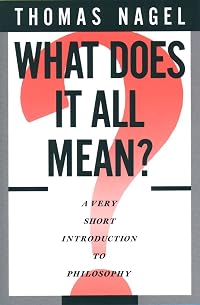
What Does It All Mean?: A Very Short Introduction to Philosophy
by Thomas Nagel
On This Page
Description
In this cogent and accessible introduction to philosophy, the distinguished author of Mortal Questions and The View From Nowhere sets forth the central problems of philosophical inquiry for the beginning student. Arguing that the best way to learn about philosophy is to think about its questions directly, Thomas Nagel considers possible solutions to nine problems-knowledge of the world beyond our minds, knowledge of other minds, the mind-body problem, free will, the basis of morality, right show more and wrong, the nature of death, the meaning of life, and the meaning of words. Although he states his own opinions clearly, Nagel leaves these fundamental questions open, allowing students to entertain other solutions and encouraging them to think for themselves. show lessTags
Recommendations














Member Recommendations

Member Reviews
You want I should tell you what it all means, now that I finished the book? So, if I did, you could then say, "That's it? Why should I care?" Or "What does it mean that that's what it all means?" In other words, a meaning found in a book is just a meaning found in a book. That's not a fault of the book, though. Nagel gives this very argument.
I'll admit I went into this less naive than the intended audience. It was written for people who never asked these questions in the first place. I couldn't tell you whether one of those people would find this book a wake-up call to the examined life. The fact that they picked it up in the first place would mean they were already primed for it. This, by the way, is the core of what I call the show more Goodread's Paradox: the distortion in ratings caused by the fact that readers aren't reviewing at random but are evaluating just those books toward which they are already disposed to find interesting. Someone picking up Nagel and expecting a romantic comedy would give it only 1 star.
And, indeed, my only real complaint about the book is that Nagel doesn't sufficiently question what he is reading into to his observations. Yes, he treats the topics of solipsism and materialism but he doesn't ask whether those topics themselves reflect a bias that could, if not be escaped, at least be seen as an inescapable bias for him (though perhaps not for someone else with different inescapable biases) and whether the self is just that, a bias, which keeps one from a "view from nowhere" (a book of his I promise to return to.) show less
I'll admit I went into this less naive than the intended audience. It was written for people who never asked these questions in the first place. I couldn't tell you whether one of those people would find this book a wake-up call to the examined life. The fact that they picked it up in the first place would mean they were already primed for it. This, by the way, is the core of what I call the show more Goodread's Paradox: the distortion in ratings caused by the fact that readers aren't reviewing at random but are evaluating just those books toward which they are already disposed to find interesting. Someone picking up Nagel and expecting a romantic comedy would give it only 1 star.
And, indeed, my only real complaint about the book is that Nagel doesn't sufficiently question what he is reading into to his observations. Yes, he treats the topics of solipsism and materialism but he doesn't ask whether those topics themselves reflect a bias that could, if not be escaped, at least be seen as an inescapable bias for him (though perhaps not for someone else with different inescapable biases) and whether the self is just that, a bias, which keeps one from a "view from nowhere" (a book of his I promise to return to.) show less
Even though the exceptionally fine humanities course I took in high school included certain philosophy texts, I was taken by such surprise and delight when introduced to the subject in college that I couldn't help but major in it; devil take the hindmost! no matter that NO one thought I'd wind up with gainful employment, etc. etc. etc.
I've actually gotten some of my best jobs thanks to that major, but have always thought that I'd have been more confident in my youthful decisions had I a bit more background in basic epistemology, ethics and critical thinking. I knew in my gut that high school students could absorb and respond to the concepts. Much later, I taught history of philosopy, ethics and logic in an overseas high school and my show more belief in the need for these courses at earlier and earlier ages was confirmed.
All that is just a long way of saying that Dr. Nagel's book fills what I consider a truly crucial need, and I'm looking forward to sharing it in a variety of educational settings. show less
I've actually gotten some of my best jobs thanks to that major, but have always thought that I'd have been more confident in my youthful decisions had I a bit more background in basic epistemology, ethics and critical thinking. I knew in my gut that high school students could absorb and respond to the concepts. Much later, I taught history of philosopy, ethics and logic in an overseas high school and my show more belief in the need for these courses at earlier and earlier ages was confirmed.
All that is just a long way of saying that Dr. Nagel's book fills what I consider a truly crucial need, and I'm looking forward to sharing it in a variety of educational settings. show less
This extremely short and easy to read book is packed with the essential questions that philosophers have pondered over the millennia. To keep it short and accessible, Nagel writes in approachable language, there are no -ology or -isms here. Nor are there any names. If you want a summary of Kant's Categorical Imperative or a comparison of Plato and Aristotle's views on reality, this is not the book to read. But that's not the goal here. Instead, Nagel covers several fundamental issues, providing a brief summary of the deeper possibilities to ponder by presenting a summary of the most popular approaches to answering these vexing questions. Topics range from the nature of reality, theory of mind, the relationship between mind and body, show more morality, determinism vs free will, death, and the meaning of life.
I think that everyone should read this book. Younger readers may be exposed to some of these concepts for the first time, and will enjoy spending the rest of their lives grappling with them. Many adults will be re-introduced to the thoughts that vexed their teenaged selves but were dropped by the wayside as responsibilities and other interests took over. Different sections will resonate with different readers, and hopefully have their interests kindled to pursue those areas in more depth.
Even experts and academics will be well served by the reminder that although technical language and jargon is necessary for rigorous analysis, they should always be able to explain the basic concepts of their theories in common language, and Nagel provides the blueprint for how to do that. show less
I think that everyone should read this book. Younger readers may be exposed to some of these concepts for the first time, and will enjoy spending the rest of their lives grappling with them. Many adults will be re-introduced to the thoughts that vexed their teenaged selves but were dropped by the wayside as responsibilities and other interests took over. Different sections will resonate with different readers, and hopefully have their interests kindled to pursue those areas in more depth.
Even experts and academics will be well served by the reminder that although technical language and jargon is necessary for rigorous analysis, they should always be able to explain the basic concepts of their theories in common language, and Nagel provides the blueprint for how to do that. show less
Clear, concise introduction to philosophical issues without jargon. Not without it's biases though, since Nagel is a practicing philosopher with his own takes on different issues. Make sure you see where he goes from introduction of the issue to his own arguments, which are very good ones.
The word clear has different meanings, but fundamentally it gets at the idea that an exposition is "bright", "full of light" -- that is, it brings its subject out into the light where we can get a good look at it. This in contrast with the obscure, which withdraws its subject matter and itself back into the shadows. Perhaps it would not be ironic to say that all philosophical writing aims at clarity, but there is an especial difficulty in the achievement because of this peculiarity of language -- that whatever it shows it also hides -- that is, whatever it clears it obscures.
Aside from wondering what all of this may have to do with a short book entitled "What Does It All Mean?", you may notice that part of the problem is that the show more distinction between clear / obscure is not itself clear. This is the kind of thing that Nagel wants us to think about while reading his book: what does it mean to make a distinction and what kinds of distinctions about the world are accurate -- that is, hit the boundaries between things and ideas on the mark?
So while each of his chapters *seems* to cover a "philosophical problem", we often find that the real subject of each chapter, and of the book as a whole, is whether the distinctions we commonly make between phenomena are valid distinctions. "Am I inside myself, and if I am inside of myself, am I inside myself in a different way than my brain is inside my head?" -- this is at issue in the chapter on "The Mind/Body Problem". "What distinguishes my mind from the minds of other people? What distinguishes consciousness from unconsciousness?" -- these are the questions Nagel looks at in his chapters on "Death" and "Other Minds". And of course, the perennial "Does the world really exist outside my experience?" is easily seen to participate in the same problematic attempt to distinguish inside from outside, right from wrong, self from other, etc.
One might be tempted to ask, after reading this book, whether it is not the distinctions themselves that are, in each case, the problem, and become taken with the peculiar idea that, if only we stopped making distinctions, we would stop having problems. On the contrary, it seems a certain amount of distinction between the phenomena presented to our senses (and present in our thought) is necessary to live in the world. The goal of philosophy, I suppose, is to minimize the damage. Nagel's book is one such exercise in this kind of "damage control". show less
Aside from wondering what all of this may have to do with a short book entitled "What Does It All Mean?", you may notice that part of the problem is that the show more distinction between clear / obscure is not itself clear. This is the kind of thing that Nagel wants us to think about while reading his book: what does it mean to make a distinction and what kinds of distinctions about the world are accurate -- that is, hit the boundaries between things and ideas on the mark?
So while each of his chapters *seems* to cover a "philosophical problem", we often find that the real subject of each chapter, and of the book as a whole, is whether the distinctions we commonly make between phenomena are valid distinctions. "Am I inside myself, and if I am inside of myself, am I inside myself in a different way than my brain is inside my head?" -- this is at issue in the chapter on "The Mind/Body Problem". "What distinguishes my mind from the minds of other people? What distinguishes consciousness from unconsciousness?" -- these are the questions Nagel looks at in his chapters on "Death" and "Other Minds". And of course, the perennial "Does the world really exist outside my experience?" is easily seen to participate in the same problematic attempt to distinguish inside from outside, right from wrong, self from other, etc.
One might be tempted to ask, after reading this book, whether it is not the distinctions themselves that are, in each case, the problem, and become taken with the peculiar idea that, if only we stopped making distinctions, we would stop having problems. On the contrary, it seems a certain amount of distinction between the phenomena presented to our senses (and present in our thought) is necessary to live in the world. The goal of philosophy, I suppose, is to minimize the damage. Nagel's book is one such exercise in this kind of "damage control". show less
This seems more targeted to a highschool crowd who haven't engaged with philosophy at all. It's pedagogically laid out as a journey through most common philosophical topics from how we can know anything at all to theories about life and death.
This seems more targeted to a highschool crowd who haven't engaged with philosophy at all. It's pedagogically laid out as a journey through most common philosophical topics from how we can know anything at all to theories about life and death.
Members
- Recently Added By
Lists

Philosophy Reading List
9 works; 1 member
Author Information

Some Editions
Series
Belongs to Publisher Series
Common Knowledge
- Canonical title*
- Was bedeutet das alles? Eine ganz kurze Einführung in die Philosophie
- Original title
- What Does It All Mean?: A Very Short Introduction to Philosophy
- Original publication date
- 1987
- Last words
- (Click to show. Warning: May contain spoilers.)...perhaps we have to put up with being ridiculous. Life may be not only meaningless but absurd.
*Some information comes from Common Knowledge in other languages. Click "Edit" for more information.
Classifications
Statistics
- Members
- 1,123
- Popularity
- 22,643
- Reviews
- 15
- Rating
- (3.57)
- Languages
- 13 — Catalan, Chinese, Dutch, English, French, German, Italian, Norwegian (Bokmål), Polish, Romanian, Spanish, Swedish, Portuguese (Portugal)
- Media
- Paper, Audiobook, Ebook
- ISBNs
- 40
- ASINs
- 6