
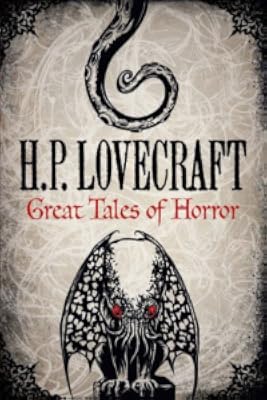
H. P. Lovecraft: Great Tales of Horror
by H. P. Lovecraft
On This Page
Description
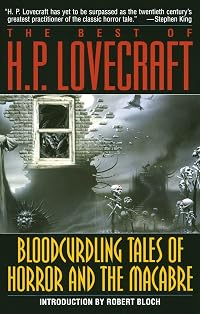
H.P. Lovecraft: Great Talesof Horror features twenty of horror master H.P. Lovecrafts classic stories, among them some of the greatest works of horror fiction ever written, including: "The Rats in the Walls," "Pickmans Model," "The Colour out of Space," "The Call of Cthulhu," "The Dunwich Horror," "The Shadow over Innsmouth," "At the Mountains of Madness," "The Shadow out of Time," and "The Haunter of the Dark.".Tags
Recommendations









Member Reviews
Reading Lovecraft, you'll see exactly where American horror of the 20s and 30s made a turn, and it was with him. At the time, scary stories were something for children, still primarily Victorian in style, and written with the bloody parts alluded to but rarely shown. Though he had limited success in his lifetime, Lovecraft wrote stories of horror, but also of strangeness. Here you have multiple stories of odd young men being drawn to the odd behavior of neighbors, of devoted friends who are dealing with body invasion, reanimating the dead, and the raising of the great sea creature Cthulhu. "The Thing on the Doorstep" is one of the few that straddles the old, Victorian style while dealing with Lovecraft's modern weirdness. "Pickman's show more Model" deals with acute mental illness in the art world, but "The Dunwich Horror" is the greatest of Lovecraft's stories, managing to feel modern even though it's nearly 100 years old.
This volume has his greatest hits, and probably a few that are deep dives. show less
This volume has his greatest hits, and probably a few that are deep dives. show less
A whole range of novels, novellas, and short stories, all set in the same shared multiverse, impassionately overlooked by immeasurably old gods, and based around a city and its satellite towns in New England? It's not hard to see why Lovecraft is considered a major influence on Stephen King.
Having twenty of Lovecraft's works here in one place is both a blessing and a curse for his writing. As noted above, his fiction does take place in a shared universe and oftentimes the action occurs in or around Arkham, Massachusetts. This vast fictional universe – the Cthulhu Mythos – is easier to grasp when juxtaposed like this, and it's easier to appreciate the grandeur of Lovecraft's undertaking. Stories written decades apart still manage show more to link themes and present a consistent world-picture.
On the other hand, anthologies by authors of a particular genre always run the risk of becoming formulaic long before the end. Especially anthologies of this size: twenty stories covering six hundred pages. It's like a best-of album by Status Quo. You might like their songs individually but after twenty of their greatest hits you can't help but realise you've been listening to the same three chords for an hour, just with different words over the top.
Fortunately Lovecraft is no Status Quo. When the genre in question is “weird fiction” you can probably guess that things aren't going to become overly formulaic. I was slightly concerned going into the collection that my preconceptions about Lovecraft would prove themselves terribly accurate, that all his stories were essentially about guys wandering around somewhere then bumping into some Eldritch Abomination that is Too Terrible To Describe, and then the guy goes mad and dies. The end. There is, after all, only so many times an author can get away with playing the “indescribable” card before the reader starts to wonder if the subject is truly beyond description or whether the author is just inept or lazy. Lovecraft seems to have been aware of this, with several of his narrators initially lamenting that some abomination is beyond our language to describe, but then confessing that if you can see it you can probably make some attempt at describing it, and doing so. The beings encountered and events experienced in the tales might be confusing for the narrators, even discombobulating, but Lovecraft is never inept or lazy as a writer. show less
Having twenty of Lovecraft's works here in one place is both a blessing and a curse for his writing. As noted above, his fiction does take place in a shared universe and oftentimes the action occurs in or around Arkham, Massachusetts. This vast fictional universe – the Cthulhu Mythos – is easier to grasp when juxtaposed like this, and it's easier to appreciate the grandeur of Lovecraft's undertaking. Stories written decades apart still manage show more to link themes and present a consistent world-picture.
On the other hand, anthologies by authors of a particular genre always run the risk of becoming formulaic long before the end. Especially anthologies of this size: twenty stories covering six hundred pages. It's like a best-of album by Status Quo. You might like their songs individually but after twenty of their greatest hits you can't help but realise you've been listening to the same three chords for an hour, just with different words over the top.
Fortunately Lovecraft is no Status Quo. When the genre in question is “weird fiction” you can probably guess that things aren't going to become overly formulaic. I was slightly concerned going into the collection that my preconceptions about Lovecraft would prove themselves terribly accurate, that all his stories were essentially about guys wandering around somewhere then bumping into some Eldritch Abomination that is Too Terrible To Describe, and then the guy goes mad and dies. The end. There is, after all, only so many times an author can get away with playing the “indescribable” card before the reader starts to wonder if the subject is truly beyond description or whether the author is just inept or lazy. Lovecraft seems to have been aware of this, with several of his narrators initially lamenting that some abomination is beyond our language to describe, but then confessing that if you can see it you can probably make some attempt at describing it, and doing so. The beings encountered and events experienced in the tales might be confusing for the narrators, even discombobulating, but Lovecraft is never inept or lazy as a writer. show less
H.P. Lovecraft sits in a rather weird place in history. His books heavily influence modern horror, to the point where "Lovecraftian horror" is an actual subgenre. His mythos is legendary, constantly referenced in works of fiction, and Cthulhu even has his own little niche in pop culture, even among people who have never heard of the original author. Even my spellcheck knows about Cthulhu! Despite all this, his work really isn't widely read. It isn't reprinted nearly as much as other authors of the time period, it's harder to find in bookstores, and even though he is commonly considered one of the greatest horror authors of all time it's rare to find someone who has actually read his stories.
So, after many years of reading about the show more author, I finally decided to actually read his work. I must say, I'm impressed!
The important thing to remember when reading Lovecraft is how utterly different it was from what made up horror during the time period. When most horror authors were writing about the supernatural; ghosts, vampires, and demons, he was writing about the cosmic. Sure, alien invaders weren't a new concept, H.G. Wells had written War of the Worlds more than a decade before he first published a story, but he made them the stuff of nightmares. Dark, horrible, madness-inducing monsters from the depths of space and time. It was fairly unique for the time.
I say all that, because I'll be the first to admit that his stories are often dense, and plotless. I would consider it the horror version of Tolkien's The Siilmarillion. It's all about the lore, and Lovecraft's strength was world-building. He didn't just write stories, he created believable worlds, alien races, and alternate histories. Sure, there are some plot-driven stories, but his best and most memorable stories are the ones that describe some horrifying cosmic monstrosity. Cthulhu, Yog-Sothoth, Nyarlathotep...THESE are what Lovecraft gave us, and it has inspired horror authors for nearly a hundred years now. show less
So, after many years of reading about the show more author, I finally decided to actually read his work. I must say, I'm impressed!
The important thing to remember when reading Lovecraft is how utterly different it was from what made up horror during the time period. When most horror authors were writing about the supernatural; ghosts, vampires, and demons, he was writing about the cosmic. Sure, alien invaders weren't a new concept, H.G. Wells had written War of the Worlds more than a decade before he first published a story, but he made them the stuff of nightmares. Dark, horrible, madness-inducing monsters from the depths of space and time. It was fairly unique for the time.
I say all that, because I'll be the first to admit that his stories are often dense, and plotless. I would consider it the horror version of Tolkien's The Siilmarillion. It's all about the lore, and Lovecraft's strength was world-building. He didn't just write stories, he created believable worlds, alien races, and alternate histories. Sure, there are some plot-driven stories, but his best and most memorable stories are the ones that describe some horrifying cosmic monstrosity. Cthulhu, Yog-Sothoth, Nyarlathotep...THESE are what Lovecraft gave us, and it has inspired horror authors for nearly a hundred years now. show less
Some of these tales are better than others, but all reflect the authors command of English and mastery of (literally) unspeakable horror. The genre isn't exactly my cup of tea, but the writing and the myth building made it worthy of a serious perusal. The only complaint I have is the ordering of the stories, not chronological, not by subject. not by length or location but by ??? Perhaps just another of the mysteries the author revered...
A whole range of novels, novellas, and short stories, all set in the same shared multiverse, impassionately overlooked by immeasurably old gods, and based around a city and its satellite towns in New England? It's not hard to see why Lovecraft is considered a major influence on Stephen King.
Having twenty of Lovecraft's works here in one place is both a blessing and a curse for his writing. As noted above, his fiction does take place in a shared universe and oftentimes the action occurs in or around Arkham, Massachusetts. This vast fictional universe – the Cthulhu Mythos – is easier to grasp when juxtaposed like this, and it's easier to appreciate the grandeur of Lovecraft's undertaking. Stories written decades apart still manage to show more link themes and present a consistent world-picture.
On the other hand, anthologies by authors of a particular genre always run the risk of becoming formulaic long before the end. Especially anthologies of this size: twenty stories covering six hundred pages. It's like a best-of album by Status Quo. You might like their songs individually but after twenty of their greatest hits you can't help but realise you've been listening to the same three chords for an hour, just with different words over the top.
Fortunately Lovecraft is no Status Quo. When the genre in question is “weird fiction” you can probably guess that things aren't going to become overly formulaic. I was slightly concerned going into the collection that my preconceptions about Lovecraft would prove themselves terribly accurate, that all his stories were essentially about guys wandering around somewhere then bumping into some Eldritch Abomination that is Too Terrible To Describe, and then the guy goes mad and dies. The end. There is, after all, only so many times an author can get away with playing the “indescribable” card before the reader starts to wonder if the subject is truly beyond description or whether the author is just inept or lazy. Lovecraft seems to have been aware of this, with several of his narrators initially lamenting that some abomination is beyond our language to describe, but then confessing that if you can see it you can probably make some attempt at describing it, and doing so. The beings encountered and events experienced in the tales might be confusing for the narrators, even discombobulating, but Lovecraft is never inept or lazy as a writer. show less
Having twenty of Lovecraft's works here in one place is both a blessing and a curse for his writing. As noted above, his fiction does take place in a shared universe and oftentimes the action occurs in or around Arkham, Massachusetts. This vast fictional universe – the Cthulhu Mythos – is easier to grasp when juxtaposed like this, and it's easier to appreciate the grandeur of Lovecraft's undertaking. Stories written decades apart still manage to show more link themes and present a consistent world-picture.
On the other hand, anthologies by authors of a particular genre always run the risk of becoming formulaic long before the end. Especially anthologies of this size: twenty stories covering six hundred pages. It's like a best-of album by Status Quo. You might like their songs individually but after twenty of their greatest hits you can't help but realise you've been listening to the same three chords for an hour, just with different words over the top.
Fortunately Lovecraft is no Status Quo. When the genre in question is “weird fiction” you can probably guess that things aren't going to become overly formulaic. I was slightly concerned going into the collection that my preconceptions about Lovecraft would prove themselves terribly accurate, that all his stories were essentially about guys wandering around somewhere then bumping into some Eldritch Abomination that is Too Terrible To Describe, and then the guy goes mad and dies. The end. There is, after all, only so many times an author can get away with playing the “indescribable” card before the reader starts to wonder if the subject is truly beyond description or whether the author is just inept or lazy. Lovecraft seems to have been aware of this, with several of his narrators initially lamenting that some abomination is beyond our language to describe, but then confessing that if you can see it you can probably make some attempt at describing it, and doing so. The beings encountered and events experienced in the tales might be confusing for the narrators, even discombobulating, but Lovecraft is never inept or lazy as a writer. show less
Ratings
Members
- Recently Added By
Lists

Books Read in 2016
4,666 works; 197 members

Top Five Books of 2016
795 works; 229 members
Author Information

1,917+ Works 73,693 Members
Howard Phillips Lovecraft, 1890 - 1937 H. P. Lovecraft was born on August 20, 1890 in Providence, Rhode Island. His mother was Sarah Susan Phillips Lovecraft and his father was Winfield Scott Lovecraft, a traveling salesman for Gorham & Co. Silversmtihs. Lovecraft was reciting poetry at the age of two and when he was three years old, his father show more suffered a mental breakdown and was admitted to Butler Hospital. He spent five years there before dying on July 19, 1898 of paresis, a form of neurosyphillis. During those five years, Lovecraft was told that his father was paralyzed and in a coma, which was not the case. His mother, two aunts and grandfather were now bringing up Lovecraft. He suffered from frequent illnesses as a boy, many of which were psychological. He began writing between the ages of six and seven and, at about the age of eight, he discovered science. He began to produce the hectographed journals, "The Scientific Gazette" (1899-1907) and "The Rhode Island Journal of Astronomy" (1903-07). His first appearance in print happened, in 1906, when he wrote a letter on an astronomical matter to The Providence Sunday Journal. A short time later, he began writing a monthly astronomy column for The Pawtuxet Valley Gleaner - a rural paper. He also wrote columns for The Providence Tribune (1906-08), The Providence Evening News (1914-18), The Asheville (N.C.) Gazette-News (1915). In 1904, his grandfather died and the family suffered severe financial difficulties, which forced him and his mother to move out of their Victorian home. Devastated by this, he apparently contemplated suicide. In 1908, before graduating from high school, he suffered a nervous breakdown. He didn't receive a diploma and failed to get into Brown University, both of which caused him great shame. Lovecraft was not heard from for five years, re-emerging because of a letter he wrote in protest to Fred Jackson's love story in The Argosy. His letter was published in 1913 and caused great controversy, which was noted by Edward F. Daas, President of the United Amateur Press Association (UAPA). Daas invited Lovecraft to join the UAPA, which he did in early 1914. He eventually became President and Official Editor of the UAPA and served briefly as President of the rival National Amateur Press Association (NAPA). He published thirteen issues of his own paper, The Conservative (1915-23) and contributed poetry and essays to other journals. He also wrote some fiction which titles include "The Beast in the Cave" (1905), "The Alchemist" (1908), "The Tomb" and "Dagon" (1917). In 1919, Lovecraft's mother was deteriorating, mentally and physically, and was admitted to Butler Hospital. On May 24, 1921, his mother died from a gall bladder operation. While attending an amateur journalism convention in Boston, Lovecraft met his future wife Sonia Haft Greene, a Russian Jew. They were married on March 3, 1924 and Lovecraft moved to her apartment in Brooklyn. Sonia had a shop on Fifth Avenue that went bankrupt. In 1925, Sonia went to Cleveland for a job and Lovecraft moved to a smaller apartment in the Red Hook district of Brooklyn. In 1926, he decided to move back to Providence. Lovecraft had his aunts bar his wife, Sonia, from going to Providence to start a business because he couldn't have the stigma of a tradeswoman wife. They were divorced in 1929. After his return to Providence, he wrote his greatest fiction, which included the titles "The Call of Cthulhu" (1926), "At the Mountains of Madness" (1931), and "The Shadow Out of Time" (1934-35). In 1932, his aunt, Mrs. Clark, died; and he moved in with his other aunt, Mrs. Gamwell, in 1933. Suffering from cancer of the intestine, Lovecraft was admitted to Jane Brown Memorial Hospital and on March 15, 1937 he died. (Bowker Author Biography) show less
Some Editions
Series
Belongs to Publisher Series
Work Relationships
Contains
Common Knowledge
- Canonical title
- H. P. Lovecraft: Great Tales of Horror
- Original publication date
- 2012
Classifications
Statistics
- Members
- 1,231
- Popularity
- 19,986
- Reviews
- 5
- Rating
- (4.08)
- Languages
- English
- Media
- Paper, Ebook
- ISBNs
- 3
- ASINs
- 2