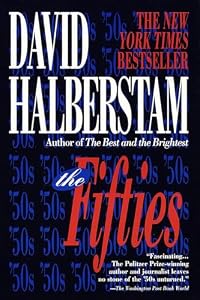
The Fifties
by David Halberstam
On This Page
Description
Exuberant and ambitious, The Fifties delves into a decade that remains a monumental and lasting turning point in American history Joe McCarthy. Marilyn Monroe. The H-bomb. Ozzie and Harriet. Elvis. Civil rights. It's undeniable: The fifties were a defining decade for America, complete with sweeping cultural change and political upheaval. This decade is also the focus of David Halberstam's triumphant The Fifties, which stands as an enduring classic and was an instant New York Times bestseller show more upon its publication. More than a survey of the decade, it is a masterfully woven examination of far-reaching change, from the unexpected popularity of Holiday Inn to the marketing savvy behind McDonald's expansion. show lessTags
Recommendations















Member Reviews
Wonderfully readable for a 600‑plus page history book or, really, for any type of book at all. Halberstam's clear writing is a big part of the reason why, but I also think it’s because of how well this is organized. It consists of 46 chapters in rough chronological order that focus on a particular topic related to the decade. These topics range from the Cold War of the nuclear age to Elvis Presley’s impact on popular culture and include the emerging civil rights movement, the pill, Korea, Cuba, and the televised presidential debate that cast the die for the following decade, among many others. My only complaint is that he didn't write a follow-up book about the ‘60s.
This is a big book with over 700 pages of text, yet it is fast-paced, a page-turner, as it takes the reader deep into the 1950s, that decade that is so often portrayed as innocent with sock hops and “Leave it to Beaver.” But the era was anything but innocent. Beneath the façade of the idyllic life of the suburbs much more was happening. Thermonuclear bomb development, the McCarthy communist trials, the introduction of “Playboy Magazine,” the space race, the U-2 spy plane flights over Russia, the game show scandals---all of these events happened in the 1950s. Also Holiday Inn was established, McDonalds was born, and television and marketing became powerful mediums that influenced everyday life and promoted consumerism. And show more finally the civil rights movement gained momentum though it faced some difficult times and tense situations.
All of these events and more are explored in this book, a book that gives a good overview of the 50s decade. Totally accurate? Probably not. But even if some details follow popular lore, or are totally off, the book still gives a good feel for the era and does a good job of tearing away the nostalgic curtain through which the time is often viewed.
The negative that I find is the author’s own views creeping in through word choices and phrases that seem either to condemn or praise particular subjects. show less
All of these events and more are explored in this book, a book that gives a good overview of the 50s decade. Totally accurate? Probably not. But even if some details follow popular lore, or are totally off, the book still gives a good feel for the era and does a good job of tearing away the nostalgic curtain through which the time is often viewed.
The negative that I find is the author’s own views creeping in through word choices and phrases that seem either to condemn or praise particular subjects. show less
An eerie moment while reading The Fifties: A day ago, towards the end of the book, I finished the chapter on Charles Van Doren and the quiz show scandals of the 1950s. I almost immediately fell asleep thereafter. About eight hours later, I woke up and decided to look up Van Doren and see where he was these days, knowing he must be in his nineties. And the first thing I saw? Van Doren had just died. Eight hours previously. Just as I was finishing the chapter on him. I suppose with a world population closing in on eight billion people that a coincidence like that was inevitable. But it also goes to show you how far back in time, now, were the 1950s and the people who headlined those years. They are all succumbing to age and show more mortality.
David Halberstam's book remains a nice contribution to understanding the decade. In the past, I've used it almost like a reference book. But this time, I decided to read it through cover to cover. And doing so reveals his method along with his strengths and weaknesses.
The chapters of The Fifites are built around biographical sketches of leading figures from politics, science, art, film, television, journalism, business, and literature. And if you read Halberstam's most famous work, which is about the background to the men who led the US into Vietnam, The Best and the Brightest, you will recognize the same technique at work, here. Like that volume, The Fifties relies upon Halberstam's skill as a journalist and an interviewer, especially someone with access to the then still living people who were among the 1950s most significant cultural and political icons.
The Best and the Brightest is Halberstam's best work and has kept its place as one of the most important studies of the Vietnam War. And that is because Halberstam is at his most formidable when he is taking a skeptical attitude towards his subjects and questioning the everyday presentation of social and governmental propaganda that surrounds them. The same approach cannot be said entirely of The Fifties.
In this book, Halberstam has divided his focus onto saints and evildoers. And the result is likely unintentional. That is, the people Halberstam obviously disapprove of are far more interesting than the semi-divine figures he often comes close to worshiping. A few examples: I'm far more interested in reading about the tumultuous background and motivations of Edward Teller, the father of the H-bomb, than I am of the prim and proper Robert Oppenheimer, on whose side in the Teller-Oppenheimer conflict Halberstam firmly affixes himself. So, too, with figures from the civil rights movement. Orville Faubus makes for an intriguing Richard III type character of sympathetic background but self-serving and morally compromised personal ambition. Meanwhile, Martin Luther King and Rosa Parks come across as cardboard cutouts, so saintly that they lose all human quality. Halberstam literally mentions the issues of King's plagiarism and fondness for prostitutes in a one sentence parenthesis, commenting on how even great men have their foibles! Not so, of course, with Joseph McCarthy or John Foster Dulles, who he goes into depth to psychoanalyze and rake through their weaknesses. The result? Dulles and McCarthy again appear as fascinating subjects for further reading. At the same time, the cultural figures Halberstam gives pages to, Elvis, James Dean, and Marlon Brando, come across as boring. How do you make Brando boring! Finally, there are two figures from 1950s feminism highlighted in the book, Betty Friedan and Grace Metalious, the latter being the author of Peyton Place. The chapter on Saint Betty provides the literary equivalent of the Bataan Death March in that you think you will never make it through to the end. But the pages on Metalious, on the other hand, are captivating. I want to know more about this tragic figure made all the more human for her debauchery and lack of discipline.
There is much, much more in the book. And while it isn't a work you would ascribe to a professional historian (as was very nearly the case in The Best and the Brightest), it gives a sense of completeness to the overall feel of the decade.
What a tragedy itself was Halberstam's death in a useless automobile accident. He had many more fascinating books on plan. I wish we could have read them. show less
David Halberstam's book remains a nice contribution to understanding the decade. In the past, I've used it almost like a reference book. But this time, I decided to read it through cover to cover. And doing so reveals his method along with his strengths and weaknesses.
The chapters of The Fifites are built around biographical sketches of leading figures from politics, science, art, film, television, journalism, business, and literature. And if you read Halberstam's most famous work, which is about the background to the men who led the US into Vietnam, The Best and the Brightest, you will recognize the same technique at work, here. Like that volume, The Fifties relies upon Halberstam's skill as a journalist and an interviewer, especially someone with access to the then still living people who were among the 1950s most significant cultural and political icons.
The Best and the Brightest is Halberstam's best work and has kept its place as one of the most important studies of the Vietnam War. And that is because Halberstam is at his most formidable when he is taking a skeptical attitude towards his subjects and questioning the everyday presentation of social and governmental propaganda that surrounds them. The same approach cannot be said entirely of The Fifties.
In this book, Halberstam has divided his focus onto saints and evildoers. And the result is likely unintentional. That is, the people Halberstam obviously disapprove of are far more interesting than the semi-divine figures he often comes close to worshiping. A few examples: I'm far more interested in reading about the tumultuous background and motivations of Edward Teller, the father of the H-bomb, than I am of the prim and proper Robert Oppenheimer, on whose side in the Teller-Oppenheimer conflict Halberstam firmly affixes himself. So, too, with figures from the civil rights movement. Orville Faubus makes for an intriguing Richard III type character of sympathetic background but self-serving and morally compromised personal ambition. Meanwhile, Martin Luther King and Rosa Parks come across as cardboard cutouts, so saintly that they lose all human quality. Halberstam literally mentions the issues of King's plagiarism and fondness for prostitutes in a one sentence parenthesis, commenting on how even great men have their foibles! Not so, of course, with Joseph McCarthy or John Foster Dulles, who he goes into depth to psychoanalyze and rake through their weaknesses. The result? Dulles and McCarthy again appear as fascinating subjects for further reading. At the same time, the cultural figures Halberstam gives pages to, Elvis, James Dean, and Marlon Brando, come across as boring. How do you make Brando boring! Finally, there are two figures from 1950s feminism highlighted in the book, Betty Friedan and Grace Metalious, the latter being the author of Peyton Place. The chapter on Saint Betty provides the literary equivalent of the Bataan Death March in that you think you will never make it through to the end. But the pages on Metalious, on the other hand, are captivating. I want to know more about this tragic figure made all the more human for her debauchery and lack of discipline.
There is much, much more in the book. And while it isn't a work you would ascribe to a professional historian (as was very nearly the case in The Best and the Brightest), it gives a sense of completeness to the overall feel of the decade.
What a tragedy itself was Halberstam's death in a useless automobile accident. He had many more fascinating books on plan. I wish we could have read them. show less
The practice of using decades as a units of history seems to be popular in the US but not elsewhere. Appropriately, The Fifties is primarily about the United States; its topics may seem as insular as some of the individuals who figure in the story.. Another characteristic of the decade as an American historical unit is that it is probably more of a popular rather than an academic way to think about the past. The Fifties is popular not academic history.
CONS: Ends rather abruptly. Tend to lose track of the year being covered; since a lot of the biographical sketches naturally pre-date the period under consideration. Noteworthy gaps in coverage: general financial history, infrastructure and the economy, and taxes. Feminist history lacks show more nuance. Focusing on Betty Friedan limits scope to college-educated women’s careers. LGBT history barely touched on. Nothing on the environment although to be fair, the book was written before it became a big topic. Maybe too much attention paid to what I would consider relatively trivial popular culture topics: basketball, rock and roll, quiz shows. The juxtaposition with the themes of race relations and the development of the birth control pill (and the hydrogen bomb) with lengthy coverage of the passion of Charles Van Doren or the adventures of Allen Ginsberg at Columbia made me a little uncomfortable.
PROS. Highly readable. The biographies and the details of the topics the author chooses to cover are skillful and on point. The technique is not all that different from pre-modern histories except the biographies aren’t about kings, emperors, generals and clerics. History as a series of interesting lives can be a little misleading, on the other hand. Some items I found interesting:
Theme. The triumph of the Midwest. The image of the family, the family car, and the interaction of family and car on TV, all come out of the Midwest.
Biography. Pat Nixon meets Gloria Steinem. Pat Nixon did not have a Betty Friedan childhood. While, understandably, the author emphasizes the growth of the economy in the 50s, one wonders what portion of the population was not able to float with the rising tide.
The ironies of US foreign policy. Eisenhower, a former general, was nevertheless a fiscal conservative. His objection to the military industrial complex was that its minions spent too much taxpayer money. The trump card for the MI complex was the conventional wisdom that the Soviets were devoting most of their economy to weapons development. The U2 spyplane showed that the size and power of the Soviet arsenal was highly exaggerated. Eisenhower and his staff knew this, but the thinking was that making this common knowledge would be admitting that the US was flying over Soviet airspace and would, in addition, undermine the CIA, so the information had to be classified. So during the Eisenhower presidency the Democrats and the Republicans out of the classified loop constantly attacked the administration for not keeping up with the Soviets because the government was not spending enough on weapons development. This also resulted in the administration considering nuclear weapons as the first resort in times of crisis because they were seen as the cheaper alternative to conventional weapons development.
Detail: the pill. Gregory (Goody) Pincus was denied tenure at Harvard (possibly because he was Jewish). With financing via Margaret Sanger, he put together a laboratory and staff that isolated the steroid that would be used to regulate ovulation. The big pharma company Searle controlled the patent on progesterone, the basis of the oral contraceptive, and did not pay out royalties to Pincus, his widow, and his staff, but Searle generously donated a half million dollars to Harvard research! Related detail: during the 20s it was apparently against Roman Catholic doctrine to perform a Caesarean section (logically as unnatural as condoms and the pill, after all). John Rock, instrumental in the development of the pill, was Roman Catholic (devout, not nominal) and was nearly denied the sacrament because he performed Caesareans in his practice.
Detail. In segregated Alabama, African-Americans paid fare to the bus driver, but were then required to exit from the front and enter through the back door of the bus. Some bus drivers did not open the back door and simply drove off. Many more details about life as it was lived by African Americans in the decade. Micro and macro aggression squared. Eisenhower’s racism (see the anecdote about Ralph Bunche) and how it allowed the Little Rock crisis to expand. show less
CONS: Ends rather abruptly. Tend to lose track of the year being covered; since a lot of the biographical sketches naturally pre-date the period under consideration. Noteworthy gaps in coverage: general financial history, infrastructure and the economy, and taxes. Feminist history lacks show more nuance. Focusing on Betty Friedan limits scope to college-educated women’s careers. LGBT history barely touched on. Nothing on the environment although to be fair, the book was written before it became a big topic. Maybe too much attention paid to what I would consider relatively trivial popular culture topics: basketball, rock and roll, quiz shows. The juxtaposition with the themes of race relations and the development of the birth control pill (and the hydrogen bomb) with lengthy coverage of the passion of Charles Van Doren or the adventures of Allen Ginsberg at Columbia made me a little uncomfortable.
PROS. Highly readable. The biographies and the details of the topics the author chooses to cover are skillful and on point. The technique is not all that different from pre-modern histories except the biographies aren’t about kings, emperors, generals and clerics. History as a series of interesting lives can be a little misleading, on the other hand. Some items I found interesting:
Theme. The triumph of the Midwest. The image of the family, the family car, and the interaction of family and car on TV, all come out of the Midwest.
Biography. Pat Nixon meets Gloria Steinem. Pat Nixon did not have a Betty Friedan childhood. While, understandably, the author emphasizes the growth of the economy in the 50s, one wonders what portion of the population was not able to float with the rising tide.
The ironies of US foreign policy. Eisenhower, a former general, was nevertheless a fiscal conservative. His objection to the military industrial complex was that its minions spent too much taxpayer money. The trump card for the MI complex was the conventional wisdom that the Soviets were devoting most of their economy to weapons development. The U2 spyplane showed that the size and power of the Soviet arsenal was highly exaggerated. Eisenhower and his staff knew this, but the thinking was that making this common knowledge would be admitting that the US was flying over Soviet airspace and would, in addition, undermine the CIA, so the information had to be classified. So during the Eisenhower presidency the Democrats and the Republicans out of the classified loop constantly attacked the administration for not keeping up with the Soviets because the government was not spending enough on weapons development. This also resulted in the administration considering nuclear weapons as the first resort in times of crisis because they were seen as the cheaper alternative to conventional weapons development.
Detail: the pill. Gregory (Goody) Pincus was denied tenure at Harvard (possibly because he was Jewish). With financing via Margaret Sanger, he put together a laboratory and staff that isolated the steroid that would be used to regulate ovulation. The big pharma company Searle controlled the patent on progesterone, the basis of the oral contraceptive, and did not pay out royalties to Pincus, his widow, and his staff, but Searle generously donated a half million dollars to Harvard research! Related detail: during the 20s it was apparently against Roman Catholic doctrine to perform a Caesarean section (logically as unnatural as condoms and the pill, after all). John Rock, instrumental in the development of the pill, was Roman Catholic (devout, not nominal) and was nearly denied the sacrament because he performed Caesareans in his practice.
Detail. In segregated Alabama, African-Americans paid fare to the bus driver, but were then required to exit from the front and enter through the back door of the bus. Some bus drivers did not open the back door and simply drove off. Many more details about life as it was lived by African Americans in the decade. Micro and macro aggression squared. Eisenhower’s racism (see the anecdote about Ralph Bunche) and how it allowed the Little Rock crisis to expand. show less
David Halberstam is a self-styled “child of the fifties,” and this large book is a highly personal reflection on the events of the decade. From the author’s monogram on the front cover to the reflective “Author’s Note” on the final pages, The Fifties bears the imprint of the author’s sense of self. Halberstam was a college student and cub reporter during the fifties, and he reports to the reader that this era shaped his values and outlook. He therefore undertook this project in order to reflect on “things that happened when I was much younger” (799). Halberstam also assumes the role of a champion for what he considers an unjustly neglected decade in United States history.
As one of the most acclaimed non-fiction show more writers of his generation, Halberstam understandably presents his survey of the fifties in engaging, novelistic prose. The book belongs in the tradition of previous popular “decade” summaries including Eric F. Goldman’s The Crucial Decade and After (which Halberstam cites) and Frederick Lewis Allen’s Only Yesterday, on the 1920s, and Since Yesterday, on the 1930s.
Halberstam’s thesis — that the fifties were “a more interesting and complicated decade than most people imagine,” and that developments in the fifties show “why the sixties took place” (799) — is not so much demonstrated as assumed, and Halberstam does not marshal evidence to support it. Instead, his approach is to narrate what he considers key events of the decade, combined with convincing character sketches of influential figures in politics, business, academia, entertainment, and the arts. Halberstam’s unevenly documented research rests on published memoirs, secondary works, and a considerable number of interviews by the author. The narrative drive of the book allows no room for criticism of these sources, and Halberstam seems to place implicit faith in the accuracy and truthfulness of his informants’ memories, even decades after the events being recalled.
The book’s structure is neither chronological nor thematic. Instead, the text is arranged in forty-six numbered chapters divided into three large chunks labeled, somewhat less than helpfully, as “One,” “Two,” and “Three.” Most topics are dispensed with in a single chapter, but some narrative threads, such as the career of Richard Nixon and the development of the oral contraceptive pill, are advanced in each of the three parts. The arrangement of the material appears to have been made for reasons of literary taste, further reinforcing the book’s resemblance to a contemporary novel. The index is thorough, but some entries point to adjacent pages rather than the page containing the targeted reference. For these reasons the book is difficult to use as a historical resource.
By interspersing character sketches within a well-written narrative, Halberstam uses a historiographical method dating back at least to Clarendon’s history of the English civil wars. Like Clarendon, Halberstam is an engaged narrator, writing for instance of U.S. foreign policy in terms of “we,” “us,” and “ours.” But whereas the royalist earl wrote from the perspective of order and authority, Halberstam’s sympathies are more often with his decade’s outsiders, rebels, and malcontents, from Jack Kerouac to Rosa Parks. Even his portrait of Joe McCarthy stresses the maverick senator’s misfit qualities.
In sum, The Fifties is highly subjective history. Its value lies in its comprehensive coverage of a wide range of events and trends by an engaged chronicler. show less
As one of the most acclaimed non-fiction show more writers of his generation, Halberstam understandably presents his survey of the fifties in engaging, novelistic prose. The book belongs in the tradition of previous popular “decade” summaries including Eric F. Goldman’s The Crucial Decade and After (which Halberstam cites) and Frederick Lewis Allen’s Only Yesterday, on the 1920s, and Since Yesterday, on the 1930s.
Halberstam’s thesis — that the fifties were “a more interesting and complicated decade than most people imagine,” and that developments in the fifties show “why the sixties took place” (799) — is not so much demonstrated as assumed, and Halberstam does not marshal evidence to support it. Instead, his approach is to narrate what he considers key events of the decade, combined with convincing character sketches of influential figures in politics, business, academia, entertainment, and the arts. Halberstam’s unevenly documented research rests on published memoirs, secondary works, and a considerable number of interviews by the author. The narrative drive of the book allows no room for criticism of these sources, and Halberstam seems to place implicit faith in the accuracy and truthfulness of his informants’ memories, even decades after the events being recalled.
The book’s structure is neither chronological nor thematic. Instead, the text is arranged in forty-six numbered chapters divided into three large chunks labeled, somewhat less than helpfully, as “One,” “Two,” and “Three.” Most topics are dispensed with in a single chapter, but some narrative threads, such as the career of Richard Nixon and the development of the oral contraceptive pill, are advanced in each of the three parts. The arrangement of the material appears to have been made for reasons of literary taste, further reinforcing the book’s resemblance to a contemporary novel. The index is thorough, but some entries point to adjacent pages rather than the page containing the targeted reference. For these reasons the book is difficult to use as a historical resource.
By interspersing character sketches within a well-written narrative, Halberstam uses a historiographical method dating back at least to Clarendon’s history of the English civil wars. Like Clarendon, Halberstam is an engaged narrator, writing for instance of U.S. foreign policy in terms of “we,” “us,” and “ours.” But whereas the royalist earl wrote from the perspective of order and authority, Halberstam’s sympathies are more often with his decade’s outsiders, rebels, and malcontents, from Jack Kerouac to Rosa Parks. Even his portrait of Joe McCarthy stresses the maverick senator’s misfit qualities.
In sum, The Fifties is highly subjective history. Its value lies in its comprehensive coverage of a wide range of events and trends by an engaged chronicler. show less
The Fifties by David Halberstam was a massive look at practically all aspects of the decade. Even though I lived through the fifties I was largely unaware of anything outside my immediate orbit until the sixties came along so I learned a great deal from this book. He began with the aftermath of WWII in the U.S. and Truman's Presidency before moving into the various events that the author felt defined the decade for the United States and then ended with the Kennedy-Nixon televised debate. The chapters on social trends and the early push for broadening the civil rights of minorities held my interest better than the ones on the political infighting and the meddling overseas in places like Central America.
As far as Halberstam's writing show more goes, some chapters flowed along smoothly but others really needed better editing to take care of wrong words that got by his spell-checker and the occasional awkward sentence. show less
As far as Halberstam's writing show more goes, some chapters flowed along smoothly but others really needed better editing to take care of wrong words that got by his spell-checker and the occasional awkward sentence. show less
The 1950s. The greatest generation. To put it into perspective, Churchill announced America was poised to be the most powerful country in the world by 1950. The 1950s also gave birth to the microwave oven, Lucy and Desi, desegregation, Holiday Inns, the photocopier, McDonald's restaurant, the credit card, the polio vaccination, hip=shaking Elvis, the discovery of DNA, the color TV...I could go on and on but Halberstam does that for me brilliantly in The Fifties. He covers everything from inventions to politics; from fads to phenomenons; from people to places.
One of the best things about The Fifties is the insight into personal lives. For example, who knew that General Douglas MacArthur was a mama's boy? She "took up residence in a show more nearby hotel for four years" (p 80), while MacArthur was in school. Or that Lucille Ball was adamant about her real Cuban husband playing the role in I Love Lucy?
As an aside: you can't launch into the 1950s without backing up and talking about the mid to late 1940s. Expect a little history lesson before the history lesson. show less
One of the best things about The Fifties is the insight into personal lives. For example, who knew that General Douglas MacArthur was a mama's boy? She "took up residence in a show more nearby hotel for four years" (p 80), while MacArthur was in school. Or that Lucille Ball was adamant about her real Cuban husband playing the role in I Love Lucy?
As an aside: you can't launch into the 1950s without backing up and talking about the mid to late 1940s. Expect a little history lesson before the history lesson. show less
Members
- Recently Added By
Lists

r/History Recommended Reading List
603 works; 12 members

Stephen King's 'On Writing' reading list
95 works; 4 members
Author Information

43+ Works 16,002 Members
David Halberstam was born on April 10, 1934 in New York City and later attended Harvard University. After graduating in 1955, Halberstam worked at a small daily newspaper until he attained a position at the Nashville Tennessean. Halberstam has written over 20 books including The Children, a written account of his coverage of the Civil Rights show more Movement; The Best and Brightest, which was a bestseller; and The Game and October, 1964, both detailing his fascination of sports. Halberstam also won a Pulitzer Prize for his reports on the Vietnam War while working for the New York Times. He was killed in a car crash on April 23, 2007 at the age of 73. (Bowker Author Biography) show less
Some Editions
Awards and Honors
Distinctions
Work Relationships
Contains
Is abridged in
Common Knowledge
- Canonical title
- The Fifties
- Original title
- The Fifties
- Original publication date
- 1993
- People/Characters
- Franklin Delano Roosevelt; Harry S. Truman; Thomas E. Dewey; Robert Taft
- Important events
- Cold War
- Related movies
- The Fifties (1997 | IMDb)
- Dedication
- For Julia Sandness Halberstam
- First words
- In the beginning, that era was dominated by the shadow of a man no longer there—Franklin D. Roosevelt.
- Last words
- (Click to show. Warning: May contain spoilers.)These two ... bore the hell out of me."
- Original language*
- Anglais (Etats-Unis) (Etats-Unis)
*Some information comes from Common Knowledge in other languages. Click "Edit" for more information.
Classifications
Statistics
- Members
- 1,975
- Popularity
- 10,617
- Reviews
- 34
- Rating
- (4.10)
- Languages
- Czech, English, French
- Media
- Paper, Audiobook, Ebook
- ISBNs
- 12
- UPCs
- 1
- ASINs
- 13