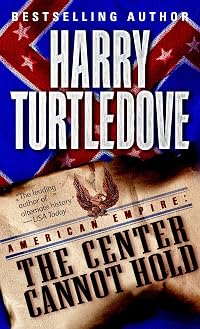
American Empire: The Center Cannot Hold
by Harry Turtledove
American Empire Trilogy (2), Timeline-191 (6)
On This Page
Description
AMERICAN EMPIRE: BOOK TWOIn this spectacular, thought-provoking epic of alternate history, Harry Turtledove has created an unparalleled vision of social upheaval, war, and cutthroat politics in a world very much like our own--but with dramatic differences.
It is 1924--a time of rebuilding, from the slow reconstruction of Washington's most honored monuments to the reclamation of devastated cities in Europe and Canada. In the United States, the Socialist Party, led by Hosea Blackford, show more battles Calvin Coolidge to hold on to the Powell House in Philadelphia. And it seems as if the Socialists can do no wrong, for the stock market soars and America enjoys prosperity unknown in a half century. But as old names like Custer and Roosevelt fade into history, a new generation faces new uncertainties.
The Confederate States, victorious in the War of Secession and in the Second Mexican War but at last tasting defeat in the Great War, suffer poverty and natural calamity. The Freedom Party promises new strength and pride. But if its chief seizes the reins of power, he may prove a dangerous enemy for the hated U.S.A. Yet the United States take little note. Sharing world domination with Germany, they consider events in the Confederacy of little consequence.
As the 1920s end, calamity casts a pall across the continent. With civil war raging in Mexico, terrorist uprisings threatening U.S. control in Canada, and an explosion of violence in Utah, the United States are rocked by uncertainty.
In a world of occupiers and the occupied, of simmering hatreds, shattered lives, and pent-up violence, the center can no longer hold. And for a powerful nation, the ultimate shock will come when a fleet of foreign aircraft rain death and destruction upon one of the great cities of the United States. . . .
From the Hardcover edition.. show less
Tags
Recommendations






Member Reviews
My reactions to reading this novel in 2003.
This book exhibits the usual strengths and weaknesses of what has been termed Turtledove’s “worm’s eye view” of history. Through sheer volume, he fully develops several of his characters and creates a sense of realism about his alternate world.
What this technique often lacks is high drama. We never get long descriptions of important events. For instance, Sam Carsten is present when the war between Japan and the United States break out. But, just as it gets interesting, we cut away and see Colonel Morrell discussing the naval battle with his wife.
Some of the stories seem to continue on the basis of sheer inertia and because they involve characters from earlier books. For instance, not show more much is revealed about the world by continuing to follow Lucien Galtier in the Republic of Quebec, not even after his wife dies. The same holds mostly true for continuing to follow Nellie Jacobs, her husband, and children -- though Turtledove does an effective scene where some Confederate officers visiting Washington DC calmly declare their attention to avenge themselves on the USA. He also has a rather gratuitous scene where Hal Jacobs and his son-in-law fail to make the connection between tobacco and its bad effects. (I say gratuitous because I’ve heard Turtledove say that several people have actually complained about the prevalent use of tobacco in his stories.)
In fact, there are several bits where Turtledove can’t resist winking at his audience and breaking the mood a bit by alluding to our contemporary world: a character thinking climate is just too complex to say that the massive artillery barrages have changed the climate, calling Jake Featherston’s radio network the “wireless web” (perhaps a way of reminding us that the Internet is not the first communication media to change lives drastically), complaints about Congress trying to ban a solvent as dangerous, and, of course, many references to rampant speculation which is entirely consistent with including a version of the Great Depression and preceding stock market crash.
A curious lapse -- I suspect an editor’s influence -- is that the romantic relationship between Anne Colleton and Clarence Potter is not depicted. The first we hear of it, it’s already over.
As with his Basil Agroyos stories, you can complain that Turtledove too often insists on repeating history. Would a stock market crash really have happened around 1929 if Socialist policies would have been in effect in the USA? Calvin Coolidge conveniently drops dead after being elected, and Herbert Hoover is inaugurated as President Blackford’s successor. (Part of me suspects Blackford comes from Dakota because Turtledove suspects no one knows the history of their senators. He also gets Dakota’s weather a bit wrong in claiming its humid in the summer.) On the other hand, Turtledove is less guilty of that in this book than others. The war in the thirties between Japan and the USA has no analog in our history. He also has no Dust Bowl. It is also interesting to see the USA contemplate war not only with the Confederate States of America but also Kaiser Germany and Japan. (Japan came be a much greater power in this world because, since there was no Spanish-American War, the US never developed a Pacific empire.) There is also no Panama Canal. Russia has not gone communist, and France and England and the CSA have thriving fascist parties. And, of course, the all too plausible Mormon unrest in Utah continues.
This is a grim book. Jake Featherston long ago ceased to be a sympathetic character, but his rise to power is completed by novel’s end when he is inaugurated CSA president. Anne Colleton, already arrogant and unlikeable, sells her soul to the Freedom Party. Other characters loose our sympathy. Hipolito Rodriguez becomes a Freedom Party thug as does Jefferson Pinkard. We genuinely begin to fear for Scipio’s life and that of Clarence Potter. The former because he’s black in the CSA, and the latter because he has publically opposed the Freedom Party and has even gone so far as to contemplate assassinating Featherston.
Turtledove has some fun with some cameo appearances by disguised and barely disguised historical figures. The vitrolically anti-Semite sergeant who accompanies visiting German officer Heinz Guderian (one of the inventors of the blitzkrieg in our world) on a tour of occupied Canada seems to be Adolf Hitler. Ernest Hemmingway, here rendered impotent by a war wound on the Canadian front, helps Sylvia Enos write her memoirs. Robert Howard seems to be writing for the aviation pulps. Samuel Clemens' daughter is a reporter, and Franklin Delano Roosevelt is an assistant secretary of war.
The books ends with fascism looming almost everywhere in the midst of a worldwide depression. (Turtledove effectively communicates the desperation of those trying to survive the Depression.) And the hints -- and Turtledove’s authorial proclivities -- point to Featherston initiating genocide against the CSA’s blacks. show less
This book exhibits the usual strengths and weaknesses of what has been termed Turtledove’s “worm’s eye view” of history. Through sheer volume, he fully develops several of his characters and creates a sense of realism about his alternate world.
What this technique often lacks is high drama. We never get long descriptions of important events. For instance, Sam Carsten is present when the war between Japan and the United States break out. But, just as it gets interesting, we cut away and see Colonel Morrell discussing the naval battle with his wife.
Some of the stories seem to continue on the basis of sheer inertia and because they involve characters from earlier books. For instance, not show more much is revealed about the world by continuing to follow Lucien Galtier in the Republic of Quebec, not even after his wife dies. The same holds mostly true for continuing to follow Nellie Jacobs, her husband, and children -- though Turtledove does an effective scene where some Confederate officers visiting Washington DC calmly declare their attention to avenge themselves on the USA. He also has a rather gratuitous scene where Hal Jacobs and his son-in-law fail to make the connection between tobacco and its bad effects. (I say gratuitous because I’ve heard Turtledove say that several people have actually complained about the prevalent use of tobacco in his stories.)
In fact, there are several bits where Turtledove can’t resist winking at his audience and breaking the mood a bit by alluding to our contemporary world: a character thinking climate is just too complex to say that the massive artillery barrages have changed the climate, calling Jake Featherston’s radio network the “wireless web” (perhaps a way of reminding us that the Internet is not the first communication media to change lives drastically), complaints about Congress trying to ban a solvent as dangerous, and, of course, many references to rampant speculation which is entirely consistent with including a version of the Great Depression and preceding stock market crash.
A curious lapse -- I suspect an editor’s influence -- is that the romantic relationship between Anne Colleton and Clarence Potter is not depicted. The first we hear of it, it’s already over.
As with his Basil Agroyos stories, you can complain that Turtledove too often insists on repeating history. Would a stock market crash really have happened around 1929 if Socialist policies would have been in effect in the USA? Calvin Coolidge conveniently drops dead after being elected, and Herbert Hoover is inaugurated as President Blackford’s successor. (Part of me suspects Blackford comes from Dakota because Turtledove suspects no one knows the history of their senators. He also gets Dakota’s weather a bit wrong in claiming its humid in the summer.) On the other hand, Turtledove is less guilty of that in this book than others. The war in the thirties between Japan and the USA has no analog in our history. He also has no Dust Bowl. It is also interesting to see the USA contemplate war not only with the Confederate States of America but also Kaiser Germany and Japan. (Japan came be a much greater power in this world because, since there was no Spanish-American War, the US never developed a Pacific empire.) There is also no Panama Canal. Russia has not gone communist, and France and England and the CSA have thriving fascist parties. And, of course, the all too plausible Mormon unrest in Utah continues.
This is a grim book. Jake Featherston long ago ceased to be a sympathetic character, but his rise to power is completed by novel’s end when he is inaugurated CSA president. Anne Colleton, already arrogant and unlikeable, sells her soul to the Freedom Party. Other characters loose our sympathy. Hipolito Rodriguez becomes a Freedom Party thug as does Jefferson Pinkard. We genuinely begin to fear for Scipio’s life and that of Clarence Potter. The former because he’s black in the CSA, and the latter because he has publically opposed the Freedom Party and has even gone so far as to contemplate assassinating Featherston.
Turtledove has some fun with some cameo appearances by disguised and barely disguised historical figures. The vitrolically anti-Semite sergeant who accompanies visiting German officer Heinz Guderian (one of the inventors of the blitzkrieg in our world) on a tour of occupied Canada seems to be Adolf Hitler. Ernest Hemmingway, here rendered impotent by a war wound on the Canadian front, helps Sylvia Enos write her memoirs. Robert Howard seems to be writing for the aviation pulps. Samuel Clemens' daughter is a reporter, and Franklin Delano Roosevelt is an assistant secretary of war.
The books ends with fascism looming almost everywhere in the midst of a worldwide depression. (Turtledove effectively communicates the desperation of those trying to survive the Depression.) And the hints -- and Turtledove’s authorial proclivities -- point to Featherston initiating genocide against the CSA’s blacks. show less
This is the middle volume of the American Empire trilogy, and volume six of the story arc in which the South's victory in the Civil War makes the North American continent a place of hatred and bloodshed. At this point, the whole story has run out of steam, somewhat. This part of the tale runs from the early 1920s until 1932. Things happen, but life during the boom of the Roaring 20's and the depressed 30s isn't quite as dramatic as it was during wartime. The characterization is still good, and I'll undoubtedly read onward. It's just not as good as its predecessors.
--J.
--J.
Another excellent book by Harry Turtledove. I am enjoying this series more then the previous in the Timeline-191 series of books. I enjoy how Turtledove uses different points of view to get the story across. The repetition, that each of the characters has can be a little annoying at times. I do not have to hear the same things every time that character is used, but it is the style of this series. Overall a recommendation, but you will have to have read the 5 books that precede it to fully appreciate it.
Maybe a bit better than the previous one in the series. At the end of this one, Jake Featherstone, the Confederate Hitler, has just taken the oath of office as president.
"It is 1924—a time of rebuilding, from the slow reconstruction of Washington’s most honored monuments to the reclamation of devastated cities in Europe and Canada. In the United States, the Socialist Party, led by Hosea Blackford, battles Calvin Coolidge to hold on to the Powell House in Philadelphia. And it seems as if the Socialists can do no wrong, for the stock market soars and America enjoys prosperity unknown in a half century. But as old names like Custer and Roosevelt fade into history, a new generation faces new uncertainties."--from good reads
Ratings
Members
- Recently Added By
Author Information

279+ Works 43,221 Members
Harry Turtledove was born in Los Angeles, California on June 14, 1949. He received a Ph.D. in Byzantine history from UCLA in 1977. From the late 1970's to the early 1980's, he worked as a technical writer for the Los Angeles County Office of Education. He left in 1991 to become full-time writer. His first two novels, Wereblood and Werenight, were show more published in 1979 under the pseudonym Eric G. Iverson because his editor did not think people would believe that Turtledove was his real name. He used this name until 1985 when he published Herbig-Haro and And So to Bed under his real name. He has received numerous awards including the Homer Award for Short Story for Designated Hitter in 1990, the John Esthen Cook Award for Southern Fiction for Guns of the Southand in 1993, and the Hugo Award for Novella for Down in the Bottomlands in 1994. (Bowker Author Biography) show less
Series


Common Knowledge
- Canonical title
- American Empire: The Center Cannot Hold
- Original publication date
- 2002-06-25
Classifications
Statistics
- Members
- 692
- Popularity
- 41,510
- Reviews
- 5
- Rating
- (3.62)
- Languages
- English
- Media
- Paper, Audiobook, Ebook
- ISBNs
- 10
- ASINs
- 4