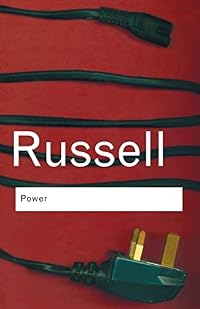
Power: A New Social Analysis
by Bertrand Russell
On This Page
Description
The key to human nature that Marx found in wealth and Freud in sex, Bertrand Russell finds in power. Power, he argues, is man's ultimate goal, and is, in its many guises, the single most important element in the development of any society. Writting in the late 1930s when Europe was being torn apart by extremist ideologies and the world was on the brink of war, Russell set out to found a 'new science' to make sense of the traumatic events of the day and explain those that would follow. The show more result was Power, a remarkable book that Russell regarded as one of the most important of his show lessTags
Recommendations














Member Reviews
لا تستطيع ان تخالف رسل في ما يقوله وما يتناوله في كتبه عادة لان طريقته العقلانية والمنطقية لا يدعان لك مجال لذلك, الكتاب صغير الحجم كبير القيمة وممتع لضربه امثلة تمس حياتنا المعاصرة واعتقد ان اي شخص وان اختلفت عقيدته السياسية لن يخبرك بان الكتاب مهم حتى وان كان قد كتب منتصف القرن الماضي . موضوع الحرية الفردية وسلطة الدول هي من المواضيع الحية والمهمة في وقتنا الحاضر ونحن نلمس هذه الاهمية من الاحداث التي تدور show more حولنا في العالم ولو كان رسل لايزال بيننا اليوم لذكر في كتابه التعدي السافر على حريتنا نحن والاجيال القادمة بسبب عدم انصياع الحكومات لاتخاذ مواقف حازمة لتجنب كارثة المناخ او حرب عالمية اخرى مدمرة او حتى ازمة اقتصادية قريبة . ان ادراك حدود حرياتنا وكذلك حقوقنا سيجنبنا الكثير من المتاعب وسيخدم البشرية خدمة عظمى. show less
Despite its promises, "Power" isn't really a new analysis of anything, but it is an interesting, and sometimes bracing, meander through the subject. Russell was writing at a particularly tense point in history -- the Second World War was coming on, but hadn't broken out yet -- and so it's not surprising that many of his arguments tend to revolve around what some might term "statism." Still, it's nice to hear from a twentieth-century thinker not in thrall to either Marxism of free-market absolutism, and the author often focuses on some of the emotional or crypto-religious dimensions of power that these philosophies often gloss over as too subjective or unserious for study. Even if you're not inclined to agree with Russell, however, this show more one is, for a book its type, a surprisingly entertaining read. Reading this one, you can imagine sitting around with the author -- whose intellectual breadth was hugely impressive -- as he expounded what he saw as the basic rules of the power game and illustrated them with examples from the ancient Greeks to the present day. For that reason alone, readers interested in Russell's intellectual background and thought process will likely find a lot to to gnaw on here. For everyone else, "Power" is an interesting lecture in book form, given by a lecturer with an exquisitely lively and organized mind. show less
After two years of reading a chapter every now and again I have finally finished. It's a slow book. The concepts are big, and trying to get your head around them requires you to read, stop, slow down, think, reread. But once you learn to accept that this is going to take a while, its magic really does start to show.
As does it's magical humour, which amazingly had me laughing loudly and scribbling down quotes to share.
As does it's magical humour, which amazingly had me laughing loudly and scribbling down quotes to share.
Ratings
Members
- Recently Added By
Lists

The Works of Bertrand Russell
62 works; 1 member
Author Information

419+ Works 39,342 Members
Bertrand Arthur William Russell (1872-1970) was a British philosopher, logician, essayist and social critic. He was best known for his work in mathematical logic and analytic philosophy. Together with G.E. Moore, Russell is generally recognized as one of the main founders of modern analytic philosophy. Together with Kurt Gödel, he is regularly show more credited with being one of the most important logicians of the twentieth century. Over the course of a long career, Russell also made contributions to a broad range of subjects, including the history of ideas, ethics, political and educational theory, and religious studies. General readers have benefited from his many popular writings on a wide variety of topics. After a life marked by controversy--including dismissals from both Trinity College, Cambridge, and City College, New York--Russell was awarded the Order of Merit in 1949 and the Nobel Prize for Literature in 1950. Noted also for his many spirited anti-nuclear protests and for his campaign against western involvement in the Vietnam War, Russell remained a prominent public figure until his death at the age of 97. (Bowker Author Biography) show less
Series
Belongs to Publisher Series
Common Knowledge
- Canonical title
- Power: A New Social Analysis
- Original title
- Power: A New Social Analysis
- Original publication date
- 1938-10
- First words
- Between man and other animals there are various differences, some intellectual, some emotional.
- Last words
- (Click to show. Warning: May contain spoilers.)This is the task of a liberal education: to give a sense of the value of things other than domination, to help to create wise citizens of a free community, and through the combination of citizenship with liberty in individual creativeness to enable men to give to human life that splendour which some few have shown that it can achieve.
- Original language
- English
Classifications
- Genres
- Philosophy, Nonfiction, Sociology, Politics and Government, General Nonfiction
- DDC/MDS
- 320.011 — Social sciences Political science Political science (Politics and government) Political Science Philosophy and Theory Systems
- LCC
- JC330 .R87 — Political Science Political theory Political theory. The state. Theories of the state
- BISAC
Statistics
- Members
- 488
- Popularity
- 61,657
- Reviews
- 4
- Rating
- (4.03)
- Languages
- 15 — Dutch, English, French, German, Greek, Hebrew, Hungarian, Italian, Norwegian (Bokmål), Farsi/Persian, Polish, Portuguese, Spanish, Swedish, Turkish
- Media
- Paper, Ebook
- ISBNs
- 30
- ASINs
- 20