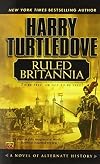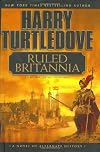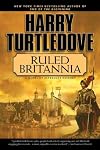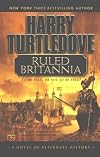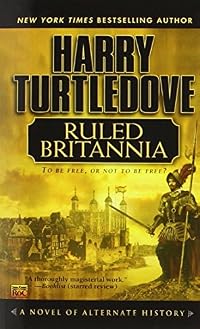
Ruled Britannia
by Harry Turtledove
On This Page
Description
In this novel of alternative history from bestselling author Harry Turtledove, the Spanish Armada has conquered England, King Phillip holds the English throne, and Elizabeth I languishes as a prisoner in the Tower of London. Meanwhile, in London, a mysterious stranger approaches young playwright William Shakespeare with an offer that could change the course of history.Tags
Recommendations

Member Reviews
What if the Spanish Armada did make it to England, and won? That's the premise of this alternate history tale about life in London ten years later. The plot centers on a plot, one organized by the aging Lord Burghley and his son, Robert Cecil, involving William Shakespeare and his troupe of players. The tale is told from two points of view: Shakespeare himself and a Spanish playwright/occupation officer named Lt. Lope de Vega, who was actually part of the Spanish Armada and one of the lucky few to make it home again in one piece (in real life). The two men are friends, even collaborators, and yet must play a deadly cat and mouse game that may well get both of them killed. Why? Because at heart, each is loyal to his own monarch. I was show more highly impressed with the author's detailed portrayal of London, the world of Elizabethan theater, and the religious conflicts involved in the war between Spain and England. I was blown away by the verses offered from not one, but two plays Shakespeare never actually wrote (the author does note his sources on that), and by the way the author managed to incorporate all sorts of phrases taken from Shakespeare's actual work. Bravo! show less
What if the Spanish Armada had won, and what if England had fallen under Spanish rule? These are the questions Harry Turtledove tries to answer in this novel, which is truly a piece of art.
In this novel, England has been under Spanish rule for almost a decade, and life for the British is one of constant fear: fear of treason, fear of the Inquisition, fear of the dons. For in this alternate history, being Protestant could mean burning at the stake, and only murmuring against the conqueror is considered treason. And punishment for treason, well, is death. So every single British citizen publicly praises the Spanish and is Catholic, but in private...not so much, except for the rare exception.
William Shakespeare is the pivotal character in show more this novel. When he commissioned by Lord Burghley, aka Sir William Cecil, to write a play that will certainly cause a revolt against the Spanish, Shakespeare's life, which is already difficult, will take a sharp turn. Only mentioning the play would be considered treason, and all must be kept in secrecy, for pain of death.
The pressure increases significantly when the Spanish hire him to write a play praising King Philip II, to be presented upon his imminent death. From now on, he must produce two plays, one that may bring on his doom if Lord Burghley's plot fails, and another that may deem him a hero. Only one of them will be put forth on stage: which one?
Harry Turtledove artfully gives us insight into the Elizabethan world, using idioms and terms of speech of that time. However, while the British used all the "thee"s and "thou"s, the Spanish were cursed in using modern English, which seemed annoying at times. Granted, when it was used, it was as if Spanish were translated into English, as many Spaniards never took the effort to learn the least bit of English, but it would have added flavor if the same dialect were used for all characters, British and Spanish alike. Shakespeare quotes, and that of his contemporaries, such as Christopher Marlowe, are often and skilfully used to create humour amidst the tragedy and the plotting.
The characters in themselves are quite developed and many are based on real historical figures. Soldier and Spanish playwright Lope de Vega is an example, and also a strong supporting character. While he is in love with Shakespeare's work, it is his duty to root out suspected treason, a job he somewhat reluctant to do. A few British nobles are portrayed in this novel as well, such as William Cecil, and, in a very minor role, Francis Bacon.
All in all, this was a very entertaining alternate history, which responds well to all the "what ifs", as extensive research of the era was obviously made. The story isn't just an alternate history, it's also a story of political intrigue, and of a people struggling to regain their freedom from an oppressive regime. show less
In this novel, England has been under Spanish rule for almost a decade, and life for the British is one of constant fear: fear of treason, fear of the Inquisition, fear of the dons. For in this alternate history, being Protestant could mean burning at the stake, and only murmuring against the conqueror is considered treason. And punishment for treason, well, is death. So every single British citizen publicly praises the Spanish and is Catholic, but in private...not so much, except for the rare exception.
William Shakespeare is the pivotal character in show more this novel. When he commissioned by Lord Burghley, aka Sir William Cecil, to write a play that will certainly cause a revolt against the Spanish, Shakespeare's life, which is already difficult, will take a sharp turn. Only mentioning the play would be considered treason, and all must be kept in secrecy, for pain of death.
The pressure increases significantly when the Spanish hire him to write a play praising King Philip II, to be presented upon his imminent death. From now on, he must produce two plays, one that may bring on his doom if Lord Burghley's plot fails, and another that may deem him a hero. Only one of them will be put forth on stage: which one?
Harry Turtledove artfully gives us insight into the Elizabethan world, using idioms and terms of speech of that time. However, while the British used all the "thee"s and "thou"s, the Spanish were cursed in using modern English, which seemed annoying at times. Granted, when it was used, it was as if Spanish were translated into English, as many Spaniards never took the effort to learn the least bit of English, but it would have added flavor if the same dialect were used for all characters, British and Spanish alike. Shakespeare quotes, and that of his contemporaries, such as Christopher Marlowe, are often and skilfully used to create humour amidst the tragedy and the plotting.
The characters in themselves are quite developed and many are based on real historical figures. Soldier and Spanish playwright Lope de Vega is an example, and also a strong supporting character. While he is in love with Shakespeare's work, it is his duty to root out suspected treason, a job he somewhat reluctant to do. A few British nobles are portrayed in this novel as well, such as William Cecil, and, in a very minor role, Francis Bacon.
All in all, this was a very entertaining alternate history, which responds well to all the "what ifs", as extensive research of the era was obviously made. The story isn't just an alternate history, it's also a story of political intrigue, and of a people struggling to regain their freedom from an oppressive regime. show less
For those who have ever thought about reading at least one alternate history novel, Harry Turtledove's Ruled Britannia is the one you should try. The premise of the novel is the successful invasion of England via the famed Spanish Armada by the Duke of Parma's army that places Queen Elizabeth in captive within the Tower of London and places Philip II's daughter Isabella on the throne along side her husband-cousin Albert. Almost 10 years later, celebrated English playwright Williams Shakespeare is brought into a conspiracy to write and stage a play that will insight London to rise up upon learning of the death of Philip, but then Shakespeare must contend with the occupying Spaniards wanting him to write a play in tribute of Philip to by show more staged upon news of this death.
The novel is seen from only two point-of-view characters: Shakespeare and Lope de Vega, an officer in the occupying Spanish army fluent in English and an unpublished playwright. Through their eyes the setting of Spanish-occupied late 16th-century London comes alive as well as the individuals the two encounter without throughout the novel, including those they both interact with. Obviously it allows the reader to view both sides of Spanish-controlled Catholic England politically speaking, but also religiously. Although both men are friendly with one another, especially as Shakespeare doesn't want to upset an officer of the occupying army, there is an unspoken barrier between the two the reader readily recognizes that is present throughout the novel that adds to the story.
The use of late 16th-century English speech patterns by Turtledove brought an authentic feel to the story, though it does take a little time to get use nonetheless by the end of the book its very easy to follow. Though the story does seem to tread water around the 60-70% mark, in retrospect the events that happen therein really pay off throughout the climax of the story. With all of this said, if you've ever wanted to read an alternate history novel this standalone work by Harry Turtledove is the one you should try. show less
The novel is seen from only two point-of-view characters: Shakespeare and Lope de Vega, an officer in the occupying Spanish army fluent in English and an unpublished playwright. Through their eyes the setting of Spanish-occupied late 16th-century London comes alive as well as the individuals the two encounter without throughout the novel, including those they both interact with. Obviously it allows the reader to view both sides of Spanish-controlled Catholic England politically speaking, but also religiously. Although both men are friendly with one another, especially as Shakespeare doesn't want to upset an officer of the occupying army, there is an unspoken barrier between the two the reader readily recognizes that is present throughout the novel that adds to the story.
The use of late 16th-century English speech patterns by Turtledove brought an authentic feel to the story, though it does take a little time to get use nonetheless by the end of the book its very easy to follow. Though the story does seem to tread water around the 60-70% mark, in retrospect the events that happen therein really pay off throughout the climax of the story. With all of this said, if you've ever wanted to read an alternate history novel this standalone work by Harry Turtledove is the one you should try. show less
A great read, one of my favourite alternate historical novels. The language is wonderful, and there is a galaxy of marvellous colourful characters. The depiction of late 16th century London under Spanish control is quite realistic and grim. My only criticism would be that the eventual uprising takes place with what seems to be improbable swiftness and completeness once the play Boudicca finishes. But it makes for stirring and exciting reading.
I liked it, but not quite 4 stars worth.
I liked the story, most of the characters, the period details, the fact that we had likable viewpoint characters on both sides. Got a little tired of the Spanish/Catholics being *such* the bad guys after a while, even tho it made perfect sense in the context of the story. The climactic scene, specifically the epilogue of the Boudicca play that invites/challenges/sparks the uprising, was excellent & will stay with me.
I don't know the work of Shakespeare (or his contemporaries) well enough to fully appreciate the degree to which quotations from those works were incorporated in this book, sometimes directly, sometimes appropriately riffed. If I did, that would likely have been enough fun to push it show more up to four stars. show less
I liked the story, most of the characters, the period details, the fact that we had likable viewpoint characters on both sides. Got a little tired of the Spanish/Catholics being *such* the bad guys after a while, even tho it made perfect sense in the context of the story. The climactic scene
I don't know the work of Shakespeare (or his contemporaries) well enough to fully appreciate the degree to which quotations from those works were incorporated in this book, sometimes directly, sometimes appropriately riffed. If I did, that would likely have been enough fun to push it show more up to four stars. show less
Appena ho letto la quarta copertina il mio senso "storico" si è riacceso incuriosito. Turtledove mi era noto da anni come scrittore di libri ucronici (ossia di storia alternativa), soprattutto per il suo ciclo dell'Invasione.
Tuttavia non avevo mai avuto l'occasione di approfondire la conoscenza leggendone almeno un libro.
Quando ho visto la proposta di ucronia sulla vittoria Spagnola contro gli inglesi e con uno Shakespeare protagonista, potevo non leggere questo libro?
Il romanzo è curioso, ben scritto e ben condotto. Forse un pò troppo allungato, però storicamente curatissimo. La coerenza con l'epoca, benché si tratti di ucronia, è uno degli elementi base di romanzi di questo tipo e Turtledove si rivela davvero maestro in show more questo.
Un buon romanzo e un'esperienza da provare, soprattutto per coloro che amano il romanzo storico, la storia e i "....e se?" show less
Tuttavia non avevo mai avuto l'occasione di approfondire la conoscenza leggendone almeno un libro.
Quando ho visto la proposta di ucronia sulla vittoria Spagnola contro gli inglesi e con uno Shakespeare protagonista, potevo non leggere questo libro?
Il romanzo è curioso, ben scritto e ben condotto. Forse un pò troppo allungato, però storicamente curatissimo. La coerenza con l'epoca, benché si tratti di ucronia, è uno degli elementi base di romanzi di questo tipo e Turtledove si rivela davvero maestro in show more questo.
Un buon romanzo e un'esperienza da provare, soprattutto per coloro che amano il romanzo storico, la storia e i "....e se?" show less
Appena ho letto la quarta copertina il mio senso "storico" si è riacceso incuriosito. Turtledove mi era noto da anni come scrittore di libri ucronici (ossia di storia alternativa), soprattutto per il suo ciclo dell'Invasione.
Tuttavia non avevo mai avuto l'occasione di approfondire la conoscenza leggendone almeno un libro.
Quando ho visto la proposta di ucronia sulla vittoria Spagnola contro gli inglesi e con uno Shakespeare protagonista, potevo non leggere questo libro?
Il romanzo è curioso, ben scritto e ben condotto. Forse un pò troppo allungato, però storicamente curatissimo. La coerenza con l'epoca, benché si tratti di ucronia, è uno degli elementi base di romanzi di questo tipo e Turtledove si rivela davvero maestro in show more questo.
Un buon romanzo e un'esperienza da provare, soprattutto per coloro che amano il romanzo storico, la storia e i "....e se?" show less
Tuttavia non avevo mai avuto l'occasione di approfondire la conoscenza leggendone almeno un libro.
Quando ho visto la proposta di ucronia sulla vittoria Spagnola contro gli inglesi e con uno Shakespeare protagonista, potevo non leggere questo libro?
Il romanzo è curioso, ben scritto e ben condotto. Forse un pò troppo allungato, però storicamente curatissimo. La coerenza con l'epoca, benché si tratti di ucronia, è uno degli elementi base di romanzi di questo tipo e Turtledove si rivela davvero maestro in show more questo.
Un buon romanzo e un'esperienza da provare, soprattutto per coloro che amano il romanzo storico, la storia e i "....e se?" show less
Members
- Recently Added By
Lists

Best Alternate History
111 works; 60 members
Author Information

279+ Works 43,110 Members
Harry Turtledove was born in Los Angeles, California on June 14, 1949. He received a Ph.D. in Byzantine history from UCLA in 1977. From the late 1970's to the early 1980's, he worked as a technical writer for the Los Angeles County Office of Education. He left in 1991 to become full-time writer. His first two novels, Wereblood and Werenight, were show more published in 1979 under the pseudonym Eric G. Iverson because his editor did not think people would believe that Turtledove was his real name. He used this name until 1985 when he published Herbig-Haro and And So to Bed under his real name. He has received numerous awards including the Homer Award for Short Story for Designated Hitter in 1990, the John Esthen Cook Award for Southern Fiction for Guns of the Southand in 1993, and the Hugo Award for Novella for Down in the Bottomlands in 1994. (Bowker Author Biography) show less
Some Editions
Awards and Honors
Awards
Distinctions
Common Knowledge
- Canonical title
- Ruled Britannia
- Original title
- Ruled Britannia
- Original publication date
- 2002-11-05; 2002
- People/Characters
- William Shakespeare; Elizabeth I, Queen of England; Queen Isabella; Philip II, King of Spain; Lope de Vega; Christopher Marlowe (Kit) (show all 8); Richard Burbage; Will Kemp (Will Kempe)
- Important places
- London, England
- First words
- Two Spanish soldiers swaggered up Tower street toward William Shakespeare.
- Last words
- (Click to show. Warning: May contain spoilers.)He stood up, too, and kissed his intended, and forgot all about Walter Strawberry.
Classifications
- Genres
- Fiction and Literature, Science Fiction, General Fiction, Poetry
- DDC/MDS
- 813.54 — Literature & rhetoric American literature in English American fiction in English 1900-1999 1945-1999
- LCC
- PS3570 .U76 .R84 — Language and Literature American literature American literature Individual authors 1961-
- BISAC
Statistics
- Members
- 783
- Popularity
- 35,457
- Reviews
- 21
- Rating
- (3.59)
- Languages
- 5 — English, Indonesian, Italian, Portuguese, Spanish
- Media
- Paper, Audiobook, Ebook
- ISBNs
- 14
- ASINs
- 9