Buying a Fishing Rod for My Grandfather
by Gao Xingjian
On This Page
Description
These six stories by Nobel Prize winner Gao Xingjian transport the reader to moments where the fragility of love and life, and the haunting power of memory, are beautifully unveiled. In "The Temple," the narrator's acute and mysterious anxiety overshadows the delirious happiness of an outing with his new wife on their honeymoon. In "The Cramp," a man narrowly escapes drowning in the sea, only to find that no one even noticed his absence. In the titlestory, the narrator attempts to relieve show more his homesickness only to find that he is lost in a labyrinth of childhood memories.Everywhere in this collection are powerful psychological portraits of characters whose unarticulated hopes and fears betray the never-ending presence of the past in their present lives. show lessTags
Recommendations


















Member Reviews
I'm not usually a fan of short stories and this collection of translated stories by the Nobel Prize winning author Gao Xingjian reminded me of why that is.
I just don't get drawn into short story collections. As soon as I start to get interested, it ends and I'm left trying to get to know a whole new set of characters or to care about an entirely new set of circumstances.
Those issues in this book were only exacerbated, for one main reason.
These stories, by design, are not plot driven in the slightest. In fact, an afterword contains the following information :
"Gao warns readers that his fiction does not set out to tell a story. There is no plot, as found in most fiction, and anything of interest to be found in it is inherent in the show more language itself."
As a reader who is more interested in the way a story is told than the actual story, this isn't necessarily a problem.
But. It was translated! If the whole point of the work is the use of language, and I can't see that language in the way the author intended, what's the point? I simply don't understand why you'd translate a work that was completely about the writing and not the plot.
That said, a few of the stories were interesting. In the Park in particular struck me. It was the story of a couple spending a lazy day together. Nothing exciting happened, there was no passion, no twists. But it sort of gave you a glimpse into these people's lives in a way that felt very intimate and beautiful.
Overall though, I can't say that I'd recommend it, considering that I'm not really reading Xingjian's work, but that of his translator. show less
I just don't get drawn into short story collections. As soon as I start to get interested, it ends and I'm left trying to get to know a whole new set of characters or to care about an entirely new set of circumstances.
Those issues in this book were only exacerbated, for one main reason.
These stories, by design, are not plot driven in the slightest. In fact, an afterword contains the following information :
"Gao warns readers that his fiction does not set out to tell a story. There is no plot, as found in most fiction, and anything of interest to be found in it is inherent in the show more language itself."
As a reader who is more interested in the way a story is told than the actual story, this isn't necessarily a problem.
But. It was translated! If the whole point of the work is the use of language, and I can't see that language in the way the author intended, what's the point? I simply don't understand why you'd translate a work that was completely about the writing and not the plot.
That said, a few of the stories were interesting. In the Park in particular struck me. It was the story of a couple spending a lazy day together. Nothing exciting happened, there was no passion, no twists. But it sort of gave you a glimpse into these people's lives in a way that felt very intimate and beautiful.
Overall though, I can't say that I'd recommend it, considering that I'm not really reading Xingjian's work, but that of his translator. show less
This collection of six short stories by Nobel Laureate Gao Xingjian were tied together by their sense of impending doom and loss.
"The Temple" is the story of a couple on their honeymoon who impulsively get off the train in a village and hike up to an old temple. There, a man approaches them while ominous music played in my head. Although nothing untoward happened, the story ends with a loose tile hanging overhead about to fall.
"In the Park" is a conversation between a man and a woman who are meeting after a long separation. There is attraction between them, but the woman is married. Before long the repressed emotions come out as frustrated anger. In the background a woman has clearly been waiting for someone, but when he fails to show more appear, she bursts into tears.
"Cramp" begins with a man swimming in the ocean at night. He gets a cramp and worries that he won't make it to shore. Does anyone see him out there? The story ends with a woman on crutches watching two friends swimming.
"The Accident" begins almost in slow motion, with a man on a bicycle pulling a child in an attached carrier passing in front of a bus. As a crowd gathers around the accident, the language speeds up until all we hear are snippets of conversation. The story ends with the narrator (author?) saying,
I have been discussing philosophy again, but life is not philosophy, even if philosophy can derive from knowledge of life. And there is no need to turn life's traffic accidents into statistics, because that's a job for the traffic department or the public security department. Of course, a traffic accident can serve as an item for a newspaper. And it can serve as the raw material for literature when it is supplemented by the imagination and written up as a moving narrative: this would then be creation. However, what is related here is simply the process of this traffic accident itself, a traffic accident that occurred at five o'clock, in the central section of Desheng Avenue in front of the radio repair shop.
The title story, although it sounds prosaic, is actually a confused narrative that mixes memories with a dream state while a soccer game plays on tv in the background. It's about lost childhoods, lost family, and the drastic changes brought to a village by modernization.
"In an Instant" begins with a man in a deck chair looking out at the ocean. But this narrative is broken, with paragraphs about a woman and her sexual proclivities interspersed. Each time the story reverts to the man in the chair, the water is higher, until only the chair is floating. Then it gets weird. show less
"The Temple" is the story of a couple on their honeymoon who impulsively get off the train in a village and hike up to an old temple. There, a man approaches them while ominous music played in my head. Although nothing untoward happened, the story ends with a loose tile hanging overhead about to fall.
"In the Park" is a conversation between a man and a woman who are meeting after a long separation. There is attraction between them, but the woman is married. Before long the repressed emotions come out as frustrated anger. In the background a woman has clearly been waiting for someone, but when he fails to show more appear, she bursts into tears.
"Cramp" begins with a man swimming in the ocean at night. He gets a cramp and worries that he won't make it to shore. Does anyone see him out there? The story ends with a woman on crutches watching two friends swimming.
"The Accident" begins almost in slow motion, with a man on a bicycle pulling a child in an attached carrier passing in front of a bus. As a crowd gathers around the accident, the language speeds up until all we hear are snippets of conversation. The story ends with the narrator (author?) saying,
I have been discussing philosophy again, but life is not philosophy, even if philosophy can derive from knowledge of life. And there is no need to turn life's traffic accidents into statistics, because that's a job for the traffic department or the public security department. Of course, a traffic accident can serve as an item for a newspaper. And it can serve as the raw material for literature when it is supplemented by the imagination and written up as a moving narrative: this would then be creation. However, what is related here is simply the process of this traffic accident itself, a traffic accident that occurred at five o'clock, in the central section of Desheng Avenue in front of the radio repair shop.
The title story, although it sounds prosaic, is actually a confused narrative that mixes memories with a dream state while a soccer game plays on tv in the background. It's about lost childhoods, lost family, and the drastic changes brought to a village by modernization.
"In an Instant" begins with a man in a deck chair looking out at the ocean. But this narrative is broken, with paragraphs about a woman and her sexual proclivities interspersed. Each time the story reverts to the man in the chair, the water is higher, until only the chair is floating. Then it gets weird. show less
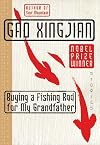
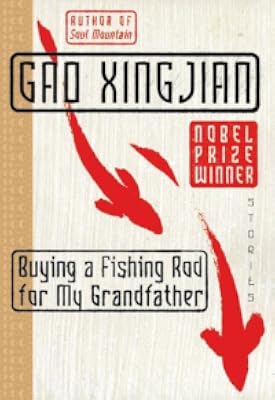
A short book, with stylized Chinese fish on its cover, Buying a Fishing Rod for My Grandfather was an intriguing foray into foreign short stories for me. The author is a Nobel prize winner, so I knew at the outset that this wouldn’t be light reading. But the stories are truly fascinating. In the first tale I feel like a fly on the wall, listening to someone speak; is he remembering the past? Is he talking to his family, or to his wife, or to the pictures in his mind? The stories each left me slightly off-balance, not quite sure what I was reading. But the title story, Buying a Fishing Rod for My Grandfather, suddenly centered me as the narrator looks into memories of his past and finds himself lost in change.
The final story, In an show more Instant, fills most of the second half of the book. It is a beautiful piece, reminding me of a Chinese plate my grandmother had. I don’t remember much about the plate, except that there were blue pictures, a temple and a bridge, trees, and a feeling that the closer I looked at one image the more likely I was to find myself in another. The writing flows in the same way between scenes, adding imagination to each and drawing the reader on with the movement of the prose. There’s no story as such, but there’s reflection and change; it’s oddly mesmerizing, like that moment of falling asleep or of waking up, when objects take on meanings that really belong to something else. It takes much more than an instant to read, and stays longer than an instant in the mind, but it’s beautiful in the same way as that plate.
So now I’ll go back and reread them all, in light of the mysteries of memory and time, and in appreciation of something truly different and impressive. show less
The final story, In an show more Instant, fills most of the second half of the book. It is a beautiful piece, reminding me of a Chinese plate my grandmother had. I don’t remember much about the plate, except that there were blue pictures, a temple and a bridge, trees, and a feeling that the closer I looked at one image the more likely I was to find myself in another. The writing flows in the same way between scenes, adding imagination to each and drawing the reader on with the movement of the prose. There’s no story as such, but there’s reflection and change; it’s oddly mesmerizing, like that moment of falling asleep or of waking up, when objects take on meanings that really belong to something else. It takes much more than an instant to read, and stays longer than an instant in the mind, but it’s beautiful in the same way as that plate.
So now I’ll go back and reread them all, in light of the mysteries of memory and time, and in appreciation of something truly different and impressive. show less
You know, there is nothing more I wanted than to give this critically well-regarded collection of short stories by Chinese Nobel-laureate Gao Xingjian a glowing review, it would made me feel part of a community who appreciate the best in world literature, which is how I'd like to think of myself. But I have to go with my truthful reaction which is -- "eh". There are six stories total. The first four (which make up 50% of the books length) are Chekhovian slices of life from 1980s China. "The Cramp" is best, it captures the sense of quiet isolation and terror a handicap person feels surrounded by normal people. It does this by putting a normal person into a temporary handicap position which we can all understand (swimming cramp), and ends show more the story showing a girl in crutches looking out at her healthy friends in the water while she waits alone, a reversal of perspective. "The Accident" is the most Chekhovian, about a man who is killed in a street accident and we see how events unfold among the townspeople and finally slip away as if nothing had happened. It is perhaps a fable of the Maoist years, the baby survived to carry on but the fathers blood turned to dust and forgotten on the road of progress. The last two stories which compose the final half of the book, and provide its title, are in a style or school or writing that I found difficult to understand. There is no plot, sentences seem to exist for emotional impact but do not advance a storyline, stream of conscious incomprehension that leaves on either mystically enraptured or frustratingly confused.
[205/34,845/3.31] show less
[205/34,845/3.31] show less
An unsuccessful experiment--for me anyway. He may have something to say, but this collection of six short stories left me unconvinced. In fairness, I only read five and a half. The first four simply didn’t amount to much: simple, straightforward stories, the point of which escaped me in every instance. I don’t mind that nothing much “happened.” I don’t need an intricate plot or story, though I will admit that I do enjoy a narrative of some sort. The first four stories provided that. However. I’m not especially good at delving deep into the structure or text in order to come up with its substance/meaning/significance. But these all require that to one degree or another. The fifth story I finally just gave up on. It lacked show more narrative, it lacked sense, and finally, even the structure fell apart. As I wrote elsewhere, I quit when I got to this: "'What is not to understand and 'what' is to understand or not is not to understand that even when 'what' is understood, it is not understood, for 'what' is to understand and 'what' is not to understand, 'what' is 'what' and 'is not' is 'is not,' and so is not to understand not wanting to understand or simply not understanding why 'what' needs to be understood or whether 'what' can be understood and also it is not understood whether 'what' is really not understood or that it simply hasn't been rendered so that it can be understood or is really understood..." and so on for another six lines. The prose in the first five stories is comprehensible even if not engaging. I am too lazy to bother with this. I don’t know whether he writes for readers to read or for himself. I will try Soul Mountain at some point, but at least I’ll have a notion of what to expect. I think. show less
Opening Sentence of the first short story 'The Temple': '...We were deliriously happy: delirious with the hope, infatuation, tenderness and warmth that go with a honeymoon...'
Gao Xingjian is a winner of the Nobel Prize for Literature, and reading the gentle but powerfully visual words in each story, I can understand why he was rewarded.
Each story is a snap shot of time. All the thoughts, conversations and scenes tumble one after the other to give the reader a brief glimpse of something real - a brief intrusion into someones life. He uses language to paint a picture of what the reader is 'seeing' there are no plots - not beginning, middle and end - just the story.
The first story, "The Temple," describes a honeymooning couple as they show more leave their train on the spur of the moment, on a whim, to explore a decaying hillside temple.
In, "In the Park," it is the aimless conversation between two villagers who meet by coincidence in a park and reclaim their childhood memories as they discuss what might be happening in the life of a young woman who is crying on a nearby park bench.
Next there is, "The Cramp," relates the life and death struggle of a swimmer who gets a bad cramp alone within sight of the shore,.
"The Accident," is about death - describing a minute by minute account of a fatal traffic accident between a pushbike and a bus on a Beijing street. The conversations swirl around from the crowd as they watch the events unfold, making up what they don't know. The police arrive and take care of the situation, street cleaners come to remove the broken bicycle and wipe the blood from the streets, and life continues on as if the death never occurred.
The title story follows "Buying a Fishing Rod for my Grandfather - the main character sees a fishing rod which he knows his grandfather would love. As he travels to his grandfather's house he finds the old neighborhood is no longer recognizable from when he was there as a boy.
The final story "In an Instance" was the only story that didn't sweep me in. To be perfectly honest I am not sure what it was about so confess to giving up on it.
A slim little volume - worth picking up for the experience. I initially only picked it because I needed an author whose surname started with X for a reading challenge - I ended up loving what I was reading. show less
Gao Xingjian is a winner of the Nobel Prize for Literature, and reading the gentle but powerfully visual words in each story, I can understand why he was rewarded.
Each story is a snap shot of time. All the thoughts, conversations and scenes tumble one after the other to give the reader a brief glimpse of something real - a brief intrusion into someones life. He uses language to paint a picture of what the reader is 'seeing' there are no plots - not beginning, middle and end - just the story.
The first story, "The Temple," describes a honeymooning couple as they show more leave their train on the spur of the moment, on a whim, to explore a decaying hillside temple.
In, "In the Park," it is the aimless conversation between two villagers who meet by coincidence in a park and reclaim their childhood memories as they discuss what might be happening in the life of a young woman who is crying on a nearby park bench.
Next there is, "The Cramp," relates the life and death struggle of a swimmer who gets a bad cramp alone within sight of the shore,.
"The Accident," is about death - describing a minute by minute account of a fatal traffic accident between a pushbike and a bus on a Beijing street. The conversations swirl around from the crowd as they watch the events unfold, making up what they don't know. The police arrive and take care of the situation, street cleaners come to remove the broken bicycle and wipe the blood from the streets, and life continues on as if the death never occurred.
The title story follows "Buying a Fishing Rod for my Grandfather - the main character sees a fishing rod which he knows his grandfather would love. As he travels to his grandfather's house he finds the old neighborhood is no longer recognizable from when he was there as a boy.
The final story "In an Instance" was the only story that didn't sweep me in. To be perfectly honest I am not sure what it was about so confess to giving up on it.
A slim little volume - worth picking up for the experience. I initially only picked it because I needed an author whose surname started with X for a reading challenge - I ended up loving what I was reading. show less
Gah. First I want to say that the eponymous story in this collection is really good, 4/5 stars. The rest of the stories are quite good, and different from other things I've read. The way they're different is in the fact that, beyond the titular story, Xingjian's translation does not use too much wordplay or prose to get across his 'message'. I'm not sure if there is a message, really, because what he's doing is trying to tell a story behind the story he's actually telling. The story you read isn't all that interesting, but the hints at what's beneath, or the way he gets you to think beyond the story, is very interesting. I only wish the writing didn't come off as so simple.
I would give this 3.5/5 stars, but that's not an option. It's show more short and good, so I would suggest reading it. I may re-read some of the stories. show less
I would give this 3.5/5 stars, but that's not an option. It's show more short and good, so I would suggest reading it. I may re-read some of the stories. show less
Members
- Recently Added By
Lists

Books featuring grandfathers
23 works; 4 members
Books featuring grandfathers
24 works; 3 members

Books Read in 2023
5,638 works; 147 members

My TBR Challenge Leftovers
22 works; 1 member

Books Read in 2018
4,360 works; 110 members
Author Information

61+ Works 4,372 Members
Xingjian Gao was born on January 4, 1940 in Ganzhou, China. As a child, he was encouraged to paint, write and play the violin, and at the age of 17, he attended the Beijing Foreign languages Institute, majoring in French and Literature. He is known as being at the fore of Chinese/French Literature, attempting to revolutionize Chinese literature show more and art. At the height of the Cultural Revolution, Gao destroyed all of his early work after being sent to the country for "rehabilitation." His "Preliminary Explorations Into the Techniques of Modern Fiction" caused serious debate in the Chinese literary world by challenging the social realism that was at the core of Chinese literature and art. The authorities condemned his work and Gao was placed under surveillance. He left China for Paris in 1987 and was honored by the French with the title of Chevalier de L'Ordere des Artes et des Lettres. None of Gao's plays have been performed in China since 1987, when "The Other Shore" had been banned. In 1989, Gao left the Communist party. After the publication of "Fugitives," which was about the reason he left the communist party, Gao was declared "persona noon grata" by the Chinese regime and all of his works banned. On October 12, 2000, Gao won the Nobel Prize for Literature, becoming the first Chinese writer ever to do so. He is well known for his writing as well as his painting and has had exhibitions all over the world. (Bowker Author Biography) show less
Some Editions
Awards and Honors
Distinctions
Series
Belongs to Publisher Series
Colecção Mil Folhas (59)
Otavan kirjasto (201)
Common Knowledge
- Canonical title
- Buying a Fishing Rod for My Grandfather
- Original title
- Gei wo laoye mai yugan; Chao lai de shihou
- Alternate titles*
- Kramp : verhalen
- Original publication date
- 2004 (English) (English); 1983-1990 (Chinese) (Chinese)
- First words
- We were deliriously happy: delirious with the hope, infatuation, tenderness and warmth that go with a honeymoon.
- Original language
- Chinese
*Some information comes from Common Knowledge in other languages. Click "Edit" for more information.
Classifications
- Genres
- Fiction and Literature, General Fiction
- DDC/MDS
- 895.1352 — Literature & rhetoric Literatures of other languages Literatures of East and Southeast Asia Chinese Chinese fiction Modern period 1912–2010 1949–2010
- LCC
- PL2869 .O128 .G4513 — Language and Literature Languages and literatures of Eastern Asia, Africa, Oceania Languages of Eastern Asia, Africa, Oceania Chinese language and literature Chinese literature Individual authors and works
- BISAC
Statistics
- Members
- 501
- Popularity
- 60,125
- Reviews
- 16
- Rating
- (3.28)
- Languages
- 11 — Catalan, Danish, Dutch, English, Finnish, French, German, Italian, Portuguese, Spanish, Swedish
- Media
- Paper, Ebook
- ISBNs
- 34
- ASINs
- 8