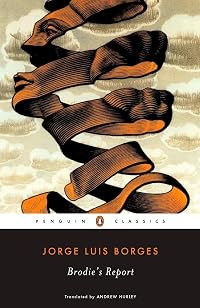
Doctor Brodie's Report
by Jorge Luis Borges
On This Page
Description
At the age of seventy, after a gap of twenty years, Jorge Luis Borges returned to writing short stories. In "Brodie's Report," he returned also to the style of his earlier years with its brutal realism, nightmares, and bloodshed. Many of these stories, including "Unworthy" and "The Other Duel," are set in the macho Argentinean underworld, and even the rivalries between artists are suffused with suppressed violence. Throughout, opposing themes of fate and free will, loyalty and betrayal, time show more and memory flicker in the recesses of these compelling stories, among the best Borges ever wrote. show lessTags
Recommendations






















Member Reviews
I will read any collection of Borges' writing that happens to turn up, so can never be sure how many times I've read any particular story of his. I think at least some of those in [b:Brodie's Report|929585|Brodie's Report|Jorge Luis Borges|https://i.gr-assets.com/images/S/compressed.photo.goodreads.com/books/1622618013l/929585._SY75_.jpg|914584] were new to me. It is a less mystical and more historical collection than my favourite Borges stories, but still powerful and beguiling. Most deal with Argentina's violent past, in the form of unsettling anecdotes that hint at multiple deeper meanings. Several elide fact and fiction, which is helpfully pointed out by the footnotes that add context for names and places. The overall mood is show more definitely sombre, preoccupied with memory and old age:
I appreciated the detailed six-and-a-half page translator's note, which comments on general style, word choice, prior translations, and Borges' own thoughts about translation. It includes this lovely comment:
Sleeping, as we all know, is the most secret thing we do. We devote one third of our lives to sleep, yet we do not understand it. Some believe it is only an eclipse of wakefulness; others, a more complex state which embraces at once yesterday, the present, and tomorrow; still others see it as an uninterrupted series of dreams. To say that the elderly lady of my story spent ten years in a state of serene chaos is perhaps an error; every moment of those ten years may have been pure present, without past or future. If so, we should not marvel overmuch at that present (which in our own case as count in days and nights and hundreds of pages torn from many calendars, and in anxieties and events) - we voyage through it every morning before we are fully awake and every night before we fall asleep. Twice every day we are that elderly lady.
I appreciated the detailed six-and-a-half page translator's note, which comments on general style, word choice, prior translations, and Borges' own thoughts about translation. It includes this lovely comment:
Borges has tried in his essays to teach us, however, that we should not translate 'against' our predecessors; a new translation is always justified by the new voice given the old work, by the new life in a new land that the translation confers on it, by the 'shock of the new' that both old and new readers will experience from this inevitably new (or renewed) work. What Borges teaches is that we should simply commend the translation to the reader, with the hope that that the reader will find in it a literary experience that is rich and moving. I have listened to Borges' advice as I have listened to Borges' fictions, and I - like the translators who have preceded me - have rendered Borges in the style that I hear when I listen to him.show less
Perhaps Borges' most inessential book, Brodie's Report is a sort of counterpart to A Universal History of Iniquity in that it's a collection of laconic short stories revolving around Argentine gauchos and knife-fighters. But whereas Iniquity, despites its flaws, had the exuberant ideas of youth, Brodie's Report, written when Borges was in his seventies, just seems stale.
The stories are surprisingly shallow; there was not one stand-out piece of writing and their only notable feature, beyond Borges' ever-present and often-underrated storytelling, is their bone-white violence. The brutality on show among Borges' characters is stronger here than in any of his other writing.
But why this is the case is not clear, and it's certainly not why show more people read Borges. Brodie's Report is entirely absent the evocative labyrinths, metaphysics and mythology that make his most enduring stories sparkle, but this would be fine if there was something intellectually sustaining in their stead. But there isn't, and the book lacks literary validity. There is in truth very little to say about it in a review; it pains me to write of Borges in demerit, but the book contains little of what makes readers fall (and stay) in love with this singular writer. show less
The stories are surprisingly shallow; there was not one stand-out piece of writing and their only notable feature, beyond Borges' ever-present and often-underrated storytelling, is their bone-white violence. The brutality on show among Borges' characters is stronger here than in any of his other writing.
But why this is the case is not clear, and it's certainly not why show more people read Borges. Brodie's Report is entirely absent the evocative labyrinths, metaphysics and mythology that make his most enduring stories sparkle, but this would be fine if there was something intellectually sustaining in their stead. But there isn't, and the book lacks literary validity. There is in truth very little to say about it in a review; it pains me to write of Borges in demerit, but the book contains little of what makes readers fall (and stay) in love with this singular writer. show less
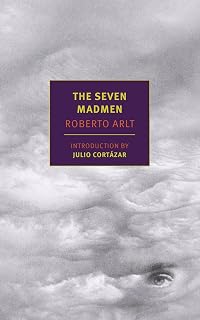
Since I'd just re-read Los siete locos and pondered a few comparisons between the literatures of Roberto Arlt and Jorge Luis Borges, why not read this book I bought the other day, published when Borges was 71? I'd not read it before, and I find the later Borges, the Borges that lives on in the world alongside the published works of the earlier Borges, to be an intriguing author. Surprisingly enough, none other than Bob Arlt himself is mentioned in the prologue as JLB has a go at those language purists who have a problem with his choice of words: "Along these lines, I remember that they used to shove Roberto Arlt's lack of knowledge of Lunfardo in his face and that he replied: 'I grew up in Villa Luro, amongst poor folks and hoodlums, show more and in truth I haven't had the time to study those things.'" By the way, I've always found Borges to be an excellent self-prologist. This one got me especially pumped for these stories with comments like these:
"I've renounced the surprises of a baroque style; also those which an unforeseen ending hopes to provide. I've preferred, in short, the development of feelings of expectation or those of amazement. For many years I believed that I would one day write a good page by way of variations and innovations; now, having celebrated my seventieth year, I believe I have found my voice."
Or this one:
"Who, in 1970, remembers with precision what the communities of Palermo or Lomas were like in the final years of the past century?"
That second comment caused in me the feelings of expectation mentioned in the first comment because Borges was already asking in 1929 (in Evaristo Carriego) what Palermo was like (or what it might conceivably and poetically have been like) at the turn of the century. As I started moving through these stories and saw how many of them were about gauchos, knife fights, card games and childhood encounters with legendary tough guys, I saw how this book was something of a second go-round at the representation of a past that was already tinged with nostalgia the first time he visited these Argentine themes. Many of the stories are framed in a way that emphasizes the effects of time on memory: the narrator might explain how he was told the story by a certain person in a certain situation, and cautions that their perspective may not accurately reflect the truth of the matter; or he might recount a fading memory with "the inevitable variations brought by time and good or bad literature." The differences between the way things happened and the way they're remembered/interpreted stand prominent throughout the book. In the final story that gives the book its title, the missionary Brodie relates his experience with a strange indigenous tribe in the Amazon. Their beliefs are as odd as one might possibly imagine (they blind and dismember their king and send him to live in a cave, smearing him with dung), yet the outsider concludes that, as shocking as his report might seem, we must consider that in many ways this tribe is no different than us: their language is not entirely unlike ours, they compose poetry, and they believe that the soul outlives the body, to cite a few examples. Truth is in the eyes of the beholder, or, in many of these stories, the rememberer. I think it's also fair to say that it's in the eyes of the reader, who in many cases (such as my own) is even further displaced from the author's world and must conform his or her own perspective to the words on the page. Old man Borges seems so very aware of the complexities of even the most straightforward statements, and here he tells simple stories that are not really that simple.
A few that I especially enjoyed: "Guayquil," where two academics meet to discuss which one of them will travel to Colombia to transcribe a long lost document written by Simón Bolívar containing details of his meeting with general San Martín in 1822. After that meeting, I believe, San Martín retired to his rural estate and Bolívar continued his fight for American independence. What I assume the two professors are really doing is unknowingly reenacting the events of that meeting. In another, the young Borges meets an old grammar school acquaintance shortly after the publication of Evaristo Carriego and is told the unlikely story of the knife of the notorious Palermo hoodlum Juan Muraña. Years after his death, the knife is used to commit a crime and the perpetrator, his lady, affirms that Juan lives on through his knife and helped her use it in order to protect her from being evicted. That story begins with an evocation of certain statements made in Borges' prologue to his 1929 book, which confirmed my assumption that I'd find in this book nostalgic looks back in time raised to the second degree. In another story, "Historia de Rosendo Juárez," the narrator listens to a man in a bar tell the story of a longtime political lackey/strongman who's famed to never back down but one day finally does.
There's one other story that is definitely worth discussing: "El indigno," which is mentioned by Ricardo Piglia's character Renzi in Respiración artificial as Borges' possible homage to Roberto Arlt. Once I finished reading it I was pretty sure that it had to be the story mentioned by Renzi, because it really is quite similar to the final episode of Arlt's first novel, El juguete rabioso (translated to English as Mad Toy). I'd always thought of the two authors as polar opposites and representatives of opposite ends of the Argentine literary world. I believed that people compared Arlt to Borges because they were so different, and I remember reading somewhere that when the two met, they didn't hit it off at all and were more or less unable to communicate with each other (I think the anecdote concerning their meeting is in Mario Vargas Llosa's book about Juan Carlos Onetti, Viaje a la ficción). It's neat to see that Borges, entering his seventh decade, may have felt a greater connection to Arlt and his work than I might have expected. I'm glad I thought to read this book after an Arlt novel. show less
"I've renounced the surprises of a baroque style; also those which an unforeseen ending hopes to provide. I've preferred, in short, the development of feelings of expectation or those of amazement. For many years I believed that I would one day write a good page by way of variations and innovations; now, having celebrated my seventieth year, I believe I have found my voice."
Or this one:
"Who, in 1970, remembers with precision what the communities of Palermo or Lomas were like in the final years of the past century?"
That second comment caused in me the feelings of expectation mentioned in the first comment because Borges was already asking in 1929 (in Evaristo Carriego) what Palermo was like (or what it might conceivably and poetically have been like) at the turn of the century. As I started moving through these stories and saw how many of them were about gauchos, knife fights, card games and childhood encounters with legendary tough guys, I saw how this book was something of a second go-round at the representation of a past that was already tinged with nostalgia the first time he visited these Argentine themes. Many of the stories are framed in a way that emphasizes the effects of time on memory: the narrator might explain how he was told the story by a certain person in a certain situation, and cautions that their perspective may not accurately reflect the truth of the matter; or he might recount a fading memory with "the inevitable variations brought by time and good or bad literature." The differences between the way things happened and the way they're remembered/interpreted stand prominent throughout the book. In the final story that gives the book its title, the missionary Brodie relates his experience with a strange indigenous tribe in the Amazon. Their beliefs are as odd as one might possibly imagine (they blind and dismember their king and send him to live in a cave, smearing him with dung), yet the outsider concludes that, as shocking as his report might seem, we must consider that in many ways this tribe is no different than us: their language is not entirely unlike ours, they compose poetry, and they believe that the soul outlives the body, to cite a few examples. Truth is in the eyes of the beholder, or, in many of these stories, the rememberer. I think it's also fair to say that it's in the eyes of the reader, who in many cases (such as my own) is even further displaced from the author's world and must conform his or her own perspective to the words on the page. Old man Borges seems so very aware of the complexities of even the most straightforward statements, and here he tells simple stories that are not really that simple.
A few that I especially enjoyed: "Guayquil," where two academics meet to discuss which one of them will travel to Colombia to transcribe a long lost document written by Simón Bolívar containing details of his meeting with general San Martín in 1822. After that meeting, I believe, San Martín retired to his rural estate and Bolívar continued his fight for American independence. What I assume the two professors are really doing is unknowingly reenacting the events of that meeting. In another, the young Borges meets an old grammar school acquaintance shortly after the publication of Evaristo Carriego and is told the unlikely story of the knife of the notorious Palermo hoodlum Juan Muraña. Years after his death, the knife is used to commit a crime and the perpetrator, his lady, affirms that Juan lives on through his knife and helped her use it in order to protect her from being evicted. That story begins with an evocation of certain statements made in Borges' prologue to his 1929 book, which confirmed my assumption that I'd find in this book nostalgic looks back in time raised to the second degree. In another story, "Historia de Rosendo Juárez," the narrator listens to a man in a bar tell the story of a longtime political lackey/strongman who's famed to never back down but one day finally does.
There's one other story that is definitely worth discussing: "El indigno," which is mentioned by Ricardo Piglia's character Renzi in Respiración artificial as Borges' possible homage to Roberto Arlt. Once I finished reading it I was pretty sure that it had to be the story mentioned by Renzi, because it really is quite similar to the final episode of Arlt's first novel, El juguete rabioso (translated to English as Mad Toy). I'd always thought of the two authors as polar opposites and representatives of opposite ends of the Argentine literary world. I believed that people compared Arlt to Borges because they were so different, and I remember reading somewhere that when the two met, they didn't hit it off at all and were more or less unable to communicate with each other (I think the anecdote concerning their meeting is in Mario Vargas Llosa's book about Juan Carlos Onetti, Viaje a la ficción). It's neat to see that Borges, entering his seventh decade, may have felt a greater connection to Arlt and his work than I might have expected. I'm glad I thought to read this book after an Arlt novel. show less
Welcome to the many universes of Jorge Luis Borges. For those new to the author, this is an excellent book of Borges to read first, since these stories are accessible and straightforward, containing very little of the baroque complexity characteristic of his earlier collections. To share the flavor of these eleven Borges tales, I will focus on the title story. And let me tell you folks, I have read a number of books on indigenous tribes by cultural anthropologists such as Raymond Firth and Colin Turnbull, but I have never encountered a study quite like “Brodie's Report.”
BRODIE’S REPORT
Strange Find: The narrator relates how he discovers a manuscript tucked inside the cover of “Thousand and One Nights," a manuscript written by one show more David Brodie, a Scottish missionary who preached in the jungles of Brazil, a manuscript he is now making known to the world; and, the narrator says, how he will take pains to reproduce the manuscript’s colorless language verbatim. Such a mysterious find is classic Borges: the narrator is only the messenger, any actual firsthand experience of unfolding peculiar events belongs to another.
Bare Facts: Here are the raw facts about this bestial, wild, brutish tribe Brodie calls Yahoos: vowels are absent in their harsh language; the number of their tribe never exceeds seven hundred; they sleep wherever they find themselves at night and only a few have names; they call one another by flinging mud or throwing themselves in the dirt; their diet consists of fruits, roots, reptiles and milk from cats and bats; they hide themselves while eating but have sex out in the open; they walk about naked since clothing and tattoos are unknown to them; they prefer to huddle in swamps rather than grasslands with springs of fresh water and shade trees; they devour the raw flesh of their king, queen and witch doctors so as to imbibe their respective virtues. For an author like Borges, a highly cultivated, refined, aesthetically attuned urbane gentleman and man of letters, life among this tribe of Yahoo could be seen as his worst nightmare.
Questionable Honor: The tribe is ruled over by a king whose power is absolute. Each male child is closely examined to see if he possess bodily signs, both secret and sacred, revealing him as their future king. Once a child is chosen as king of the Yahoos, he is immediately castrated, blinded, and his hands and feet cut off so as he will not be distracted by the outside world, setting him free to imbibe inner wisdom. The king is then taken to a cavern where only witch doctors and a pair of female slaves are permitted entry to serve the king and smear his body with dung. By this extreme social custom, I think Borges is asking us to ponder the perennial philosophical question: is our basic, corrupt human nature improved by society and culture, a view held by such as Plato and Aristotle; or, are we, as according to Jean-Jacques Rousseau, good by nature and corrupted by society? However we approach this question, one thing is for sure: no other non-human primate tribe would inflict such brutal dismemberment on their leader.
Vision and Creativity: The queen looks at Brodie and then, in full sight of her attendants, offers herself to him. He declines but then the queen does something unexpected – she pricks Brodie with a pin, a pin manufactured elsewhere since the Yahoos are incapable of manufacturing even the simplest objects. Pin pricking from the queen is seen by the Yahoo as an honor -the queen projects that Brodie will not feel any pain since all the Yahoos are insensitive to pain and pleasure with the exception of the pleasure they take in gorging on raw and rancid food and smelling its noxious odor. On the heels of this episode, Brodie make a startling pronouncement: lack of imagination makes them cruel. To my mind, one of the most powerful statements within the story: linking cruelty with an individual’s lack of imagination and also linking cruelty with a society’s lack of imagination. How far removed are we from the Yahoos in this respect, really?
Bizarre: Brodie reports how the Yahoo number system is unique, how they count one, two, three, four, and then immediately go to infinity. Also unique is the power the witch doctors have to transform anyone into an ant or a tortoise; as proof of this truth, the Yahoo point out red ants swarming on an anthill. Then we arrive something truly unique: the Yahoo have virtually no memory, they barely have any recollection of past time beyond yesterday. On this topic, Brodie makes a general philosophically point: memory is no less marvelous than prophesy since the ancient happenings we easily recall (the building of the pyramids; the parting of the Red Sea) are much more distant in time than tomorrow. As we all know, our very human capacity to remember can be a mixed blessing: although our humanity is enriched, we can frequently be burdened by continually bringing to mind not only nasty and sad memories but tragic and horrific memories. Not the Yahoo - they only go back as far as yesterday.
Theology: Since Brodie is a Scottish missionary, predictably his report includes the Yahoo system of religious belief. Turns out, the Yahoo believe both heaven and hell are underground: their hell is bright, dry and inhabited by the old, the sick, the mistreated as well as Arabs, leopards and the Apemen. Yes, Brodie reports how the Yahoo have to fend off attacks by the Apemen. No further detail is given on the Apemen which makes the whole report a bit spooky. Anyway, the Yahoo heaven is dark and marsh-like and the afterlife reward for kings, queens, witch doctors along with the happy, the hardhearted and the bloodthirsty. I can just imagine what Jorge Luis Borges must have been thinking outlining such a Yahoo theology, a theology that really stretches our more conventional views of the afterlife, to say the least.
The Arts: Brodie’s report includes the two Yahoo sports: organized cat fights and executions. Sound like fun? I wonder if they would sell tickets to outsiders. Then Brodie reports on how a poet is a Yahoo who can string together six or seven enigmatic words. The poet will then shriek out these mysterious words surrounded by his fellow Yahoo who consider the poet no longer a man but a god. And as a god, they have the right to kill the poet on the spot. However, if the poet can escape the circle, he can seek refuge in a desert to the north of the jungle. Again, I wonder what was going through the mind of Borges when he envisioned poetry and the Yahoo – certainly enough to make a refined aesthete’s skin crawl.
Home Sweet Home: Bordie reports how now that he’s home in Scotland, he still dreams of the Yahoo and how the Yahoo are not that far removed from the streets of Glasgow, since, after all, the Yahoo have institutions, a king, speak a language based on abstract concepts, believe in the divine origin of poetry and also believe the soul survives death. Lastly, let me note how Brodie reports how, based on their rather abstract language, the Yahoo are not a primitive people but a degenerative people; in other words, they are a people whose ancestors were once highly civilized, perhaps even European. A rather chilling thought. show less
Welcome to the many universes of Jorge Luis Borges. For those new to the author, this is an excellent book of Borges to read first, since these stories are accessible and straightforward, containing very little of the baroque complexity characteristic of his earlier collections. To share the flavor of these eleven Borges tales, I will focus on the title story. And let me tell you folks, I have read a number of books on indigenous tribes by cultural anthropologists such as Raymond Firth and Colin Turnbull, but I have never encountered a study quite like “Brodie's Report.”
BRODIE’S REPORT
Strange Find: The narrator relates how he discovers a manuscript tucked inside the cover of “Thousand and One Nights," a manuscript written by one show more David Brodie, a Scottish missionary who preached in the jungles of Brazil, a manuscript he is now making known to the world; and, the narrator says, how he will take pains to reproduce the manuscript’s colorless language verbatim. Such a mysterious find is classic Borges: the narrator is only the messenger, any actual firsthand experience of unfolding peculiar events belongs to another.
Bare Facts: Here are the raw facts about this bestial, wild, brutish tribe Brodie calls Yahoos: vowels are absent in their harsh language; the number of their tribe never exceeds seven hundred; they sleep wherever they find themselves at night and only a few have names; they call one another by flinging mud or throwing themselves in the dirt; their diet consists of fruits, roots, reptiles and milk from cats and bats; they hide themselves while eating but have sex out in the open; they walk about naked since clothing and tattoos are unknown to them; they prefer to huddle in swamps rather than grasslands with springs of fresh water and shade trees; they devour the raw flesh of their king, queen and witch doctors so as to imbibe their respective virtues. For an author like Borges, a highly cultivated, refined, aesthetically attuned urbane gentleman and man of letters, life among this tribe of Yahoo could be seen as his worst nightmare.
Questionable Honor: The tribe is ruled over by a king whose power is absolute. Each male child is closely examined to see if he possess bodily signs, both secret and sacred, revealing him as their future king. Once a child is chosen as king of the Yahoos, he is immediately castrated, blinded, and his hands and feet cut off so as he will not be distracted by the outside world, setting him free to imbibe inner wisdom. The king is then taken to a cavern where only witch doctors and a pair of female slaves are permitted entry to serve the king and smear his body with dung. By this extreme social custom, I think Borges is asking us to ponder the perennial philosophical question: is our basic, corrupt human nature improved by society and culture, a view held by such as Plato and Aristotle; or, are we, as according to Jean-Jacques Rousseau, good by nature and corrupted by society? However we approach this question, one thing is for sure: no other non-human primate tribe would inflict such brutal dismemberment on their leader.
Vision and Creativity: The queen looks at Brodie and then, in full sight of her attendants, offers herself to him. He declines but then the queen does something unexpected – she pricks Brodie with a pin, a pin manufactured elsewhere since the Yahoos are incapable of manufacturing even the simplest objects. Pin pricking from the queen is seen by the Yahoo as an honor -the queen projects that Brodie will not feel any pain since all the Yahoos are insensitive to pain and pleasure with the exception of the pleasure they take in gorging on raw and rancid food and smelling its noxious odor. On the heels of this episode, Brodie make a startling pronouncement: lack of imagination makes them cruel. To my mind, one of the most powerful statements within the story: linking cruelty with an individual’s lack of imagination and also linking cruelty with a society’s lack of imagination. How far removed are we from the Yahoos in this respect, really?
Bizarre: Brodie reports how the Yahoo number system is unique, how they count one, two, three, four, and then immediately go to infinity. Also unique is the power the witch doctors have to transform anyone into an ant or a tortoise; as proof of this truth, the Yahoo point out red ants swarming on an anthill. Then we arrive something truly unique: the Yahoo have virtually no memory, they barely have any recollection of past time beyond yesterday. On this topic, Brodie makes a general philosophically point: memory is no less marvelous than prophesy since the ancient happenings we easily recall (the building of the pyramids; the parting of the Red Sea) are much more distant in time than tomorrow. As we all know, our very human capacity to remember can be a mixed blessing: although our humanity is enriched, we can frequently be burdened by continually bringing to mind not only nasty and sad memories but tragic and horrific memories. Not the Yahoo - they only go back as far as yesterday.
Theology: Since Brodie is a Scottish missionary, predictably his report includes the Yahoo system of religious belief. Turns out, the Yahoo believe both heaven and hell are underground: their hell is bright, dry and inhabited by the old, the sick, the mistreated as well as Arabs, leopards and the Apemen. Yes, Brodie reports how the Yahoo have to fend off attacks by the Apemen. No further detail is given on the Apemen which makes the whole report a bit spooky. Anyway, the Yahoo heaven is dark and marsh-like and the afterlife reward for kings, queens, witch doctors along with the happy, the hardhearted and the bloodthirsty. I can just imagine what Jorge Luis Borges must have been thinking outlining such a Yahoo theology, a theology that really stretches our more conventional views of the afterlife, to say the least.
The Arts: Brodie’s report includes the two Yahoo sports: organized cat fights and executions. Sound like fun? I wonder if they would sell tickets to outsiders. Then Brodie reports on how a poet is a Yahoo who can string together six or seven enigmatic words. The poet will then shriek out these mysterious words surrounded by his fellow Yahoo who consider the poet no longer a man but a god. And as a god, they have the right to kill the poet on the spot. However, if the poet can escape the circle, he can seek refuge in a desert to the north of the jungle. Again, I wonder what was going through the mind of Borges when he envisioned poetry and the Yahoo – certainly enough to make a refined aesthete’s skin crawl.
Home Sweet Home: Bordie reports how now that he’s home in Scotland, he still dreams of the Yahoo and how the Yahoo are not that far removed from the streets of Glasgow, since, after all, the Yahoo have institutions, a king, speak a language based on abstract concepts, believe in the divine origin of poetry and also believe the soul survives death. Lastly, let me note how Brodie reports how, based on their rather abstract language, the Yahoo are not a primitive people but a degenerative people; in other words, they are a people whose ancestors were once highly civilized, perhaps even European. A rather chilling thought. show less
”I can’t say whether the story was true; the important thing… was that it had been told and believed.”
I have the Collected Fictions (with copious translator's notes), but am splitting my review of that into its components, listed in publication order: Collected Fictions - all reviews. This is the seventh, published in 1970.
The Encounter is a crucial story, describing a seminal episode in JLB’s childhood, suggesting the roots of so many of his recurring themes.
Foreword
This prepares the chronological reader for a significant change of style: these are “plain tales” that avoid unexpected endings, in the mould of Kipling. JLB asserts that he (JLB) is not “a fabulist or spinner of parables” and that his tales “are show more intended not to persuade readers, but to entertain and touch them.”
Most have an introductory section, explaining the (allegedly true) roots of the story, while conceding he may yield “to the literary temptation to heighten or insert the occasional small detail”.
“For many years I believed that it would be my fortune to achieve literature through variations and novelties; now that I am seventy years old I think I have found my own voice.”
I confess I was slightly disappointed; this led me to expect something closer to A Universal History of Iniquity than the more extraordinary pieces in between that and this. But I was heartened by the fact they are set “at some distance in both time and space” and that although they are “realistic… two of the stories… can be opened with the same fantastic key… I am decidedly monotonous.” Having finished this collection, they are deeper and more mysterious than those in A Universal History, but more straightforward than those in between.
For all that these are “plain”, two stories suggest the importance of imagination. In The Other Duel, it’s the familiarity of killing animals and the lack of imagination that makes killing people so easy, and in Brodie’s Report, the Yahoos’ “lack of imagination makes them cruel”.
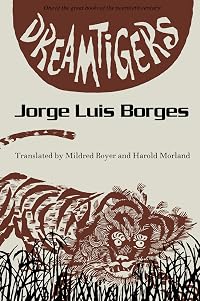
He makes no mention here or in the stories themselves of his blindness (unlike In Praise of Darkness, reviewed as part of Dreamtigers). I suppose he was long used to it by then.
The Interloper
This concerns knife fighters in harsh neighbourhoods. Familiar territory, but not really my thing. I assumed (incorrectly) that this would set the tone for all those that followed.
Fortunately, this was deeper and more complex than it seemed at first sight. Unfortunately, it was pretty grim.
Brothers (who might be deemed “white trash” in the US) are very close: “falling out with one of them was to earn yourself two enemies”. The eponymous interloper is a woman, who cleaves them (in both senses) to/from each other.One marries her (more for service than a relationship), but the other loves her too (though I would dispute the word “love”). They agree to share her: “If you want her, use her”! There is no mention of her opinion, but she does what’s demanded “with beast-like submissiveness.” When jealousy becomes too much, they sell her to a brothel, but both sneak out to visit her there, so they buy her back. More jealousy. So they kill her. “Now they were linked by yet another bond: the woman grievously sacrificed, and the obligation to forget her.”
They are dreadful men, who treat women appallingly. There’s no suggestion JLB approves, but it still left a nasty taste.
The notes mention a queer interpretation of this (and some of his others), which makes one see it in a whole new light. However, other sources say it’s based on a true story of friends; by switching the protagonists to be brothers, JLB seems to be ruling out a sexual triangle.
Unworthy
Class, friendship, betrayal, and reformation – about a Jewish boy, but with Biblical echoes.
A respectable bookshop owner was an unlikely gang member in his teens. He was shy, red-headed, Jewish, and wanted to fit in (he changed his first name to something more Catholic). When his mother and aunt were insulted, gangster Ferrari stepped in. Young Fischbein was impressed (the women were more equivocal: “a gentleman that demands respect for ladies” or “a ruffian who won’t allow competition”?), and is taken under the wing of Ferrari.
Which of them is unworthy of the other?
At first, Fischbein denies his friendship with Ferrari for fear it would be bragging. Then things take a more definite turn, for unspecified reasons.He tips off the police about a planned robbery, and Ferrari is killed. He doesn’t even seem to feel much guilt, despite the fact that at the time he saw Ferrrari as a god, and with hindsight as “a poor kid, misguided and betrayed”.
The Story from Rosendo Juarez
This is another version of Man on Pink Corner, from A Universal History of Iniquity. Both include the line “Rosendo, I think you’re needing this” as a woman hands him his own knife, from up his sleeve.
A rough kid learns to fight, kills a man, is arrested, but “turned into a gorilla for the party” and now sees himself as a reasonable man, fully reformed.
The Encounter 6*
Young JLB (unknowingly) sowing the seeds for much of his adult work: labyrinth, knives, storytelling, and a mysterious twist and a tacit lesson of being careful what you wish for.
Aged about ten, he went to stay with a cousin, but “being a boy among men”, he was lonely, so slipped out to explore the large and unfamiliar house. “A big house that one has never been in before… means more to a boy than an unexplored country to a traveller”. He gets lost, but is found by the owner, who shows him an extensive knife collection.
Some of the men, playing cards, fight. JLB “was not drunk from wine but I was drunk from adventure; I yearned for someone to be killed, so that I could tell about it later.” The honest and plausible thoughts of a ten year old, but nevertheless shocking.
With detachment, he watches the fight “as though it were a game of chess”. He sees stabbings and death. Everyone leaves and vows secrecy. “What I had longed to see had happened, and I was devastated.” Many years later, JLB mentions this incident to a police officer who recognises the knives from his description. They were mystical knives that had belonged to sworn enemies. “It was the weapons, not the men, that fought. They had lain sleeping, side by side, in a cabinet, until hands awoke them. In the blades of those knives there slept, and lurked, a human grudge.”
“I always suspected I derived more pleasure from keeping the secret than I would from telling it.” JLB doesn’t state if that remains true.
Juan Murana
A reclusive widow “confuses her man, her tiger, with that cruel object he has bequeathed to her, the weapon of his bloody deeds.”
Her landlord is killed in a (vain) attempt to stave off eviction. She insists it was the ghost of her husband that did it. Is she deluded or scheming?
The Elderly Lady
An aged widow remembers little of the minor hero who was her father, so the celebrations pass her by. The historical notes are almost as long as the story. Too many characters and generations and too much Argentine context for me to get much from.
The Duel
A knife-free duel! And female protagonists! Paintbrushes at the ready…
An ambassador’s widow decided to become an abstract artist. So begins a tacit battle with a friend, who is also an artist. “In the course of that private duel they acted with perfect loyalty to one another.”
“There were no defeats or victories, nor even so much as an open clash”, so what was the point?But when one dies, the other stops painting. Back to duality (a favourite Borgesian them. Each needed the other.
The Other Duel
A simmering feud between two men. Duality and futility again (not that the story is futile!).
“Perhaps their only passion… was their hatred, and therefore they saved it and stored it up. Without suspecting, each of the two became the other’s slave.”
They pass each other every day, but the fight comes at the end – and even then, it’s not at their behest. They have to race – after their throats have been cut. The winner didn’t know he’d won. What was there to win anyway?
Guayaquil
The title is a city in Ecuador that was important in Argentina’s battle for independence. The story is about rival interpretations of Bolivar’s role in that, and hence about truth in general.
Can you trust historical documents? Of course not. “Even if they were written by Bolivar himself… that does not mean they contain the whole truth.”
The Gospel According to Mark, 5*
In his foreword to the Brodie’s Report collection, JLB describes this as “the best story of the volume”.
The protagonist is a medical student and a man of contradictions. His name is Espinosa, meaning “thorny”, which has echoes of the crown of thorns.
He spends the summer at his cousin’s ranch, but the cousin goes away to deal with floods. Espinosa is left as de facto master of the house, with a family of illiterate staff. He finds an old Bible, with the Gutres family’s genealogy at the back. They were originally Scottish, but English (and literacy) has died out in the 100 years since their forebears arrived. Evolution does not always go forwards (see Brodie’s Report, below, and The Immortal in The Aleph).
“Throughout history, humankind has told two stories: the story of a lost ship sailing the Mediterranean seas in quest of a beloved isle, and the story of a god who allows himself to be crucified on Golgotha.” Which will this be? Both, perhaps.
The student decides to read aloud from this Bible, after supper, and he picks Mark’s gospel. The family are transfixed, even though they don’t understand it. He does this each evening. There’s a similar scene in The Congress (in The Book of Sand).
One night, the girl (age unspecified, but she was a virgin) comes to his room (a familiar Kafka trope, though with him it’s a young woman). She is naked, and climbs into his bed. The next day, the family crucify him. But only after they have interrogated him about forgiveness, and ascertained “those that drove the nails will also be saved”. If he had said not, would they have spared him? And if so, then what? Our sins will surely find us out.
Brodie’s Report 5*
Gulliver’s Travels is a clear inspiration (it even features a primitive tribe called the Yahoos). A Borgesian aspect is that it purports to be the (incomplete) notes of a Scottish missionary in Brazil, found in the pages of a copy of 1001 Nights. Is the story of its finding true? What about the contents? The comic – and sometimes grisly - implausibility suggest not the latter. But it could be a fake document, genuinely found, as Tlon, Uqbar, Orbis Tertius claims to be.
There’s no particular narrative, just a string of provocative descriptions, ending with an indirect and unanswered question.
The Yahoo diet is strange, “fruits, tubers, and reptiles”. Reptiles, but not mammals? They catch fish with their hands (fair enough) but also “drink cat’s and bat’s milk”!
Every newborn boy is examined for a specific (but secret) pattern of stigmata. If he has them, he is immediately king – and therefore “he is gelded, blinded with a fiery stick, and his hands and feet are cut off, so that the world will not distract him from wisdom”, though given how primitive they are, and the fact they “smear his body with dung”, I doubt such kings will survive long enough to develop much wisdom.
Their counting system is 1, 2, 3, 4, many and “the Yahoos have no memory”, so if someone mentions a leopard attack, no one knows if it happened to them, their parents, or in a dream.
“Philosophically speaking, memory is no less marvellous than prophesying the future” as witch doctors can do. Does that require the assumption of one past and only one future? If we believe in multiple possible outcomes (as JLB suggests in other stories), this claim doesn’t make much sense.
The lack of conversion to Christianity is original: “The phrase ‘Our Father’ disturbed them, since they lack any concept of paternity. They do not understand that an act performed nine months ago may somehow be related to the birth of a child… and… all women engage in carnal commerce, though not all are mothers.”
Their language is strange and simultaneously simple and complex. “The intellectual power of abstraction demanded by such a language suggests to me that the Yahoos… are not a primitive people but a degenerate one” Indecipherable runes nearby seem to confirm that. Like the Gutres family in The Gospel According to Mark, above, and the immortals in the story of that name in The Aleph?
Would you die for art? In this culture, spontaneous poetry is revered – but in a perverse way. “If the poem does not excite the tribe, nothing happens, but if the words of the poet surprise or astound the listeners… he is no longer a man, but a god, and anyone may kill him.”
Brodie finally lists the Yahoos’ redeeming qualities, upholds an obligation to save them (from the occasional attacks by Ape-men, or from colonialism and Christianisation?) and says “I hope Her Majesty’s government will not turn a deaf ear to the remedy this report has the temerity to suggest.” What does it suggest? We will never know.
Quotes
• “Literature is naught but guided dreaming.”
• “We all come to resemble the image others have of us.”
• “The newspapers… made him the hero that perhaps he never was, but that I had dreamed of.”
• “Friendship is as mysterious as love… the only thing that holds no mystery is happiness because it is its own justification.”
• “Time cannot be measured in days the way money is measured in pesos and centavos, because all pesos are equal, while very day, perhaps every hour, is different.”
• “Newspapers told loyal untruths.”
• “Sleeping… is the most secret thing we do.”
• Wearing a bow-tie and “a well-trimmed, military-style moustache; during the course of our conversation he lighted a cigar, and at that, I felt there were too many things on that face. Trop meuble, I said to myself.” show less
I have the Collected Fictions (with copious translator's notes), but am splitting my review of that into its components, listed in publication order: Collected Fictions - all reviews. This is the seventh, published in 1970.
The Encounter is a crucial story, describing a seminal episode in JLB’s childhood, suggesting the roots of so many of his recurring themes.
Foreword
This prepares the chronological reader for a significant change of style: these are “plain tales” that avoid unexpected endings, in the mould of Kipling. JLB asserts that he (JLB) is not “a fabulist or spinner of parables” and that his tales “are show more intended not to persuade readers, but to entertain and touch them.”
Most have an introductory section, explaining the (allegedly true) roots of the story, while conceding he may yield “to the literary temptation to heighten or insert the occasional small detail”.
“For many years I believed that it would be my fortune to achieve literature through variations and novelties; now that I am seventy years old I think I have found my own voice.”
I confess I was slightly disappointed; this led me to expect something closer to A Universal History of Iniquity than the more extraordinary pieces in between that and this. But I was heartened by the fact they are set “at some distance in both time and space” and that although they are “realistic… two of the stories… can be opened with the same fantastic key… I am decidedly monotonous.” Having finished this collection, they are deeper and more mysterious than those in A Universal History, but more straightforward than those in between.
For all that these are “plain”, two stories suggest the importance of imagination. In The Other Duel, it’s the familiarity of killing animals and the lack of imagination that makes killing people so easy, and in Brodie’s Report, the Yahoos’ “lack of imagination makes them cruel”.
He makes no mention here or in the stories themselves of his blindness (unlike In Praise of Darkness, reviewed as part of Dreamtigers). I suppose he was long used to it by then.
The Interloper
This concerns knife fighters in harsh neighbourhoods. Familiar territory, but not really my thing. I assumed (incorrectly) that this would set the tone for all those that followed.
Fortunately, this was deeper and more complex than it seemed at first sight. Unfortunately, it was pretty grim.
Brothers (who might be deemed “white trash” in the US) are very close: “falling out with one of them was to earn yourself two enemies”. The eponymous interloper is a woman, who cleaves them (in both senses) to/from each other.
They are dreadful men, who treat women appallingly. There’s no suggestion JLB approves, but it still left a nasty taste.
The notes mention a queer interpretation of this (and some of his others), which makes one see it in a whole new light. However, other sources say it’s based on a true story of friends; by switching the protagonists to be brothers, JLB seems to be ruling out a sexual triangle.
Unworthy
Class, friendship, betrayal, and reformation – about a Jewish boy, but with Biblical echoes.
A respectable bookshop owner was an unlikely gang member in his teens. He was shy, red-headed, Jewish, and wanted to fit in (he changed his first name to something more Catholic). When his mother and aunt were insulted, gangster Ferrari stepped in. Young Fischbein was impressed (the women were more equivocal: “a gentleman that demands respect for ladies” or “a ruffian who won’t allow competition”?), and is taken under the wing of Ferrari.
Which of them is unworthy of the other?
At first, Fischbein denies his friendship with Ferrari for fear it would be bragging. Then things take a more definite turn, for unspecified reasons.
The Story from Rosendo Juarez
This is another version of Man on Pink Corner, from A Universal History of Iniquity. Both include the line “Rosendo, I think you’re needing this” as a woman hands him his own knife, from up his sleeve.
A rough kid learns to fight, kills a man, is arrested, but “turned into a gorilla for the party” and now sees himself as a reasonable man, fully reformed.
The Encounter 6*
Young JLB (unknowingly) sowing the seeds for much of his adult work: labyrinth, knives, storytelling, and a mysterious twist and a tacit lesson of being careful what you wish for.
Aged about ten, he went to stay with a cousin, but “being a boy among men”, he was lonely, so slipped out to explore the large and unfamiliar house. “A big house that one has never been in before… means more to a boy than an unexplored country to a traveller”. He gets lost, but is found by the owner, who shows him an extensive knife collection.
Some of the men, playing cards, fight. JLB “was not drunk from wine but I was drunk from adventure; I yearned for someone to be killed, so that I could tell about it later.” The honest and plausible thoughts of a ten year old, but nevertheless shocking.
“I always suspected I derived more pleasure from keeping the secret than I would from telling it.” JLB doesn’t state if that remains true.
Juan Murana
A reclusive widow “confuses her man, her tiger, with that cruel object he has bequeathed to her, the weapon of his bloody deeds.”
The Elderly Lady
An aged widow remembers little of the minor hero who was her father, so the celebrations pass her by. The historical notes are almost as long as the story. Too many characters and generations and too much Argentine context for me to get much from.
The Duel
A knife-free duel! And female protagonists! Paintbrushes at the ready…
An ambassador’s widow decided to become an abstract artist. So begins a tacit battle with a friend, who is also an artist. “In the course of that private duel they acted with perfect loyalty to one another.”
“There were no defeats or victories, nor even so much as an open clash”, so what was the point?
The Other Duel
A simmering feud between two men. Duality and futility again (not that the story is futile!).
“Perhaps their only passion… was their hatred, and therefore they saved it and stored it up. Without suspecting, each of the two became the other’s slave.”
Guayaquil
The title is a city in Ecuador that was important in Argentina’s battle for independence. The story is about rival interpretations of Bolivar’s role in that, and hence about truth in general.
Can you trust historical documents? Of course not. “Even if they were written by Bolivar himself… that does not mean they contain the whole truth.”
The Gospel According to Mark, 5*
In his foreword to the Brodie’s Report collection, JLB describes this as “the best story of the volume”.
The protagonist is a medical student and a man of contradictions. His name is Espinosa, meaning “thorny”, which has echoes of the crown of thorns.
He spends the summer at his cousin’s ranch, but the cousin goes away to deal with floods. Espinosa is left as de facto master of the house, with a family of illiterate staff. He finds an old Bible, with the Gutres family’s genealogy at the back. They were originally Scottish, but English (and literacy) has died out in the 100 years since their forebears arrived. Evolution does not always go forwards (see Brodie’s Report, below, and The Immortal in The Aleph).
“Throughout history, humankind has told two stories: the story of a lost ship sailing the Mediterranean seas in quest of a beloved isle, and the story of a god who allows himself to be crucified on Golgotha.” Which will this be? Both, perhaps.
The student decides to read aloud from this Bible, after supper, and he picks Mark’s gospel. The family are transfixed, even though they don’t understand it. He does this each evening. There’s a similar scene in The Congress (in The Book of Sand).
Brodie’s Report 5*
Gulliver’s Travels is a clear inspiration (it even features a primitive tribe called the Yahoos). A Borgesian aspect is that it purports to be the (incomplete) notes of a Scottish missionary in Brazil, found in the pages of a copy of 1001 Nights. Is the story of its finding true? What about the contents? The comic – and sometimes grisly - implausibility suggest not the latter. But it could be a fake document, genuinely found, as Tlon, Uqbar, Orbis Tertius claims to be.
There’s no particular narrative, just a string of provocative descriptions, ending with an indirect and unanswered question.
The Yahoo diet is strange, “fruits, tubers, and reptiles”. Reptiles, but not mammals? They catch fish with their hands (fair enough) but also “drink cat’s and bat’s milk”!
Every newborn boy is examined for a specific (but secret) pattern of stigmata. If he has them, he is immediately king – and therefore “he is gelded, blinded with a fiery stick, and his hands and feet are cut off, so that the world will not distract him from wisdom”, though given how primitive they are, and the fact they “smear his body with dung”, I doubt such kings will survive long enough to develop much wisdom.
Their counting system is 1, 2, 3, 4, many and “the Yahoos have no memory”, so if someone mentions a leopard attack, no one knows if it happened to them, their parents, or in a dream.
“Philosophically speaking, memory is no less marvellous than prophesying the future” as witch doctors can do. Does that require the assumption of one past and only one future? If we believe in multiple possible outcomes (as JLB suggests in other stories), this claim doesn’t make much sense.
The lack of conversion to Christianity is original: “The phrase ‘Our Father’ disturbed them, since they lack any concept of paternity. They do not understand that an act performed nine months ago may somehow be related to the birth of a child… and… all women engage in carnal commerce, though not all are mothers.”
Their language is strange and simultaneously simple and complex. “The intellectual power of abstraction demanded by such a language suggests to me that the Yahoos… are not a primitive people but a degenerate one” Indecipherable runes nearby seem to confirm that. Like the Gutres family in The Gospel According to Mark, above, and the immortals in the story of that name in The Aleph?
Would you die for art? In this culture, spontaneous poetry is revered – but in a perverse way. “If the poem does not excite the tribe, nothing happens, but if the words of the poet surprise or astound the listeners… he is no longer a man, but a god, and anyone may kill him.”
Brodie finally lists the Yahoos’ redeeming qualities, upholds an obligation to save them (from the occasional attacks by Ape-men, or from colonialism and Christianisation?) and says “I hope Her Majesty’s government will not turn a deaf ear to the remedy this report has the temerity to suggest.” What does it suggest? We will never know.
Quotes
• “Literature is naught but guided dreaming.”
• “We all come to resemble the image others have of us.”
• “The newspapers… made him the hero that perhaps he never was, but that I had dreamed of.”
• “Friendship is as mysterious as love… the only thing that holds no mystery is happiness because it is its own justification.”
• “Time cannot be measured in days the way money is measured in pesos and centavos, because all pesos are equal, while very day, perhaps every hour, is different.”
• “Newspapers told loyal untruths.”
• “Sleeping… is the most secret thing we do.”
• Wearing a bow-tie and “a well-trimmed, military-style moustache; during the course of our conversation he lighted a cigar, and at that, I felt there were too many things on that face. Trop meuble, I said to myself.” show less
This collection, written late in Borges's career, includes eleven very short tales (only about 2000 words each), together with an introduction and an afterword by the author. Unlike his much more famous stories from the 40s and 50s, they are straightforward, largely naturalistic short stories, dealing with (fairly) ordinary human situations - death, rivalry, revenge, etc. Borges himself says that his inspiration came from Kipling's very short stories of the 1890s, and there is certainly an echo here of Kipling's sympathy for and engagement with characters of very different backgrounds from his own. Many of the stories centre around gauchos or working class Argentinians, who clearly have a lot in common with the ordinary soldiers and show more domestic servants Kipling so often writes about. It's generally a very male world: where women are the main characters they are either acting like men ("The Duel") or they are acting for men ("Juan Muraña", "The elderly lady"). Relations between men and women do not seem to play a significant part in any of the stories. What's also interesting is that all the stories come with some sort of frame narrative, a narrator who has heard the story in certain specified circumstances (in several cases: has heard more than one version of the story) and is now retelling it for a particular reason. They are all located in very specific places, too: certain streets or districts of Buenos Aires. Sometimes the frame seems to take up more of the text than the narrative itself. In his Afterword, Borges then destabilises this setting-up of the stories, by telling us something about what he was trying to achieve with them, and where the stories really come from. So there's a lot going on here, even if the stories themselves are deceptively simple.
This was another little book that unaccountably got stuck in my TBR collection for a decade or two. Fortunately, everything surfaces eventually... show less
This was another little book that unaccountably got stuck in my TBR collection for a decade or two. Fortunately, everything surfaces eventually... show less
Members
- Recently Added By
Published Reviews
ThingScore 75
...there is another Borges, a Borges of the streets, the brothel, the knife fight, who is unknown, except to specialists, in the Anglophone world. Brodie’s Report will probably do little to change the canonical reputation of the “magical realist,” but for the interested reader, for the reader seeking the complete Borgesian experience, it is an essential volume. Indeed, teachers of show more literature owe to themselves and their students an acquaintance with this aspect of Borges’ work, especially as Brodie’s Report goes a long way toward breaking up the critical hegemony of the colonialist imposition signified by the term “magical realism.” Magical (or “magic”) realism was imposed by North American critics on various Latin American writers such as Julio Cortazar and Gabriel Garcia Marquez, as well as on Borges, who were seen from a distance as part of a single “school.” show less
added by funkendub
Lists

1970s
657 works; 23 members

Authors from Argentina
5 works; 1 member

Las mejores obras literarias releídas en 2022 (R. D.)
19 works; 1 member

el
1,139 works; 1 member

Books Read in 2026
2,044 works; 68 members
Author Information

868+ Works 58,864 Members
Born in Buenos Aires, Argentina, in 1899, Jorge Borges was educated by an English governess and later studied in Europe. He returned to Buenos Aires in 1921, where he helped to found several avant-garde literary periodicals. In 1955, after the fall of Juan Peron, whom he vigorously opposed, he was appointed director of the Argentine National show more Library. With Samuel Beckett he was awarded the $10,000 International Publishers Prize in 1961, which helped to establish him as one of the most prominent writers in the world. Borges regularly taught and lectured throughout the United States and Europe. His ideas have been a profound influence on writers throughout the Western world and on the most recent developments in literary and critical theory. A prolific writer of essays, short stories, and plays, Borges's concerns are perhaps clearest in his stories. He regarded people's endeavors to understand an incomprehensible world as fiction; hence, his fiction is metaphysical and based on what he called an esthetics of the intellect. Some critics have called him a mystic of the intellect. Dreamtigers (1960) is considered a masterpiece. A central image in Borges's work is the labyrinth, a mental and poetic construct, that he considered a universe in miniature, which human beings build and therefore believe they control but which nevertheless traps them. In spite of Borges's belief that people cannot understand the chaotic world, he continually attempted to do so in his writing. Much of his work deals with people's efforts to find the center of the labyrinth, symbolic of achieving understanding of their place in a mysterious universe. In such later works as The Gold of the Tigers, Borges wrote of his lifelong descent into blindness and how it affected his perceptions of the world and himself as a writer. Borges died in Geneva in 1986. (Bowker Author Biography) show less
Some Editions
Awards and Honors
Notable Lists
Series
Belongs to Publisher Series
Work Relationships
Is contained in
Contains
Common Knowledge
- Canonical title
- Doctor Brodie's Report
- Original title
- El informe de Brodie
- Original publication date
- 1970-08-07 (original Spanish) (original Spanish); 1972 (English: di Giovanni) (English: di Giovanni)
- People/Characters
- Baltasar Espinosa; Gutres; Santiago Fischbein; Francisco Ferrari; Eliseo Amaro; Ciara Glencairn de Figueroa (show all 31); Marta Pizzaro; Carlos Reyles; Manuel Cardoso; Carmen Silveira; Juan Patricio Nolan; Rosendo Juárez; Nicolás Paredes; Luis Irala; Eduardo Nilsen; Cristián Nilsen; Juliana Burgos; Maneco Uriarte; Duncan; Emilio Trápani; Jorge Luis Borges; Juan Muraña; Florentina Muraña; Luchessi; María Justina Rubio de Jáuregui; Mariano Rubio; Edward Zimmerman; José de San Martín; Simón Bolivar; David Brodie; Yahoos
- Important places
- Argentina; La Colorada ranch, Junín, Buenos Aires, Argentina; Junín, Buenos Aires, Argentina; Buenos Aires, Buenos Aires, Argentina; Adrogué, Buenos Aires, Argentina; San Telmo, Buenos Aires, Buenos Aires, Argentina (show all 13); Turdera, Lomas de Zamora Partido, Buenos Aires, Argentina; Buenos Aires, Argentina; Palermo, Buenos Aires, Buenos Aires, Argentina; Barracas, Buenos Aires, Bueno Aires, Argentina; Guayaquil, Ecuador; Africa; Glasgow, Scotland, UK
- Related movies
- La intrusa (1985 | IMDb); Gost (1987 | IMDb); El evangelio según Marcos (1991 | IMDb); La otra historia de Rosendo Juárez (1993 | IMDb); La intrusa (1993 | IMDb); El encuentro (1999 | IMDb)
- First words
- These events took place at La Colorada ranch, in the southern part of the township of Junin, during the last days of March, 1928.
- The Gospel According to Mark - Last words
- (Click to show. Warning: May contain spoilers.)Not only is it our duty to save their souls, but it is my fervent prayer that the Government of Her Majesty will not ignore what this report makes bold to suggest.
- Doctor Brodie's Report - Original language
- Spanish
- Canonical DDC/MDS
- 863.64
Classifications
- Genres
- Fiction and Literature, General Fiction, Fantasy
- DDC/MDS
- 863.64 — Literature & rhetoric Spanish Literature Spanish fiction 20th Century 1945-2000
- LCC
- PQ7797 .B635 .I513 — Language and Literature French, Italian, Spanish and Portuguese literatures Spanish literature Provincial, local, colonial, etc. Spanish America
- BISAC
Statistics
- Members
- 1,301
- Popularity
- 18,673
- Reviews
- 23
- Rating
- (3.86)
- Languages
- 14 — Dutch, English, French, German, Hebrew, Italian, Japanese, Polish, Portuguese, Romanian, Croatian, Spanish, Swedish, Turkish
- Media
- Paper, Audiobook, Ebook
- ISBNs
- 52
- ASINs
- 16