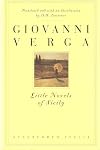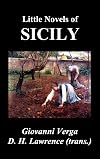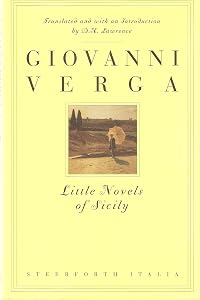
Little Novels of Sicily
by Giovanni Verga
On This Page
Description
First Published in a single volume in 1883, the stories collected in Little Novels of Sicily are drawn from the Sicily of Giovanni Verga's childhood, reported at the time to be the poorest place in Europe. Verga's style is swift, sure, and implacable; he plunges into his stories almost in midbreath, and tells them with a stark economy of words. There's something dark and tightly coiled at the heart of each story, an ironic, bitter resolution that is belied by the deceptive simplicity of show more Verga's prose, and Verga strikes just when the reader's not expecting it. Translator D. H. Lawrence surely found echoes of his own upbringing in Verga's sketches of Sicilian life: the class struggle between property owners and tenants, the relationship between men and the land, and the unsentimental, sometimes startlingly lyric evocation of the landscape. Just as Lawrence veers between loving and despising the industrial North and its people, so too Verga shifts between affection for and ironic detachment from the superstitious, uneducated, downtrodden working poor of Sicily. If Verga reserves pity for anyone or anything, it is the children and the animals, but he doesn't spare them. In his experience, it is the innocents who suffer first and last and always. show lessTags
Recommendations










Member Reviews
Short stories really, translated by D.H. Lawrence. There is a vast glossary to this edition, whose entries often appear superfluous; the meaning is clear enough in the original and further nuances of meaning to the text are minor matters.
The stories are of the cruel lives of farm labourers struggling under the threat of eviction, fraud, violence and despotic power. The setting is eastern Sicily near Catania. The stories reminded me of Maxim Gorky's stories about his youth in Russia. Poverty stricken people have little recourse but to be cruel amongst themselves in societies as broken down as those in Nineteenth century Sicily. Remoteness from effective law and government, corrupt and venal clergy, and fatalistic beliefs create a social show more order that is forever at risk from famine, wild nature and bankruptcy. show less
The stories are of the cruel lives of farm labourers struggling under the threat of eviction, fraud, violence and despotic power. The setting is eastern Sicily near Catania. The stories reminded me of Maxim Gorky's stories about his youth in Russia. Poverty stricken people have little recourse but to be cruel amongst themselves in societies as broken down as those in Nineteenth century Sicily. Remoteness from effective law and government, corrupt and venal clergy, and fatalistic beliefs create a social show more order that is forever at risk from famine, wild nature and bankruptcy. show less
Prima edizione cfr Parenti "Prime edizioni italiane", Milano, 1948
Sep 11, 2024Italian
Ratings
Members
- Recently Added By
Lists

Philip Ward's Lifetime Reading Plan
592 works; 22 members

Short Story Collections and Anthologies
261 works; 42 members

Italian Literature
558 works; 42 members

Books Set in Italy
167 works; 19 members

CCE 1000 Good Books List
1,033 works; 12 members

Harold Bloom - The Western Canon: C. The Democratic Age
336 works; 15 members

Trinity College Booklist (1951): Class Nine, Foreign Literatures
161 works; 3 members
Author Information

163+ Works 3,753 Members
A Sicilian, like Leonardo Sciascia and Luigi Pirandello, Verga was educated as a writer in Florence and Milan but drew on Sicily for the subject of his chief novels, plays, and short stories. In 1895 he returned permanently to Catania, his Sicilian birthplace, but by then he had already written his best novels of fictional realism (verismo): show more Malavoglia (The House by the Medlar Tree)Malavoglia (1881) and Mastro-don Gesualdo (Master don Gesualdo) (1889), the first dealing with a family of poor Sicilian fishermen, the second with the social climbing of a stonemason who has made a fortune. These classic works of realism established Verga as the father of the nineteenth-century Italian novel. In fact, D. H. Lawrence translated several of his novellas, calling him, "the greatest writer of Italian fiction since Manzoni."Of greater international fame has been Verga's novella Cavalleria Rusticana (Rustic Chivalry) (1880), which provided the libretto for Mascagni's famous opera. (Bowker Author Biography) show less
Some Editions
Awards and Honors
Series
Belongs to Publisher Series
Work Relationships
Is contained in
Common Knowledge
- Canonical title*
- Le novelle; Novelle Rusticane
- Original title
- Novelle rusticane; Novelle Rusticane
- Original publication date
- 1883 (original Italian) (original Italian); 1925 (Martin Secker) (Martin Secker)
- Disambiguation notice
- Little Novels of Sicily and Short Sicilian novels are both translations of Novelle rusticane. Do not combine with other selections of Verga's stories.
*Some information comes from Common Knowledge in other languages. Click "Edit" for more information.
Classifications
- Genres
- Fiction and Literature, General Fiction
- DDC/MDS
- 853.8 — Literature & rhetoric Italian, Romanian & related literatures Italian fiction Later 19th century 1859–1900
- LCC
- PQ4734 .V5 .N613 — Language and Literature French, Italian, Spanish and Portuguese literatures Italian literature Individual authors, 1701-1900
- BISAC
Statistics
- Members
- 197
- Popularity
- 166,265
- Reviews
- 2
- Rating
- (3.96)
- Languages
- English, Italian
- Media
- Paper, Ebook
- ISBNs
- 21
- ASINs
- 9