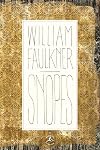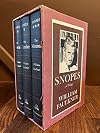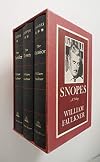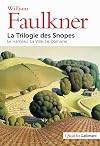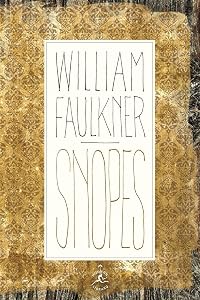
Snopes: The Hamlet, The Town, The Mansion (Modern Library)
by William Faulkner
The Snopes Trilogy (Collections and Selections — 1-3)
On This Page
Description
These three full-length novels compose the Snopes trilogy. In "The Hamlet," the cunning Flem Snopes is introduced with other members of his conniving family. Flem's dream is to marry Eula Varner and remake the small world of Frenchman's Bend as his own personal kingdom. In "The Town," Flem sets his sights on the county seat of Yoknapatawpha County, Jefferson, in a ruthless bid for even more power. Finally, in "The Mansion," Mink Snopes brings down his cousin Flem with an uncharacteristic show more Snopes sense of honor. show lessTags
Recommendations







Member Reviews
48. The Mansion by William Faulkner
OPD: 1959
format: 386-pages within a Kindle ebook trilogy called Snopes
acquired: May read: Aug 23 – Sep 7 time reading: 17:04, 2.7 mpp
rating: 3½
genre/style: Classic Fiction theme: Faulkner
locations: Fictional Jefferson Mississippi and surrounds, including Memphis, during the 1st half of the 20th century.
about the author: 1897-1962. American Noble Laureate who was born in New Albany, MS, and lived most of his life in Oxford, MS.
Full trilogy:
[3412::The Hamlet] (1940) – 4½ stars, run-on writing with lots of points for quirkiness and romantic bestiality. An experience.
[3424::The Town] (1957) – 3 stars, slightly annoying telling of an ok story with some substance
[46859::The Mansion] (1959) – 3½ show more stars, decent, but also with a wonderful ending that I’m still thinking about.
This whole trilogy is only ok, with some entertaining quirky writing in the first book, and some substance in the story and atmosphere. But it also comes with one of the most satisfying conclusions to a book ever, especially after all that the reader works through before. I won’t put in any further spoiler in than that, but it’s important when explaining my response to the book. It really ends well. My short take is that [3412::The Hamlet] was curious, [3424::The Town] was terrible (wandering narrative, soft story), and [46859::The Mansion] was OK. And I’m hoping this wasn't Faulkner’s best work. But longer take is more forgiving. The world and full substance of the series holds something more meaningful.
The Mansion seems has three parts, each titled on one character, Mink Snopes, Linda (nee Snopes) and Flem Snopes. Mink has prominent quirky bit in The Hamlet, and then got left behind in book 2. But his story unexpectedly picks up here, and he’s far more complicated and earthy than we realized. Ultimately he has a gravitas from his disoriented illogical but fierce mindset. Laura doesn’t get to tell her story. Like her mother in the previous two books, we always see her through the men, and the lust colors what isn’t supposed to be lustful story, more platonic and wanting and disenchanting in a way. Flem also doesn’t get any say in his section, although things come around back to him, with him in the center.
The true central character of the trilogy is Gavin Stephens, a bachelor and Harvard educated town lawyer, defined by his reserve and repressed lust of Linda’s mom, Eula, and later, his inappropriate love/lust of Linda, 20 years his junior. Never improper, he gets nowhere with anything, But he’s a central figure in the fictional town of Jefferson, Mississippi. And he and his nephew, with some commentary by a country-born uneducated know-everything sewing machine salesman, V.K. Ratcliff, tell most of the story. All these characters have some presence in whatever real-world Faulkner experienced in his Mississippi and wanted to share. His flawed truth, where African Americans are anonymous and where woman are physical forms defined by the way men react to them - either silently enduring screwed-up dads and husbands, or, if they’re physically attractive, silently enduring undue constant small-town attention. We’re in soiled humus of the low Mississippi hills, and also in a world of contemporary technology, high education, and distant world wars the men run off to fight, often through the air force. That is this little place is insulated, hard, inward looking and resistant, but also swamped by the larger seemingly more enlightened, but equally vicious wider world. In this way, it’s a book that is larger than its little story.
I’m glad I read this. I’m grateful for Faulkner’s ending. But I’m only recommending this to Faulkner completists.
2023
https://www.librarything.com/topic/351556#8226969 show less
OPD: 1959
format: 386-pages within a Kindle ebook trilogy called Snopes
acquired: May read: Aug 23 – Sep 7 time reading: 17:04, 2.7 mpp
rating: 3½
genre/style: Classic Fiction theme: Faulkner
locations: Fictional Jefferson Mississippi and surrounds, including Memphis, during the 1st half of the 20th century.
about the author: 1897-1962. American Noble Laureate who was born in New Albany, MS, and lived most of his life in Oxford, MS.
Full trilogy:
[3412::The Hamlet] (1940) – 4½ stars, run-on writing with lots of points for quirkiness and romantic bestiality. An experience.
[3424::The Town] (1957) – 3 stars, slightly annoying telling of an ok story with some substance
[46859::The Mansion] (1959) – 3½ show more stars, decent, but also with a wonderful ending that I’m still thinking about.
This whole trilogy is only ok, with some entertaining quirky writing in the first book, and some substance in the story and atmosphere. But it also comes with one of the most satisfying conclusions to a book ever, especially after all that the reader works through before. I won’t put in any further spoiler in than that, but it’s important when explaining my response to the book. It really ends well. My short take is that [3412::The Hamlet] was curious, [3424::The Town] was terrible (wandering narrative, soft story), and [46859::The Mansion] was OK. And I’m hoping this wasn't Faulkner’s best work. But longer take is more forgiving. The world and full substance of the series holds something more meaningful.
The Mansion seems has three parts, each titled on one character, Mink Snopes, Linda (nee Snopes) and Flem Snopes. Mink has prominent quirky bit in The Hamlet, and then got left behind in book 2. But his story unexpectedly picks up here, and he’s far more complicated and earthy than we realized. Ultimately he has a gravitas from his disoriented illogical but fierce mindset. Laura doesn’t get to tell her story. Like her mother in the previous two books, we always see her through the men, and the lust colors what isn’t supposed to be lustful story, more platonic and wanting and disenchanting in a way. Flem also doesn’t get any say in his section, although things come around back to him, with him in the center.
The true central character of the trilogy is Gavin Stephens, a bachelor and Harvard educated town lawyer, defined by his reserve and repressed lust of Linda’s mom, Eula, and later, his inappropriate love/lust of Linda, 20 years his junior. Never improper, he gets nowhere with anything, But he’s a central figure in the fictional town of Jefferson, Mississippi. And he and his nephew, with some commentary by a country-born uneducated know-everything sewing machine salesman, V.K. Ratcliff, tell most of the story. All these characters have some presence in whatever real-world Faulkner experienced in his Mississippi and wanted to share. His flawed truth, where African Americans are anonymous and where woman are physical forms defined by the way men react to them - either silently enduring screwed-up dads and husbands, or, if they’re physically attractive, silently enduring undue constant small-town attention. We’re in soiled humus of the low Mississippi hills, and also in a world of contemporary technology, high education, and distant world wars the men run off to fight, often through the air force. That is this little place is insulated, hard, inward looking and resistant, but also swamped by the larger seemingly more enlightened, but equally vicious wider world. In this way, it’s a book that is larger than its little story.
I’m glad I read this. I’m grateful for Faulkner’s ending. But I’m only recommending this to Faulkner completists.
2023
https://www.librarything.com/topic/351556#8226969 show less
This is an immersion experience: 1050 pages in the Modern Library edition.
Though I don't know why it's called Snopes. Sure folks by that name figure mightily in the novel, but really it's a sort of social and historical study of the fictional town of Jefferson running from WWI to after WWII. Although there is one good Snopes, the family as a whole represents the destruction of that old way of life by single minded commercial interests. Money, money, and the pursuit thereof.
I read it as part of my exploration of my relation to the rural south in the 1940's and 50's. I was a kid back then, but have enough of a memory of the place to feel it was a different time, really, and a very different place. Not a good place, mind you, just very show more different from sitting here at the start of the 21st century.
It's a clunky book, full of plots and sub-plots interweaving over time, and told, as Faulkner insists on doing, from multiple points of view. Full also of those nuts and lunatics that people Faulkner's fiction. I think especially of the village idiot who falls romantically and carnally in love with a cow. Though Faulkner handles this delicately and suggestively, not at all in detail.
I surmise Faulkner was one horny fellow. His descriptions of Eula, the central female character, while featuring no salacious details of the modern variety, are quite erotic, taking one back to that teenage time when powerful hormones cast the whole world in sexual tones. She just walks, but in such a way, that her clothes seem to wish to fly off her ample being.
Good stuff. All around good stuff. And mostly and basically, Faulkner treats each and every no good character with complete respect. There's no looking down. And maybe because of this, each character seems a fate. show less
Though I don't know why it's called Snopes. Sure folks by that name figure mightily in the novel, but really it's a sort of social and historical study of the fictional town of Jefferson running from WWI to after WWII. Although there is one good Snopes, the family as a whole represents the destruction of that old way of life by single minded commercial interests. Money, money, and the pursuit thereof.
I read it as part of my exploration of my relation to the rural south in the 1940's and 50's. I was a kid back then, but have enough of a memory of the place to feel it was a different time, really, and a very different place. Not a good place, mind you, just very show more different from sitting here at the start of the 21st century.
It's a clunky book, full of plots and sub-plots interweaving over time, and told, as Faulkner insists on doing, from multiple points of view. Full also of those nuts and lunatics that people Faulkner's fiction. I think especially of the village idiot who falls romantically and carnally in love with a cow. Though Faulkner handles this delicately and suggestively, not at all in detail.
I surmise Faulkner was one horny fellow. His descriptions of Eula, the central female character, while featuring no salacious details of the modern variety, are quite erotic, taking one back to that teenage time when powerful hormones cast the whole world in sexual tones. She just walks, but in such a way, that her clothes seem to wish to fly off her ample being.
Good stuff. All around good stuff. And mostly and basically, Faulkner treats each and every no good character with complete respect. There's no looking down. And maybe because of this, each character seems a fate. show less
generally, the praise i see for this trilogy plots a declining slope with The Hamlet unanimously receiving much accolade and varying degrees less being lauded upon the others with The Mansion at the bottom of this descent of fluctuant proportions, from "close, but not quite as good as the others" to "superfluous"...i think The Mansion is simply great so i just wanna give it a little of the credit i feel it's due...i'd say it's even better than The Town (though i shan't deviate from the norm with my regard for The Hamlet)...and as a trilogy i don't think these works are really separable...and any differences in quality across the series is only slight...The Hamlet sets a strong beginning and The Mansion is a strong end...i'll just keep show more my review vague and forgo the details...so, that's all... show less
The Hamlet is the best, but The Town is also great. The Mansion is very good, but it's not as terrific as the first two. I recommend reading all three of these at once to get the full scope of the Snopes family, which isn't even Faulkner's most well-drawn family. (I like the McCaslin family) But don't just read one of these and certainly read them in order. Some great writing here.
Ratings
Members
- Recently Added By
Lists

20th Century Literature
1,161 works; 55 members

Favourite Books
1,817 works; 316 members

The American Experience
173 works; 18 members

Five star books
1,755 works; 107 members

I Could Live There
185 works; 12 members

1001 Books You Must Read Before You Die
1,448 works; 1,130 members
Author Information

462+ Works 99,053 Members
Born in an old Mississippi family, William Faulkner made his home in Oxford, seat of the University of Mississippi. After the fifth grade he went to school only off and on-lived, read, and wrote much as he pleased. In 1918, refusing to enlist with the "Yankees," he joined the Canadian Air Force, and was transferred to the British Royal Air Force. show more After the war he studied a little at the University, did house painting, worked as a night superintendent at a power plant, went to New Orleans and became a friend of Sherwood Anderson, then to Europe and back home to Oxford. By this time he had written two novels. The Sound and the Fury followed in 1929. Financial success came with Sanctuary in 1931, which he assisted in filming. Faulkner 's novels are intense in their character portrayals of disintegrating Southern aristocrats, poor whites, and African Americans. A complex stream-of-consciousness rhetoric often involves Faulkner in lengthy sentences of anguished power. Most of his tales are set in the mythical Yoknapatawpha County, Mississippi, and are characterized by the use of many recurring characters from families of different social levels spanning more than a century. His best subjects are the old, dying South and the newer materialistic South. As I Lay Dying (1930), is a grotesquely tragicomic story about a family of poor southern whites. With Absalom, Absalom! (1936); the difficult parts of his famous short novel "The Bear" (published in Go Down, Moses, 1942); and the allegorical A Fable (1954), a non-Yoknapatawpha novel set in France during World War I; Faulkner returned to an innovative and difficult style that most readers have trouble with. Yet, interspersed among such works are collections of easily read stories originally published in popular magazines. There seems to be a growing sentiment among critics that the Snopes trilogy-The Hamlet (1940), The Town (1957), and The Mansion (1959)-for the most part an example of Faulkner's "moderate" style, could well be among his most important works. Faulkner was awarded the 1949 Nobel Prize for literature "for his powerful and artistically independent contribution to the new American novel," but it would appear now that he also deserved to win that honor for his contribution to world literature. When reporting his death, the Boston Globe quoted Faulkner's having once told an interviewer: "Since man is mortal, the only immortality for him is to leave something behind him that is immortal since it will always move. That is the artist's way of scribbling "Kilroy was here" on the wall of the final and irrevocable oblivion through which he must some day pass." In addition to the Nobel Prize, Faulkner received the Howells Medal of the American Academy of Arts and Letters in 1950, and in 1951 he was given the National Book Award for his Collected Stories Collected Stories. For his novel A Fable he received the National Book Award for the second time, as well as the Pulitzer Prize in 1955. The Reivers (1962) was awarded the Pulitzer Prize in 1963. In 1957 and 1958, he was the University of Virginia's first writer-in-residence, and in January 1959 he accepted an appointment as consultant on contemporary literature to the Alderman Library of that university. Although Faulkner was not without honors in his lifetime and has received world recognition since then, it is surprising to learn that, when Malcolm Cowley edited The Portable Faulkner in 1946, he found that almost all of Faulkner's books were out of print. By arranging selections from the works to form a continuous chronicle, Cowley deserves much of the credit for making readers aware of the way in which Faulkner was creating a fictive world on a scale grander than that of any novelist since Balzac. William Faulkner died in Oxford, Mississippi, in 1962. (Bowker Author Biography) show less
Some Editions
Awards and Honors
Series

Belongs to Publisher Series
Work Relationships
Contains
Has as a commentary on the text
Common Knowledge
- Canonical title*
- Snopes: A Trilogy (The Hamlet, The Town, The Mansion) (The Hamlet, The Town, The Mansion)
- Original title
- Snopes: The Hamlet, The Town, The Mansion
- Alternate titles
- Snopes
- Original publication date
- 1959
- People/Characters
- Mink Snopes; Linda Snopes; Eula Varner Snopes; V. K. Ratliff; Gavin Stevens; Flem Snopes (show all 9); Charles 'Chick' Mallison; Melisandre Backus Harriss Stevens; Clarence Egglestone Snopes
- Important places
- Yoknapatawpha County, Mississippi, USA; Mississippi, USA
- First words
- The jury said "Guilty" and the Judge said "Life", but he didn't hear them.
- Quotations
- "So the one true bitch we had was not a bitch at all but a saint and martyr, the one technically true pristine immaculate unchallengeable son of a bitch we ever produced wasn't even a Snopes."
- Last words
- (Click to show. Warning: May contain spoilers.)"...the beautiful, the splendid, the proud and the brave, right on up to the very top itself among the shining phantoms and dreams which are the milestones of the long human recording---Helen and the bishops, the kings and the unhomed angels, the scornful and the graceless seraphim."
- Original language
- English
*Some information comes from Common Knowledge in other languages. Click "Edit" for more information.
Classifications
Statistics
- Members
- 445
- Popularity
- 68,610
- Reviews
- 4
- Rating
- (4.45)
- Languages
- 5 — Dutch, English, French, Russian, Spanish
- Media
- Paper, Audiobook, Ebook
- ISBNs
- 10
- ASINs
- 14