On This Page
Description
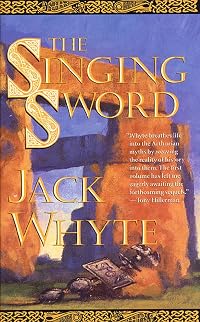
We know the legends: Arthur, who brought justice to a land that had known only cruelty and force; his father, Uther, who had carved a kingdom out of the chaos of the fallen Roman Empire; the sword Excalibur, drawn from stone by England's greatest king. But legends do not tell the whole tale. Legends do not tell of the despairing Roman soldiers, abandoned by their empire, faced with the choice of fleeing back to Rome or struggling to create a last stronghold against barbarian onslaughts from show more the north and the east. Legends do not tell of Arthur's great-grandfather, Publius Varrus, the warrior who marked the boundaries of a reborn empire with his own shed blood; they do not tell of Publius' wife, Luceiia, British-born and Roman-raised, whose fierce beauty burned pale next to her passion for law and honor. The Singing Sword continues the gripping epic begun in The Skystone. As the great night of the Dark Ages falls over Roman Britain, a lone man and woman fight to build a last stronghold of law and learning - a crude hill-fort which one day, long after their deaths, will become a great city; a crude hill-fort which one day will be known as Camelot. show lessTags
Recommendations





Member Reviews
So the Chronicles of the Roman Preppers continues to be unintentionally hilarious as old war buddies band together to prepare for the coming of the Roman Apocalypse. Still fairly entertaining although not much happens. I would have given it 3 stars if I had not become weary of the women's roles in this story and totally offended by the way he describes gay men. I haven't decided whether to continue my rereading of this series (as prelude to finally finishing the last volumes) or spend my time on something less hopelessly trapped in its own limited perspectives.
With the second volume of the Camulud chronicles, Mr. Whyte has departed from the world of "Historical Fiction" to the murky area between "Arthuriana" and Fantasy. The first volume, "the Skystone" worked well in presenting a pre-scientific world, quite reasonably. But now, we have the invention of the hilted sword usually thought to have occurred in Scandinavia in the 900's CE. And, the stirrup, now considered to to have ben brought to Eastern Europe at about 650 in Byzantium, and sliding into the further west in the Carolingian period. of the 800's. So, we are into romance as opposed to the tighter world of say Sharon Penman, or Bernard Cornwell. So, how does it stack up as fantasy, dealing with the matters of "Things too real to be show more true." So so, so far. The characterization is a bit stiff, and now we are coming to see how well the tropes of the Arthurian world are negotiated by Mr. Whyte. Overall the series remains readable, but not compelling. Looking at the title, which could be an homage to the "Prince Valiant" Comic strip of Hal Foster, I am now searching for further little amusing touches. The novel was first published by Viking Penguin in 1993, in Canada. show less
I thought this was a fair bit better than the first book. It lost some steam at the end - and having now started book 3 I wonder if that could have been offset by starting the otherwise abrupt transition to a new perspective there more in this book - but I still thought structurally this book was solid, did a good job of developing and exploring some interesting topics, and kept the plot moving along well. Some of the same disappointments hold as before, I still wish I learned more about the history from these books, it almost feels like Whyte just needed a team of historians to read these books and suggest places to add more dashes of reality and context. But that’s a huge ask, they’re still good reads, even if I’m slightly show more apprehensive about the next book. show less
When we last encountered Publius Varrus and his friend Caius Britannicus, the two men had founded a colony in south-west Britain, hoping to preserve Roman values and public order even after the Empire inevitably withdraws from the island. This second book in the series shows us the teething struggles of the infant colony, as Saxon raids multiply along the coast and, far across the sea, the Roman empire begins to tear itself apart. While I was glad to be reunited with our two doughty protagonists, of whom I grew rather fond in the first book, I felt that this sequel failed to live up to its eventful predecessor. Pacing becomes a serious issue here, and some factors which only niggled faintly in the first volume became problematic in The show more Singing Sword. And yet there’s still the pleasure of watching various Arthurian motifs (or characters) coming into being. In short, a curate’s egg – and hopefully only a temporary misstep...
For the full review, please see my blog:
https://theidlewoman.net/2019/11/07/the-singing-sword-jack-whyte/ show less
For the full review, please see my blog:
https://theidlewoman.net/2019/11/07/the-singing-sword-jack-whyte/ show less
This is the second book in Whyte's Camulod Chronicles, a saga of the Arthurian Legend. These are historical novels, as opposed to the fantasy books that generally populate the Arthurian genre.
This book follows Publius Varrus, as did the last one. He's a blacksmith, but also the leader of the army at the Colony. They run into a spot of trouble at the Colony, thanks to an old foe, but once that is cleared up, they make some very powerful friends. The threat of Saxon raiders comes closer to home in this book as does the need for true laws at the Colony. All of this is setting things up for that which is to come. You know it's a long series when Merlyn isn't born until the end of the second book.
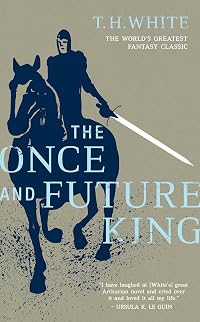
Arthurian legend is one of my favorite show more genres of all time. This deep-seated love is borne of an awesome Brit Lit class my junior year in high school. Mrs. Nixon introduced me to The Once and Future King by T.H. White and I was hooked. My home library has not been the same since. I started this particular series believing that it was a trilogy. Learning my mistake after I had already finished the first novel, I was fully set to continue with the series anyway. The first had me drawn in that much, even though there wasn't a single character in it who I knew from all my other readings in the genre. The same is true mostly of The Singing Sword until Merlyn and Uther Pendragon (cousins) are born at the end of the book.
My point is that the story and the history and the anticipation of my beloved story are all well enough to keep me interested. I knew that the metal from the skystone would become Excalibur, how could it not? The joy is in getting there, in learning about the end of Roman Britain and the rise of all the warrior-kings. I'm thoroughly engrossed in Whyte's telling of how these historical facts intermingle with the Arthurian legend.
I just started book three. I can't wait to see where this leads me. show less
This book follows Publius Varrus, as did the last one. He's a blacksmith, but also the leader of the army at the Colony. They run into a spot of trouble at the Colony, thanks to an old foe, but once that is cleared up, they make some very powerful friends. The threat of Saxon raiders comes closer to home in this book as does the need for true laws at the Colony. All of this is setting things up for that which is to come. You know it's a long series when Merlyn isn't born until the end of the second book.
Arthurian legend is one of my favorite show more genres of all time. This deep-seated love is borne of an awesome Brit Lit class my junior year in high school. Mrs. Nixon introduced me to The Once and Future King by T.H. White and I was hooked. My home library has not been the same since. I started this particular series believing that it was a trilogy. Learning my mistake after I had already finished the first novel, I was fully set to continue with the series anyway. The first had me drawn in that much, even though there wasn't a single character in it who I knew from all my other readings in the genre. The same is true mostly of The Singing Sword until Merlyn and Uther Pendragon (cousins) are born at the end of the book.
My point is that the story and the history and the anticipation of my beloved story are all well enough to keep me interested. I knew that the metal from the skystone would become Excalibur, how could it not? The joy is in getting there, in learning about the end of Roman Britain and the rise of all the warrior-kings. I'm thoroughly engrossed in Whyte's telling of how these historical facts intermingle with the Arthurian legend.
I just started book three. I can't wait to see where this leads me. show less
A long-awaited reread of this Arthurian retelling! Set in the 4th and 5th centuries as Rome withdraws from Britain, it follows Caius Brittanicus and Publius Varrus as they establish a colony in southwest Britain, laying the foundation for what will become the Arthurian legends. This realistic, non-magical take introduces key elements like the forging of Excalibur and the early echoes of Camelot’s chivalric ideals.
Hero and teller of the story, Varrus, lurches through the plot by binge drinking and fighting, often ending up unconscious as the result. I'm surprised he's not brain damaged, and can manage to put together a simple sentence. However, I enjoy the premise of the series (King Arthur's ancestors, men of the Roman army), and I expect I'll read further volumes.
Members
- Recently Added By
Lists

Best Arthurian Fiction
104 works; 33 members

Historical Fiction Books
99 works; 5 members

World War II Books
34 works; 1 member
Author Information

37 Works 11,743 Members
Writer Jack Whyte was born in Scotland in 1940. He was raised in Scotland, but educated in England and France before migrating to Canada in 1967. He spent one year teaching English in high school, before focusing on a career as a professional singer, musician, and actor. He wrote, directed and appeared in a one man show about Scotland's national show more poet Robert Burns in the early 1970's. Due to the show's success, he started writing for CBC national television and eventually went into advertising. He is the author of The Camulod Chronicles or A Dream of Eagles series which sets the tales of King Arthur in Roman Britain and Templar Trilogy which deals with the rise and fall of the Order of the Knights of the Temple of Solomon. (Bowker Author Biography) show less
Some Editions
Awards and Honors
Notable Lists
Series

Belongs to Publisher Series
Work Relationships
Common Knowledge
- Canonical title
- The Singing Sword
- Original title
- The Singing Sword
- Original publication date
- 1996-10
- People/Characters
- Publius Varrus; Caius Britannicus
- Important events
- Stilicho's expedition to Britain in 400.
- Dedication
- For Beverley...
my personal Jean Armour - First words
- The tribune recognized the first signs from more than a mile away, just as the road dropped down from the ridge to enter the trees: a whirlpool of hawks and carrion-eaters, spiralling above the treetops of the forest ahead of... (show all) him.
- Last words
- (Click to show. Warning: May contain spoilers.)Within six years, even the legions left behind had followed that first exodus, and after four hundred years of Pax Romana - Roman peace, protection and prosperity in Britain - the country lay soft and undefended, at the mercy of her enemies.
Classifications
- Genres
- Fiction and Literature, General Fiction, Fantasy, Historical Fiction
- DDC/MDS
- 813.54 — Literature & rhetoric American literature in English American fiction in English 1900-1999 1945-1999
- LCC
- PR9199.3 .W4589 .S56 — Language and Literature English English Literature English literature: Provincial, local, etc.
- BISAC
Statistics
- Members
- 1,309
- Popularity
- 18,432
- Reviews
- 17
- Rating
- (3.97)
- Languages
- English, Italian, Spanish
- Media
- Paper, Audiobook, Ebook
- ISBNs
- 19
- ASINs
- 14