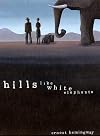
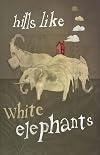
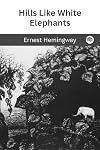
Hills Like White Elephants
by Ernest Hemingway 
On This Page
Description
A couple's future hangs in the balance as they wait for a train in a Spanish café in this short story by a Nobel and Pulitzer Prize-winning author. At a small café in rural Spain, a man and woman have a conversation while they wait for their train to Madrid. The subtle, casual nature of their talk masks a more complicated situation that could endanger the future of their relationship. First published in the 1927 collection Men Without Women, "Hills Like White Elephants" exemplifies Ernest show more Hemingway's style of spare, tight prose that continues to win readers over to this day. show lessTags
Recommendations



















Member Reviews
In “Hills Like White Elephants” Hemingway employs the imagery of the setting and the alterations in behavior during conversation to highlight the roller coaster of emotions couples face at a point of serious conflict. The beauty of the story lays in Hemingway’s style in showing the unclear pathways of the two lovers. From the beginning, the divided hills and two parting train tracks between Madrid and Barcelona give the feeling of conflict and foreshadow the divergence in the two individuals’ viewpoints. His mastery comes in showing all this personal, internal emotion through these external expressions – the imagery of the setting and also their tone and diction during conversation. The older man and the girl Jig have drinks show more at the station, and in their initially delightful, normal conversation does Hemingway bring about the conflict and the futility in the relationship. The man promises a return to the loving old days in return of the girl doing something with which she has great difficulty. Through Jig’s speech, Hemingway depicts how she becomes energized, sarcastic, defensive, angry and passive and how the man becomes angry and soothing in order to show their emotional and personal dilemmas to take form. However, the point of conflict is so great in the man asking the woman to sacrifice something very dear to her and an identity of herself that the futility in their relationship is evident. Her sarcasm and belief that part of the world will forever be away from her grasp further illuminate this. Hemingway shows how the relationship has been fundamentally altered due to this conflict and that no matter what the decision that the relationship will inevitably break. With the train arriving at the station and ending with the girl’s mind made up on a decision with “There’s nothing wrong with me”, Hemingway leaves the ending for the reader to decide. His use of imagery and exploration of behavior are thus what makes this story great. Though it is hard to grasp without knowing the point of conflict, Hemingway’s style proves effective. Learning that the conflict is over an abortion further shows his mastery of emotions. show less
"Hills Like White Elephants" is a short story written by Ernest Hemingway, and like all works by Hemingway, every little detail has its own underlying meaning. Hemingway does a great job of characterizing a young couple without directly telling the reader much about them. It is apparent that they are a young American couple, and Hemingway gives off little hints so that the reader may infer that. The man is referred to as the American, and the girl only speaks English, which can be taken as a sign that she is also American. The fact that Hemingway refers to her as the girl, rather than the woman suggests that she is young and still naive. The story reflects the struggle of a making a difficult decision between life and death and whether show more the girl should have an abortion or not. Hemingway uses imagery to contrast the two different decisions. He describes the hills as being white in the sun and the country was brown and dry. The hills symbolized the purity and fertility, while the countryside represented a barren alternative. The American wanted to go through with the abortion, and references were continually made supporting this. He kept playing the operation down and making it seem like it was no big deal. He even said "They just let the air in and then it's all perfectly natural". Other metaphors are also made such as the metaphor of the American telling her to come back into the shade which represented the abortion. The couples views of the situation contrast against one another, and although the American feels that the baby would be a burden, the girl feels otherwise. In the end, the man takes their bags to the other side of the station, which symbolizes the consent of the abortion, and the story ends. Hemingway did a great job in writing this, giving subtle hints for the reader to pick up on. These kinds of things are why Hemingway has been my favorite author for some time now. show less
In Ernest Hemingway’s Hills like White Elephants, there are many notions to symbolic meanings behind the actual text. One instance is the idea of hills looking like a white elephant to portray the meaning that the girl in the story is pregnant. The hills are large, white, and round representing a woman’s stomach during pregnancy. However, this story isn’t about love rather one more of abortion. They are stuck in between two cities in the middle of nowhere. In one direction is Madrid while the other is Barcelona. Two choices of where they are heading, one of keeping the baby or another option is aborting it. There are a lot of symbols representing these two choices, at one point the girl “looks at the bead curtain, put her hand show more out and took hold of the two strings of beads”. Another symbolic message is near the end of the story when the man picks up the “two heavy bags (…)”. These small references bring to light the drama and tension this couple is facing. The “heavy bags” show a darker side to this decision instead of the rather light argument that is occurring. The tension can be felt through the tone of the story and how each character speaks to one another. One part in the story the couple goes back and forth between two ideas and yet the man’s response is continually “No, we can’t”. For such a short story, there is an extremely dark and heavy side that is only told through symbols, tone, and Hemingway’s text. show less
Probably not a good idea to read Hemingway's stories in close time proximity. It's too much ornery, male passive-aggression, often juxtaposed by what may or may not be framed as an "inferior" that is actually the saint putting up with the main character's crap. Even if not a part of the story, I tend to imagine the main character as a middle-aged family man with a protruding gut, leaning back in an old lounge chair with a couple of beers, and whining and blaming the day away. Now that I've written that out, it sounds funny.
In “Hills like White Elephants,” Hemingway divulges little about the characters involved; however, the fact that he tells us so little is what makes this story interesting. He quickly sets up the story with the imagery of the white hills in Spain, which represent purity and fertility to give the reader a hint about the plot (through reading the whole story, we learn that they are discussing a possible abortion). We are then introduced to our characters – “the American” and “the girl,” who remain nameless throughout the whole story. Since Hemingway chooses to call one of the characters “the girl,” we can assume that she is fairly young. The girl’s uncertainty and naivety in the story also gives us a clue of her age. show more She seems like she does not know what she wants, and whatever the American wants to do is what she wants to do. However, it seems like the American is naïve as well because he believes the whole situation (abortion) is “perfectly simple” and once it is over they will be happy again. This short story is successful because Hemingway never hits the reader over the head with the plot. He engages the reader by letting them fill in the blanks for themselves. show less
“Hills like White Elephants” is a brilliant illustration of two characters in conflict. Throughout the story, the characters never directly address the problem or cause of the conflict at hand. It is up to the reader to put the pieces of Hemingway’s obscure puzzle together. This short story allows the reader to participate in the story because so much is left unsaid. This allows for a vast variety of interpretation and a richer reading experience. Hemingway’s minimalist style allows a focus on what is important or truly essential to the story. Due to this style, the story primarily focuses on conflict and the different directions or decisions that can be taken. For example, Hemingway begins his story with a description of the show more setting; his story takes place at a train station between Barcelona and Madrid. These are two cities completely different from one another and positioned in two opposite directions. Hemingway’s decision to include this in his story highlights the state in which his two characters are in; they are stuck in the midst of a major decision and must choose a path to take. The setting symbolizes the life decision the characters must make. Hemingway is able to subtly bring the reader into his work, and his piece “Hills like White Elephants” is certainly an exceptional example of this. show less
In "Hills Like White Elephants" Hemingway uses language, setting, and dialogue to emphasize the dichotomy between the girl and the American despite the fact that they share a pregnancy. Hemingway's writing is very minimalist in this story, which puts very important emphasis on what he does choose to write. The setting is between two cities, on one side of a station, situated in between two sets of railroad tracks. This setting highlights that, although they have a common bond, these two are very separtate, on different sides if you will. The girl, Jig, whimsically points out that the hills in the distance remind her of white elephants. It is unclear whether Jig has ever seen a white elephant before but one gets the sense that it show more wouldn’t really matter to her. It matters to the American though, he is not able to even imagine what one would look like. He makes no attempt to entertain her frivolous ideas; he is very literal. However, the difference between them highlight both of their humanness. Both of them are reacting differently to the unexpected pregnancy but both of them share essential, human fear. In the dialogue both characters allude to happier times; unfortunately, it seems as though they are letting their fears tear them apart. show less
Members
- Recently Added By
Published Reviews
"Hills Like White Elephants" is a short story written by Ernest Hemingway, and like all works by Hemingway, every little detail has its own underlying meaning. Hemingway does a great job of characterizing a young couple without directly telling the reader much about them. It is apparent that they are a young American couple, and Hemingway gives off little hints so that the reader may infer show more that. The man is referred to as the American, and the girl only speaks English, which can be taken as a sign that she is also American. The fact that Hemingway refers to her as the girl, rather than the woman suggests that she is young and still naive. The story reflects the struggle of a making a difficult decision between life and death and whether the girl should have an abortion or not. Hemingway uses imagery to contrast the two different decisions. He describes the hills as being white in the sun and the country was brown and dry. The hills symbolized the purity and fertility, while the countryside represented a barren alternative. The American wanted to go through with the abortion, and references were continually made supporting this. He kept playing the operation down and making it seem like it was no big deal. He even said "They just let the air in and then it's all perfectly natural". Other metaphors are also made such as the metaphor of the American telling her to come back into the shade which represented the abortion. The couples views of the situation contrast against one another, and although the American feels that the baby would be a burden, the girl feels otherwise. In the end, the man takes their bags to the other side of the station, which symbolizes the consent of the abortion, and the story ends. Hemingway did a great job in writing this, giving subtle hints for the reader to pick up on. This is partly why Hemingway has been my favorite author for some time now. show less
added by smyth104
Ernest Hemingway portrays women within his short stories as inferior to men, and utilizes degrading terms within his literature to characterize the womanly figure. However in juxtaposition to the various claims against Ernest Hemingway as being an antifeminist, Hemingway’s short story, Hills Like White Elephants, embodies the usage of derogatory characterization towards women as a means of show more character development, to illustrate the growing strength within women.
The two characters within Hills Like White Elephants face an arduous decision as they contemplate their options in regard to child bearing, at a junction between Barcelona and Madrid. Whether the two characters Hemingway depicts chose to board the train to Madrid or not signifies a decision has been made. Within the introductory paragraph Hemingway instantly creates inferiority between the characters within the short story by the Hemingway utilizes demeaning terms within the narration of Hills Like White Elephants to highlight the inferiority between man and woman. “The American” or “The man” serve as respectable terms, that allocate respect and power to the stature of the beholder. However the term “The Girl” depicts a lack of respect and power towards the woman. Throughout the short story, The Man consistently urges the girl to think about following through with an abortion as a means of supposedly regaining a happy relationship, the girl states, “Then I’ll do it. Because I don’t care about me” (64), an illustration of her unrelenting ease to which she adheres to the whims of the male figure. However towards the very end of the short story, when the woman finally decides to stay at the train station, and leave the man, Hemingway refers to the “the girl” as “she”, a term Hemingway never used to describe the girl when she listened to the pleas of the man instead of her own needs. Hemingway also empowers the woman figure, at the resolution of the short story, when he depicts the woman as one of her own decisions and willing to provide for herself in a foreign country as opposed to the traditional system of women being dependent on men.
Hemingway creates a structure within Hills Like White Elephants through diction and setting to illustrate growth within women, as a proponent of feminism. show less
The two characters within Hills Like White Elephants face an arduous decision as they contemplate their options in regard to child bearing, at a junction between Barcelona and Madrid. Whether the two characters Hemingway depicts chose to board the train to Madrid or not signifies a decision has been made. Within the introductory paragraph Hemingway instantly creates inferiority between the characters within the short story by the Hemingway utilizes demeaning terms within the narration of Hills Like White Elephants to highlight the inferiority between man and woman. “The American” or “The man” serve as respectable terms, that allocate respect and power to the stature of the beholder. However the term “The Girl” depicts a lack of respect and power towards the woman. Throughout the short story, The Man consistently urges the girl to think about following through with an abortion as a means of supposedly regaining a happy relationship, the girl states, “Then I’ll do it. Because I don’t care about me” (64), an illustration of her unrelenting ease to which she adheres to the whims of the male figure. However towards the very end of the short story, when the woman finally decides to stay at the train station, and leave the man, Hemingway refers to the “the girl” as “she”, a term Hemingway never used to describe the girl when she listened to the pleas of the man instead of her own needs. Hemingway also empowers the woman figure, at the resolution of the short story, when he depicts the woman as one of her own decisions and willing to provide for herself in a foreign country as opposed to the traditional system of women being dependent on men.
Hemingway creates a structure within Hills Like White Elephants through diction and setting to illustrate growth within women, as a proponent of feminism. show less
added by Laurenwuvsu01
Lists

Forbes: The 25 Greatest Short Stories of All Time
25 works; 4 members
Author Information

663+ Works 174,125 Members
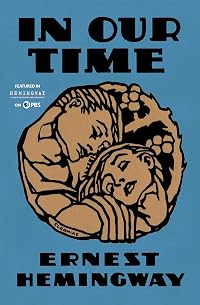
Ernest Miller Hemingway was born in the family home in Oak Park, Ill., on July 21, 1899. In high school, Hemingway enjoyed working on The Trapeze, his school newspaper, where he wrote his first articles. Upon graduation in the spring of 1917, Hemingway took a job as a cub reporter for the Kansas City Star. After a short stint in the U.S. Army as a show more volunteer Red Cross ambulance driver in Italy, Hemingway moved to Paris, and it was here that Hemingway began his well-documented career as a novelist. Hemingway's first collection of short stories and vignettes, entitled In Our Time, was published in 1925. His first major novel, The Sun Also Rises, the story of American and English expatriates in Paris and on excursion to Pamplona, immediately established him as one of the great prose stylists and preeminent writers of his time. In this book, Hemingway quotes Gertrude Stein, "You are all a lost generation," thereby labeling himself and other expatriate writers, including F. Scott Fitzgerald, T.S. Eliot, and Ford Madox Ford. Other novels written by Hemingway include: A Farewell To Arms, the story, based in part on Hemingway's life, of an American ambulance driver on the Italian front and his passion for a beautiful English nurse; For Whom the Bell Tolls, the story of an American who fought, loved, and died with the guerrillas in the mountains of Spain; and To Have and Have Not, about an honest man forced into running contraband between Cuba and Key West. Non-fiction includes Green Hills of Africa, Hemingway's lyrical journal of a month on safari in East Africa; and A Moveable Feast, his recollections of Paris in the Roaring 20s. In 1954, Hemingway won the Nobel Prize in Literature for his novella, The Old Man and the Sea. A year after being hospitalized for uncontrolled high blood pressure, liver disease, diabetes, and depression, Hemingway committed suicide on July 2, 1961, in Ketchum, Idaho. (Bowker Author Biography) show less
Ernest Hemingway has a Legacy Library. Legacy libraries are the personal libraries of famous readers, entered by LibraryThing members from the Legacy Libraries group.
Work Relationships
Is contained in
Ernest Hemingway Book-of-the-Month-Club Set of 6: A Farewell to Arms, A Moveable Feast, For Whom the Bell Tolls, The Sun Also Rises, The Old Man and the Sea, The Complete Short Stories by Ernest Hemingway (indirect)
The Complete Short Stories of Ernest Hemingway: The Finca Vigía Edition by Ernest Hemingway (indirect)
The Sun Also Rises / A Farewell to Arms / For Whom the Bell Tolls / The Old Man and the Sea / The Complete Short Stories by Ernest Hemingway (indirect)
The Short Stories of Ernest Hemingway: The First Forty-Nine Stories and the Play The Fifth Column by Ernest Hemingway (indirect)
6 Volume Set: Death in the Afternoon / A Farewell to Arms / The Fifth Column and the First 49 Stories / For Whom the Bell Tolls / The Sun Also Rises / To Have and to Have Not by Ernest Hemingway (indirect)
A Farewell to Arms & Other Writings 1927-1932 : Men Without Women / A Farewell to Arms / Death in the Afternoon / letters by Ernest Hemingway (indirect)
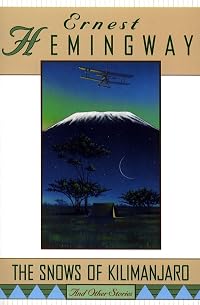
Short Stories By Ernest Hemingway, including: The Snows Of Kilimanjaro, Hills Like White Elephants, The Killers (short Story), The Short Happy Life Of ... Place, A Day's Wait, Big Two-hearted River by Hephaestus Books
Common Knowledge
- Original publication date
- 1928
Classifications
Statistics
- Members
- 189
- Popularity
- 173,370
- Reviews
- 31
- Rating
- (3.64)
- Languages
- English, Swedish
- Media
- Paper, Ebook
- ISBNs
- 3
- ASINs
- 9