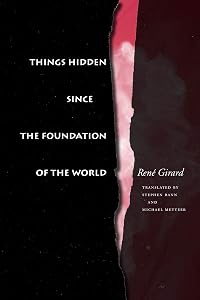
Things Hidden Since the Foundation of the World
by René Girard
On This Page
Description
An astonishing work of cultural criticism, this book is widely recognized as a brilliant and devastating challenge to conventional views of literature, anthropology, religion, and psychoanalysis. In its scope and interest, it can be compared with Freud's Totem and Taboo, the subtext Girard refutes with polemic daring, vast erudition, and a persuasiveness that leaves the listener compelled to respond, one way or another. This is the single fullest summation of Girard's ideas to date, the book show more by which they will stand or fall. In a dialogue with two psychiatrists (Jean-Michel Oughourlian and Guy Lefort), Girard probes an encyclopedic array of topics, ranging across the entire spectrum of anthropology, psychoanalysis, and cultural production. Girard's point of departure is what he calls mimesis, the conflict that arises when human rivals compete to differentiate themselves from each other yet succeed only in becoming more and more alike. At certain points in the life of a society, according to Girard, this mimetic conflict erupts into a crisis in which all difference dissolves in indiscriminate violence. In primitive societies, such crises were resolved by the scapegoating mechanism, in which the community, en masse, turned on an unpremeditated victim. The repression of this collective murder and its repetition in ritual sacrifice then formed the foundations of both religion and the restored social order The book is not merely, or perhaps not mainly, biblical exegesis, for within its scope fall some of the most vexing problems of social history. the paradox that violence has social efficacy, the function of the scapegoat, the mechanism of anti-semitism. show lessTags
Recommendations













Member Reviews
Summary
An astonishing work of cultural criticism, this book is widely recognized as a brilliant and devastating challenge to conventional views of literature, anthropology, religion, and psychoanalysis. In its scope and itnerest it can be compared with Freud’s Totem and Taboo, the subtext Girard refutes with polemic daring, vast erudition, and a persuasiveness that leaves the reader compelled to respond, one way or another. This is the single fullest summation of Girard’s ideas to date, the book by which they will stand or fall. In a dialogue with two psychiatrists (Jean-Michel Oughourlian and Guy Lefort), Girard probes an encyclopedic array of topics, ranging across the entire spectrum of anthropology, psychoanalysis, and cultural show more production. Girard’s point o departure is what he calles “mimesis,” the conflict that arises when human rivals compete to differentiate themselves from each other, yet succeed only in becoming more and more alike. At certain points in the life of a society, according to Girard, this mimetic conflict erupts into a crisis in which all difference dissolves in indiscriminate violence. In primitive societies, such crises were resolved by the “scapegoating mechanism,” in which the community, en masse, turned on an unpremeditated victim. The repression of this collective murder and its repetition in ritual sacrifice then formed the foundations of both religion and the restored social order. How does Christianity, at once the most “sacrificial” of religions and a faith with a non-violent ideology, fit into this scheme? Girard grants Freud’s point, in Totem and Taboo, that Christianity is similar to primitive religion, but only to refute Freud--if Christ is sacrificed, Girard argues, it is not becuase God willed it, but becaus ehuman beings wanted it. The book is not merely, or perhaps not mainly, biblical exegesis, for within its scope fall some of the most vexing problems of social history--the paradox that violance has social efficacy, the function of the scapegoat, the mechanism of anti-semitism. show less
An astonishing work of cultural criticism, this book is widely recognized as a brilliant and devastating challenge to conventional views of literature, anthropology, religion, and psychoanalysis. In its scope and itnerest it can be compared with Freud’s Totem and Taboo, the subtext Girard refutes with polemic daring, vast erudition, and a persuasiveness that leaves the reader compelled to respond, one way or another. This is the single fullest summation of Girard’s ideas to date, the book by which they will stand or fall. In a dialogue with two psychiatrists (Jean-Michel Oughourlian and Guy Lefort), Girard probes an encyclopedic array of topics, ranging across the entire spectrum of anthropology, psychoanalysis, and cultural show more production. Girard’s point o departure is what he calles “mimesis,” the conflict that arises when human rivals compete to differentiate themselves from each other, yet succeed only in becoming more and more alike. At certain points in the life of a society, according to Girard, this mimetic conflict erupts into a crisis in which all difference dissolves in indiscriminate violence. In primitive societies, such crises were resolved by the “scapegoating mechanism,” in which the community, en masse, turned on an unpremeditated victim. The repression of this collective murder and its repetition in ritual sacrifice then formed the foundations of both religion and the restored social order. How does Christianity, at once the most “sacrificial” of religions and a faith with a non-violent ideology, fit into this scheme? Girard grants Freud’s point, in Totem and Taboo, that Christianity is similar to primitive religion, but only to refute Freud--if Christ is sacrificed, Girard argues, it is not becuase God willed it, but becaus ehuman beings wanted it. The book is not merely, or perhaps not mainly, biblical exegesis, for within its scope fall some of the most vexing problems of social history--the paradox that violance has social efficacy, the function of the scapegoat, the mechanism of anti-semitism. show less
En este ensayo, Girard reflexiona sobre el papel de la violencia y la imitación en la cultura, abordando la revelación cristiana como un punto de inflexión en la comprensión del sacrificio. La obra prolonga las tesis de La violencia y lo sagrado, ofreciendo una lectura teológica y antropológica del mensaje evangélico.
Girard's basic thesis is well known; Human culture arose out of the resolution of mimetic desire. By nature we desire what is desired by others, this leads to conflict and ultimately murder. Institutions and rituals arise out of this act. Girard sees the Gospel texts of the New Testament as a revolutionary exposing of this basic mechanism. However, the church has continued to offer a sacrificial reading of the Gospel which undermines its revelatory potential.
This book is an excellent and accessible overview of his thought. What I found interesting was his conclusion. At the end of the book Girard suggests we suffer most basically from a lack of meaning. I find this to be a bit dissonant from much of his work. Perhaps he is was still too show more heavily influenced by the existential angst that seemed to exist in the middle of the twentieth century but I expected him to move in a much more 'material' direction in his conclusion. Here are some of his parting lines,
"What is important above all is to realize that there are no recipes; there is no pharmakon anymore, not even a Marxist or a psychoanalytic one. Recipes are not what we need, nor do we need to be reassured - our need is to escape from meaninglessness.
. . .
I hold that truth is not an empty word, or a mere 'effect' as people say nowadays. I hold that everything capable of diverting us from madness and death, from now on, is inextricably linked with this truth. But I do not know how to speak about these matters. I can only approach texts and institutions, and relating them to one another seems to me to throw light in every direction.
. . .
Present-day thought is leading us in the direction of the valley of death, and it is cataloguing the bones one by one. All of us are in this valley but it is up to us to resuscitate meaning by relating all the [Judeo-Christian] texts to one another without exception, rather than stopping at just a few of them. All the issues of 'psychological health' seem to me to take second place to a much greater issue - that of meaning which is being lost or threatened on all sides but simply awaits the breath of the Spirit to be reborn."
At which point Girard concludes by quoting Ezekiel 37's vision of the valley of dry bones. show less
This book is an excellent and accessible overview of his thought. What I found interesting was his conclusion. At the end of the book Girard suggests we suffer most basically from a lack of meaning. I find this to be a bit dissonant from much of his work. Perhaps he is was still too show more heavily influenced by the existential angst that seemed to exist in the middle of the twentieth century but I expected him to move in a much more 'material' direction in his conclusion. Here are some of his parting lines,
"What is important above all is to realize that there are no recipes; there is no pharmakon anymore, not even a Marxist or a psychoanalytic one. Recipes are not what we need, nor do we need to be reassured - our need is to escape from meaninglessness.
. . .
I hold that truth is not an empty word, or a mere 'effect' as people say nowadays. I hold that everything capable of diverting us from madness and death, from now on, is inextricably linked with this truth. But I do not know how to speak about these matters. I can only approach texts and institutions, and relating them to one another seems to me to throw light in every direction.
. . .
Present-day thought is leading us in the direction of the valley of death, and it is cataloguing the bones one by one. All of us are in this valley but it is up to us to resuscitate meaning by relating all the [Judeo-Christian] texts to one another without exception, rather than stopping at just a few of them. All the issues of 'psychological health' seem to me to take second place to a much greater issue - that of meaning which is being lost or threatened on all sides but simply awaits the breath of the Spirit to be reborn."
At which point Girard concludes by quoting Ezekiel 37's vision of the valley of dry bones. show less
Un eccesso di parole per una tesi interessante ma che si basa su fondamenta molto labili, l'autore esplora campi diversi, facendo una cernita molto stretta di singoli esempi che possano sostenere la sua idea, omettendo di aprlare di qualsiasi controesempio che possa mettere in dubbio la tesi. La costruzione del libro si basa su un dialogo a tre voci, ma non c'è contradditorio ne occasione di spunti, è un concerto di tre voci che convergono in una. Anche il ragionamento è molto piatto, alla fine si basa su un empirismo parziale e specialista, privo di profondità universale, per dimostrare una tesi che invece è ontologica, lo trovo un modo fallace di argomentare.
Sulla scrittura (e la relativa traduzione) nulla da dire, sono entrambe show more fatte bene.
Per quello che di interessante c'è da dire bastavano cinquanta pagine, il resto è ridondante e non significativo. show less
Sulla scrittura (e la relativa traduzione) nulla da dire, sono entrambe show more fatte bene.
Per quello che di interessante c'è da dire bastavano cinquanta pagine, il resto è ridondante e non significativo. show less
May 19, 2025Italian
Difficile à lire - compliqué - mais la pensée de Girard est intéressante
Feb 23, 2008French
Members
- Recently Added By
Lists

Mo's Reading List
218 works; 1 member

Mo's Reading List (Abridged)
75 works; 1 member

Story/Myth Reading List
25 works; 1 member

Maybe This Year? Books to Look Forward To
412 works; 9 members
Author Information

76+ Works 4,693 Members
René Girard was born on December 25, 1923 in Avignon, France. He received an advanced degree in medieval studies at the École Nationale des Chartes in 1947 and a Ph.D. in history from Indiana University in 1950. He taught French language and literature at Indiana University, Duke University, Bryn Mawr College, Johns Hopkins University, and the show more State University at Buffalo. He taught at Stanford University from 1981 until his retirement in 1995. His explorations of literature and myth helped establish influential theories about how people are motivated to want things. His first book, Deceit, Desire, and the Novel, was published in French in 1961 and in English in 1965. His other works included Violence and the Sacred and Things Hidden Since the Foundation of the World. He received a lifetime achievement award from the Modern Language Association in 2009 and the Order of Isabella the Catholic from the king of Spain for his work in philosophy and anthropology in 2013. He died on November 4, 2015 at the age of 91. (Bowker Author Biography) show less
Common Knowledge
- Canonical title*
- Des choses cachées depuis la fondation du monde
- Original title
- Des choses cachées depuis la fondation du monde
- Alternate titles*
- Das Ende der Gewalt. Analyse des Menschheitsverhängnisses. Erkundungen zu Mimesis und Gewalt mit Jean-Michel Oughourlian und Guy Lefort
- Original language*
- Français
- Canonical DDC/MDS
- 291.34
*Some information comes from Common Knowledge in other languages. Click "Edit" for more information.
Classifications
- Genres
- Nonfiction, Religion & Spirituality, Philosophy, Literature Studies and Criticism, General Nonfiction
- DDC/MDS
- 291.34 — Religion Other religions [Formerly: General Religious Topics] [formerly: Public worship and other practices. Relocated to 203] [formerly: Sacrifice. Relocated to 203.4]
- LCC
- BL570 .G56 — Philosophy, Psychology and Religion Religions. Mythology. Rationalism Religions. Mythology. Rationalism Worship. Cultus
- BISAC
Statistics
- Members
- 626
- Popularity
- 46,393
- Reviews
- 8
- Rating
- (3.97)
- Languages
- 9 — Dutch, English, French, German, Italian, Portuguese, Romanian, Spanish, Turkish
- Media
- Paper, Audiobook, Ebook
- ISBNs
- 18
- ASINs
- 7