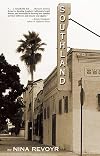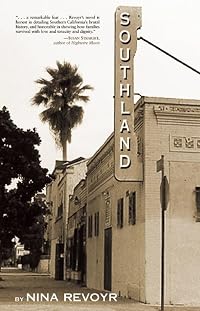
Southland
by Nina Revoyr
On This Page
Description
Southland brings us a fascinating story of race, love, murder and history, against the backdrop of an ever-changing Los Angeles. A young Japanese-American woman, Jackie Ishida, is in her last semester of law school when her grandfather, Frank Sakai, dies unexpectedly. While trying to fulfill a request from his will, Jackie discovers that four African-American boys were killed in the store Frank owned during the Watts Riots of 1965. Along with James Lanier, a cousin of one of the victims, show more Jackie tries to piece together the story of the boys' deaths. In the process, she unearths the long-held secrets of her family's history. Southland depicts a young woman in the process of learning that her own history has bestowed upon her a deep obligation to be engaged in the larger world. And in Frank Sakai and his African-American friends, it presents characters who find significant common ground in their struggles, but who also engage each other across grounds--historical and cultural--that are still very much in dispute. Moving in and out of the past--from the internment camps of World War II, to the barley fields of the Crenshaw District in the 1930s, to the streets of Watts in the 1960s, to the night spots and garment factories of the 1990s--Southland weaves a tale of Los Angeles in all of its faces and forms. show lessTags
Recommendations

























Member Reviews
i really liked this so much. it was so layered and about so many things, all of them interesting and worth talking about. i found it a little difficult to keep some of the characters and time periods straight in my head since we were going between the 40s (during wwii), the 60s (around and during the watts riots), and 1994 and were bouncing between two families, and so many perspectives. but i did really like the way she told this story, with so many different voices carrying it through.
so many interesting characters, and the realistic and everyday tragedy that is not knowing someone of an older generation until it's too late, and learning about them after their death. seeing how much you could have gotten from a relationship with them show more once it's too late. the racism and how it was both the same and different when it was experienced by the japanese and the blacks. the internment camps - i don't think i've read fiction that takes place there before, and i learned a lot. there is so much nuance and sadness and violence and beauty in this book. i loved the characters of curtis and jimmy and jackie and frank. the immigrant stories, the racism faced by the japanese and the black families, the hiding of self that happens when you don't want to discuss your sexuality. the way the characters throughout history all had something to relate to others because of their histories and their treatment. (the way frank and alma understood what their families had gone through, even though it was so different, because it was all oppression and prejudice.) plus the murders and the figuring out of who did it. the murders were the backdrop of the story but not nearly the most interesting thing. the relationships and the histories, this is what made this book shine.
the only problems i had with the book werefirst of all that jackie and jimmy kissed at all; that made no sense really for either of them. they were vulnerable and overcome with emotion in general, but they could have sobbed together instead, and that would have felt just as natural. but not such a big deal. it also annoyed me the way she kept talking in a denigrating way about her friend rebecca's asian features. i know that was more an issue with her own self-image and discomfort with her own asian heritage, but it didn't feel good to see her project that onto someone else. i do love the arc she takes, though, back toward her heritage and history, and how that manifests in an attraction to rebecca at the end. my biggest hiccup in the book, what kept taking me out of the story was a consistent issue, most often in the 1994 sections where jackie was the third person narrator. over and over again we'd get a glimpse into someone else's head, just for a paragraph or sentence, but it was something jackie shouldn't have known and so we shouldn't know it either. an example, from a curtis chapter: "...the Irish cop drove by, and they all appealed silently for him to stop." it should say something like "...the Irish cop drove by and Curtis knew he wasn't the only one silently appealing for him to stop." because in this chapter we are only in curtis' head. this happens over and over again and it was both annoying and also in some cases confusing, but always drew me out of the story. if not for these things it'd be 4.5 stars, or even 5.
even so, those aren't huge deals and this book overcomes them anyway. there is so much happening here that makes this book worthwhile.i also like the ambiguity of the ending. we don't know if justice, even belatedly, will be served or what will happen to any of those implicated in the murders. show less
so many interesting characters, and the realistic and everyday tragedy that is not knowing someone of an older generation until it's too late, and learning about them after their death. seeing how much you could have gotten from a relationship with them show more once it's too late. the racism and how it was both the same and different when it was experienced by the japanese and the blacks. the internment camps - i don't think i've read fiction that takes place there before, and i learned a lot. there is so much nuance and sadness and violence and beauty in this book. i loved the characters of curtis and jimmy and jackie and frank. the immigrant stories, the racism faced by the japanese and the black families, the hiding of self that happens when you don't want to discuss your sexuality. the way the characters throughout history all had something to relate to others because of their histories and their treatment. (the way frank and alma understood what their families had gone through, even though it was so different, because it was all oppression and prejudice.) plus the murders and the figuring out of who did it. the murders were the backdrop of the story but not nearly the most interesting thing. the relationships and the histories, this is what made this book shine.
the only problems i had with the book were
even so, those aren't huge deals and this book overcomes them anyway. there is so much happening here that makes this book worthwhile.
I started reading this the day after I visited the Watts Towers in south central LA. As a rather nervous visitor to the area (not without reason - there was a drive by killing of an 11 year old outside a church the same day) I was absolutely glued to this book.
I love the LA noir genre of detective fiction. This is very different, and offers far more insight into WHY LA is as it is. It takes us to other parts of LA - the more middleclass areas of West LA (where I was staying), for example.
This book is a riveting story, and it deftly juggles the historical context and so achieves so much 'explanation' and 'history' in a naturalistic way.
It also, most importantly of all, offers hope (which, by contrast, noir fiction rarely does)
I love the LA noir genre of detective fiction. This is very different, and offers far more insight into WHY LA is as it is. It takes us to other parts of LA - the more middleclass areas of West LA (where I was staying), for example.
This book is a riveting story, and it deftly juggles the historical context and so achieves so much 'explanation' and 'history' in a naturalistic way.
It also, most importantly of all, offers hope (which, by contrast, noir fiction rarely does)
It's pretty good historical fiction/mystery, about Japanese American and African American history in LA. It's told in three time periods; the 40's, covering WWII and internment camps; the Watts Riots, and then 1994.
The story did hold my interest, and an interesting setting, but at times I felt that Revoyr tried to do too much, and the story could have been told with fewer characters and details. The lesbian sup-plot seemed like an add-on that didn't add a lot.
I did like the historical detail. I was especially interested in the parts about the experience of Japanese American GI's.
The story did hold my interest, and an interesting setting, but at times I felt that Revoyr tried to do too much, and the story could have been told with fewer characters and details. The lesbian sup-plot seemed like an add-on that didn't add a lot.
I did like the historical detail. I was especially interested in the parts about the experience of Japanese American GI's.
The story is interesting, the themes are definitely timely, and I enjoyed reading another novel about Los Angeles, but the execution is a bit clumsy. The exposition is obvious and some of the characters not entirely believable, as though intentionally "too much" in order to make a point. The juxtaposition of violence and sex is also a little off-putting to me. Still, I liked this novel enough that I'd be interested in checking out Revoyr's later work.
3.5 stars. Family saga, mystery, crime drama, with a bit of romance thrown in.
After Frank Sakai's death, his daughter Lois finds an old will naming someone she doesn't know, and a box of memorabilia. She tasks her niece, Frank's granddaughter Jackie--with figuring out what it's about.
Jackie learns a lot about her grandfather--his life when interred, his WW2 experiences, his store, his community (Angeles Mesa), his family, his friends. She also finds out all about what happened during the Watts riots.
This book is interesting and worth the read, and I especially liked the real places referenced. I found the romance to be an odd distraction in the story--unless the idea was to contrast a current relationship with a historic relationship?
After Frank Sakai's death, his daughter Lois finds an old will naming someone she doesn't know, and a box of memorabilia. She tasks her niece, Frank's granddaughter Jackie--with figuring out what it's about.
Jackie learns a lot about her grandfather--his life when interred, his WW2 experiences, his store, his community (Angeles Mesa), his family, his friends. She also finds out all about what happened during the Watts riots.
This book is interesting and worth the read, and I especially liked the real places referenced. I found the romance to be an odd distraction in the story--unless the idea was to contrast a current relationship with a historic relationship?
I am so impressed with this author. She brings the hidden history of this country to life. The hidden history of gays and lesbians, of Japanese-Americans, African-Americans, And what is so amazing is that she tells a compelling story...while her novels are truly educational they succeed as fiction.This novel works on so many levels for me--intellectual, emotional, and spiritual. I found it very inspiring in all kinds of ways.
Well written book. The mystery plot is great and the background history throughout the book is an added plus.
Members
- Recently Added By
Lists

top 10 books read in 2017
5 works; 1 member

Best Mysteries With a Historical Setting
292 works; 160 members
Author Information

6+ Works 925 Members
Awards and Honors
Common Knowledge
- Original publication date
- 2003
- First words
- Now, the old neighborhood is feared and avoided, even by the people who live there. Although stores wait for customers right down on the Boulevard, people drive to the South Bay, or even over to the Westside, to see a movie o... (show all)r to do their weekly shopping. The local places sell third-rate furniture and last year's clothes, and despite the promises of city leaders in the months after the riots, no bigger businesses, or schools, are on their way. A few traces of that other tie remain - a time when people not only lived in the neighborhood, but never chose to leave it. And if some outside looked closely, some driver who'd taken a wrong turn and ended up on the run-down streets, if that driver looked past the weather-worn lettering and cracked or broken windows, he'd have a sense of what the neighborhood once was. -Prologue
Ten days after her grandfather died, Jackie Ishida pulled into the entrance of the Tara Estate, the apartment complex where he'd lived with her aunt and uncle. It was eleven a.m. on a Saturday, February 1994. Normally at this... (show all) time she'd be studying already - she was in her third year of law school at UCLA - but Lois had called her the night before, voice rough with cigarettes and tears, and asked her to come over this morning. -Chapter One, 1994 - Canonical DDC/MDS
- 813.54
- Canonical LCC
- PS3568.E7964
Classifications
- Genres
- Fiction and Literature, LGBTQ+, General Fiction, Mystery, Historical Fiction
- DDC/MDS
- 813.54 — Literature & rhetoric American literature in English American fiction in English 1900-1999 1945-1999
- LCC
- PS3568 .E7964 — Language and Literature American literature American literature Individual authors 1961-
- BISAC
Statistics
- Members
- 249
- Popularity
- 130,274
- Reviews
- 10
- Rating
- (3.90)
- Languages
- English, French, Japanese
- Media
- Paper, Audiobook, Ebook
- ISBNs
- 7
- ASINs
- 1