
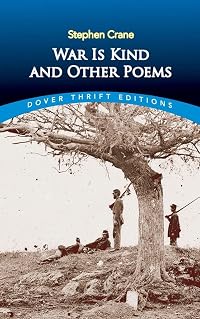
Poems of Stephen Crane
by Stephen Crane 
On This Page
Description
Poems of Stephen Crane.Tags
Recommendations






























Member Reviews
Stephen Crane wrote one of my all-time favorite poems, which I discovered because Stephen King quoted it in Four Past Midnight. The untitled poem goes:
It's a brutal and evocative poem, grim and incredibly appropriate for the beginning of a collection of Stephen King horror stories. This poem can be found in this collection.
Many of Crane's poems explore similar themes. They allegorically present lonely wanderers trudging forward to face strange encounters in an hostile world, and yet, there is show more a light too, for though god as presented in these poems is often uncaring or cruel, also "the voice of God whispers in the head / so softly / that the soul pauses."
It's interesting that in the forward the editor Gerald D. McDonald notes that in its original editions Crane's poetry was presented in all capital letters, whereas McDonald choose to remove this in this collection. In Crane's originals the word "GOD" would have been all caps like all the rest of the text, and therefore did not afford any special importance to the word. Whereas, McDonald's choice to upper and lowercase the text (into more proper grammatical format) means "God" is now capitalized as religion dictates it should be, which certainly changes the effect.
I wouldn't call it beautiful. Crane's poetry is terse, straightforward, and blunt rather than lyrical, and often delves into dark unpleasant realms, but it's poetry that lingers, squatting in peripheral of the mind. show less
In the desert
I saw a creature, naked, bestial,
Who, squatting upon the ground,
Held his heart in his hands,
And ate of it.
I said: "Is it good, friend?"
"It is bitter - bitter," he answered;
"But I like it
Because it is bitter,
And because it is my heart."
It's a brutal and evocative poem, grim and incredibly appropriate for the beginning of a collection of Stephen King horror stories. This poem can be found in this collection.
Many of Crane's poems explore similar themes. They allegorically present lonely wanderers trudging forward to face strange encounters in an hostile world, and yet, there is show more a light too, for though god as presented in these poems is often uncaring or cruel, also "the voice of God whispers in the head / so softly / that the soul pauses."
It's interesting that in the forward the editor Gerald D. McDonald notes that in its original editions Crane's poetry was presented in all capital letters, whereas McDonald choose to remove this in this collection. In Crane's originals the word "GOD" would have been all caps like all the rest of the text, and therefore did not afford any special importance to the word. Whereas, McDonald's choice to upper and lowercase the text (into more proper grammatical format) means "God" is now capitalized as religion dictates it should be, which certainly changes the effect.
I wouldn't call it beautiful. Crane's poetry is terse, straightforward, and blunt rather than lyrical, and often delves into dark unpleasant realms, but it's poetry that lingers, squatting in peripheral of the mind. show less
Ratings
Members
- Recently Added By
Author Information

319+ Works 27,188 Members
Stephen Crane authored novels, short stories, and poetry, but is best known for his realistic war fiction. Crane was a correspondent in the Greek-Turkish War and the Spanish American War, penning numerous articles, war reports and sketches. His most famous work, The Red Badge of Courage (1896), portrays the initial cowardice and later courage of a show more Union soldier in the Civil War. In addition to six novels, Crane wrote over a hundred short stories including "The Blue Hotel," "The Bride Comes to Yellow Sky," and "The Open Boat." His first book of poetry was The Black Riders (1895), ironic verse in free form. Crane wrote 136 poems. Crane was born November 1, 1871, in Newark, New Jersey. After briefly attending Lafayette College and Syracuse University, he became a freelance journalist in New York City. He published his first novel, Maggie: Girl of the Streets, at his own expense because publishers found it controversial: told with irony and sympathy, it is a story of the slum girl driven to prostitution and then suicide. Crane died June 5, 1900, at age 28 from tuberculosis. (Bowker Author Biography) show less
Stephen Crane has a Legacy Library. Legacy libraries are the personal libraries of famous readers, entered by LibraryThing members from the Legacy Libraries group.
Some Editions
Classifications
Statistics
- Members
- 23
- Popularity
- 1,147,500
- Reviews
- 2
- Rating
- (4.00)
- Languages
- English
- Media
- Paper
- ISBNs
- 4
- ASINs
- 1


