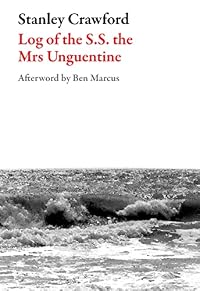
Log of the S.S. the Mrs Unguentine
by Stanley Crawford
On This Page
Description
Log of the S.S. The Mrs. Unguentine is a masterpiece of modern domestic life, a comic novel of closeness and difficulty, miscommunication and stubborn resolve. "Forty years ago I first linked up with Unguentine and we made love on twin-hulled catamarans, sails a-billow, bless the seas . . ." So begins the courtship of a certain Unguentine to the woman we know only as "Mrs. Unguentine," the chronicler of their sad, fantastical tale. For forty years, they sail the seas together, alone on a show more giant land-covered barge of their own devising. They tend their gardens, raise a child, invent an artificial forest--all the while steering clear of civilization. Rarely has a book so perfectly registered the secret solitude of marriage, how shared loneliness can result in a powerful bond. show lessTags
Recommendations






































Member Reviews
On one of the great literary voyages, Mrs Unguentine (the narrator and her vessel) gives her awed, but exasperated, account of a dead marriage, an endless voyage, and a phantom husband. And the story is replete with lush organic architecture, Rube Goldberg-esque ideas and botanical colour. If you have ever desired to drift away from the world, or create an Eden, or enact the Fall, and if you think living with someone is inherently funny, you'll probably love this book.
A curiously clever book told first in short logs from aboard the titular S.S. the Mrs. Unguentine, and then increasingly longer "logs" that become more stream-of-consciousness in nature, all from the point of view of Mrs. Unguentine regarding life with her husband on the high seas.
It is to Crawford's credit that his linguistic wordplay and astute psychological portrait of his narrator cause even pages upon pages of catalogues of mundane and often petty chores aboard an ever-adrift barge and in-depth accounts of the animals and plant life living in the gardens on said barge to never grow tiring for the reader. Instead, we understand that life on the sea is their world:
But there is also a bitter comedy in Crawford's precious prose, too, that revels in how marriage—and all relationships of such a duration and in such solitude—builds strong ties of intimacy just as it does enmity. Indeed, the extremes of love and hate, of empathy and psychical violence, are all at play here, with the background a tragicomic barge that is as much a commentary on sustainable living as it is on marriage, interpersonal relationships, and the work that is required (and the sacrifices necessary) to keep the barge afloat, drifting calmly, toward nowhere. show less
It is to Crawford's credit that his linguistic wordplay and astute psychological portrait of his narrator cause even pages upon pages of catalogues of mundane and often petty chores aboard an ever-adrift barge and in-depth accounts of the animals and plant life living in the gardens on said barge to never grow tiring for the reader. Instead, we understand that life on the sea is their world:
For whatever happened, it would never end. We were out of time. On andshow more
on. Forever. That man. These seas...Even their marriage is consecrated by telephone:
The barge, magnificent barge, a jewel cresting upon the high seas those thirty to forty years when the weather was still a true marvel, when one could see stars at noon, when the rare clouds were so fine and gauze-like and so much more transparent to moons, when rains were frank and without whining drizzle and cleared without lingering—such was the bright and empty space we sailed across seemingly to no end...
Some high priest on a party line made us man and wife or at least did consecrate the phone line, the electrodes, or whatever. And made me drop all my names, maiden, first and middle, the result being Mrs. Unguentine.Although there are some mentions of dances and teases that Mrs. Unguentine gives to customs officers they meet along the way while sailing the high seas, there are no other characters encountered—as such, it is telling that their marriage begins with no physical party present to pronounce them man and wife, because the increasingly claustrophobic and insular relationship that is presented to us in her narrative is really the tale of how Mrs. Unguentine's identity has become subsumed beneath her husband's, "the silent stranger I now so selflessly serve ... not even wondering why anymore, that being the way things happen to have worked out, God knows how." For forty-plus years, she has catered to his dream of living aboard a barge always on the sea, never in sight of land; and, of course, it is a life of which Mrs. Unguentine is becoming increasingly resentful:
Now, years and years later, those nights, the thought and touch of them is enough to make me throw myself down on the ground and roll in the dust like a hen nibbled by mites, generating clouds, stars, and all the rest.Crawford's use of the barge as both a microcosm of the larger world—again, a world which we (and because of this, the two main characters) never see—and also as a metaphor for the constrained lives the two Unguentines lead after they are married is very skillfully done here. Their work on the barge is their attempt to keep their life together intact. And, in spite of Mrs. Ungeuntine's silent seething with regard to her husband and the control he has over her life, it is with an understanding of his own loneliness that she has, in the forty years of drifting on the seas with him, come to terms with his flaws and also come to realize that the two of them are interdependent: two shared lonelinesses comprising one singular relationship, again one that emphasizes loneliness.
But there is also a bitter comedy in Crawford's precious prose, too, that revels in how marriage—and all relationships of such a duration and in such solitude—builds strong ties of intimacy just as it does enmity. Indeed, the extremes of love and hate, of empathy and psychical violence, are all at play here, with the background a tragicomic barge that is as much a commentary on sustainable living as it is on marriage, interpersonal relationships, and the work that is required (and the sacrifices necessary) to keep the barge afloat, drifting calmly, toward nowhere. show less
An amazing invention of a short novel, most impressive for the details that are required for the imagined world of a barge-cum-island to take root in the reader's mind. Fantastic in its Daumaul-ian logic, its Roussel-ish sense of spectacle. I would not go as far as Ben Marcus does in his afterword, in which he praises it for its examination of a marriage--this aspect of the book I found not fully satisfying, existing only in the most allegorically surface sense. We never get a feel for who these characters are except through a fog of whimsy. Certainly I would not (as Marcus does) compare this to the brilliant Bergman film Scenes from a Marriage, a film that plunges deep into the psyche. Instead, we have a book where there is no show more plunging, only the barest outward remnants of two people's madnesses. Still, quite enjoyable: I especially loved the many parts that strained the boundaries of real possibility, you could see it stretching like the marks from childbirth, but how far? When does reality break through into fantasy? show less
An interesting genre-bending novella that fills in much of the world and character relationships in passing as the narrative recounts the voyages of a barge-turned-floating-garden. Is it an apocalyptic science fiction tale, or a reimagining of Noah's ark, or something else entirely? All but impossible to say for sure, but one thing that you can know for certain is that Log of the S.S. the Mrs. Unguentine uses this ambiguous story and tangential style of exposition to create a fascinating atmosphere.
Despite being only a sliver over one hundred pages this book was not as quick a read as you might expect, as every page contains descriptions of how the barge is growing and changing. Interspersed with those descriptions are details show more concerning how the rest of the world might be faring, and how the main characters of Mr. and Mrs. Unguentine's relationship is playing out. To say it has its ups and downs is a vast understatement. Instead of making the relationship front and center in the book, as most authors probably would, Crawford puts the barge front and center while the conflict between the two characters is often on the periphery- although always present. I thought it was a more interesting take on the subject than most.
That being said, while the atmosphere is fascinating, the setting intriguing, and the relationship explored in a stylistically interesting way, I'm left not particularly satisfied with this book. For one thing the narrative obfuscates the actual events too much to decipher what exactly is occurring- in particular there are two "birth" scenes that I can't make heads nor tails of. Even the central events of the book are left up to interpretation thanks to Mrs. Unguentine's perspective being questionable at best. What exactly is the state of the world? Impossible to say. What exactly happened with Mr. Unguentine and what is his fate? Again, not something we can know. Is there anything concrete that this book is saying, or is it solely concerned with capturing the feeling of a troubled marriage in an original manner? Having left several of the mysteries of this book unsolved I can't say for certain, but the latter is a distinct possibility. That's a fine goal and a worthy accomplishment, but not one that spoke to me.
If you're looking for a unique atmosphere, then page for page Log of the S.S. the Mrs. Unguentine can't be beat, but if you're looking for something more substantive I can't say you'll find it here. show less
Despite being only a sliver over one hundred pages this book was not as quick a read as you might expect, as every page contains descriptions of how the barge is growing and changing. Interspersed with those descriptions are details show more concerning how the rest of the world might be faring, and how the main characters of Mr. and Mrs. Unguentine's relationship is playing out. To say it has its ups and downs is a vast understatement. Instead of making the relationship front and center in the book, as most authors probably would, Crawford puts the barge front and center while the conflict between the two characters is often on the periphery- although always present. I thought it was a more interesting take on the subject than most.
That being said, while the atmosphere is fascinating, the setting intriguing, and the relationship explored in a stylistically interesting way, I'm left not particularly satisfied with this book. For one thing the narrative obfuscates the actual events too much to decipher what exactly is occurring- in particular there are two "birth" scenes that I can't make heads nor tails of. Even the central events of the book are left up to interpretation thanks to Mrs. Unguentine's perspective being questionable at best. What exactly is the state of the world? Impossible to say. What exactly happened with Mr. Unguentine and what is his fate? Again, not something we can know. Is there anything concrete that this book is saying, or is it solely concerned with capturing the feeling of a troubled marriage in an original manner? Having left several of the mysteries of this book unsolved I can't say for certain, but the latter is a distinct possibility. That's a fine goal and a worthy accomplishment, but not one that spoke to me.
If you're looking for a unique atmosphere, then page for page Log of the S.S. the Mrs. Unguentine can't be beat, but if you're looking for something more substantive I can't say you'll find it here. show less
A married couple on a barge sailing the seas with everything needed to sustain life including a forest... Mrs Unguentine writes her story in a log retelling her life with Mr Unguentine. Though in an unlikely and unusual setting as a floating 'island', I couldn't help but think that she was actually a wife recounting her life, as she defined it, from her house in the suburbs. Interesting book.
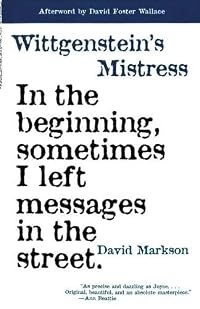
I may not have been in the best place reading this book, so I am loathe to attach a rating. Perhaps I will revisit it someday, and give a much more charitable review. It's certainly a complex book, a cross between Life of Pi (for the fantastical & nautical nature) & Wittgenstein's Mistress (the monologue of the last woman on earth).
So so good. Why is this not better-known? Reminds me of Wittgenstein's Mistress.
Members
- Recently Added By
Lists

The Atlantic's The Great American Novel
136 works; 12 members
Author Information

15+ Works 719 Members
Stanley Crawford is co-owner with his wife, RoseMary Crawford, of El Bosque Garlic Farm in Dixon, New Mexico, where they have lived since 1969. Crawford was born in 1937 and was educated at the University of Chicago and at the Sorbonne. He is the author of nine novels, including Village, Log of the S.S. The Mrs. Unguentine, Travel Notes, GASCOYNE, show more and Some Instructions, a classic satire on all the sanctimonious marriage manuals ever produced. He is also the author of two memoirs: A Garlic Testament: Seasons on a Small Farm in New Mexico, and Mayordomo: Chronicle of an Acequia in Northern New Mexico. He has written numerous articles in various publications such as the New York Times, the Los Angeles Times, Double Take, and Country Living. For more information, please visit stanleycrawford.net. show less
Awards and Honors
Notable Lists
Series
Belongs to Publisher Series
Common Knowledge
- Canonical DDC/MDS
- 813.54
- Canonical LCC
- PS3553.R295
Classifications
Statistics
- Members
- 228
- Popularity
- 142,310
- Reviews
- 7
- Rating
- (3.76)
- Languages
- English, French
- Media
- Paper, Ebook
- ISBNs
- 7
- ASINs
- 2