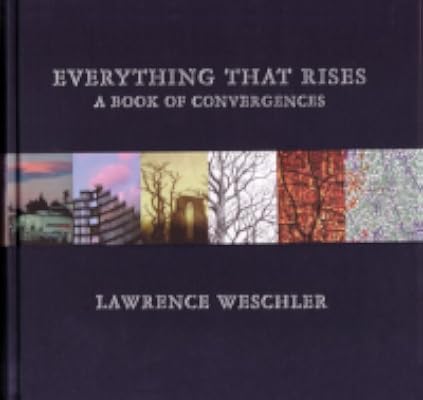
Everything That Rises: A Book of Convergences
by Lawrence Weschler
On This Page
Description
From a cuneiform tablet to a Chicago prison, from the depths of the cosmos to the text on our T-shirts, Lawrence Weschler finds strange connections wherever he looks. The farther (and further) one travels (through geography, through art, through science, through time), the more everything seems to converge -- at least, it does through Weschler's giddy, brilliant eyes. Weschler combines his keen insights into art (both contemporary and Renaissance), his years of experience as a chronicler of show more the fall of Communism, and his triumphs and failures as the father of a teenage girl into a series of articles -- complemented by color photos and illustrations throughout -- that are sure to illuminuate, educate, and astound. show lessTags
Recommendations




















Member Reviews
Lawrence Weschler has collected convergences throughout his life. With EVERYTHING THAT RISES: A BOOK OF CONVERGENCES, he offers his thoughts on these resonations in a series of essays that are both personal and universal.
Weschler has a distinct knack for seeing in the floating lips of a Man Ray painting or in a photograph of a solitary cloud the backside of a nude Venus but his ruminations are much broader than art history. His agglutinating mind embraces poetry, Einstein, cuneiform tablets, prisons and politics. He skillful links these seemingly disparate subjects with one common element – his human response to them. The connection of imagery and ideas seems strangely familiar even if one has not previously considered these show more particular images juxtaposition. It might be human nature to find strange correspondences between things but few have the breadth of knowledge to link such wide-ranging subjects and fewer still would describe them with Weschler’s easy elegance. His musings offer delightful possibilities rather than prescriptions and he stops short of any forced conclusions.
Of particular interest are Weschler’s his discussion with photographer Joel Meyerowitz, who documented the World Trade Center site, in which he finds the beauty and stylistic echoes of Vermeer and early Civil War photography. Also moving is Weschler’s changing response to a photograph of a father and daughter as he and his own daughter reach the relative ages of those in the photograph.
This pleasing volume is bound (with the customary McSweeney’s care for design) in black cloth and features color reproductions of the paintings or photographs mentioned in the essays. It is an aesthetic delight to read. The short essays make it an ideal work to pick up and set down and I suspect I will return repeatedly to this unique book show less
Weschler has a distinct knack for seeing in the floating lips of a Man Ray painting or in a photograph of a solitary cloud the backside of a nude Venus but his ruminations are much broader than art history. His agglutinating mind embraces poetry, Einstein, cuneiform tablets, prisons and politics. He skillful links these seemingly disparate subjects with one common element – his human response to them. The connection of imagery and ideas seems strangely familiar even if one has not previously considered these show more particular images juxtaposition. It might be human nature to find strange correspondences between things but few have the breadth of knowledge to link such wide-ranging subjects and fewer still would describe them with Weschler’s easy elegance. His musings offer delightful possibilities rather than prescriptions and he stops short of any forced conclusions.
Of particular interest are Weschler’s his discussion with photographer Joel Meyerowitz, who documented the World Trade Center site, in which he finds the beauty and stylistic echoes of Vermeer and early Civil War photography. Also moving is Weschler’s changing response to a photograph of a father and daughter as he and his own daughter reach the relative ages of those in the photograph.
This pleasing volume is bound (with the customary McSweeney’s care for design) in black cloth and features color reproductions of the paintings or photographs mentioned in the essays. It is an aesthetic delight to read. The short essays make it an ideal work to pick up and set down and I suspect I will return repeatedly to this unique book show less
Once Weschler started seeing relationships between images from disparate sources, he started seeing such relationships, and others (between stories and images, stories and stories, etc.) everywhere. He began to write these 'convergences' up over the years in a series of essays which eventually were collected and published by the good folks at McSweeney's.
Some of the connections seem a bit of a stretch and, at first, simply coincidence. Many may be coincidence, but the characteristics that tie these images and stories together are often numerous and repeated across centuries, leading Weschler (and this reader) to conclude that there are, at least, certain characteristics shared by these tools for passing on human experience which show more contribute, at least in part, to their power and timelessness.
The first essay, related to 9/11, is a bit too easy, since the emotional impact of this recent event remains strong in most, if not all, of us. But that doesn't minimize the value of what Weschler has to show us in these images (and their stories). After the first three essays, I was sold on the premise and felt that I was reading a book that provided a very special way of looking at the world and its images. Like any collection of essays not originally written as a single work, there are some which don't stand up quite as well as others, but overall, these are a fine collection of observations on today, history, art, image, and how humans percieve their world and the events that surround us.
Highly recommended.
Os. show less
Some of the connections seem a bit of a stretch and, at first, simply coincidence. Many may be coincidence, but the characteristics that tie these images and stories together are often numerous and repeated across centuries, leading Weschler (and this reader) to conclude that there are, at least, certain characteristics shared by these tools for passing on human experience which show more contribute, at least in part, to their power and timelessness.
The first essay, related to 9/11, is a bit too easy, since the emotional impact of this recent event remains strong in most, if not all, of us. But that doesn't minimize the value of what Weschler has to show us in these images (and their stories). After the first three essays, I was sold on the premise and felt that I was reading a book that provided a very special way of looking at the world and its images. Like any collection of essays not originally written as a single work, there are some which don't stand up quite as well as others, but overall, these are a fine collection of observations on today, history, art, image, and how humans percieve their world and the events that surround us.
Highly recommended.
Os. show less
Once Weschler started seeing relationships between images from disparate sources, he started seeing such relationships, and others (between stories and images, stories and stories, etc.) everywhere. He began to write these 'convergences' up over the years in a series of essays which eventually were collected and published by the good folks at McSweeney's.
Some of the connections seem a bit of a stretch and, at first, simply coincidence. Many may be coincidence, but the characteristics that tie these images and stories together are often numerous and repeated across centuries, leading Weschler (and this reader) to conclude that there are, at least, certain characteristics shared by these tools for passing on human experience which show more contribute, at least in part, to their power and timelessness.
The first essay, related to 9/11, is a bit too easy, since the emotional impact of this recent event remains strong in most, if not all, of us. But that doesn't minimize the value of what Weschler has to show us in these images (and their stories). After the first three essays, I was sold on the premise and felt that I was reading a book that provided a very special way of looking at the world and its images. Like any collection of essays not originally written as a single work, there are some which don't stand up quite as well as others, but overall, these are a fine collection of observations on today, history, art, image, and how humans percieve their world and the events that surround us.
Highly recommended.
Os. show less
Some of the connections seem a bit of a stretch and, at first, simply coincidence. Many may be coincidence, but the characteristics that tie these images and stories together are often numerous and repeated across centuries, leading Weschler (and this reader) to conclude that there are, at least, certain characteristics shared by these tools for passing on human experience which show more contribute, at least in part, to their power and timelessness.
The first essay, related to 9/11, is a bit too easy, since the emotional impact of this recent event remains strong in most, if not all, of us. But that doesn't minimize the value of what Weschler has to show us in these images (and their stories). After the first three essays, I was sold on the premise and felt that I was reading a book that provided a very special way of looking at the world and its images. Like any collection of essays not originally written as a single work, there are some which don't stand up quite as well as others, but overall, these are a fine collection of observations on today, history, art, image, and how humans percieve their world and the events that surround us.
Highly recommended.
Os. show less
After the first couple of essays I was forced to conclude that Weschler has an over-active imagination. It's an interesting imagination and he sees lots of interesting connections, but I'm more inclined to credit other reasons to the convergences than he does, such a fundamentals of human aesthetics that we don't understand, not to mention pure coincidence.
Really fascinating series of essays about how artists unconsciously echo each other in the images they use. Lots of great illustrations.
My favorite was the photo of the welder guy next to the painting of Mars (the god, not the planet).
My favorite was the photo of the welder guy next to the painting of Mars (the god, not the planet).
Weschler writes compellingly about connections you might think of as a bit of a stretch at first. He'll have you looking at the world in a new way by the time you've read through the first series about the World Trade Center, though. With a beautiful binding and incredible color reproductions throughout. -Cory
Do you ever hear a new word or come across a certain concept or image and then seem to see it EVERYWHERE you go? This book is all about those convergences, and the author specifically pulls things from art, photography and other images. The text is interesting if you get into it, but it's also really fun to just browse the pages and look at the images, noticing all the connections.
Reviewed by: Betsy
Reviewed by: Betsy
Members
- Recently Added By
Lists

Favourite Books
1,817 works; 316 members
Author Information

35+ Works 3,318 Members
Lawrence Weschler is regarded as one of the leading practitioners of literary nonfiction. His essays have appeared in The New Yorker for over twenty years, and his series of "Convergences" is a regular feature in McSweeney's Quarterly. The recepient of a Lannan Literary Award and the National Book Critics Circle Award for Criticism, he currently show more teaches at New York University. show less
Awards and Honors
Awards
Common Knowledge
- Epigraph
- Tree, always in the middle
of everything that surrounds it [...]
Tree, that (who knows?)
may be thinking there inside
-Rainer Maria Rilke, from "Le noyer"
Useless to think you'll park or capture it
More thoroughly. You are neither here nor there,
A hurry through which known and strange things pass
As big soft buffetings come at the car sideways
And catch the... (show all) heart off guard and blow it open.
-Seamus Heaney, from "Postscript" - Dedication
- For Robert, Toni, and Ray --
my wildly divergent siblings - First words
- I don't remember exactly how I got started - come to think of it, it was probably reading John Berger one day in college, the essay on Che Guevara in The Look of Things where he's talking about the famous photo of Che'... (show all)s corpse, gruesomely splayed out like that for public display, his military captors proudly arrayed alongside and Berger in effect says, "We all know what this photo's based on," and then proceeds to tell us: Rembrandt's Anatomy Lesson. And of course he's right, he's dead right..."
- Last words
- (Click to show. Warning: May contain spoilers.)Maybe it just takes a circle to know a circle.
Classifications
Statistics
- Members
- 348
- Popularity
- 90,544
- Reviews
- 11
- Rating
- (3.78)
- Languages
- English
- Media
- Paper
- ISBNs
- 2
- ASINs
- 1