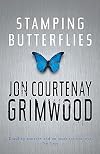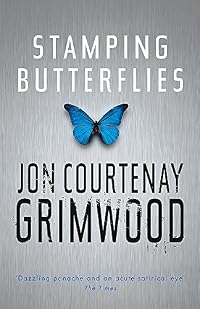
Stamping Butterflies
by Jon Courtenay Grimwood
On This Page
Description
STAMPING BUTTERFLIES tells the story of two dreamers. One, a would be assassin in tomorrow's Marrakech. He aims to kill the US President and holds in his head the secret to a faster-than-light drive. The other, a Chinese Emperor, ruler of 148 billion people on an immense Dyson sphere thousands of years in the future. Each believes they are dreaming the other. One must change the future, one must change the past. Both have only days to live. This is a fast moving unusually well written SF show more novel of ideas. Ideas that will change the reader's perception of time and fate. Ideas from the cutting edge of hard science. It is peopled with vivid characters and evocative of Marrakech, where the author has lived. show lessTags
Recommendations










Member Reviews
http://www.livejournal.com/users/nhw/307911.html
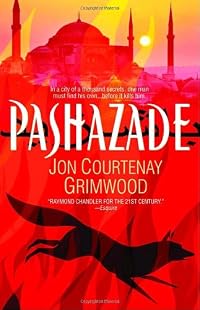
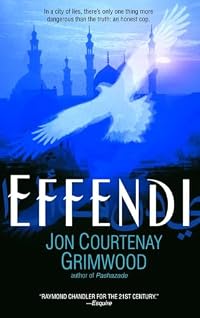
Finished this on Monday night, so it just about counts as my last book of last month. I wasn't overwhelmed by RedRobe, but really very much enjoyed Pashazade, Felaheen and Effendi, Grimwood's trilogy set in an alternate history (but very contemporary) Alexandria where the German and Ottoman empires never fell. This latest combines present day US/western Mediterranean political interactions, a far future empire of two thousand worlds, a near future Chinese space mission, and 1970s Marrakech which is the key to the whole story.
I love Grimwood's prose and characterisation - he stated at PicoCon the weekend before last how important it is for him to be able to experience the world he is show more writing, and that is very believable. For most of the book it was able to carry me past the shoals of unsuspended disbelief. I was left at the end just a bit unsatisfied, unfortunately. show less
Finished this on Monday night, so it just about counts as my last book of last month. I wasn't overwhelmed by RedRobe, but really very much enjoyed Pashazade, Felaheen and Effendi, Grimwood's trilogy set in an alternate history (but very contemporary) Alexandria where the German and Ottoman empires never fell. This latest combines present day US/western Mediterranean political interactions, a far future empire of two thousand worlds, a near future Chinese space mission, and 1970s Marrakech which is the key to the whole story.
I love Grimwood's prose and characterisation - he stated at PicoCon the weekend before last how important it is for him to be able to experience the world he is show more writing, and that is very believable. For most of the book it was able to carry me past the shoals of unsuspended disbelief. I was left at the end just a bit unsatisfied, unfortunately. show less
A confusing and, to my mind, often badly structured plot that fails to reach any kind of satisfactory conclusion - and I loved it. I would have liked a little more explanation (just a tad, here and there), especially towards the end where we find that Zero is really Moz. I'm still not entirely sure how it was that Moz was able to see the future, or just how the alt-future was averted, but SB was so compellingly written, the characters beautifully drawn. A real page turner (though I'm still not entirely sure why).
I was too confused through most of this book to be able to link the three story lines together. I am surprised I lasted to a point where things started to come together, around 250 pages of a 400 page book. Once things started to jell together, it got a little bit better, but overall I am just as confused at the end as I am at the beginning. I think the part that leaves me cold is the part of the future. I don't see how this section really plays into the larger story as a whole. The past and the present I got the relationship pretty early in the book, and enjoyed the story that was being described quite a bit. The future always left me cold, and more confused then enlightned, which to me always took me out of the story being told. An show more interesting read, just not one I would recommend highly. This is more an enter at your own risk sort of book. show less
ORIGINALLY POSTED AT Fantasy Literature.
I picked up John Courtenay Grimwoodƒ??s Stamping Butterflies because a trusted fellow reviewer thinks so highly of his work and I thought a stand-alone novel which has just been released in audio format would be an ideal introduction to the author. While I found much to admire about GrimwoodÂ??s style, I didnÂ??t enjoy Stamping Butterflies as much as I expect to enjoy some of his other work.
The non-linear three-pronged plot of Stamping Butterflies is ambitious. One part takes place in modern-day United States where Gene Newman, the charismatic U.S. President, refuses to collaborate on a space mission with the Chinese until their government addresses its human rights issues. A sniper, show more concerned about a Chinese-American partnership, attempts to kill Newman in Marrakech and is caught and sentenced to death. He dreams of a future Chinese emperor and the �?darkness� that influences both of them. He�?s a genius with mathematics, quantum physics, and theology, so keeping him alive may be the best thing for the U.S. government �? if they can get him to talk.
A second plot is set in Marrakech in the 1960s and 1970s. Here, as we explore the city with a couple of teenage street urchins and a rock star named Jake Razor, we relive some of Prisoner ZeroÂ??s past and begin to understand how he became a killer. The third part of the plot is set in the far future where, generations before, a Chinese space mission managed to set up an emperor and a computer to rule the future 2023 worlds. The current emperor, whose every move is broadcast live across his bored kingdom, dreams of Prisoner Zero as he waits for his own assassin and wonders which of his surroundings are real and which are computer-generated.
The story seems to jump around almost randomly between these three plot lines. Each has a different flavor Â?? the modern plot feels like a political thriller, the past plot feels like historical fiction, and the future plot feels like cyberpunk. Underneath each lurks the same shadowy organizing principle which the characters refer to as Â??the darknessÂ?Â, Â??the coldÂ?Â, or Â??the library.Â?Â
I admire the vision, style, and structure of Stamping Butterflies. The characterization is quite good (though I didnÂ??t particularly like the characters) and the places Grimwood takes us come alive. I think I could smell the streets and the food stalls of Marrakech. There is also some awesome scenery, some really cool math and science, and a ride in a racing space yacht called All TomorrowÂ??s Parties Â?? a nod to William GibsonÂ??s novel which has a similar convoluted structure and is also about a haunted man who can sense eminent world-changing events.
As with GibsonÂ??s novel, I couldnÂ??t manage to get immersed in Stamping Butterflies. Its chapters are presented as random pieces of a puzzle that donÂ??t all fit together until the end (and even then, IÂ??m not sure how snugly they fit), so thereÂ??s a constant sense of being lost or not having enough information to be able to just relax and enjoy the story. By the time it all came together (sort of), it was too late. At that point all I could do was sit back and admire the idea and wish I had been more fully engaged much earlier. IÂ??m sure a re-read would be enlightening, but I didnÂ??t like the story well enough to do that. I did, however, really like Grimwood's style and look forward to reading more of his work.
I listened to Audible FrontierÂ??s version of Stamping Butterflies which was read by Noah James Butler. Butler has a nice voice for narration and he mostly gives a good reading. However, the voices he used for some of the charactersÂ?? dialogue were unpleasant (especially for female characters) and there were several obvious places where Butler must have made a mistake and a patch was dubbed in. This wasnÂ??t enough to keep me from recommending the audio version of this book, but it wasnÂ??t up to the excellent quality I expect from Audible Frontiers. show less
I picked up John Courtenay Grimwoodƒ??s Stamping Butterflies because a trusted fellow reviewer thinks so highly of his work and I thought a stand-alone novel which has just been released in audio format would be an ideal introduction to the author. While I found much to admire about GrimwoodÂ??s style, I didnÂ??t enjoy Stamping Butterflies as much as I expect to enjoy some of his other work.
The non-linear three-pronged plot of Stamping Butterflies is ambitious. One part takes place in modern-day United States where Gene Newman, the charismatic U.S. President, refuses to collaborate on a space mission with the Chinese until their government addresses its human rights issues. A sniper, show more concerned about a Chinese-American partnership, attempts to kill Newman in Marrakech and is caught and sentenced to death. He dreams of a future Chinese emperor and the �?darkness� that influences both of them. He�?s a genius with mathematics, quantum physics, and theology, so keeping him alive may be the best thing for the U.S. government �? if they can get him to talk.
A second plot is set in Marrakech in the 1960s and 1970s. Here, as we explore the city with a couple of teenage street urchins and a rock star named Jake Razor, we relive some of Prisoner ZeroÂ??s past and begin to understand how he became a killer. The third part of the plot is set in the far future where, generations before, a Chinese space mission managed to set up an emperor and a computer to rule the future 2023 worlds. The current emperor, whose every move is broadcast live across his bored kingdom, dreams of Prisoner Zero as he waits for his own assassin and wonders which of his surroundings are real and which are computer-generated.
The story seems to jump around almost randomly between these three plot lines. Each has a different flavor Â?? the modern plot feels like a political thriller, the past plot feels like historical fiction, and the future plot feels like cyberpunk. Underneath each lurks the same shadowy organizing principle which the characters refer to as Â??the darknessÂ?Â, Â??the coldÂ?Â, or Â??the library.Â?Â
I admire the vision, style, and structure of Stamping Butterflies. The characterization is quite good (though I didnÂ??t particularly like the characters) and the places Grimwood takes us come alive. I think I could smell the streets and the food stalls of Marrakech. There is also some awesome scenery, some really cool math and science, and a ride in a racing space yacht called All TomorrowÂ??s Parties Â?? a nod to William GibsonÂ??s novel which has a similar convoluted structure and is also about a haunted man who can sense eminent world-changing events.
As with GibsonÂ??s novel, I couldnÂ??t manage to get immersed in Stamping Butterflies. Its chapters are presented as random pieces of a puzzle that donÂ??t all fit together until the end (and even then, IÂ??m not sure how snugly they fit), so thereÂ??s a constant sense of being lost or not having enough information to be able to just relax and enjoy the story. By the time it all came together (sort of), it was too late. At that point all I could do was sit back and admire the idea and wish I had been more fully engaged much earlier. IÂ??m sure a re-read would be enlightening, but I didnÂ??t like the story well enough to do that. I did, however, really like Grimwood's style and look forward to reading more of his work.
I listened to Audible FrontierÂ??s version of Stamping Butterflies which was read by Noah James Butler. Butler has a nice voice for narration and he mostly gives a good reading. However, the voices he used for some of the charactersÂ?? dialogue were unpleasant (especially for female characters) and there were several obvious places where Butler must have made a mistake and a patch was dubbed in. This wasnÂ??t enough to keep me from recommending the audio version of this book, but it wasnÂ??t up to the excellent quality I expect from Audible Frontiers. show less
Galloped through this, and I know I have to re-read this... I could see how all the threads were drawing together at the end, but I can't make sense of it all yet... not the authors fault but my speed reading, and anyway, it's always nice to go back and see how it all "works"
The individual storylines were absorbing, and the characters interesting, the settings exotic but convincing. I really liked it (4 stars) and may even love it on the next go :)
A re-read in Oct 2014, upgraded to 5 stars, for the way in which the individual storylines are grabbed in a fist and brought together but still ambiguously related...
The individual storylines were absorbing, and the characters interesting, the settings exotic but convincing. I really liked it (4 stars) and may even love it on the next go :)
A re-read in Oct 2014, upgraded to 5 stars, for the way in which the individual storylines are grabbed in a fist and brought together but still ambiguously related...
John Courtenay Grimwood's books tend to be both thrilling and totally confusing. What exactly happened at the end? What was the darkness? How did it fiddle with time? And why? How did the 2023 worlds work, exactly? Anyway, it was thrilling. I guess I'm OK with being a little confused.
Odd. Split into three apparently unrelated plot themes that do resolve in the final chapter it is confusing reading.
A past timeline of Makkeresh in the 70's invovles the life and love of a young streey arab (well not actually an arab but a mix of bloods). His girlfriend some europeans and the local police and drug runners.
A contempary timeline featuring theUS president, who is nearly assinated by an unknown prisoner who is easily captured and proves to decidedly odd, but not willing to declare himself insane. Infact he doesn't talk at all.
the third timeline is just very peculiar. China were the first nation to develop interstella space drives and eventually a survivor make shis way to a formally inhabited artifact of 2023 worlds show more orbiting a sun. This now ruled by a chinese style Emporer with magical Library
Most of these thread get dull after a while but the final resolution in thelast couple of chapters is interesting enough to make the book worth reading once at least. There is graphic and probably unnecessary sex and torture in the Makerresh threads, but it isn't too unplesant. show less
A past timeline of Makkeresh in the 70's invovles the life and love of a young streey arab (well not actually an arab but a mix of bloods). His girlfriend some europeans and the local police and drug runners.
A contempary timeline featuring theUS president, who is nearly assinated by an unknown prisoner who is easily captured and proves to decidedly odd, but not willing to declare himself insane. Infact he doesn't talk at all.
the third timeline is just very peculiar. China were the first nation to develop interstella space drives and eventually a survivor make shis way to a formally inhabited artifact of 2023 worlds show more orbiting a sun. This now ruled by a chinese style Emporer with magical Library
Most of these thread get dull after a while but the final resolution in thelast couple of chapters is interesting enough to make the book worth reading once at least. There is graphic and probably unnecessary sex and torture in the Makerresh threads, but it isn't too unplesant. show less
Members
- Recently Added By
Lists

Best Cyberpunk
41 works; 7 members
Author Information

32+ Works 4,355 Members
Some Editions
Awards and Honors
Awards
Distinctions
Common Knowledge
- Original publication date
- 2004
Classifications
Statistics
- Members
- 393
- Popularity
- 78,980
- Reviews
- 11
- Rating
- (3.41)
- Languages
- English
- Media
- Paper, Ebook
- ISBNs
- 5
- ASINs
- 3