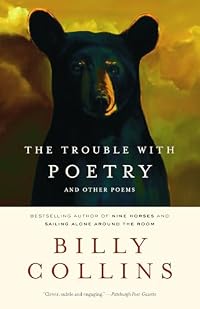
The Trouble with Poetry and Other Poems
by Billy Collins
On This Page
Description
A collection of poetry by American poet Billy Collins which reflects themes on boyhood, jazz, love, the passage of time, and writing.Tags
Recommendations













Member Reviews
If I could choose the US Poet Laureate, here at the beginning of the twenty-first century, it would be Billy Collins – partly because he took the role so seriously and played it so well, partly because of his influence and comments on contemporary poetry, his opposition to the academic obliqueness of most of his widely recognized colleagues, and mostly, of course, because of the nature and quality of his own poetry. In my opinion the US has had only one real Poet Laureate, and that was Robert Frost. He spoke for and to the people; he represented our country’s character, and he assumed his public role naturally. Collins is like that.
Just one reservation. Most great poets have one or two – or a half dozen or more – really show more memorable poems, ones that stand out in public and critical acclaim: “Stopping by Woods on a Snowy Evening,” “Design,” “The Death of a Hired Man,” “The Road Not Taken,” “Mending Wall” . . . you get the point. Ginsberg has “Howl”; Ferlinghetti, “Dog” and “Christ climbed down…,” Robert Lowell, “Skunk Hour” and “For the Union Dead,” Plath, “Black Rook in Rainy Weather” and “Tulips,” Dickey, “Falling” and “Drowning with Others.” One could go on and on. I like all of Collins’ poems as I read them. His voice, his lyric form, his wit and self-deprecating humor, his language – at once, everyday language and well-crafted diction, simple but precise. But when I close his books and put them back on the shelf, there are no single titles I hold in mind. I remember his voice, his rhythms, and share his vision of the poet. But if I were going to teach a class on current poetry, what would be the five poems of his that I would choose? Hard to say.
For, you see, the triumph of Collins’ poetry is that what he writes – everything he writes – is something you could have said yourself. “Yeah, yeah, that’s exactly what I would have said.” “I could have said the same thing, couldn’t I’ve?” Collins knows this. At the beginning of The Trouble with Poetry (Random House, 2005), in the first lines of the very first poem, he says it frankly and plainly:
I wonder how you are going to feel
when you find out
that I wrote this instead of you.
Most of his poems, it seems, come to him at the breakfast table while he is looking out his back window (“I was only thinking / about the shakers of salt and pepper”). The second one in this book begins,
The birds are in their trees,
the toast is in the toaster,
and the poets are at their windows.
Yeah, yeah, I could have said the same thing, couldn’t I’ve? Isn’t that exactly what you would have said? Of course, we aren’t poets, and we can’t sit at our breakfast table waiting for lines to come to us. But if we did, they would have sounded just like this, wouldn’t they have?
for there is always something to see –
a bird grasping a thin branch,
the headlights of a taxi rounding a corner,
those two boys in wool caps angling across the street.
Well, with me, it might have been a cardinal or a titmouse, it might have been a Checkered Cab, the boys might have worn red toboggans. But what he says lets me see what I would have seen. That’s his triumph, and he does it in such plain, simple language – everyday, ordinary, like yours and mine – but his language rings with authenticity and tingles just a smidgen bit with unnoticed assonance and consonance, almost iambic but not quite, almost triplets or quatrains, but only subtly. I want to keep reading, and I do. These first two poems are entitled, appropriately, “You, Reader” and “Monday.” Well, of course, he would start out on a Monday morning, wouldn’t he? When else?
Next, he takes a few short walks. “Statues” reflects on the meaning of the horses’ stance in statues honoring military heroes, but wondering what kind of statue we might want or deserve. “Traveling Alone” goes a bit farther afield:
At the hotel coffee shop that morning,
[after all, poets go on reading tours, and the breakfast table is in a hotel coffee shop; that’s just an ordinary day with us poets, our home away from home, even if we aren’t poets]
the waitress was wearing a pink uniform
with “Florence” written in script over her heart.
And the redcap’s nameplate said “Ben,” and the flight attendants had been “Debbie” and “Lynn.” They all wanted to talk, didn’t they, but they didn’t, so he has to talk for them:
Did they not look eager to ask about my writing process,
my way of composing in the morning
by a window
But, of course, this poem is written in the past tense; it’s a fading memory. He’s really back in his “House,” he’s lying in the sun “In the Moment.” Even when he writes of ultimate themes, mortality and the meaning of it all, clearly he’s back in his own bedroom, surrounded by ordinary things, as we all would be:
Soon enough it will all be over –
the shirt hanging from the doorknob,
trees beyond the windows,
and the kettle of water bubbling on a burner.
So here I sit, reading his lines and writing my own – sort of – and my freshly laundered shirts are still hanging on the closet doorknob and I gaze at the trees outside my window and sip the coffe I just heated in a microwave. Of course, he and I, would like to get serious, to contemplate a great “Theme,” say, “the longing for immortality / despite the roaring juggernaut of time,” but the new-mown grass in the front yard smells sweet and the pink spirea are in full bloom. This is the day of the pink spirea, the week of the pink spirea. With him it’s a jasmine, but never mind. Whatever, it certainly holds us back from a “fall from exuberant maturity / into sudden headlong decline . . . .”
And so the book ambles on, and how pleasant to amble with this poet, who talks to me, for me, about ourselves, just the way I talk – or would if I were a poet. It’s pleasant. Not a single false note. Full of life, of the little things of life. Of life as it is, and as it should be. Spoken like a laureate. As I near the end of the amble and, reluctantly, put the book down, I realize how neatly it fits with Collins’ other works on my shelf. I realize how much I admire them all. I remember his voice, his imagery, his humor, his sense of celebration, his diffidence. But I’m not sure I will remember any one poem.
The book ends, as one might expect, with “Silence,” with “the silence of this morning . . . the silence before I wrote a word.” Maybe that’s part of Collins’ triumph as a poet, what makes him so memorable and meaningful to us. He writes out of our silence and returns us to our silence.
The penultimate poem, the title poem, “The Trouble with Poetry,” however points in a different direction:
the trouble with poetry is
that it encourages the writing of more poetry
Each of his poems encourages the poet to keep on writing. Each poem he reads, Ferlinghetti's for instance, does the same. And each of his poems shows us how to go write our own. We probably won’t do it, but we are encouraged. Why not?
Collins and I must be the same age. At least we graduated from high school the same year. His poem, “Class Picture, 1954,” could be about my class picture, 1954.
I am the middle one
in the second row,
right under the faculty.
The boy to my right,
my best friend,
broke my nose in the third grade.
The girl to my left
is the one who used
to call me crybaby.
No, let’s not go there. It’s better to let Billy do it for me, for he begins to see above and beyond these stiff, solemn, black-and-white senior pictures:
and over there, off to the side,
Superman is balancing
a green car over his head with one hand.
Now that’s better. Except for me it is Captain Marvel, and I can still hear the word “Shazam!” like a clap of thunder and see the flash of lightning. I needed a book of Collins’ poetry – as he had Ferlinghetti’s Coney Island of the Mind – to carry around in my hip pocket “up and down the treacherous halls of high school.”
But mostly poetry fills me
with the urge to write poetry. show less
Just one reservation. Most great poets have one or two – or a half dozen or more – really show more memorable poems, ones that stand out in public and critical acclaim: “Stopping by Woods on a Snowy Evening,” “Design,” “The Death of a Hired Man,” “The Road Not Taken,” “Mending Wall” . . . you get the point. Ginsberg has “Howl”; Ferlinghetti, “Dog” and “Christ climbed down…,” Robert Lowell, “Skunk Hour” and “For the Union Dead,” Plath, “Black Rook in Rainy Weather” and “Tulips,” Dickey, “Falling” and “Drowning with Others.” One could go on and on. I like all of Collins’ poems as I read them. His voice, his lyric form, his wit and self-deprecating humor, his language – at once, everyday language and well-crafted diction, simple but precise. But when I close his books and put them back on the shelf, there are no single titles I hold in mind. I remember his voice, his rhythms, and share his vision of the poet. But if I were going to teach a class on current poetry, what would be the five poems of his that I would choose? Hard to say.
For, you see, the triumph of Collins’ poetry is that what he writes – everything he writes – is something you could have said yourself. “Yeah, yeah, that’s exactly what I would have said.” “I could have said the same thing, couldn’t I’ve?” Collins knows this. At the beginning of The Trouble with Poetry (Random House, 2005), in the first lines of the very first poem, he says it frankly and plainly:
I wonder how you are going to feel
when you find out
that I wrote this instead of you.
Most of his poems, it seems, come to him at the breakfast table while he is looking out his back window (“I was only thinking / about the shakers of salt and pepper”). The second one in this book begins,
The birds are in their trees,
the toast is in the toaster,
and the poets are at their windows.
Yeah, yeah, I could have said the same thing, couldn’t I’ve? Isn’t that exactly what you would have said? Of course, we aren’t poets, and we can’t sit at our breakfast table waiting for lines to come to us. But if we did, they would have sounded just like this, wouldn’t they have?
for there is always something to see –
a bird grasping a thin branch,
the headlights of a taxi rounding a corner,
those two boys in wool caps angling across the street.
Well, with me, it might have been a cardinal or a titmouse, it might have been a Checkered Cab, the boys might have worn red toboggans. But what he says lets me see what I would have seen. That’s his triumph, and he does it in such plain, simple language – everyday, ordinary, like yours and mine – but his language rings with authenticity and tingles just a smidgen bit with unnoticed assonance and consonance, almost iambic but not quite, almost triplets or quatrains, but only subtly. I want to keep reading, and I do. These first two poems are entitled, appropriately, “You, Reader” and “Monday.” Well, of course, he would start out on a Monday morning, wouldn’t he? When else?
Next, he takes a few short walks. “Statues” reflects on the meaning of the horses’ stance in statues honoring military heroes, but wondering what kind of statue we might want or deserve. “Traveling Alone” goes a bit farther afield:
At the hotel coffee shop that morning,
[after all, poets go on reading tours, and the breakfast table is in a hotel coffee shop; that’s just an ordinary day with us poets, our home away from home, even if we aren’t poets]
the waitress was wearing a pink uniform
with “Florence” written in script over her heart.
And the redcap’s nameplate said “Ben,” and the flight attendants had been “Debbie” and “Lynn.” They all wanted to talk, didn’t they, but they didn’t, so he has to talk for them:
Did they not look eager to ask about my writing process,
my way of composing in the morning
by a window
But, of course, this poem is written in the past tense; it’s a fading memory. He’s really back in his “House,” he’s lying in the sun “In the Moment.” Even when he writes of ultimate themes, mortality and the meaning of it all, clearly he’s back in his own bedroom, surrounded by ordinary things, as we all would be:
Soon enough it will all be over –
the shirt hanging from the doorknob,
trees beyond the windows,
and the kettle of water bubbling on a burner.
So here I sit, reading his lines and writing my own – sort of – and my freshly laundered shirts are still hanging on the closet doorknob and I gaze at the trees outside my window and sip the coffe I just heated in a microwave. Of course, he and I, would like to get serious, to contemplate a great “Theme,” say, “the longing for immortality / despite the roaring juggernaut of time,” but the new-mown grass in the front yard smells sweet and the pink spirea are in full bloom. This is the day of the pink spirea, the week of the pink spirea. With him it’s a jasmine, but never mind. Whatever, it certainly holds us back from a “fall from exuberant maturity / into sudden headlong decline . . . .”
And so the book ambles on, and how pleasant to amble with this poet, who talks to me, for me, about ourselves, just the way I talk – or would if I were a poet. It’s pleasant. Not a single false note. Full of life, of the little things of life. Of life as it is, and as it should be. Spoken like a laureate. As I near the end of the amble and, reluctantly, put the book down, I realize how neatly it fits with Collins’ other works on my shelf. I realize how much I admire them all. I remember his voice, his imagery, his humor, his sense of celebration, his diffidence. But I’m not sure I will remember any one poem.
The book ends, as one might expect, with “Silence,” with “the silence of this morning . . . the silence before I wrote a word.” Maybe that’s part of Collins’ triumph as a poet, what makes him so memorable and meaningful to us. He writes out of our silence and returns us to our silence.
The penultimate poem, the title poem, “The Trouble with Poetry,” however points in a different direction:
the trouble with poetry is
that it encourages the writing of more poetry
Each of his poems encourages the poet to keep on writing. Each poem he reads, Ferlinghetti's for instance, does the same. And each of his poems shows us how to go write our own. We probably won’t do it, but we are encouraged. Why not?
Collins and I must be the same age. At least we graduated from high school the same year. His poem, “Class Picture, 1954,” could be about my class picture, 1954.
I am the middle one
in the second row,
right under the faculty.
The boy to my right,
my best friend,
broke my nose in the third grade.
The girl to my left
is the one who used
to call me crybaby.
No, let’s not go there. It’s better to let Billy do it for me, for he begins to see above and beyond these stiff, solemn, black-and-white senior pictures:
and over there, off to the side,
Superman is balancing
a green car over his head with one hand.
Now that’s better. Except for me it is Captain Marvel, and I can still hear the word “Shazam!” like a clap of thunder and see the flash of lightning. I needed a book of Collins’ poetry – as he had Ferlinghetti’s Coney Island of the Mind – to carry around in my hip pocket “up and down the treacherous halls of high school.”
But mostly poetry fills me
with the urge to write poetry. show less
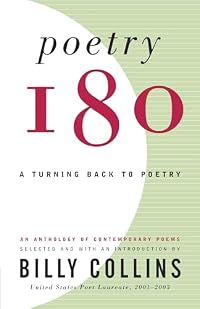
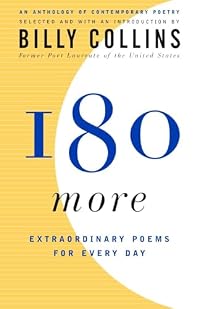
In my quest to understand poetry I read Billy Collins's 180 More: Extraordinary Poems for Every Day on and off last year, a few poems at a time, and liked it very much. From what I've read here and there (particularly on LT), Billy Collins is a widely-read, well-loved poet who is very accessible, and this led to my picking up The Trouble With Poetry.
Unlike 180 More, which had many poets and many voices, the poems in The Trouble With Poetry are all by Billy Collins and it is in his voice that the poems speak. I found a great similarity in tone and mood in many of these poems, and I found that comforting. While there were some poems that just didn't speak to me, there were none that I actively disliked or that I found incomprehensible. show more And there were several poems that I really liked.
As a mother (and as a daughter who made more than one of these at summer camp), I loved "The Lanyard":
The other day as I was ricocheting slowly
off the pale blue walls of this room,
bouncing from typewriter to piano,
from bookshelf to an envelope lying on the floor,
I found myself in the L section of the dictionary
where my eyes fell on the word lanyard.
No cookie nibbled by a French novelist
could send one more suddenly into the past--
a past where I sat at a workbench at a camp
by a deep Adirondack lake
learning how to braid thin plastic strips
into a lanyard, a gift for my mother.
I had never seen anyone use a lanyard
or wear one, if that's what you did with them,
but that did not keep me from crossing
strand over strand again and again
until I had made a boxy
red and white lanyard for my mother.
She gave me life and milk from her breasts,
and I gave her a lanyard.
She nursed me in many a sickroom,
lifted teaspoons of medicine to my lips,
set cold face-clothes on my forehead,
and then led me out into the light
and taught me to walk and swim,
and I, in turn, presented her with a lanyard.
Here are thousands of meals, she said,
and here is clothing and a good education.
And here is your lanyard, I replied,
which I made with a little help from a counselor.
Here is a breathing body and a beating heart,
strong legs, bones and teeth,
and two clear eyes to read the world, she whispered,
and here, I said, is the lanyard I made at camp.
And here, I wish to say to her now,
is a smaller gift--not the archaic truth
that you can never repay your mother,
but the rueful admission that when she took
the two-tone lanyard from my hands,
I was as sure as a boy could be
that this useless, worthless thing I wove
out of boredom would be enough to make us even.
I also liked how Collins often uses poetry to comment on poetry. (Well, the title of the collection is The Trouble With Poetry, after all.) I particularly liked The Student, which begins:
My poetry instruction book,
which I bought at an outdoor stall along the river
contains many rules....
The final rule, and how the poem ends is
And always keep your poem in one season.
I try to be mindful
but in these last days of summer
whenever I look up from my page
and see a burn-mark of yellow leaves,
I think of the icy winds
that will soon be knifing through my jacket.
The poem I really got a kick out of was The Introduction, with its gentle jab at pretension:
I don't think this next poem
needs any introduction--
it's best to let the work speak for itself.
Maybe I should just mention
that whenever I use the word five
I'm referring to that group of Russian composers
who came to be known as "The Five,"
Balakirev, Moussorgsky, Borodin--that crowd.
Oh--and Hypsicles was a Greek astronomer.
He did something with the circle.
That's about it, but for the record,
"Grimke" is Angelina Emity Grimke, the abolitionist.
"Imroz" is that little island near the Dardanelles.
"Monad"--well you all know what a monad is.
There could be a little problem
with Martaba, which was one of those Egyptian
above-ground sepulchers, sort of brick and limestone.
And you're all familiar with helminthology?
It's the science of worms.
Oh, and you will recall that Phoebe Mozee
is the real name of Annie Oakley.
Other than that, everything should be obvious.
Wagga Wagga is in New South Wales.
Rhyolite is that soft volcanic rock.
What else?
Yes Meranti is a type of timber, in tropical Asia I think,
and Rahway is just Rahway, New Jersey.
The rest of the poem should be clear.
I'll just read it and let it speak for itself.
It's about the time I went picking wild strawberries.
It's called "Picking Wild Strawberries."
Highly recommended,
4 1/2 stars show less
Unlike 180 More, which had many poets and many voices, the poems in The Trouble With Poetry are all by Billy Collins and it is in his voice that the poems speak. I found a great similarity in tone and mood in many of these poems, and I found that comforting. While there were some poems that just didn't speak to me, there were none that I actively disliked or that I found incomprehensible. show more And there were several poems that I really liked.
As a mother (and as a daughter who made more than one of these at summer camp), I loved "The Lanyard":
The other day as I was ricocheting slowly
off the pale blue walls of this room,
bouncing from typewriter to piano,
from bookshelf to an envelope lying on the floor,
I found myself in the L section of the dictionary
where my eyes fell on the word lanyard.
No cookie nibbled by a French novelist
could send one more suddenly into the past--
a past where I sat at a workbench at a camp
by a deep Adirondack lake
learning how to braid thin plastic strips
into a lanyard, a gift for my mother.
I had never seen anyone use a lanyard
or wear one, if that's what you did with them,
but that did not keep me from crossing
strand over strand again and again
until I had made a boxy
red and white lanyard for my mother.
She gave me life and milk from her breasts,
and I gave her a lanyard.
She nursed me in many a sickroom,
lifted teaspoons of medicine to my lips,
set cold face-clothes on my forehead,
and then led me out into the light
and taught me to walk and swim,
and I, in turn, presented her with a lanyard.
Here are thousands of meals, she said,
and here is clothing and a good education.
And here is your lanyard, I replied,
which I made with a little help from a counselor.
Here is a breathing body and a beating heart,
strong legs, bones and teeth,
and two clear eyes to read the world, she whispered,
and here, I said, is the lanyard I made at camp.
And here, I wish to say to her now,
is a smaller gift--not the archaic truth
that you can never repay your mother,
but the rueful admission that when she took
the two-tone lanyard from my hands,
I was as sure as a boy could be
that this useless, worthless thing I wove
out of boredom would be enough to make us even.
I also liked how Collins often uses poetry to comment on poetry. (Well, the title of the collection is The Trouble With Poetry, after all.) I particularly liked The Student, which begins:
My poetry instruction book,
which I bought at an outdoor stall along the river
contains many rules....
The final rule, and how the poem ends is
And always keep your poem in one season.
I try to be mindful
but in these last days of summer
whenever I look up from my page
and see a burn-mark of yellow leaves,
I think of the icy winds
that will soon be knifing through my jacket.
The poem I really got a kick out of was The Introduction, with its gentle jab at pretension:
I don't think this next poem
needs any introduction--
it's best to let the work speak for itself.
Maybe I should just mention
that whenever I use the word five
I'm referring to that group of Russian composers
who came to be known as "The Five,"
Balakirev, Moussorgsky, Borodin--that crowd.
Oh--and Hypsicles was a Greek astronomer.
He did something with the circle.
That's about it, but for the record,
"Grimke" is Angelina Emity Grimke, the abolitionist.
"Imroz" is that little island near the Dardanelles.
"Monad"--well you all know what a monad is.
There could be a little problem
with Martaba, which was one of those Egyptian
above-ground sepulchers, sort of brick and limestone.
And you're all familiar with helminthology?
It's the science of worms.
Oh, and you will recall that Phoebe Mozee
is the real name of Annie Oakley.
Other than that, everything should be obvious.
Wagga Wagga is in New South Wales.
Rhyolite is that soft volcanic rock.
What else?
Yes Meranti is a type of timber, in tropical Asia I think,
and Rahway is just Rahway, New Jersey.
The rest of the poem should be clear.
I'll just read it and let it speak for itself.
It's about the time I went picking wild strawberries.
It's called "Picking Wild Strawberries."
Highly recommended,
4 1/2 stars show less
This small volume of poetry by Billy Collins was an unexpected pleasure to read. I tried to only read a couple of poems each time I picked up the book in order to actually think about what I was reading and how it was relevant to me. I do not read poetry on a regular basis so the most surprising thing of all about this book was how easy it was to read, this is a volume of poems that are about ordinary life, yet some of his prose captures life’s perfect moments so clearly that it leaves one amazed at his vision.
There are many moods to the writing from playful to graceful, ironic to vulnerable but at all times these are words to ponder. I am not saying that I totally understood the meaning of each poem, or exactly what Collins was show more revealing with each phrase, but there were many that did either speak to me or cause me to pause and think about what I was reading.
In the poem Monday he writes, “The poets are at their windows”, and windows seem to be a reoccurring theme in his writing. In The Trouble With Poetry, Billy Collins has invited his readers to look into his windows and discover how unexpected the ordinary can be. show less
There are many moods to the writing from playful to graceful, ironic to vulnerable but at all times these are words to ponder. I am not saying that I totally understood the meaning of each poem, or exactly what Collins was show more revealing with each phrase, but there were many that did either speak to me or cause me to pause and think about what I was reading.
In the poem Monday he writes, “The poets are at their windows”, and windows seem to be a reoccurring theme in his writing. In The Trouble With Poetry, Billy Collins has invited his readers to look into his windows and discover how unexpected the ordinary can be. show less
National Poetry Month! Billy Collins is delightful and this collection, though 10 years old, is still a good touchstone of his talents and themes. He is not afraid to poke fun at the seriousness with which people regard poetry (witness the title) and he has a sense of play and whimsy -- almost as if his poems happen to him by accident. His subjects have depth, but he is good at undercutting heaviness with a dose of levity. To hear/see him read and add the effective pause, touch of sarcasm, or deadpan expression is a treat. One of my all-time favorite contemporary poems is The Lanyard, found here. Is there anything more serious than mother-love? Yet Collins renders it poignant instead of schmaltzy with lines like: "Here are thousands of show more meals, she said, and here is clothing and a good education. And here is your lanyard, I replied, which I made with a little help from a counselor." Other worthwhile titles here include: Genius, The Revenant (about a revenge-seeking dog), Monday. Billy Collins makes anything fair game for a poem and the new perspective it provides. show less
According to Billy Collins,
The trouble with poetry is this:
That it engenders further poetry.
Since my reviews of poetry
Are written in blank verse, I suppose
That Collins must be more or less
Correct.
(Probably less. Can book reviews
Really count as poems?)
These ones are full of death,
But also dogs
Taken for a walk around the lake,
And wine, and candles,
And blue and white striped wallpaper.
Simple, universal imagery,
The sort of thing that Collins
Does so well.
The trouble with poetry is this:
That it engenders further poetry.
Since my reviews of poetry
Are written in blank verse, I suppose
That Collins must be more or less
Correct.
(Probably less. Can book reviews
Really count as poems?)
These ones are full of death,
But also dogs
Taken for a walk around the lake,
And wine, and candles,
And blue and white striped wallpaper.
Simple, universal imagery,
The sort of thing that Collins
Does so well.
Billy Collins is one of my favorite poets for playfully constructing evocative but easy-to-understand imagery in his poetry. He writes about everyday experiences, putting a fresh spin on them, and doesn't take himself too seriously. He is in fine form in this collection, which may be my favorite of those I've read so far.
Billy Collins has a knack for taking the mundane, ordinary pieces of the world and extracting the fundamental, insightful or just plain humorous essence of it with an economy only a poet of exceptional skill can accomplish. The Trouble with Poetry takes it even further by exploiting some of the foibles of the poet caught in a modern world. Collins offers up an accessible style of freeform poetry that anyone can appreciate. However, it isn’t simplistic at all – more often than not multiple readings are necessary to begin to penetrate the nuances of his writing. Still, The Trouble with Poetry speaks in the conversational voice of that quirky but essential neighbor who you go to when you need someone to shine a different light on the show more world. I completely enjoyed this short collection and my only quibble was that I wanted more when I reached the last page. I suppose that is the essence of a successful poet. A great introduction to Billy Collins. show less
Members
- Recently Added By
Lists

Poetry Corner
187 works; 13 members

2000s (the decade, not the century)
184 works; 9 members

Poetry volumes by single author
121 works; 8 members
Author Information

42+ Works 12,797 Members
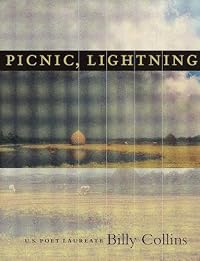
Billy Collins has published six collections of poetry, including Questions About Angels and The Art of Drowning, Picnic, Lightning, his latest, sold more than 25,000 copies in its first year. He teaches at Lehman College of the City University of New York and at Sarah Lawrence College. He was named U.S. Poet Laureate in June 2000. (Bowker Author show more Biography) Billy Collins was born in New York City in 1941. He earned a BA from the College of the Holy Cross, and both an MA and PhD from the University of California-Riverside. Collins conducted summer poetry workshops at University College Galway and is the Poet in Residence at Burren College of Art in Ireland. He is also a professor of English at Lehman College (CUNY). In 1992, Collins was chosen to be the Literary Lion of the New York Public Library. He was named U.S. Poet Laureate in 2001 and held the title until 2003. Collins then served as Poet Laureate for the State of New York from 2004 until 2006. His poetry has appeared in anthologies, textbooks and periodicals including Poetry, The American Poetry Review, The American scholar, Harper's, The Paris Review and The New Yorker. He is the author of six books of poetry including "The Art of Drowning." His poems have also been selected to appear in The Best American Poetry of 1992, 1993 and 1997. His works have won various awards including the Bess Hokin Prize, the Frederick Bock Prize, the Oscar Blumenthal Prize and the Levinson Prize, all awarded by Poetry. He has received fellowships from the New York Foundation for the Arts, the National Endowment for the Arts and the Guggenheim Foundation. His collection of poems entitled Aimless Love made numerous best-seller lists in 2013. (Bowker Author Biography) show less
Common Knowledge
- Canonical title
- The Trouble with Poetry and Other Poems
- Original publication date
- 2005
- Epigraph
- My idea of paradise is a perfect automobile going thirty miles an hour on a smooth road to a twelfth-century cathedral. ... (show all) --Henry James
- Dedication
- To my students and my teachers
Classifications
Statistics
- Members
- 1,258
- Popularity
- 19,404
- Reviews
- 29
- Rating
- (4.19)
- Languages
- English, Japanese
- Media
- Paper, Ebook
- ISBNs
- 6
- ASINs
- 3