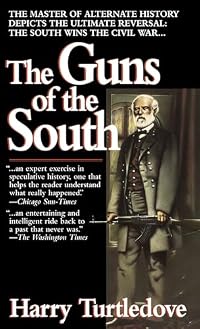
The Guns of the South
by Harry Turtledove
On This Page
Description
January 1864: General Robert E. Lee faces defeat. The Army of Northern Virginia is ragged and ill-equpped. Gettysburg has broken the back of the Confederacy and decimated its manpower. Then, Andries Rhoodie, a strange man with an unplaceable accent, approaches Lee with an extraordinary offer. Rhoodie demonstrates an amazing rifle: its rate of fire is incredible, its lethal efficiency breathtaking-and Rhoodie guarantees unlimited quantities to the Confederates. The name of the weapon is the AK.Tags
Recommendations






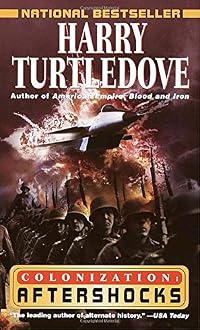
Member Recommendations
CaptKen This whole series rocks
Member Reviews
My reactions to reading this novel in 1994. Spoilers follow.
If alternate histories are to be judged by the skill they evoke another world and the rigor and seriousness of their extrapolations, than this is one of the best alternate history I’ve ever read.
Even though only the first paragraph of this book (a quote from Robert E. Lee) is from history, I had to remind myself several times that this was not a history of my world, an account of something that really happened. The book had that much verisimilitude.
Turtledove makes two excellent choices in viewpoint characters: Robert E. Lee to give us the large scale picture of the political and military matters he is involved in and First Sergeant Nate Caudell to give us the common show more man’s view of the changes that sweep the South in the wake of the change to history Turtledove postulates. Specifically, Turtledove introduces time travelers in the year 1864. They can only travel back 150 years into their past – no later, no sooner, and they didn’t get a time machine quick enough to help Lee earlier in the war. They are white supremacists from South Africa who think things for their cause begin to go wrong with the defeat of the Confederacy. They propose to arm the Southern army with AK-47s to make up for their smaller numbers and fewer resources. With the aid of the new arms (and a few rifle grenades during the taking of Washington and some nitroglycerin pills for Lee’s heart condition – however, the time travelers aren’t willing to reveal their knowledge of computers or radio), the South wins.
Turtledove doesn’t have the time travelers on stage a lot – though their existence looms large in the minds of the leaders of the victorious Confederacy. Turtledove makes a few points about the limited use, out of historic context, of the technology and knowledge of a time traveler. The South has problems manufacturing the cartridges and powders suitable for an AK-47 nor is their metallurgical skill up to duplicating them. The South Africans’ knowledge of Civil War history is only of use in the first stages of the Battle of the Wilderness – the first battle after their intervention. Latter, when they are suppressed, Benny Lang – the most decent of the South Africans – tells the South that they’ll only be able to use their captured computers until they break down.
But the South and the South Africans begin to part company after the war. Lee wants to emancipate the slaves. I liked Turtledove’s brief take on whether the Civil War was fought over state’s rights or slavery. One character remarks that the South fought the war to keep the federal government from telling state’s what to do and the specific thing the federal government wanted to tell the states’ was abolish slavery. Too many slaves were freed by Northern occupation or ran away to make it an easy matter to retrieve them. Many are in armed guerilla bands, ruthlessly suppressed by Nathan Bedford Forrest). Morally, if a slave shows the willingness to fight an army for freedom, showed bravery when fighting for the North, capable of learning reading and writing in both Northern and Southern schools, it becomes increasingly hard for thoughtful Southerners to think of blacks as less than fully human. Some already had little pleasure or patience for slavery. Economically, slaves are simply getting very expensive. Some masters rent theirs out. Other people hire freedman. Diplomatically, Britain and many other nations are reluctant to treat with a slave country. Turtledove has Lee using some anachronistic emancipation proposals from the Empire of Brazil as well as emancipation proposals from real American history.
Lee comes across as the duty-conscious, honorable man he must have been. His adventures in the complex world of the post-Second American Revolution are interesting be it dealing with the hard-fought Presidential campaign against Afrikaner backed Forrest. Forrest, who in our history was a slave trader and involved in the massacre of surrendering black Northern troops and helped form the Klan, fights a hard, vicious campaign. Yet, when Lee wins, he graciously concedes and when the lies and treachery of the Afrikaners are revealed by their Inauguration Day massacre – including Lee’s wife – Forrest helps brutally quell them. Given the animosity in the novel between the low born Forrest and aristocratic Lee and their respective views on slavery, this change in Forrest’s character seems implausible tell one remembers that in our world Forrest eventually let the Klan after they became too violent for him and, when the pervading social mores changed, spoke in favor of integration.
There are disputes with the North over Kentucky and Missouri and Maryland, or the complexities of the post-war world where the North is fighting – a lá Stanton – over Canada with Britain and the Confederacy’s sphere of influence in the West and Mexico. Caudell’s story provides a good slice of changing southern life. I also liked his romance with prostitute Mollie Bean – a real historical character who fought in disguise for the South. The battles, the characterization, the plotting, the pacing, the details of life were all well done without a misstep. There were small bits I liked: the whole plot with Caudell’s friend Henry Pleasants, a Northern prisoner of war at Andersonville that Caudell meets as Pleasants is returning home after the war. Pleasants decides to stay in the South and makes it his home. He even makes a mark when, as a railroad engineer, he comes up with a successful scheme to mine under the Afrikaner fortifications in the final battle. In our time, he tried a similar scheme unsuccessfully at Vicksburg. The theme of race relations runs throughout the book. It’s best illustrated by noting that slave George Ballentine, a soldier for the South and respected by his white comrades, is killed by sadistic (and the worst) Afrikaner Andries Rhoodie. At novel’s end, Rhodie is killed by black. The white soldiers simply remark he had it coming. show less
If alternate histories are to be judged by the skill they evoke another world and the rigor and seriousness of their extrapolations, than this is one of the best alternate history I’ve ever read.
Even though only the first paragraph of this book (a quote from Robert E. Lee) is from history, I had to remind myself several times that this was not a history of my world, an account of something that really happened. The book had that much verisimilitude.
Turtledove makes two excellent choices in viewpoint characters: Robert E. Lee to give us the large scale picture of the political and military matters he is involved in and First Sergeant Nate Caudell to give us the common show more man’s view of the changes that sweep the South in the wake of the change to history Turtledove postulates. Specifically, Turtledove introduces time travelers in the year 1864. They can only travel back 150 years into their past – no later, no sooner, and they didn’t get a time machine quick enough to help Lee earlier in the war. They are white supremacists from South Africa who think things for their cause begin to go wrong with the defeat of the Confederacy. They propose to arm the Southern army with AK-47s to make up for their smaller numbers and fewer resources. With the aid of the new arms (and a few rifle grenades during the taking of Washington and some nitroglycerin pills for Lee’s heart condition – however, the time travelers aren’t willing to reveal their knowledge of computers or radio), the South wins.
Turtledove doesn’t have the time travelers on stage a lot – though their existence looms large in the minds of the leaders of the victorious Confederacy. Turtledove makes a few points about the limited use, out of historic context, of the technology and knowledge of a time traveler. The South has problems manufacturing the cartridges and powders suitable for an AK-47 nor is their metallurgical skill up to duplicating them. The South Africans’ knowledge of Civil War history is only of use in the first stages of the Battle of the Wilderness – the first battle after their intervention. Latter, when they are suppressed, Benny Lang – the most decent of the South Africans – tells the South that they’ll only be able to use their captured computers until they break down.
But the South and the South Africans begin to part company after the war. Lee wants to emancipate the slaves. I liked Turtledove’s brief take on whether the Civil War was fought over state’s rights or slavery. One character remarks that the South fought the war to keep the federal government from telling state’s what to do and the specific thing the federal government wanted to tell the states’ was abolish slavery. Too many slaves were freed by Northern occupation or ran away to make it an easy matter to retrieve them. Many are in armed guerilla bands, ruthlessly suppressed by Nathan Bedford Forrest). Morally, if a slave shows the willingness to fight an army for freedom, showed bravery when fighting for the North, capable of learning reading and writing in both Northern and Southern schools, it becomes increasingly hard for thoughtful Southerners to think of blacks as less than fully human. Some already had little pleasure or patience for slavery. Economically, slaves are simply getting very expensive. Some masters rent theirs out. Other people hire freedman. Diplomatically, Britain and many other nations are reluctant to treat with a slave country. Turtledove has Lee using some anachronistic emancipation proposals from the Empire of Brazil as well as emancipation proposals from real American history.
Lee comes across as the duty-conscious, honorable man he must have been. His adventures in the complex world of the post-Second American Revolution are interesting be it dealing with the hard-fought Presidential campaign against Afrikaner backed Forrest. Forrest, who in our history was a slave trader and involved in the massacre of surrendering black Northern troops and helped form the Klan, fights a hard, vicious campaign. Yet, when Lee wins, he graciously concedes and when the lies and treachery of the Afrikaners are revealed by their Inauguration Day massacre – including Lee’s wife – Forrest helps brutally quell them. Given the animosity in the novel between the low born Forrest and aristocratic Lee and their respective views on slavery, this change in Forrest’s character seems implausible tell one remembers that in our world Forrest eventually let the Klan after they became too violent for him and, when the pervading social mores changed, spoke in favor of integration.
There are disputes with the North over Kentucky and Missouri and Maryland, or the complexities of the post-war world where the North is fighting – a lá Stanton – over Canada with Britain and the Confederacy’s sphere of influence in the West and Mexico. Caudell’s story provides a good slice of changing southern life. I also liked his romance with prostitute Mollie Bean – a real historical character who fought in disguise for the South. The battles, the characterization, the plotting, the pacing, the details of life were all well done without a misstep. There were small bits I liked: the whole plot with Caudell’s friend Henry Pleasants, a Northern prisoner of war at Andersonville that Caudell meets as Pleasants is returning home after the war. Pleasants decides to stay in the South and makes it his home. He even makes a mark when, as a railroad engineer, he comes up with a successful scheme to mine under the Afrikaner fortifications in the final battle. In our time, he tried a similar scheme unsuccessfully at Vicksburg. The theme of race relations runs throughout the book. It’s best illustrated by noting that slave George Ballentine, a soldier for the South and respected by his white comrades, is killed by sadistic (and the worst) Afrikaner Andries Rhoodie. At novel’s end, Rhodie is killed by black. The white soldiers simply remark he had it coming. show less
Review: The Guns of the South by Harry Turtledove.
I really enjoyed this book. The author combined history with future scientific elements. He created a coming of the age idea and weaved it through the era of the Civil War. I found that intriguing.
The first part of the novel starts in the winter camp of the Army of Northern Virginia in 1864. It was months after Robert E. Lee defeated Gettysburg that he was now encountering some confrontation with the North when he was approached by a man offering him an unequal advantage in the war…Weapons from the 20th Century in the form of AK-47’s …but how could this be!! As it turns out this man is the leader of a group of South African whites who have traveled back in time to 1864 in an show more attempt to change the course of history and create in the Confederate States of America a power control for the white race into the 21st Century.
There were many battle scenarios and scenes that took up a lot of reading time but I thought it was interesting. The author also created a female character in the center of the battles as a soldier fighting in the war. This part of the novel ends with the Confederate Army on the lawn of the White House as General Lee accepts the surrender of Abraham Lincoln.
Many interesting things happen in the second half of the novel. The South has won its independence and now the question is what will they do with it? This is where Harry Turtledove reflected primarily through Robert E. Lee’s character that the Confederacy was not entirely at ease with the institution that sets it apart from its Northern neighbor. At this time Robert E. Lee starts his campaigning for Presidency. He begins to wonder whether slavery should continue and comes to a conclusion that puts him at odds with the foreign supporters who gave the South the means to achieve its independence.
I think the author of this book was clever by mixing the future in what the Civil War was really about. Was it about state’s rights and federalism as modern day Southern supporters claimed or was it about slavery and the domination of one race of men by another? show less
I really enjoyed this book. The author combined history with future scientific elements. He created a coming of the age idea and weaved it through the era of the Civil War. I found that intriguing.
The first part of the novel starts in the winter camp of the Army of Northern Virginia in 1864. It was months after Robert E. Lee defeated Gettysburg that he was now encountering some confrontation with the North when he was approached by a man offering him an unequal advantage in the war…Weapons from the 20th Century in the form of AK-47’s …but how could this be!! As it turns out this man is the leader of a group of South African whites who have traveled back in time to 1864 in an show more attempt to change the course of history and create in the Confederate States of America a power control for the white race into the 21st Century.
There were many battle scenarios and scenes that took up a lot of reading time but I thought it was interesting. The author also created a female character in the center of the battles as a soldier fighting in the war. This part of the novel ends with the Confederate Army on the lawn of the White House as General Lee accepts the surrender of Abraham Lincoln.
Many interesting things happen in the second half of the novel. The South has won its independence and now the question is what will they do with it? This is where Harry Turtledove reflected primarily through Robert E. Lee’s character that the Confederacy was not entirely at ease with the institution that sets it apart from its Northern neighbor. At this time Robert E. Lee starts his campaigning for Presidency. He begins to wonder whether slavery should continue and comes to a conclusion that puts him at odds with the foreign supporters who gave the South the means to achieve its independence.
I think the author of this book was clever by mixing the future in what the Civil War was really about. Was it about state’s rights and federalism as modern day Southern supporters claimed or was it about slavery and the domination of one race of men by another? show less
This was a far more intelligent book than I was anticipating. The whole summary is "time-traveling racists give the confederacy ak-47's to win the war" sounds like a dumb story but it did a really good job telling a compelling story while also giving an impression on perceptions from that time period. And based on the Praise of and Historical notes section it seems like the author put in a lot of research to get the story as accurately based as possible.
As this was my first venture into the world of Alternate History, I wasn't quite sure what to expect. Who better to take this journey with than the master of the genre', Harry Turtledove? I was pleased with my journey and will probably wander down this path again some day.
"The Guns of the South" looked at what would have happened to the outcome of the civil war if the South had been equipped with superior firepower - in this case, AK47's. The book begins not long after the South's demoralizing defeat at Gettysburg. General Robert E. Lee, distraught over the loss of thousands of his troops, is approached by a strange man who offers Lee the gift of thousands of the superior weapons. Lee and his generals are impressed with the firepower show more and ease of use they find when testing the weapons and soon put them in the hands of their soldiers.
In the next series of battles and skirmishes, the Confederates soon overpower and devastate their Union rivals and their single-shot Springfield rifles. This pattern continues through the next few months until it's clear to President Lincoln and General Ulysses S. Grant that a cessation of conflict is needed to save Union lives. The new automatic weapon used by the Rebels is killing Union soldiers by the thousands.
From this point, the book moves into a look at the new Confederate States, the election of a new President and the real reason why Lee was given the "gift" by the strange man. The book, though long, never drags and remains as true historically as an alternate history can. As a teacher of the subject matter, I was impressed with Turtledove's research, attention to detail, and ability to keep this from reading like an historical text.
If you are a fan of this genre' and/or especially a Civil War buff, then you will enjoy this unique look at a different ending to the War Between the States. show less
"The Guns of the South" looked at what would have happened to the outcome of the civil war if the South had been equipped with superior firepower - in this case, AK47's. The book begins not long after the South's demoralizing defeat at Gettysburg. General Robert E. Lee, distraught over the loss of thousands of his troops, is approached by a strange man who offers Lee the gift of thousands of the superior weapons. Lee and his generals are impressed with the firepower show more and ease of use they find when testing the weapons and soon put them in the hands of their soldiers.
In the next series of battles and skirmishes, the Confederates soon overpower and devastate their Union rivals and their single-shot Springfield rifles. This pattern continues through the next few months until it's clear to President Lincoln and General Ulysses S. Grant that a cessation of conflict is needed to save Union lives. The new automatic weapon used by the Rebels is killing Union soldiers by the thousands.
From this point, the book moves into a look at the new Confederate States, the election of a new President and the real reason why Lee was given the "gift" by the strange man. The book, though long, never drags and remains as true historically as an alternate history can. As a teacher of the subject matter, I was impressed with Turtledove's research, attention to detail, and ability to keep this from reading like an historical text.
If you are a fan of this genre' and/or especially a Civil War buff, then you will enjoy this unique look at a different ending to the War Between the States. show less
A group of apartheid-era Afrikaners time-travels to the American South during our Civil War to arm the Confederate army with AK-47s. The South wins. Lincoln loses the 1864 election and returns to Illinois to practice law. Robert E. Lee wins the Confederate presidency.
It's too bad the novel had to include the time-travel element, because the sci-fi/action scenes were the least engaging element of the book for me. I was bored when most of a chapter was devoted to how to dissemble and clean an AK-47, and disappointed that the book ended with a big shoot-'em-up with the Afrikaners. Let's just suppose the South won the Civil War. The Confederates still had a lot to reckon with, particularly what to do with the blacks who had already had a show more taste of freedom with emancipation and the movement of the Union armies. The book looks at these issues, too, and those are the parts of it I enjoyed most. That kind of focus truly makes the book thought-provoking "speculative" fiction--what I like about sci-fi the most.
Eliminate the time-travel element, and you also are rid of other stumbling blocks. Certainly, any sci-fi requires considerable suspension of disbelief, but my suspension could only go so far--especially when the premises laid out in the story end up contradicting themselves. For instance, when we finally see what serves as the Afrikaners' time portal, it ends up being a platform only 3'x3' square. From that little opening they were able to transport enough Ak-47s to equip the entire Confederate army (as well as mountains of other supplies, too)? Moreover, any time-travel book must deal with the Time Paradox: if the Afrikaners were successful in changing history to make the world more accepting slavery, why would they have felt the need to travel from the 20th century to disrupt the flow of history in the first place?
In short, the novel could have been better, but for its thoughtful passages, I'll give it three stars. show less
It's too bad the novel had to include the time-travel element, because the sci-fi/action scenes were the least engaging element of the book for me. I was bored when most of a chapter was devoted to how to dissemble and clean an AK-47, and disappointed that the book ended with a big shoot-'em-up with the Afrikaners. Let's just suppose the South won the Civil War. The Confederates still had a lot to reckon with, particularly what to do with the blacks who had already had a show more taste of freedom with emancipation and the movement of the Union armies. The book looks at these issues, too, and those are the parts of it I enjoyed most. That kind of focus truly makes the book thought-provoking "speculative" fiction--what I like about sci-fi the most.
Eliminate the time-travel element, and you also are rid of other stumbling blocks. Certainly, any sci-fi requires considerable suspension of disbelief, but my suspension could only go so far--especially when the premises laid out in the story end up contradicting themselves. For instance, when we finally see what serves as the Afrikaners' time portal, it ends up being a platform only 3'x3' square. From that little opening they were able to transport enough Ak-47s to equip the entire Confederate army (as well as mountains of other supplies, too)? Moreover, any time-travel book must deal with the Time Paradox: if the Afrikaners were successful in changing history to make the world more accepting slavery, why would they have felt the need to travel from the 20th century to disrupt the flow of history in the first place?
In short, the novel could have been better, but for its thoughtful passages, I'll give it three stars. show less
A fun guilty pleasure. At least, until the end.
That's right. White supremacists breaking the laws of physics to travel back in time and supply the Confederacy with AK-47s and Kevlar body armor? I found that to be an intriguing and enjoyable read and the story should've ended there.
Butthe South, after winning the Civil War, going on to free the slaves out of moral and democratic grounds? Yeah, right. I've got my own historical revisionism to sell you. I was willing to suspend my disbelief for time traveling gunrunners, but the South becoming a racial utopia? That's just over the top.
Five stars for: AK-47s, time travelers, the Civil War, and combining them in a thoroughly enjoyable book.
Negative three stars for the utterly ridiculous ending.
That's right. White supremacists breaking the laws of physics to travel back in time and supply the Confederacy with AK-47s and Kevlar body armor? I found that to be an intriguing and enjoyable read and the story should've ended there.
But
Five stars for: AK-47s, time travelers, the Civil War, and combining them in a thoroughly enjoyable book.
Negative three stars for the utterly ridiculous ending.
An excellent alternate history 'what if' novel. What if time travel were possible and could be used to try and alter the history of the Civil War? I won't give anything else away, but this was fun to read. If you enjoy alternate history that is solidly based on real history, you'll enjoy this. Unlike a lot of alternate history, just one thing changes, not the entire nature of the country or the conflict, but how that changes things is the fun of the book.
Members
- Recently Added By
Lists

Best Time Travel Novels
165 works; 124 members

Best Alternate History
111 works; 60 members

Best Military Science Fiction
57 works; 26 members

Best Historical Fiction
620 works; 261 members

Books Read in 2014
2,341 works; 86 members

KayStJ's to-read list
1,616 works; 11 members

Unshelved Book Clubs
579 works; 5 members

Books Read in 2020
4,379 works; 124 members
Recommended AltHist
24 works; 1 member
Author Information

279+ Works 43,117 Members
Harry Turtledove was born in Los Angeles, California on June 14, 1949. He received a Ph.D. in Byzantine history from UCLA in 1977. From the late 1970's to the early 1980's, he worked as a technical writer for the Los Angeles County Office of Education. He left in 1991 to become full-time writer. His first two novels, Wereblood and Werenight, were show more published in 1979 under the pseudonym Eric G. Iverson because his editor did not think people would believe that Turtledove was his real name. He used this name until 1985 when he published Herbig-Haro and And So to Bed under his real name. He has received numerous awards including the Homer Award for Short Story for Designated Hitter in 1990, the John Esthen Cook Award for Southern Fiction for Guns of the Southand in 1993, and the Hugo Award for Novella for Down in the Bottomlands in 1994. (Bowker Author Biography) show less
Some Editions
Awards and Honors
Awards
Common Knowledge
- Canonical title
- The Guns of the South
- Original title
- The Guns of the South
- Original publication date
- 1992-09
- People/Characters
- Andries Rhoodie; Robert E. Lee (General); Abraham Lincoln (President); Jefferson Davis; Nathan Bedford Forrest (General); Albert Gallatin Brown (show all 130); Jubal A. Early; Henry Pleasants; Nate Caudell; Mollie Bean; Judah P. Benjamin; E. Porter Alexander; Ransom Bailey; George Ballentine; Ethelbert Barskdale; Gideon Bass; Josiah A. Beard; Billy Beddingfield; Ruffin Biggs; Barbara Bissett; Willie Blount; Thomas Bocock; Henry Brown; Benjamin Butler; Isaac Cockrell; John Dabney; Rufus Daniel; Fred Darby; Varina Davis; Konrad de Buys; Charles Dimmock; Ben Drake; Will Dunn; Dempsey Eure; Lucy Eure; Richard Ewell; George Faribault; Asbury Finch; Bob Finney; John Floyd; Lucius Gartrell; Wilhelm Gebhard; Yancey Glover; Avram Goldfarb; Josiah Gorgas; Ernie Graaf; Ulysses S. Grant; Andrew Gwynn; J. D. Halyburton; Piet Hardie; John Hay; Edwin Helper; Henry Heth; Allison High; A. P. Hill; George Hines; Alsie Hopkins; John Johns; Henry Johnson; John Beauchamp Jones; Cornelius Joyner; Henry Joyner; Preston Kelly; Duncan Kenner; William Kirkland; William Lacy; Lucius Quintus Cincinnatus Lamar II; Benny Lang; Lankford; Eleanor Agnes Lee; George Washington Custis Lee; Mary Anna Custis Lee; Mary Custis Lee; Mildred Childe Lee; David Leonard; George Lewis; Raeford Liles; Iverson Longmire; James Longstreet; Richard Lyons, 1st Viscount Lyons; Stephen R. Mallory; Charles Marshall; Otis Massey; Lloyd Morgan; John Moring; John Nicolay; Paschall Page; George Pendleton; Jonas Perry; Horace Porter; Edwin Powell; Granbury Proctor; Emelius Pullen; Virgil Quincy; George W. Rains; James Seddon; William H. Seward; Tom Short; Bob Southard; Edwin Stanton; Alexander Stephens; J. P. Strange; Jeb Stuart; Kennel Tant; Walter Taylor; John Thorp; Wren Tisdale; Rex Van Lew; Willem van Pelt; Charles Venable; Ben Whitley; Louis Wigfall; William Winstead; B. L. Wynn; Columbus; Dock; Hattie; Israel; Jesse; Joe; Josephine; Julia; Luke; Perry; Pete; Rufus; Shadrach; Tom; Westly; William
- Important places
- Virginia, USA; Nash County, North Carolina, USA; Richmond, Virginia, USA
- Important events
- American Civil War
- First words
- Mr. President:
I have delayed replying to your letter of the 4th until the time arrived for the execution of the attempt on New Berne. - Last words
- (Click to show. Warning: May contain spoilers.)Despite the happy nature of the interruption, that letter to the British minister remained to be written.
- Blurbers
- McPherson, James M.
- Original language
- English
Classifications
Statistics
- Members
- 1,838
- Popularity
- 11,697
- Reviews
- 41
- Rating
- (3.85)
- Languages
- English
- Media
- Paper, Audiobook, Ebook
- ISBNs
- 10
- ASINs
- 6